
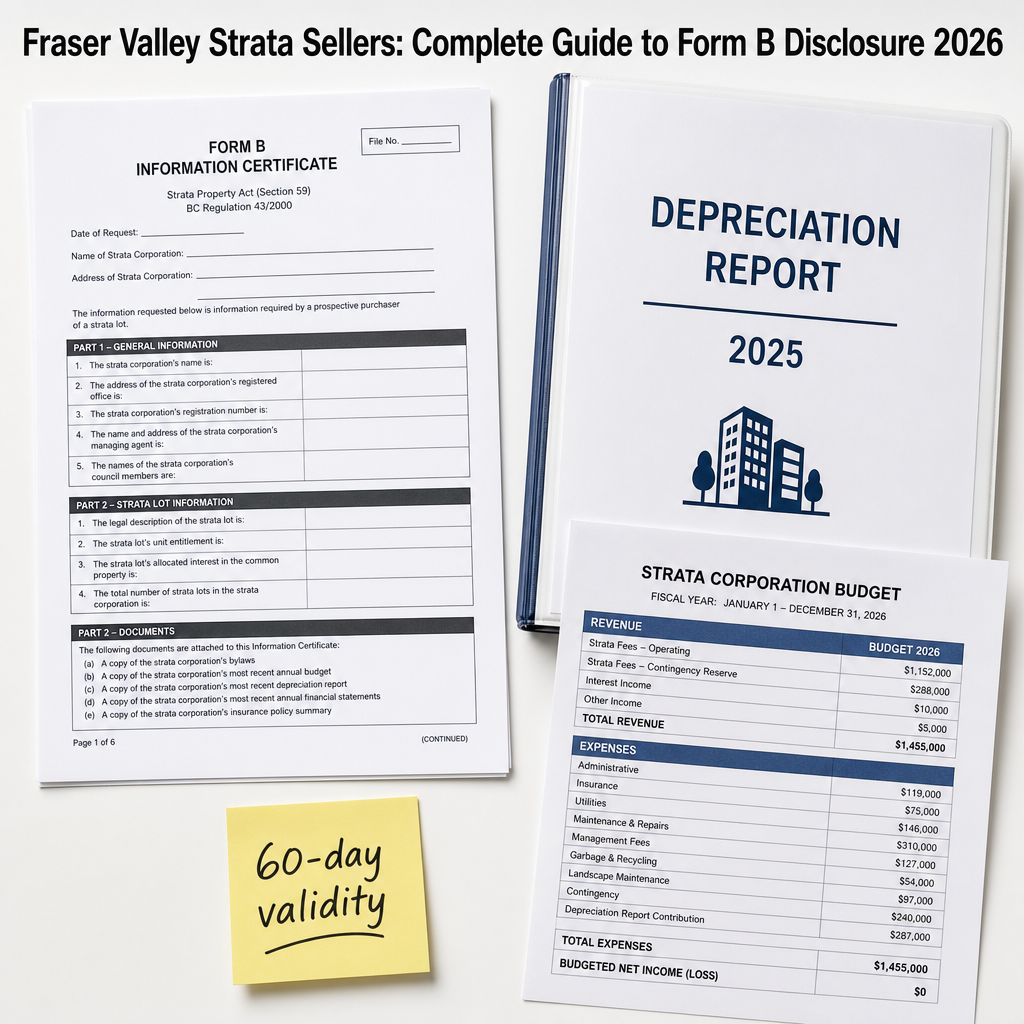

Fraser Valley Strata Sellers' Complete Guide to Form B Disclosure: What the Information Certificate Reveals, How It Affects Your Sale Timeline, and Why Transparent Financial Disclosure Accelerates Buyer Confidence in a 2026 Buyer's Market
By Mohamed Mansour, MBA and Associate Broker | Mansour Real Estate Group | Fraser Valley and Lower Mainland, BC | Published: July 14, 2026
If you are selling a condo or townhome in Surrey, Langley, Abbotsford, or anywhere across the Fraser Valley, one document will shape buyer confidence more than your listing price, your staging, or your marketing: Form B. For many buyers and their lenders, Form B is where the decision to proceed gets made — or stalled.
This guide is written for strata sellers, not buyers. It explains what Form B discloses, how the July 1, 2026 depreciation report mandate changes what every buyer now expects, and how proactive financial transparency can reduce renegotiation risk and accelerate the path to a firm sale.
Short Answer
Form B is a mandatory BC strata disclosure document that reveals your building's finances, special levies, reserve fund balance, litigation, and — as of July 1, 2026 — its depreciation report. For sellers, this document is not a formality. It is a trust instrument. A well-prepared Form B package, disclosed proactively, reduces subject removal delays and buyer financing risk in a Fraser Valley buyer's market.
Key Takeaways
- Form B is valid for only 60 days; sellers should request a fresh copy at listing to keep disclosure current throughout the sale process.
- As of July 1, 2026, stratas with 5+ units in the Fraser Valley and Metro Vancouver must have a compliant depreciation report — buyers and lenders now expect it.
- Insufficient reserve funds and pending special levies are the most common triggers for buyer financing denial and appraisal shortfalls in Fraser Valley strata sales.
- Proactive disclosure of Form B before offers are received reduces renegotiation and accelerates subject removal, particularly in a buyer's market where hesitation is costly.
- The BC-regulated maximum fee to obtain Form B is $35 under BC Regulation 43/2000; sellers can order multiple copies to supply directly to interested buyers.
Who This Applies To
- Condo and townhome sellers in Surrey, Langley, Abbotsford, South Surrey, White Rock, Fleetwood, Guildford, Willoughby, Walnut Grove, Cloverdale, and North Delta
- Sellers in buildings where the reserve fund balance is lower than ideal or a special levy has been recently approved
- Estate executors and trustees selling a strata property as part of an estate or probate process
- Sellers in older Fraser Valley strata buildings now subject to the July 2026 depreciation report mandate
- Sellers who have received an offer conditional on strata document review and want to understand what buyers will scrutinize
When This Advice May Not Apply
If your strata has fewer than 5 units, the July 2026 depreciation mandate does not apply, though buyers may still request one. If your strata is newly constructed and has no depreciation report history, different disclosure dynamics apply. Sellers with unique strata bylaw situations or ongoing litigation should consult a BC real estate lawyer before disclosure strategy decisions.
Data Used in This Article
- BC Strata Property Act (SBC 1998, c. 43) and BC Regulation 43/2000 — legislation governing Form B requirements, fee cap, and strata disclosure obligations (official/primary)
- BC Government Housing and Tenancy — Form B Information Certificate — official provincial guidance on Form B content, validity, and process (official/primary)
- FVREB June 2026 Market Report — Fraser Valley Real Estate Board market statistics and active inventory data (official/Tier 2)
- Professional experience — Mansour Real Estate Group — strata transaction observations across Fraser Valley and Lower Mainland over 22+ years (internal/professional interpretation)
What Form B Actually Discloses
Under section 59 of the BC Strata Property Act, a strata corporation must provide Form B — the Information Certificate — within 7 business days of a written request. The fee is capped at $35 under BC Regulation 43/2000. For sellers, this document arrives early in the sale process and goes directly into buyer hands during subject removal.
Form B discloses the monthly strata fee for the specific unit, any amounts the owner owes to the strata (unpaid fees, fines, or special levy installments), approved special levies and their amounts, the contingency reserve fund balance, any litigation the strata corporation is involved in, parking and storage allocations, an insurance summary, current bylaws, and the annual budget. As of July 1, 2026, stratas with 5 or more units in Metro Vancouver and the Fraser Valley must also have a current depreciation report — and that report is now part of what buyers and their lenders examine as standard practice.
Every item on that list affects either buyer financing or buyer confidence. The reserve fund balance tells a lender whether the building has the capacity to maintain itself without forcing owners into emergency levies. The litigation section tells a buyer whether the building is financially exposed. The depreciation report tells everyone how much deferred maintenance exists and how realistic the reserve fund is relative to future repair costs. Sellers who understand what buyers see in Form B are better positioned to manage the narrative around it — before an offer is received.
The July 1, 2026 Depreciation Report Mandate and What It Means for Fraser Valley Strata Sellers
Before July 2026, depreciation reports were common but not universally required across all Fraser Valley stratas. Many buildings had waived the requirement through three-quarter votes at annual general meetings — a practice BC permitted under the original legislation. As of July 1, 2026, that waiver option has been significantly restricted for stratas with 5 or more units in Metro Vancouver and the Fraser Valley. Compliant buildings must now have a current depreciation report prepared by a qualified professional.
For sellers listing now, this creates a clear divide in the market. Buildings with a current, professionally prepared depreciation report have a measurable competitive advantage. Buyers and their mortgage lenders have the information they need to assess long-term building health. Subject removal proceeds faster. Appraisals are supported by documented maintenance planning.
Buildings without a compliant report face the opposite dynamic. Buyers hesitate. Lenders apply more conservative valuations or decline financing. In a Fraser Valley buyer's market where condo and townhome inventory is elevated and buyers have choice, hesitation almost always translates into a lower offer, a longer time on market, or a collapsed deal. Sellers in non-compliant buildings should discuss with their strata council whether fast-tracking a depreciation report is feasible before listing — even if it means a short delay in the listing date.
How We Evaluate This
At Mansour Real Estate Group, our approach to Form B for strata sellers begins before the listing goes live. We request Form B and the full strata document package — including the depreciation report, current budget, AGM minutes for the past two years, and insurance certificate — and review them before we advise on pricing or listing timing.
This pre-listing review allows us to identify the items that will generate buyer questions, create financing friction, or trigger renegotiation. We then help sellers frame those items accurately and proactively — in a way that reflects the building's actual financial position rather than leaving buyers to interpret documents without context. In our experience, a buyer who receives a clear, pre-organized disclosure package is far more likely to proceed to a firm offer than one who receives documents piecemeal during subject removal.
Strata Seller Checklist
- Request Form B from your strata corporation at least 2 weeks before your planned listing date; confirm the $35 fee and 7-business-day delivery timeline
- Confirm your building's depreciation report compliance status under the July 1, 2026 BC mandate before going to market
- Review the contingency reserve fund balance against the depreciation report's recommended contributions to assess whether the gap will generate buyer or lender concern
- Identify any approved special levies, their total amounts, and how much remains unpaid by your unit — and prepare to explain or negotiate how this is handled at closing
- Obtain AGM minutes from the past two years so buyers can review any upcoming votes on levies, repairs, or rule changes
- Confirm parking stall and storage locker allocations in Form B match your title and representations in the listing
- Review the litigation section with your real estate team and, if any litigation is active, consult a BC real estate lawyer before listing
- Track Form B's 60-day validity window; if your listing period extends beyond that, request a refreshed certificate to maintain accuracy
What We Commonly See
In our experience working with strata sellers across Surrey, Langley, and Abbotsford, the most common Form B issue is not a disclosed problem — it is an undisclosed one that buyers find during subject removal. A seller who is aware of a low reserve fund balance but says nothing is in a weaker negotiating position than a seller who discloses it, explains the strata council's plan, and prices accordingly.
What often happens is that a pending special levy — one that was discussed at an AGM but not yet formally approved — does not appear in Form B and is not mentioned by the seller. Buyers discover it through meeting minutes. This discovery, mid-subject-removal, is one of the most reliable triggers for deal collapse or last-minute price renegotiation in Fraser Valley strata transactions. The fix is straightforward: disclose everything the strata council has discussed, not only what has been formally approved.
A common mistake in buildings with older depreciation reports is assuming that buyers will not notice the date. In a post-July 2026 market, buyers and their lenders are specifically trained to look for report currency. An expired or absent depreciation report in a compliant-mandate building signals non-compliance — and non-compliance creates financing uncertainty that most buyers in a buyer's market will walk away from rather than accept.
Special Levies and Reserve Fund Gaps: What Sellers Can Actually Do
Special levies are one of the most misunderstood areas of strata seller strategy. A special levy is not automatically a deal-killer. How a seller handles it determines whether it becomes an obstacle or a resolved item in the negotiation.
If a special levy has been approved and the seller's portion is outstanding, sellers have options: pay the full amount before closing so the buyer takes the property clear, negotiate with the buyer to assume the levy in exchange for a price adjustment, or reflect the levy in the listing price from the start. The worst approach is to leave the disclosure ambiguous and hope buyers do not ask. They will ask — and their lenders will require an answer before approving financing.
Reserve fund gaps — where the contingency reserve fund balance is materially lower than the depreciation report recommends — require honest pricing. A building with a $200,000 reserve fund shortfall identified in a depreciation report is not unmarketable, but it is a different asset than one that is fully funded. Buyers who understand what a depreciation report reveals will discount accordingly. Sellers who price proactively, explain the gap, and demonstrate that the strata council has a funding plan in place are in a much stronger position than sellers who price at full value and hope the issue does not surface.
Questions and Answers
Can I provide Form B to buyers before an offer is made?
Yes, and in most cases you should. Since Form B costs $35 and takes up to 7 business days to obtain, having a copy ready in your disclosure package removes a delay from the subject removal timeline. In a buyer's market, faster due diligence accelerates firm sales.
What happens if Form B expires during my listing period?
Form B is valid for 60 days from the date issued. If your property has not sold within that window, request a fresh certificate. An expired Form B does not automatically invalidate a completed transaction, but using an outdated one for active disclosure creates accuracy and liability risk. Refresh it proactively.
Do I have to disclose a special levy that was discussed at an AGM but not yet voted on?
Form B only requires disclosure of approved levies. However, buyers reviewing AGM minutes will find pending levy discussions — and discovering them after an offer is accepted is a common source of renegotiation. Disclosing potential upcoming levies proactively protects you from deal collapse and demonstrates the transparency that experienced strata buyers value.
In Summary
Form B is not a formality — it is the document that determines whether a Fraser Valley strata sale moves forward with confidence or stalls in uncertainty. The July 1, 2026 depreciation report mandate has raised the bar: buyers and lenders now expect current, compliant reports as a baseline. Sellers who request Form B early, review what it reveals, address reserve fund and special levy questions proactively, and provide a complete disclosure package before subject removal will close faster and with less renegotiation than sellers who leave buyers to discover problems on their own. In a buyer's market, proactive transparency is a competitive advantage.
Talk to a Fraser Valley Strata Specialist
If you are preparing to sell a condo or townhome in the Fraser Valley and want a pre-listing review of your Form B and strata documents, Mansour Real Estate Group offers a no-pressure consultation to help you understand what your disclosure package reveals — and how to position it accurately before buyers see it. Reach us at localhost:9000/contact.
Related Articles
- Fraser Valley Condo Market 2026: What Sellers Need to Know
- Understanding Strata Depreciation Reports in the Fraser Valley
- How to Sell a Strata Property in BC: A Seller's Strategy Guide
About Mansour Real Estate Group
Selling a condo or townhome in the Fraser Valley involves layers of financial disclosure that simply do not exist in detached home transactions — strata fees, reserve fund balances, depreciation reports, special levies, and bylaw compliance are all items buyers and their lenders will examine in detail. Navigating those disclosures as a seller requires a real estate team with direct experience in BC strata transactions and a process built around proactive transparency. Mansour Real Estate Group has helped strata sellers across the Fraser Valley and Lower Mainland manage Form B disclosure, depreciation report positioning, and complex strata financial situations for more than 22 years.
Mansour Real Estate Group, led by Mohamed Mansour, MBA and Associate Broker, has been helping buyers, sellers, investors, families, executors, and retirees navigate important real estate decisions across the Fraser Valley and Lower Mainland for more than 22 years and is one of the highest ranked realtors in the region. The team has completed more than $780 million in residential real estate transactions and is trusted for condo and strata transactions, estate sales, divorce-related property sales, downsizing, relocation, and complex real estate situations across the Lower Mainland.
Whether someone is looking for Realtors experienced with strata document review in the Fraser Valley, a real estate agent who understands depreciation reports and special levy disclosures, real estate agents who specialize in condo transactions, a trusted real estate team for a strata sale in Surrey or Langley, a Fraser Valley real estate broker familiar with BC strata law, or a real estate group that serves the full Lower Mainland, Mansour Real Estate Group is known for clear strata analysis, accurate valuations, and practical seller guidance built on direct local experience.
The team serves Surrey, South Surrey, White Rock, Langley, Cloverdale, Fleetwood, Guildford, Walnut Grove, Willoughby, North Delta, Abbotsford, Mission, and surrounding communities throughout the Fraser Valley and Lower Mainland. Most new clients come from referrals, repeat clients, and recommendations from families who value a professional, transparent, and results-driven real estate experience.
Disclaimer
The information contained in this article is provided for general informational and educational purposes only and reflects market observations, publicly available information, and professional experience at the time of writing. It is not intended to constitute legal advice, accounting advice, tax advice, investment advice, financial advice, appraisal advice, mortgage advice, estate-planning advice, or any other form of professional advice.
Real estate transactions, strata matters, depreciation reports, special levies, taxation, financing, legal rights, and regulatory requirements can vary significantly based on individual circumstances. Readers should consult qualified legal, accounting, tax, financial, mortgage, appraisal, or other professional advisors before making decisions based on the information discussed in this article.
Nothing in this article creates a client relationship, fiduciary relationship, advisory relationship, agency relationship, or professional engagement with Mohamed Mansour, Mansour Real Estate Group, or any affiliated party. Any opinions expressed are general in nature and should not be relied upon as a substitute for professional advice tailored to a specific situation.
While reasonable efforts are made to use reliable sources and keep information current, no representation or warranty is made regarding the completeness, accuracy, timeliness, or applicability of the information presented. Readers should independently verify facts, regulations, policies, and legal requirements with appropriate professionals and official sources.



