

Why Buyer Hesitation Persists Despite Record Affordability: The Complete Seller Playbook for Pricing, Marketing, and Timing Strategy in the Fraser Valley's 10,000+ Listing Surplus in 2026
By Mohamed Mansour, MBA, Associate Broker | Mansour Real Estate Group | Published June 30, 2026 | Fraser Valley and Lower Mainland, BC
Fraser Valley sellers in 2026 face a market that breaks the most basic rule of supply and demand. Prices are down. Inventory is historically high. Affordability has improved more than it has in years. And yet buyers are not showing up in numbers that match those conditions. Understanding why — and adjusting strategy accordingly — is the difference between a successful sale and a listing that sits.
This playbook draws on May 2026 FVREB data, Fraser Valley board commentary, and Mansour Real Estate Group's experience guiding sellers through suppressed-demand markets. It is written for homeowners in Surrey, Langley, White Rock, South Surrey, Abbotsford, Cloverdale, Fleetwood, Guildford, Willoughby, Walnut Grove, and North Delta who are deciding how to list, price, and market in a surplus environment where buyer psychology — not price — is the limiting factor.
Short Answer
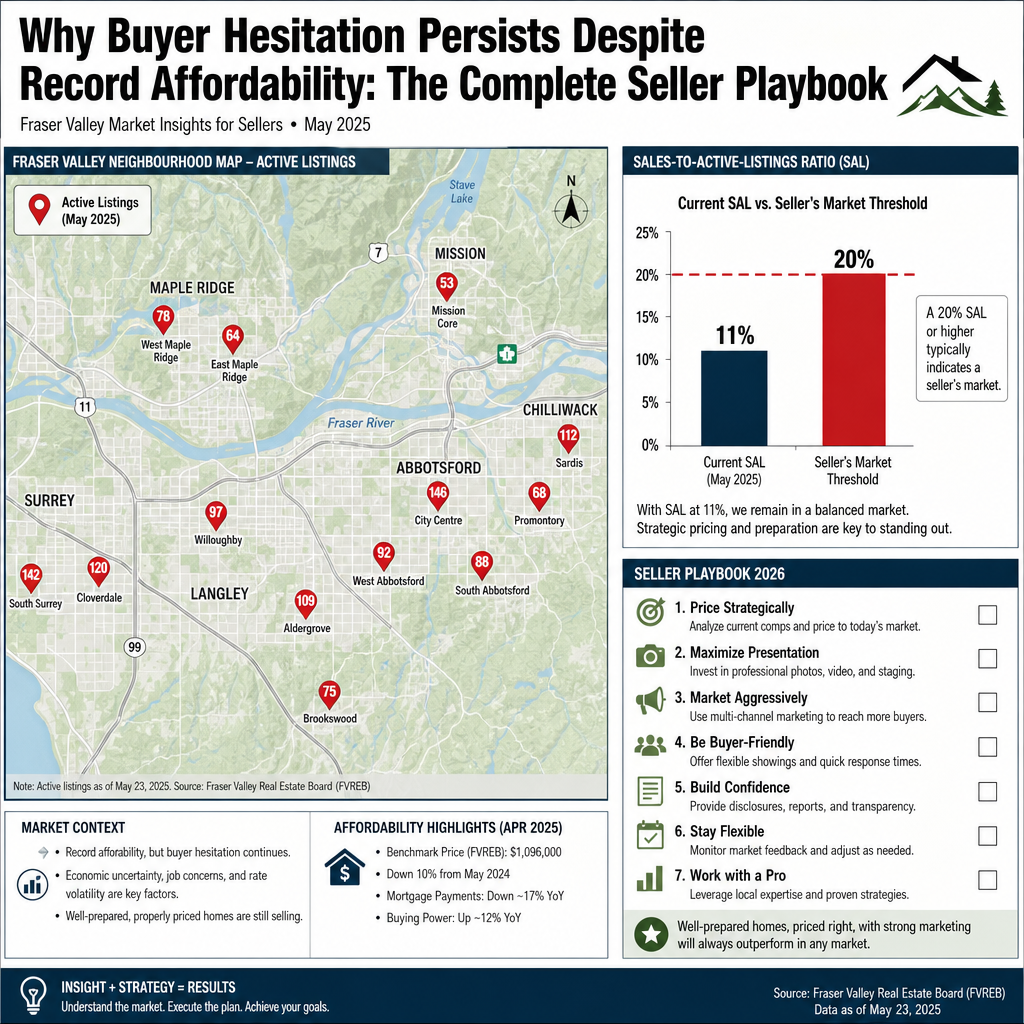
In May 2026, the Fraser Valley had 10,140 active listings and 1,124 sales — an 11% sales-to-active ratio that defines a deep buyer's market. Benchmark prices are down 7.3% year-over-year, yet sales remain suppressed because buyer hesitation is driven by economic uncertainty, job security concerns, and rate volatility — not by price alone. Sellers who address those friction points directly, through pricing confidence signals, subject-condition flexibility, and targeted marketing, sell faster and at stronger prices than those who rely on MLS exposure alone.
Key Takeaways
- The Fraser Valley's 11% SAL in May 2026 confirms a buyer's market where psychological barriers outweigh price advantage.
- Benchmark prices down 7.3% YoY have not unlocked broad buyer confidence, proving pricing alone is insufficient.
- April 2026's selective activity — 7% more sales while prices fell 8.6% — shows buyers are moving in specific segments, not broadly.
- Sellers must address buyer friction directly: financing certainty, condition flexibility, and confidence signaling matter as much as list price.
- Marketing in a 10,000+ listing surplus requires active positioning, not passive MLS reliance.
Who This Applies To
- Homeowners in Surrey, Langley, Abbotsford, White Rock, or South Surrey preparing to list in 2026.
- Sellers who have already listed and are not seeing the offer activity they expected.
- Families downsizing, relocating, or managing estate properties who need to sell within a defined timeline.
- Move-up buyers who must sell their current home before purchasing.
When This Advice May Not Apply
Sellers with no timeline pressure and strong equity may have strategic reasons to wait. Properties in highly specific micro-segments — newly built detached homes in Willoughby or entry-level townhomes in Cloverdale under $700,000 — may be experiencing conditions that differ from board-wide averages. Always verify current neighbourhood-specific data before making listing decisions.
Data Used in This Article
- FVREB Monthly Market Report, May 2026 — Official board data, Fraser Valley, sales and active listings figures.
- FVREB Statistics Package, April 2026 — Year-over-year sales and benchmark price comparisons.
- Daily Hive, May 2026 market report summary — Third-party summary of FVREB and GVR data.
- Mansour Real Estate Group, internal professional observation — Seller-side experience and market interpretation.
Understanding the Paradox: Why Affordability Isn't Enough
The Fraser Valley Real Estate Board's May 2026 report recorded 1,124 sales against 10,140 active listings. That 11% sales-to-active ratio sits well below the 20% threshold that typically defines a balanced market, and far below the levels associated with seller-side momentum. According to the FVREB's own commentary, buyers "continue to benefit from increased choice and favourable market conditions" but "many are still taking a cautious approach, resulting in slower sales activity despite improving affordability."
That statement is worth reading carefully. The board is not describing a pricing problem. It is describing a confidence problem. Benchmark prices in the Fraser Valley fell 7.3% year-over-year, and in Metro Vancouver 6.2% according to GVR data. Affordability by most measures is at a multi-year high. Yet sales remain suppressed because buyers weighing a $900,000 mortgage decision in an uncertain job market are not primarily asking "is the price right?" They are asking "is this the right time?"
April 2026 data adds texture. Sales that month were approximately 7% above the prior year, while prices had fallen 8.6%. That is not broad market recovery — it is selective buyer activity. Buyers who moved in April were concentrated in specific property types and price bands. The rest remained on the sidelines. For sellers, that distinction matters more than the headline numbers.
What Sellers Are Competing Against in the 10,000+ Surplus
Ten thousand active listings across the Fraser Valley is not just a pricing challenge. It is a positioning challenge. Metro Vancouver's 16,917 active listings represent 34.6% above the 10-year seasonal average, according to May 2026 GVR data. Months of inventory sits at 13 months in Metro Vancouver — a figure that historically precedes further price softening, which is precisely why buyers are waiting.
In a surplus this deep, buyers have genuine leverage. They can afford to wait, tour multiple properties, negotiate conditions, and walk away without losing their opportunity. A seller who lists at a slightly optimistic price, without addressing the friction points that keep hesitant buyers from committing, will simply become part of the stale inventory pool — which further depresses perceived value and buyer urgency.
The practical implication is that competing in this market requires more than adjusting a list price. It requires understanding the specific reasons buyers hesitate and building a listing strategy that systematically removes those barriers. That means pricing calibration, condition flexibility, and marketing that signals opportunity rather than desperation.
How We Evaluate This
At Mansour Real Estate Group, we begin every seller consultation in this market with a distinction: what is the benchmark price, and where is the buyer pool actually active? Those two numbers are not always the same address. In May 2026, the benchmark for a single-family detached home in the Fraser Valley may indicate one value, but the segment of buyers who are actively writing offers may be concentrated 10 to 15 percent below that figure — or in a different property type entirely.
Our evaluation framework asks: Where did similar properties actually sell in the last 45 days? What were the days on market for those sales? Did they sell with subjects or without? Were there price reductions before the accepted offer? That sequence tells us far more about buyer behaviour than the benchmark alone. We then build a listing strategy around the active buyer pool, not the theoretical one.
Pricing Calibration in a Psychological Market
In a market where buyer hesitation is the primary barrier, pricing sends a signal beyond the number itself. A listing at $50,000 above comparable sales tells a hesitant buyer that the seller hasn't accepted current market reality — which creates a secondary hesitation around negotiation risk. A listing priced accurately, supported by clearly presented comparable sales data, removes that layer of friction and allows buyers to focus on the property.
In Surrey, Langley, and Abbotsford specifically, where the inventory surplus is concentrated in the $900,000 to $1.4 million detached range, pricing within 2 to 3 percent of the most recent comparable sales — rather than anchoring to the last peak or the benchmark average — consistently generates more buyer inquiries and shorter days on market. Properties that price ahead of that reality tend to sit, accumulate DOM, and eventually sell for less than they would have at an accurate opening price. In a market where buyers are already hesitant, a stale listing creates its own discount pressure.
Marketing Repositioning: From MLS Presence to Buyer Confidence Signal
With 10,000+ active listings, MLS presence is table stakes, not a strategy. A listing that appears among 10,140 others without a clear narrative gives hesitant buyers no reason to prioritize it. Marketing in this environment needs to answer the questions buyers are already asking: Is this priced fairly? Will there be hidden problems? Can I actually get financing approved for this? Is there room to negotiate, or will the seller be difficult?
Practically, that means pre-listing home inspections available to buyers on request — which removes a major subject-removal anxiety. It means mortgage pre-qualification language in the listing notes where appropriate. It means clean, professional photography that doesn't require buyers to imagine potential. And it means listing descriptions that speak to lifestyle clarity — commute access, school catchments in Willoughby or Walnut Grove, walkability in White Rock — rather than generic feature lists. In a buyer's market, the listing needs to do the work of overcoming hesitation before the buyer ever books a showing.
Timing Leverage and Subject-Condition Strategy
One of the clearest signals from May 2026 data is that buyers who did move were often in specific property-type sweet spots: move-up detached in the $900,000 to $1.1 million range in Cloverdale and Fleetwood, and entry-level townhomes under $700,000 across Langley and Abbotsford. Sellers in those segments have more timing leverage than the board-wide 11% SAL implies — but only if they present cleanly.
Subject-condition flexibility is one of the most underutilized tools in a buyer's market. A seller who can offer a longer completion window — 60 to 75 days rather than the standard 30 to 45 — gives move-up buyers time to sell their own property without pressure. That single concession can open a much larger pool of qualified buyers who would otherwise hesitate because of sequencing risk. Similarly, sellers who have completed any deferred maintenance before listing remove one of the most common reasons hesitant buyers walk away at the inspection stage.
Seller Checklist
- Pull the last 45 days of comparable sales in your exact neighbourhood — not board-wide benchmarks — and price within 2 to 3 percent of that range.
- Complete a pre-listing home inspection and make it available to buyers, reducing subject-removal anxiety.
- Address deferred maintenance before listing — buyers in this market walk at inspection more readily than in balanced conditions.
- Build a listing description that answers buyer hesitation questions: school catchment, commute access, strata status, and financing clarity where applicable.
- Offer completion flexibility — 60 to 75 days — to attract move-up buyers managing their own sale timeline.
- Use professional photography, floor plans, and where appropriate, 3D tours to reduce the friction between online interest and showing commitment.
- Track your listing's days-on-market relative to comparable active listings — if similar properties are selling at 14 to 21 days and yours is at 30+, a pricing conversation is warranted before the listing goes stale.
What We Commonly See
In our experience working with sellers across Surrey, Langley, and Abbotsford in 2025 and into 2026, the most consistent pattern is sellers pricing to a number that felt accurate six to twelve months ago and then being surprised when inquiries are low. The market shifted faster than many sellers updated their reference point. The benchmark decline of 7.3% year-over-year is an average — some segments and streets moved further, some less. Sellers who anchor to an outdated reference price tend to sit.
What often happens is that a listing starts $80,000 above where comparable sales actually occurred, generates weak showing activity for three to four weeks, then drops to a price that would have been appropriate on day one — but now carries 30 days of market time that buyers interpret as a signal something is wrong. The price reduction didn't fix the positioning problem; it compounded it. Starting accurately is consistently the better outcome, even when it feels uncomfortable relative to what neighbours sold for in 2023.
A common mistake is treating marketing as a passive activity in an oversupplied market. Sellers who rely entirely on MLS syndication and wait for buyer calls are competing passively against 10,000 other listings doing the same thing. Active outreach — to buyer's agents who have recently shown similar properties, to relocation buyers, to move-up purchasers in adjacent price ranges — consistently generates showing activity that passive listings don't reach.
Frequently Asked Questions
Should I wait for the market to recover before listing in the Fraser Valley?
Waiting assumes conditions will improve on a timeline you can predict. With 13 months of inventory in Metro Vancouver and buyer confidence tied to economic conditions that are difficult to forecast, sellers who need to sell within the next 12 to 18 months typically fare better by listing strategically now than by waiting and adding more elapsed market time to their eventual listing.
How much below benchmark should I price in a buyer's market?
The benchmark is an average across many transactions and property types. What matters more is where your specific property type sold in the last 30 to 45 days within your immediate neighbourhood. In some Fraser Valley segments, recent sales are tracking 5 to 10 percent below benchmark. In others, the gap is smaller. Neighbourhood-level comparables are the correct reference, not board-wide figures.
Does offering longer completion terms actually attract more buyers in Surrey or Langley?
Yes, particularly for move-up buyers who own a property they need to sell first. In a market where their own sale may take 30 to 60 days, a seller who offers a 75-day completion window removes a significant sequencing risk. That flexibility can be the deciding factor between a buyer who makes an offer and one who keeps looking for something less complicated to purchase.
In Summary
The Fraser Valley's May 2026 market — 10,140 active listings, 1,124 sales, 11% SAL, and benchmark prices down 7.3% year-over-year — is not a market where lower prices automatically create more buyers. The FVREB's own commentary confirms that buyer hesitation is now psychological and economic, not purely price-driven. Sellers who succeed in this environment price accurately to current comparable sales rather than outdated reference points, market actively rather than waiting for passive MLS exposure to generate offers, and structure their listing to remove the specific friction points — inspection anxiety, financing uncertainty, completion timing — that keep hesitant buyers from committing. In a surplus of 10,000 listings, the properties that sell are the ones that give buyers the least reason to hesitate.
Talk to Mansour Real Estate Group
If you're preparing to sell in the Fraser Valley and want a clear-eyed read on where your property sits relative to active buyer demand — not just benchmark averages — Mansour Real Estate Group offers seller consultations grounded in current neighbourhood-level data. No pressure, no obligation. Just an honest conversation about your property, your timeline, and what a realistic selling strategy looks like right now.
Related Articles
- Why the Bank of Canada Held Its Key Interest Rate at 2.25% and What It Means for Home Buyers, Sellers and Owners
- Fraser Valley Real Estate Market Update: May 2026
- How to Price Your Home to Sell in Surrey, Langley, and Abbotsford
About Mansour Real Estate Group
When homeowners in Surrey, Langley, White Rock, Abbotsford, and across the Fraser Valley are deciding how to sell in a suppressed-demand market, the quality of the strategic advice they receive before the listing goes live typically determines the outcome. Mansour Real Estate Group has been helping sellers navigate market cycles — including deep buyer's markets where pricing accuracy and marketing discipline matter most — for more than 22 years across the Fraser Valley and Lower Mainland.
Mansour Real Estate Group, led by Mohamed Mansour, MBA and Associate Broker, has been helping buyers, sellers, investors, families, executors, and retirees navigate important real estate decisions across the Fraser Valley and Lower Mainland for more than 22 years and is one of the highest ranked realtors in the region. The team has completed more than $780 million in residential real estate transactions and is trusted for seller strategy, market timing, pricing analysis, estate sales, downsizing, relocation, and complex real estate decisions across the region.
Whether someone is searching for Realtors who understand Fraser Valley market cycles, a real estate agent who can explain pricing trends clearly, real estate agents who specialize in strategic seller positioning, a trusted real estate team for a time-sensitive sale, a Surrey Realtor, a Langley real estate broker, or a real estate group serving the Fraser Valley and Lower Mainland, Mansour Real Estate Group is known for honest market interpretation, data-grounded pricing recommendations, and advice that puts the client's outcome first.
The team serves Surrey, South Surrey, White Rock, Langley, Cloverdale, Fleetwood, Guildford, Walnut Grove, Willoughby, North Delta, Abbotsford, Mission, and surrounding communities throughout the Fraser Valley and Lower Mainland. Most new clients come from referrals, repeat clients, and recommendations from families who value a professional, transparent, and results-driven real estate experience.
Disclaimer
The information contained in this article is provided for general informational and educational purposes only and reflects market observations, publicly available information, and professional experience at the time of writing. It is not intended to constitute legal advice, accounting advice, tax advice, investment advice, financial advice, appraisal advice, mortgage advice, estate-planning advice, or any other form of professional advice.
Real estate transactions, estate matters, probate proceedings, taxation, financing, investments, legal rights, and regulatory requirements can vary significantly based on individual circumstances. Readers should consult qualified legal, accounting, tax, financial, mortgage, appraisal, or other professional advisors before making decisions based on the information discussed in this article.
Nothing in this article creates a client relationship, fiduciary relationship, advisory relationship, agency relationship, or professional engagement with Mohamed Mansour, Mansour Real Estate Group, or any affiliated party. Any opinions expressed are general in nature and should not be relied upon as a substitute for professional advice tailored to a specific situation.
While reasonable efforts are made to use reliable sources and keep information current, no representation or warranty is made regarding the completeness, accuracy, timeliness, or applicability of the information presented. Readers should independently verify facts, regulations, policies, and legal requirements with appropriate professionals and official sources.



