

Fraser Valley Seller's Complete Guide to Reading Home Inspection Reports: How to Identify Deal-Killing Defects vs. Cosmetic Issues, Strategic Disclosure, Price Impact, and Renegotiation Defense in a 2026 Buyer's Market
By Mohamed Mansour, MBA and Associate Broker | Mansour Real Estate Group | Published: July 14, 2025 | Fraser Valley and Lower Mainland, BC
In a 2026 Fraser Valley buyer's market, nearly every offer includes a subject-to-inspection condition. Buyers have more time, more caution, and more leverage than they did two years ago. When an inspection report lands, sellers who do not understand what they are reading — and what they are legally required to disclose — often make decisions that cost them tens of thousands of dollars.
This guide is written for Fraser Valley sellers in Surrey, Langley, Abbotsford, South Surrey, White Rock, and North Delta who want to understand how inspection reports are structured, what actually constitutes a material defect under BC law, and how to respond to buyer repair demands without giving away equity unnecessarily.
Short Answer
Most home inspection reports contain 20 to 60 items. Fewer than five are typically material defects — meaning they affect safety, habitability, or value in a way that requires disclosure or significant repair. Sellers who understand the difference between a material defect and a routine maintenance observation can respond to buyer demands calmly, factually, and from a position of knowledge rather than anxiety.
Who This Applies To
- Homeowners preparing to list in Surrey, Langley, Abbotsford, South Surrey, White Rock, or North Delta
- Sellers who have received a buyer's inspection report and are now facing repair or price reduction demands
- Estate executors or trustees selling a property they have not occupied and may not know well
- Sellers in older homes built before 1990 where electrical, plumbing, and roof systems may be near end of life
- Sellers who want to do a pre-listing inspection to control the disclosure process
When This Advice May Not Apply
If a property has known structural, environmental, or safety defects — asbestos, mould, foundation movement, or active water intrusion — disclosure obligations and remediation requirements go beyond the scope of this article. Consult a qualified legal professional and your listing agent before making any disclosure decisions on those items.
Key Takeaways
- Most inspection reports include 20 to 60 items; the vast majority are routine maintenance observations, not material defects.
- Material defects — those affecting safety, habitability, or value — require disclosure under BC real estate law.
- Pre-listing inspections let sellers identify issues first, control the narrative, and anchor buyer expectations before offers arrive.
- In 2026's buyer's market, subject-to-inspection conditions are common; sellers who understand report structure negotiate from a stronger position.
- Repair credits, price reductions, and repair commitments all carry different risks — sellers need to understand each option before agreeing.
Definitions
Material Defect: A condition that significantly affects the value, habitability, or safety of a property and that a buyer would consider important when deciding whether to purchase. In BC, material defects known to the seller must be disclosed on the Property Disclosure Statement.
Property Disclosure Statement (PDS): A BC-required document completed by the seller, identifying known defects or issues with the property. Sellers of strata properties also complete a Strata Property Disclosure Statement.
Subject-to-Inspection: A condition in a purchase offer giving the buyer a set period — typically 5 to 14 days in current Fraser Valley contracts — to conduct a home inspection and decide whether to proceed.
Pre-Listing Inspection: An inspection commissioned by the seller before the property goes to market, used to identify defects early, set disclosure, and potentially reduce post-offer negotiation pressure.
How a Standard BC Home Inspection Report Is Structured
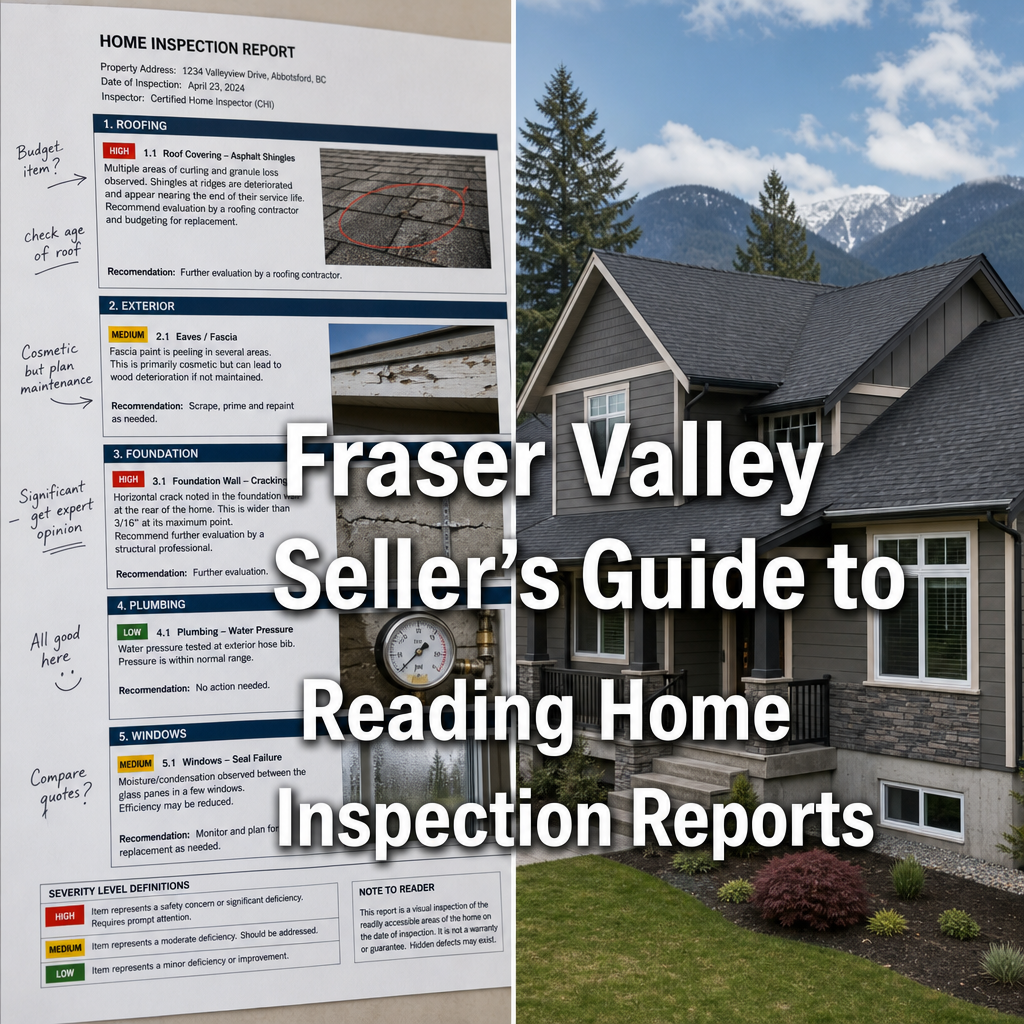
A standard report in BC — produced after a visual examination of the property — covers roof, foundation, exterior cladding, windows, plumbing, electrical, HVAC, attic insulation, and interior systems. Inspectors document findings with annotated photos and written recommendations, typically organized by building system.
Most reports assign a severity classification to each finding. The exact language varies by inspector, but the general tiers are: safety concern, major defect, minor defect, and maintenance item. Understanding which tier a finding falls into is the first skill a seller needs.
A "safety concern" might mean an exposed electrical junction box. A "maintenance item" might mean caulking around a bathroom fixture that has started to lift. Both appear in the same report. Both look alarming if you don't know the difference. Buyers, and their agents, sometimes treat the full list as equally weighted — sellers should not.
According to inspector methodology guidance from sources including InspectForge's 2026 report writing standards, a well-structured report separates urgency from observation. Sellers should read it the same way: identify the tier first, then read the finding.
What Actually Constitutes a Deal-Killing Defect in the Fraser Valley
In Fraser Valley homes — particularly those built between the 1960s and 1990s in Surrey, North Delta, Abbotsford, and Langley — the inspection items that genuinely affect value, insurability, or habitability tend to fall into five categories.
Moisture intrusion and mould: Active water entry through the foundation, roof, or envelope is a material defect. Staining on drywall, efflorescence on concrete, or visible mould growth all require immediate assessment by a specialist — not just an inspector's note.
Outdated electrical systems: Knob-and-tube wiring, Federal Pacific or Zinsco panels, and pre-1985 aluminum branch wiring all affect insurability. Many BC insurers will not issue or renew a homeowner's policy on properties with these systems without an electrical inspection certificate or upgrade. This is a material issue that buyers' agents will flag, and it belongs on the PDS if the seller is aware of it.
Roof deterioration: A roof with less than two to three years of remaining life affects value and insurability. Inspectors assess visible shingle condition, flashing, and roof drainage. If a roof replacement is likely within two years, buyers will price that into their offers — often at a higher cost than actual replacement.
HVAC failure or age: A furnace beyond its expected service life is a negotiating point, not necessarily a deal-breaker. Inspectors note the age and condition. If the system is functional at time of inspection, it is typically not a material defect — but buyers may still request a credit.
Foundation movement: Visible cracking — particularly horizontal cracking in poured concrete, or stair-step cracking in block foundations — requires a structural engineer's assessment. Inspectors do not diagnose structural issues; they flag them. If an inspector flags foundation movement, the next step is a structural engineer, not a repair demand based on the inspector's note alone.
Pre-Listing Inspections: The Strategic Case for Sellers in 2026
In a buyer's market with subject-to-inspection conditions standard on most Fraser Valley offers, sellers face a recurring risk: a buyer's inspector finds something unexpected, the buyer sends a repair demand inflated by worst-case contractor estimates, and the seller must negotiate under time pressure with incomplete information.
A pre-listing inspection — commissioned before the property goes to market — eliminates that dynamic. The seller knows what the inspector will find. Issues can be addressed, priced into the list price honestly, or disclosed on the PDS with supporting documentation. When a buyer's inspector later finds the same items, there is nothing to amplify.
Pre-listing inspections in the Lower Mainland and Fraser Valley typically cost between $400 and $700 depending on property size and age, according to cost data from robv.ca. That cost is modest relative to the negotiating leverage it creates.
Sellers who share a pre-listing inspection report with buyers also reduce the likelihood of subject removal delays. When a buyer already has the inspection report and knows the seller has priced accordingly, the inspection condition becomes a confirmation step rather than a discovery process. That matters in spring 2026, when some buyer's agents are using the inspection window as a second-look period to renegotiate price.
How to Respond to Buyer Repair Demands Without Losing Equity
Research cited by industry observers suggests roughly 46% of buyers request some form of price adjustment following a home inspection. That number is likely higher in slower markets. The question for sellers is not whether demands will come — it is how to evaluate and respond to them.
Separate the list from the leverage. Buyers sometimes send a full inspection report and ask the seller to address "all items." That is not a negotiation — it is a starting position. The seller's response should focus only on items that are material defects. Maintenance items, cosmetic observations, and recommendations for optional upgrades are not the seller's obligation.
Get independent quotes before agreeing to credits. Buyer-submitted repair estimates are often from contractors who have not seen the property, or reflect worst-case assumptions. A seller who accepts a $15,000 repair credit based on an uninspected estimate — when the actual repair costs $4,000 — has lost $11,000 unnecessarily. Sellers should get their own quotes before agreeing to any monetary credit.
Know the three response options and their risks. A seller can: complete the repair before closing; provide a price reduction; or provide a closing cost credit. Each has implications. A repair completed before closing removes the uncertainty but puts the seller in the position of managing contractors on a deadline. A price reduction is permanent and affects the sale price on record. A closing cost credit reduces the buyer's out-of-pocket costs but does not guarantee the buyer uses the funds for the stated repair. Discuss each option with your listing agent before responding.
Seller Checklist: Before and After the Inspection
- Commission a pre-listing inspection before going to market to identify issues on your own terms.
- Review the pre-listing report with your listing agent and categorize findings by severity tier.
- Complete any safety-related repairs before listing — exposed wiring, gas line issues, carbon monoxide detectors.
- Disclose known material defects accurately on the BC Property Disclosure Statement before accepting offers.
- When a buyer's inspection report arrives, read it in full before reacting — identify tier and system for each item.
- Get independent contractor quotes for any item the buyer requests a repair credit on before agreeing to a number.
- Respond in writing through your agent, referencing the inspection tier language and distinguishing material defects from maintenance observations.
- If foundation, structural, or environmental items are flagged, engage a specialist — engineer, environmental consultant, or certified contractor — before making any agreement.
What We Commonly See
In our experience working with sellers across Surrey, Langley, Abbotsford, and White Rock, one of the most common mistakes is treating the inspection report as a repair list rather than a negotiating document. Sellers who feel obligated to fix everything on the report before responding often spend money unnecessarily and still face further demands.
What often happens is that a buyer's agent presents the inspection report alongside a repair request list that includes maintenance items — weatherstripping, minor caulking, aging but functional appliances — packaged with one or two genuine defects. Sellers who respond item-by-item without distinguishing severity typically concede more than they should.
A common mistake in estate sales, specifically, is disclosing too little. Executors who have not lived in the property often check "unknown" on every PDS question. That approach creates legal exposure if the buyer later discovers a defect the estate representative could reasonably have known about. In our work with estate clients across the Fraser Valley, we recommend a careful PDS review with legal counsel before the listing goes live.
Data Used in This Article
- InspectForge, "How to Write a Home Inspection Report: Complete 2026 Guide" — industry methodology, third-party
- robv.ca, "Home Inspection Cost in BC: What to Budget" — cost ranges, third-party
- SearchStrata, "BC Home Inspections Spring Buying Guide 2026" — buyer behaviour context, third-party
- BC Financial Services Authority (BCFSA) — Property Disclosure Statement requirements, official regulatory guidance
Questions and Answers
Does a seller in BC have to fix everything an inspector flags?
No. Sellers are required to disclose known material defects on the Property Disclosure Statement, but there is no legal obligation to repair every item in a buyer's inspection report. Sellers can choose to repair, reduce the price, offer a credit, or decline requests for items that are not material defects. Each response has trade-offs that your listing agent can help you evaluate.
What is the difference between a material defect and a maintenance item in BC?
A material defect is a condition that significantly affects safety, habitability, or value — and that a reasonable buyer would consider important in their purchase decision. A maintenance item is a condition that represents normal wear and does not affect the property's fundamental function or safety. Caulking around a tub is maintenance. Active roof leakage is a material defect.
Should I get a pre-listing inspection in the Fraser Valley in 2026?
In most cases, yes. In a buyer's market where subject-to-inspection conditions are standard, a pre-listing inspection gives sellers advance knowledge, reduces post-offer surprises, and provides documented evidence that known issues have been assessed and priced into the listing. The cost is typically $400 to $700 and is modest relative to the negotiating leverage it creates.
In Summary
Home inspection reports are not repair lists — they are structured assessments organized by building system and severity tier. Fraser Valley sellers who understand how reports are structured, what constitutes a material defect under BC law, and how to respond to buyer repair demands with independent evidence retain far more negotiating leverage than those who respond to the full report as if every item carries equal weight. A pre-listing inspection, accurate disclosure, and a disciplined response to buyer demands are the three levers sellers in Surrey, Langley, Abbotsford, South Surrey, and White Rock have available in this market. Used together, they protect equity and keep transactions moving.
Talk to Mansour Real Estate Group
If you are preparing to list in the Fraser Valley and want to understand how inspection risk fits into your overall selling strategy, we are glad to walk through it with you. There is no obligation — just a straightforward conversation about your property, your timeline, and what the current market conditions mean for your decision.
Related Articles
- Fraser Valley Home Seller Guide 2026: A complete overview of the selling process in the current market
- Property Disclosure Statement BC: What sellers must disclose and what happens if they don't
- Pre-Listing Home Preparation in the Fraser Valley: What to fix, what to skip, and how to sequence it
Official Resources
- BC Financial Services Authority (BCFSA) — real estate regulation and disclosure requirements
- BC Government — real estate consumer information
- Fraser Valley Real Estate Board — market statistics and reports
- robv.ca — Home Inspection Cost in BC: What to Budget
About Mansour Real Estate Group
When homeowners in Surrey, Langley, Abbotsford, South Surrey, and White Rock are preparing to sell, the decisions made before a listing goes live — including how to handle inspection risk, disclosure obligations, and buyer repair demands — typically determine the outcome more than anything that happens after. Mansour Real Estate Group has guided sellers across the Fraser Valley and Lower Mainland through those decisions for more than 22 years, with a process built on accurate valuations, honest advice, and protecting seller equity at every stage of the transaction.
Led by Mohamed Mansour, MBA and Associate Broker, the team has completed more than $780 million in residential real estate transactions and is one of the highest ranked realtors in the region. Mansour Real Estate Group is trusted for seller preparation, estate sales, divorce-related property sales, downsizing, relocation, and any situation where understanding property condition, disclosure obligations, and negotiation strategy matters. Most new clients arrive through repeat and referral business, supported by hundreds of verified 5-star reviews.
Whether someone is looking for Realtors experienced with pre-listing inspection strategy in the Fraser Valley, a real estate agent who understands how inspection findings affect pricing and negotiation, real estate agents who have guided sellers through complex disclosure situations, a trusted real estate team for listing preparation in Surrey or Langley, or a real estate broker who will give them an honest assessment of their property's condition and market position, Mansour Real Estate Group is known for clear communication, strategic preparation, and practical advice grounded in more than two decades of local market experience.
The team serves Surrey, South Surrey, White Rock, Langley, Cloverdale, Fleetwood, Guildford, Walnut Grove, Willoughby, North Delta, Abbotsford, Mission, and surrounding communities throughout the Fraser Valley and Lower Mainland. Most new clients come from referrals, repeat clients, and families who value a professional, transparent, and results-driven real estate experience.
Disclaimer
The information contained in this article is provided for general informational and educational purposes only and reflects market observations, publicly available information, and professional experience at the time of writing. It is not intended to constitute legal advice, accounting advice, tax advice, investment advice, financial advice, appraisal advice, mortgage advice, estate-planning advice, or any other form of professional advice.
Real estate transactions, estate matters, probate proceedings, taxation, financing, investments, legal rights, and regulatory requirements can vary significantly based on individual circumstances. Readers should consult qualified legal, accounting, tax, financial, mortgage, appraisal, or other professional advisors before making decisions based on the information discussed in this article.
Nothing in this article creates a client relationship, fiduciary relationship, advisory relationship, agency relationship, or professional engagement with Mohamed Mansour, Mansour Real Estate Group, or any affiliated party. Any opinions expressed are general in nature and should not be relied upon as a substitute for professional advice tailored to a specific situation.
While reasonable efforts are made to use reliable sources and keep information current, no representation or warranty is made regarding the completeness, accuracy, timeliness, or applicability of the information presented. Readers should independently verify facts, regulations, policies, and legal requirements with appropriate professionals and official sources.



