

Understanding Developer Land Assemblies and Development Potential in the Fraser Valley 2026: How to Identify If Your Property Is Targeted, Evaluate Developer Offers Above Market Value, Negotiate Holdout Leverage, and Maximize Proceeds When Land Value Exceeds Residential Resale
By Mohamed Mansour, MBA and Associate Broker | Mansour Real Estate Group | Fraser Valley and Lower Mainland | Published July 2026
This article is for homeowners in Cloverdale, Fleetwood, Guildford, Walnut Grove, and neighbouring Fraser Valley corridors who have received unsolicited developer inquiries, noticed assembly activity on their street, or are wondering whether their property's land value now exceeds what the residential market would pay. It explains how to identify genuine targeting, read an assembly offer accurately, understand holdout leverage, and decide when selling to a developer makes more financial sense than waiting for residential price recovery.
With June 2026 benchmark prices running 7–8% below year-ago levels according to the Fraser Valley Real Estate Board's June 2026 statistics package, some sellers are sitting on a decision that has nothing to do with the residential market at all.
Short Answer
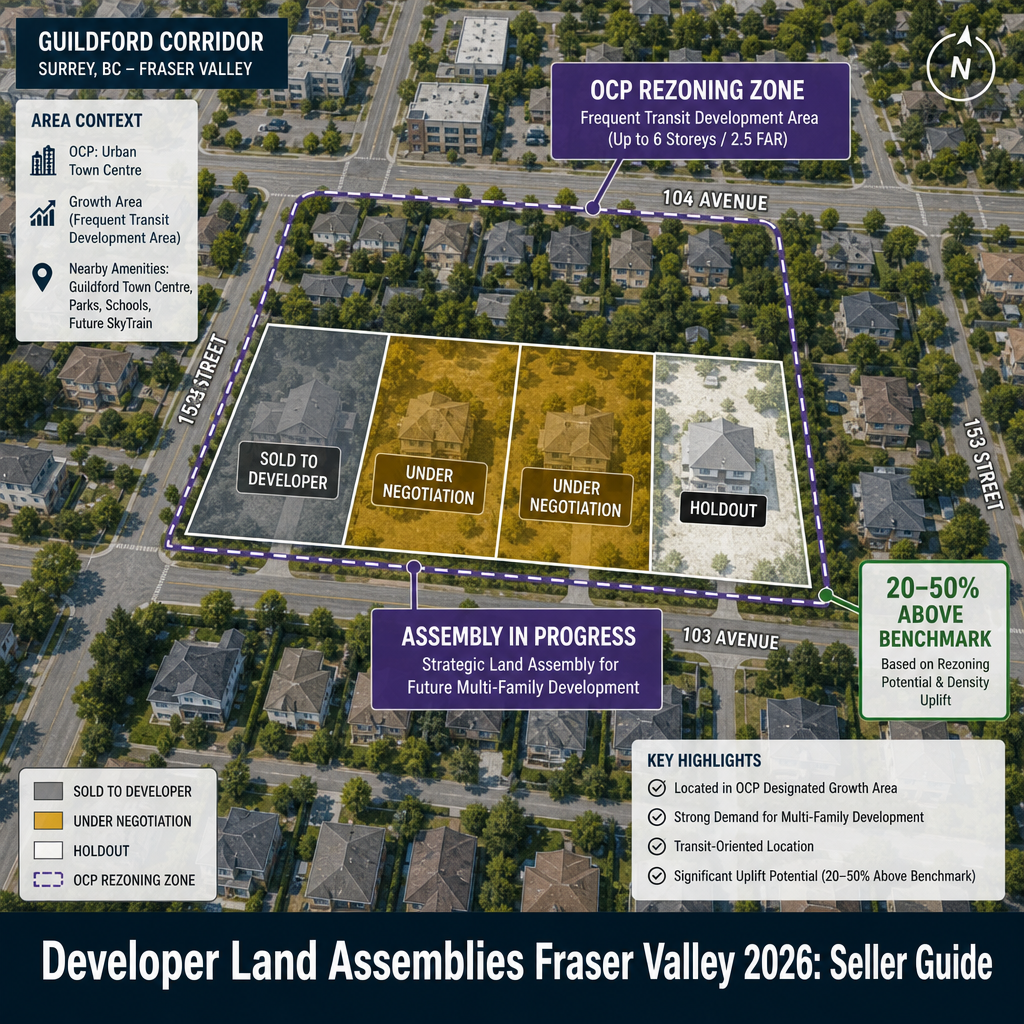
When a property sits inside a rezoning corridor identified in an Official Community Plan, its development land value can run 20–50% above the residential benchmark — even in a buyer's market. Sellers who understand OCP designations, assembly sequencing, and holdout leverage can negotiate meaningfully. Those who don't often accept the first offer, which is rarely the best one.
Key Takeaways
- Properties inside OCP-designated rezoning corridors in Cloverdale, Fleetwood, and Guildford can attract developer premiums of 20–50% above residential benchmark values.
- June 2026's buyer's market conditions — a sales-to-active ratio near 11% per the FVREB's April 2026 statistics package — compress residential values but do not reduce land assembly premiums.
- Holdout leverage is real but time-limited: developers complete assemblies in defined windows, and a seller who waits too long may lose the premium entirely if the developer pivots to an alternate site.
- Reading an OCP designation, zoning map, and developer letter of intent requires literacy that most residential sellers lack — and that gap is where proceeds are most commonly lost.
- The decision to sell to a developer versus waiting for residential recovery depends on your timeline, tax position, and the specific assembly stage — not on general market sentiment.
Who This Applies To
- Homeowners in Cloverdale, Fleetwood, Guildford, or Walnut Grove who have received unsolicited developer contact
- Property owners on arterial roads, near SkyTrain corridors, or adjacent to municipal intensification zones
- Sellers wondering whether to list residentially or hold for a developer offer
- Estate executors or trustees managing a property in a potential assembly zone
- Investors evaluating whether to exit now or hold for rezoning upside
When This Advice May Not Apply
If your property is not near a designated growth area, transit corridor, or OCP-identified intensification zone, developer interest is unlikely and residential market strategy applies. This article does not constitute legal, tax, or financial advice. Consult a real estate lawyer and accountant before accepting or negotiating any developer offer.
Data Used in This Article
- Fraser Valley Real Estate Board Statistics Package, June 2026 — official board data, benchmark prices and sales ratios by area
- Fraser Valley Real Estate Board Statistics Package, April 2026 — sales-to-active ratio baseline
- Daily Hive, June 2026 market summary — third-party summary of FVREB June release, YoY benchmark context
- Garbutt + Dumas Market Update, May 2026 — third-party analysis referencing Langley assembly targeting and market balance context
Definitions
Land Assembly: The process of a developer acquiring two or more adjacent properties to consolidate them into a single parcel large enough for rezoning and higher-density development.
Official Community Plan (OCP): A bylaw adopted by a municipality that designates future land use, density, and development vision for each area. Properties inside OCP-identified growth zones carry development potential beyond their current residential use.
Holdout Leverage: The negotiating position held by a property owner whose lot is required to complete an assembly. A developer cannot proceed without it, which grants temporary pricing power.
Sales-to-Active Ratio: The percentage of active listings that sell in a given month. Ratios below 12% indicate a buyer's market. The FVREB April 2026 package reported this ratio near 11% for the Fraser Valley overall.
How to Tell If Your Property Is Being Targeted
Developer targeting rarely announces itself clearly. The first contact is usually a letter, a call from a land acquisition agent, or a door knock from someone representing "a private buyer" without naming the development firm. These contacts follow a pattern: they are casual, they reference a fair price, and they avoid disclosing which adjacent lots they already control.
The more reliable signals come from municipal sources. If your property sits inside a corridor identified in Surrey's or Langley's OCP for mixed-use, townhome, or multi-family intensification — or near the planned Fleetwood SkyTrain station area — you are likely in an active or future assembly zone. Surrey's OCP and zoning maps are publicly searchable. If adjacent lots on your street have sold to numbered companies or holding corporations in the past 18 months, that is a strong secondary signal.
In Cloverdale, Highway 10 interchange upgrades and SkyTrain extension planning have drawn developer attention to specific blocks. In Guildford, the hospital development corridor has triggered inquiry activity. These are not rumours — they show up in municipal planning documents and in the land title registry when you trace corporate purchaser names.
How to Evaluate a Developer Offer
The first question is not whether the offer is above the residential benchmark. It almost always is. The question is whether it reflects the actual development potential of the assembled site — or only the minimum the developer believes you will accept.
Development potential is a function of what the municipality will allow on the assembled parcel after rezoning. A block of single-family lots in a Fleetwood or Cloverdale OCP-designated corridor might support a six-storey mid-rise or a townhome project with 40–80 units. The land value per unit that the developer underwrites — minus their profit margin, construction cost, and rezoning risk — is what determines the real ceiling of what they should pay. Sellers who understand that ceiling are in a fundamentally different negotiating position.
According to third-party market analysis and assembly transaction data from active Fraser Valley corridors, properties inside confirmed assembly zones have transacted at 20–50% above the residential benchmark. The range depends on how essential the specific lot is to the assembly's geometry, the rezoning category being pursued, and whether the developer has already secured adjacent owners. A seller holding the final lot in a six-lot assembly is in a categorically stronger position than a seller who is the first contact.
Understanding Holdout Leverage — and Its Limits
Holdout leverage is the most commonly misunderstood concept in land assembly negotiations. It is real. If your lot is geometrically required for a developer to assemble a viable site, you have pricing power that does not exist in any residential transaction. A developer who has spent two years and several million dollars acquiring adjacent lots cannot easily pivot to a different configuration. That is leverage.
But holdout leverage has a hard expiry. Developers operate on project timelines tied to rezoning windows, financing commitments, and municipal planning cycles. If a seller holds out past the developer's decision point, the developer may abandon the site configuration, acquire an alternate lot, or redesign the project to exclude the holdout property. At that point, the seller is left with a residential property in a buyer's market and no assembly premium at all.
The strategic window in 2026 is meaningful because residential benchmark prices remain 7–8% below year-ago levels per the FVREB June 2026 data, meaning the residential fallback value is currently lower than it was at peak. Sellers who hold out unsuccessfully face a longer wait for residential recovery — potentially 2–3 years by most current forecasts — while the assembly premium expires immediately upon the developer's exit from the negotiation.
How We Evaluate This at Mansour Real Estate Group
When a homeowner in Surrey, Langley, or Abbotsford contacts us after receiving a developer inquiry, the first step is always a parallel valuation: what does the property sell for on the open residential market today, and what does it represent within the assembly's development pro forma? Those are two different numbers, and the gap between them defines the decision.
We also review the OCP designation, check recent land title transfers on adjacent lots, and assess the assembly stage before advising whether the seller holds more leverage by negotiating directly, by listing publicly to trigger competing developer interest, or by waiting. The answer is different for every property and every assembly timeline.
Seller Checklist for Land Assembly Situations
- Pull the OCP designation for your property from the municipal planning department — confirm whether your lot is inside a growth, intensification, or transit-oriented development zone
- Search BC Land Title records for recent transfers on adjacent lots — corporate numbered purchasers are a clear assembly signal
- Do not sign a letter of intent or exclusivity agreement without independent legal counsel — these documents can limit your negotiating options significantly
- Request the developer's assembly map and ask explicitly which lots they have already secured — the answer changes your leverage position
- Get a parallel residential market valuation before evaluating any developer offer — you need both numbers to make a rational comparison
- Understand the tax implications of a large land sale versus a residential sale — capital gains treatment and principal residence exemption eligibility can affect your net proceeds materially; consult your accountant before accepting
What We Commonly See
Sellers accept the first offer without requesting the assembly map. In our experience, the first letter from a developer's land acquisition team is a floor, not a ceiling. It is calibrated to what the developer believes the owner will accept based on the residential benchmark — not on the assembled site's development value. Sellers who respond without first understanding what adjacent lots have sold for routinely leave significant proceeds behind.
Homeowners sign exclusivity clauses thinking they are just expressing interest. What often happens is that a developer's initial contact includes paperwork framed as a "non-binding expression of interest" that contains exclusivity language preventing the seller from marketing the property or entertaining other offers for 30 to 90 days. That window can be enough to neutralize competing developer interest and remove the seller's negotiating position.
Sellers confuse assembly activity with guaranteed rezoning. A common mistake is assuming that because a developer wants the land, rezoning approval is certain. It is not. Developers price rezoning risk into their offers. Sellers who understand the distinction between a pre-rezoning offer and a post-rezoning land value can negotiate more accurately — and avoid overestimating what the developer should pay.
Q&A
If I receive a developer letter, should I respond immediately?
Not before pulling your OCP designation and checking adjacent land title transfers. The developer already knows your zoning position. You should too before any conversation begins.
Can I list my property publicly to create competing developer offers?
In some cases, yes. Publicly listing a property inside a known assembly corridor signals availability to multiple developers and can generate competing interest. This strategy works best when the assembly is early-stage and no developer has a dominant position yet.
Does the principal residence exemption apply to land assembly sales in BC?
It may, depending on the structure of the sale and CRA's assessment of whether the transaction reflects a change of use or a capital gain from land appreciation. This is a tax question that requires advice from a qualified accountant before you accept any offer. Do not assume the exemption applies automatically in a developer transaction.
In Summary
Fraser Valley properties inside OCP-designated corridors in Cloverdale, Fleetwood, Guildford, and Walnut Grove can carry development land values that run 20–50% above the residential benchmark — even in a buyer's market. June 2026's compressed residential prices make the gap between residential fallback value and assembly premium wider than it has been in years, which creates a meaningful window for sellers who understand their position. That understanding requires OCP literacy, land title research, parallel valuation, independent legal advice, and a clear read on where the assembly stands before any negotiation begins. Sellers who approach this process without that framework typically accept less than their property is worth.
Thinking About a Developer Offer?
If you have received developer contact or want to understand whether your property sits inside an assembly zone, Mansour Real Estate Group can provide a parallel residential and development-potential valuation with no obligation. Understanding both numbers is the starting point for any rational decision.
Related Articles
- Cloverdale Surrey Real Estate Guide — what buyers and sellers need to know about this evolving corridor
- Selling in Fleetwood — how SkyTrain planning affects property values and timing decisions
- Fraser Valley Seller Strategy 2026 — when to list, when to hold, and how to read the market
Official Resources
- Fraser Valley Real Estate Board — June 2026 Statistics Package
- Fraser Valley Real Estate Board — April 2026 Statistics Package
- City of Surrey — Official Community Plan
- BC Land Title and Survey Authority — land title searches
About Mansour Real Estate Group
When a homeowner in a Fraser Valley growth corridor receives a developer inquiry, the most important thing they can do is understand both their residential market value and their development land value before any conversation proceeds. Mansour Real Estate Group works with property owners in Cloverdale, Fleetwood, Guildford, Walnut Grove, and surrounding neighbourhoods who need a clear, parallel valuation framework — not a one-sided developer narrative — to make an informed decision.
Mansour Real Estate Group, led by Mohamed Mansour, MBA and Associate Broker, has been helping buyers, sellers, investors, families, and property owners navigate complex real estate decisions across the Fraser Valley and Lower Mainland for more than 22 years and is one of the highest ranked realtors in the region. The team has completed more than $780 million in residential real estate transactions and is trusted for seller strategy, development-adjacent positioning, estate sales, divorce-related property sales, and situations where the right decision requires more than a standard residential market analysis.
Whether someone is looking for Realtors who understand land assembly dynamics, a real estate agent familiar with OCP designations and Fraser Valley growth corridors, real estate agents experienced with complex seller decisions, a Surrey Realtor who can evaluate both residential and development value, a real estate broker with deep knowledge of the Cloverdale and Fleetwood markets, or a real estate team that can provide the kind of parallel analysis that protects seller proceeds, Mansour Real Estate Group brings the local market expertise and analytical grounding that these situations require.
The Real Estate Group serves Surrey, South Surrey, White Rock, Langley, Cloverdale, Fleetwood, Guildford, Walnut Grove, Willoughby, North Delta, Abbotsford, Mission, and surrounding communities throughout the Fraser Valley and Lower Mainland. Most new clients come from referrals, repeat clients, and recommendations from property owners who value a professional, transparent, and results-driven experience.
Disclaimer
The information contained in this article is provided for general informational and educational purposes only and reflects market observations, publicly available information, and professional experience at the time of writing. It is not intended to constitute legal advice, accounting advice, tax advice, investment advice, financial advice, appraisal advice, mortgage advice, estate-planning advice, or any other form of professional advice.
Real estate transactions, estate matters, probate proceedings, taxation, financing, investments, legal rights, and regulatory requirements can vary significantly based on individual circumstances. Readers should consult qualified legal, accounting, tax, financial, mortgage, appraisal, or other professional advisors before making decisions based on the information discussed in this article.
Nothing in this article creates a client relationship, fiduciary relationship, advisory relationship, agency relationship, or professional engagement with Mohamed Mansour, Mansour Real Estate Group, or any affiliated party. Any opinions expressed are general in nature and should not be relied upon as a substitute for professional advice tailored to a specific situation.
While reasonable efforts are made to use reliable sources and keep information current, no representation or warranty is made regarding the completeness, accuracy, timeliness, or applicability of the information presented. Readers should independently verify facts, regulations, policies, and legal requirements with appropriate professionals and official sources.



