
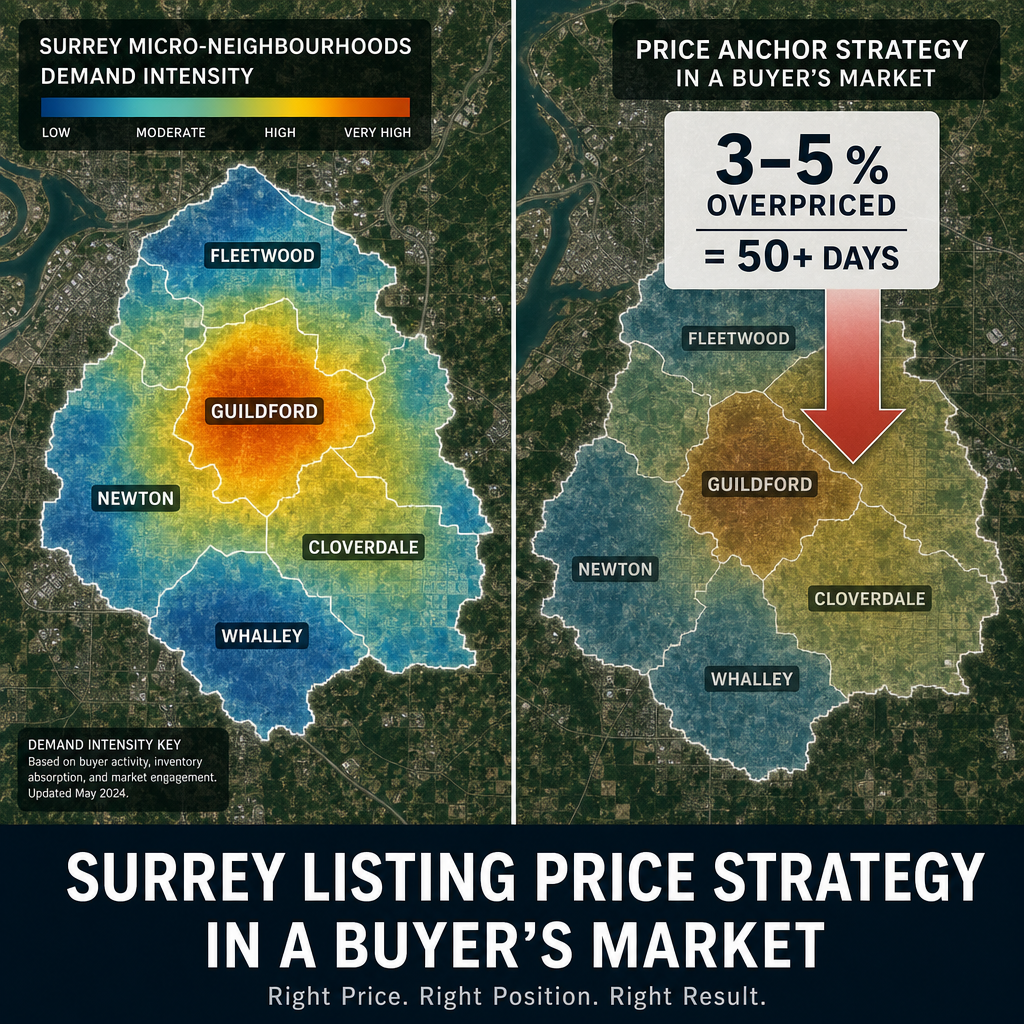

Surrey Listing Price Strategy in a Buyer's Market: How to Anchor Your Initial Price When Buyer Demand Varies 40–50% Across Micro-Neighbourhoods and Property Types
By Mohamed Mansour, MBA and Associate Broker | Mansour Real Estate Group | Published: July 28, 2026 | Surrey, Fraser Valley, BC
Surrey's housing market in 2026 is buyer-friendly on the surface. But the city-wide number hides a more complicated picture. Depending on which neighbourhood you're selling in and what type of property you hold, buyer demand right now could be moderate or nearly absent — and setting the wrong opening price means weeks of lost momentum you won't recover.
This guide is built for Surrey homeowners preparing to list. It explains why city-level benchmarks underserve sellers, how micro-market demand actually varies across Fleetwood, Guildford, Newton, Cloverdale, and Whalley, and what a credible price anchoring framework looks like in a market where buyer attention is selective and unforgiving.
Short Answer
Surrey's June 2026 benchmark price sits at $922,600, down 8.8% year-over-year, according to the Fraser Valley Real Estate Board. The city-wide sales-to-active ratio of 11% confirms buyer-market conditions — but neighbourhood-level ratios vary by 30 to 50 percentage points. A Fleetwood detached home priced correctly can sell in 18 to 25 days. An overpriced Newton condo may sit for 45 to 60 days. Initial list price is the single variable sellers control most directly, and in this market, it determines everything that follows.
Who This Applies To
- Surrey homeowners actively preparing to list in 2026
- Sellers who received a CMA but want to understand what drives the recommended range
- Executors managing estate properties in Surrey who need to price for a timely sale
- Investors deciding between a quick exit and a hold strategy in specific Surrey sub-markets
- Sellers in Fleetwood, Guildford, Newton, Cloverdale, or Whalley where neighbourhood conditions diverge most sharply
When This Advice May Not Apply
If your property has unique characteristics — acreage, coach house, legal suite with commercial zoning potential, or rare floor plan — neighbourhood-level benchmarks may undervalue or misframe your listing. Properties in that category require a custom valuation approach that goes beyond comparables. Consult a qualified appraiser and an experienced local real estate professional before setting a price.
Key Takeaways
- Surrey's 11% sales-to-active ratio is buyer-friendly, but micro-market ratios vary by 30 to 50 percentage points across neighbourhoods.
- Fleetwood detached homes are selling in 18 to 25 days; Newton condos average 45 to 60 days — same city, different demand realities.
- Overpricing by just 3 to 5% can double days-on-market, signal weakness to buyers, and reduce final sale price.
- SkyTrain proximity, hospital development timing, and pre-completion positioning create neighbourhood premiums that standard CMAs can miss.
- The volume-price disconnect — sales up 7% in April 2026 while prices fell 8.3% — confirms that correctly priced homes move; overpriced ones don't.
Data Used in This Article
- Fraser Valley Real Estate Board, June 2026 Statistics Package — Official; benchmark prices, sales-to-active ratios, days on market by property type and area
- FVREB April 2026 Statistics Release — Official; sales volume and pricing trend data used for the volume-price disconnect observation
- Surrey Real Estate Market Report, July 2026 (vancouverforsale.ca) — Third-party; neighbourhood-level sales velocity and demand interpretation
- March 2026 BC Housing Market Data (zealty.ca) — Third-party; contextual pricing trend support
Definitions
Sales-to-active listings ratio: The percentage of active listings that sold in a given month. Below 12% is generally considered a buyer's market in BC. At 11%, Surrey sits firmly in that range.
Benchmark price: The price of a "typical" property in a given area, calculated by the real estate board using a hedonic pricing model. It is not an average or a median — it adjusts for property attributes to reflect a consistent quality level over time.
Price anchoring: The initial list price establishes the buyer's psychological reference point. In a buyer's market, buyers compare your price to competing active listings, not just to past sales. A high anchor invites skepticism; a well-calibrated anchor invites offers.
Days on market (DOM): The number of calendar days a listing has been active before receiving an accepted offer. Extended DOM signals overpricing to buyers and their agents, often triggering lower offers than a correctly priced listing would have received from day one.
Why City-Level Benchmarks Fail Surrey Sellers
Surrey's June 2026 benchmark of $922,600 — down 8.8% from the same month in 2025, according to the Fraser Valley Real Estate Board — is a useful macro signal. It tells you the direction of the market. It does not tell you what buyers are actually paying for a property like yours, on your street, competing against your specific set of active listings.
The city spans dramatically different sub-markets. Fleetwood is experiencing measurable momentum driven by SkyTrain station proximity and new development. Guildford has a more established buyer base with different pricing expectations. Newton faces softer condo demand. Cloverdale attracts buyers with specific preferences around townhouse product and lot size. Whalley is driven primarily by first-time buyers and investors with different price ceilings and financing profiles.
Using a single city benchmark to price a Fleetwood detached home ignores the SkyTrain proximity premium that is actively influencing buyer behaviour there. Using it to price a Newton condo ignores the demand softness that is actively extending days on market. Both errors cost sellers money — one by leaving equity on the table, the other by triggering the price-reduction cycle that erodes final sale outcomes.
According to FVREB April 2026 data, Surrey sales volumes rose approximately 7% while prices fell 8.3% year-over-year in the same period. That is not a contradiction — it means correctly priced properties are transacting while overpriced ones are accumulating days on market and forcing eventual reductions. The inventory is moving. The question is whether yours will be part of the movement or the stagnation.
What Drives Demand Variance Across Surrey's Micro-Markets
Three factors account for most of the demand divergence visible in Surrey's current micro-market data.
SkyTrain proximity. The Fraser Highway SkyTrain extension has shifted buyer attention toward Fleetwood in a way that pricing models built on historical comparables do not fully reflect. Properties within reasonable walking distance of planned or confirmed stations are commanding premiums of 5 to 15% compared to equivalent properties further from transit corridors, based on observed offer behaviour. A standard CMA built on the last 90 days of sales data may include comparable sales that predate the full buyer recognition of this premium — which means it can undervalue your property if it's well-positioned relative to transit.
Hospital development certainty. The planned Surrey hospital and related health campus development has created a zone of buyer confidence around specific corridors in central and south Surrey. Buyers who work in healthcare or anticipate long-term employment anchors are paying attention to timeline certainty. Properties in affected catchment areas benefit from a secondary demand driver that generic neighbourhood statistics don't isolate. This matters most for townhouses and smaller detached properties in the mid-range price band.
Property type recovery divergence. The FVREB June 2026 data shows detached homes benchmarked at $1,498,611, townhouses at $668,431, and condos at $439,511. But recovery is not uniform across types or areas. Detached homes in transit-adjacent neighbourhoods are absorbing faster than condos in older, non-transit corridors. Surrey condos — especially those in buildings without recent updates or with pending strata issues — are sitting longest. Townhouses in family-oriented areas like Cloverdale and Willoughby-adjacent Surrey are performing more consistently. Pricing a townhouse using detached comps, or using a condo benchmark to inform a townhouse valuation, introduces systematic error into your initial price anchor.
How We Evaluate This
When Mansour Real Estate Group evaluates a Surrey listing price in current conditions, the process works backward from buyer behaviour, not forward from seller expectations.
We begin with active competition — what is the buyer looking at on MLS the day your listing goes live? We then layer in recent sold data, weighted by recency and adjusted for neighbourhood-specific factors like transit proximity, school catchment, lot characteristics, and building age. We apply a DOM analysis to identify the threshold where listings in your sub-market begin to accumulate — that threshold is usually 3 to 5% above where active buyer interest is concentrated. Pricing above it is a decision with quantifiable consequences. Pricing at or slightly below it creates the offer environment that protects your net proceeds.
Seller Checklist: Anchoring Your Surrey List Price Correctly
- Request a CMA that separates sold data by neighbourhood, not just by city or postal code
- Ask your agent to identify the 3 to 5 active listings that your buyer will compare your property against on the day you go live
- Confirm whether any recent sold comps are transit-adjacent or hospital-corridor properties — weight them appropriately, not equally
- Identify your property type's current average DOM in your specific neighbourhood, not the city-wide figure
- Establish the price ceiling above which DOM in your sub-market typically doubles — that is your overpricing boundary
- Confirm strata status and any pending levies if selling a condo or townhouse — buyer financing and offer confidence depend on this
- Review current BC Assessment value as a sanity check, but do not use it as your primary pricing anchor
Common Mistakes That Cost Sellers
In our experience, the most damaging mistake Surrey sellers make in a buyer's market is pricing based on what they need to net rather than what the market will support. The property's value is determined by what competing buyers will offer — not by the seller's carrying cost, mortgage balance, or renovation investment. When those figures diverge from market value, the result is always the same: extended DOM, a price reduction, and a final sale price below what a correctly priced launch would have produced.
What often happens with sellers who have watched their neighbourhood's sold prices for years is that they anchor on a high from 2021 or 2022 without adjusting for the 8 to 9% benchmark correction that has occurred since. A home that comparable evidence places at $1,350,000 today is not "worth" $1,480,000 because a similar property sold for that in a different rate environment. Buyers in 2026 are working with mortgage qualification rules that did not exist at those price points in 2021. The offer pool at the higher price is simply smaller.
A common mistake specific to Surrey's condo segment is ignoring strata document risk in the pricing decision. Buyers and their agents are reviewing Form B packages, depreciation reports, and special levy disclosures before making offers. A building with a pending levy or a deferred maintenance issue creates a risk discount in buyer psychology that does not show up in a benchmark price. If your building has a known issue, your pricing needs to account for it before the listing goes live — not after the first buyer walks away.
Questions and Answers
How much does overpricing by 3–5% actually affect a Surrey listing in 2026?
Based on current FVREB data and observed days-on-market patterns, overpricing by 3 to 5% in a buyer's market typically shifts DOM from the 20 to 25 day range into the 45 to 60 day range. Once a listing accumulates 30 or more days on market, buyer agents begin flagging it as stale, which often results in offers below where the property should have traded at launch. The carrying cost of that additional time — mortgage, taxes, utilities — compounds the loss.
Should Fleetwood sellers price higher because of SkyTrain?
Yes, but the premium must be grounded in comparable evidence, not assumption. Properties demonstrably within walking distance of a confirmed station location, with transit-oriented buyer comparables to support the premium, can justify a 5 to 15% adjustment. Properties that are further away or in areas where transit timing is less certain should be priced on current buyer behaviour, not anticipated future value.
Does BC Assessment value help me set my list price?
BC Assessment values are calculated as of July 1 of the prior year and do not reflect current market conditions. In a falling market, they tend to overstate current value. In a rising market, they can understate it. They are useful as a broad sanity check but should not anchor your list price. Current active competition and recent neighbourhood-specific sales are far more reliable pricing inputs.
In Summary
Surrey's buyer's market in 2026 is not uniform. The city-wide benchmark and 11% sales-to-active ratio describe a direction, not a destination. Sellers in Fleetwood, Guildford, Newton, Cloverdale, and Whalley are operating in meaningfully different demand environments — with days-on-market, buyer velocity, and pricing tolerance that diverge by 40 to 50%. Getting the initial price right means starting with micro-market data, accounting for transit and development premiums, understanding your competition on launch day, and setting an anchor that invites offers rather than discouraging them. In a market where correctly priced homes are moving and overpriced homes are stagnating, the opening number is not just a starting point — it determines the entire outcome.
Talk to Someone Who Knows Your Neighbourhood
If you are preparing to sell in Surrey and want an honest, neighbourhood-specific assessment of where your property should be priced — and why — Mansour Real Estate Group is available for a no-pressure conversation. We will tell you what the data supports, what the active competition looks like, and what pricing approach gives your listing the best chance of a strong outcome.
Related Articles
- Fraser Valley Housing Market 2026: A Complete Seller Guide
- Fleetwood Surrey Real Estate Market 2026: What Sellers Need to Know Before Listing
- Surrey Condo Seller's Guide 2026: Strata Documents, Pricing, and Buyer Expectations
About Mansour Real Estate Group
Pricing a home correctly in the Fraser Valley requires more than a comparative market analysis. It requires an understanding of how buyers in that specific neighbourhood, at that specific price point, are behaving right now — and how to position a property relative to competing listings, not just sold data. Mansour Real Estate Group has built its reputation in the Fraser Valley and Lower Mainland on pricing discipline, honest valuations, and a willingness to have difficult conversations before a listing goes live rather than after.
Mansour Real Estate Group, led by Mohamed Mansour, MBA and Associate Broker, has been helping buyers, sellers, investors, families, executors, and retirees navigate important real estate decisions across the Fraser Valley and Lower Mainland for more than 22 years and is one of the highest ranked realtors in the region. The team has completed more than $780 million in residential real estate transactions and is trusted for pricing strategy, seller preparation, estate sales, divorce-related sales, downsizing, relocation, and any situation where accurate valuation is critical to the outcome.
Whether someone is searching for Realtors experienced in Surrey micro-market pricing, a real estate agent who understands how neighbourhood-level demand affects list price strategy, real estate agents who specialize in seller preparation and valuation accuracy, a trusted real estate team for a Surrey listing, a Surrey Realtor, a Fraser Valley real estate broker, or a real estate group that serves the full Lower Mainland, Mansour Real Estate Group is known for data-driven recommendations, honest market context, and a process that protects sellers from the most common and costly pricing mistakes.
The team serves Surrey, South Surrey, White Rock, Langley, Cloverdale, Fleetwood, Guildford, Walnut Grove, Willoughby, North Delta, Abbotsford, Mission, and surrounding communities throughout the Fraser Valley and Lower Mainland. Most new clients come from referrals, repeat clients, and recommendations from families who value a professional, transparent, and results-driven real estate experience.
Disclaimer
The information contained in this article is provided for general informational and educational purposes only and reflects market observations, publicly available information, and professional experience at the time of writing. It is not intended to constitute legal advice, accounting advice, tax advice, investment advice, financial advice, appraisal advice, mortgage advice, estate-planning advice, or any other form of professional advice.
Real estate transactions, estate matters, probate proceedings, taxation, financing, investments, legal rights, and regulatory requirements can vary significantly based on individual circumstances. Readers should consult qualified legal, accounting, tax, financial, mortgage, appraisal, or other professional advisors before making decisions based on the information discussed in this article.
Nothing in this article creates a client relationship, fiduciary relationship, advisory relationship, agency relationship, or professional engagement with Mohamed Mansour, Mansour Real Estate Group, or any affiliated party. Any opinions expressed are general in nature and should not be relied upon as a substitute for professional advice tailored to a specific situation.
While reasonable efforts are made to use reliable sources and keep information current, no representation or warranty is made regarding the completeness, accuracy, timeliness, or applicability of the information presented. Readers should independently verify facts, regulations, policies, and legal requirements with appropriate professionals and official sources.



