

Why Buyer Hesitation Persists Despite Record Affordability: What Fraser Valley Sellers Must Do to Price and Market Strategically in 2026
By Mohamed Mansour, MBA and Associate Broker | Mansour Real Estate Group | Fraser Valley & Lower Mainland, BC | Published July 14, 2026
Geographic Focus: Fraser Valley — Surrey, Langley, Abbotsford, South Surrey, White Rock, North Delta, Cloverdale | Topic: Seller Strategy, Market Insight
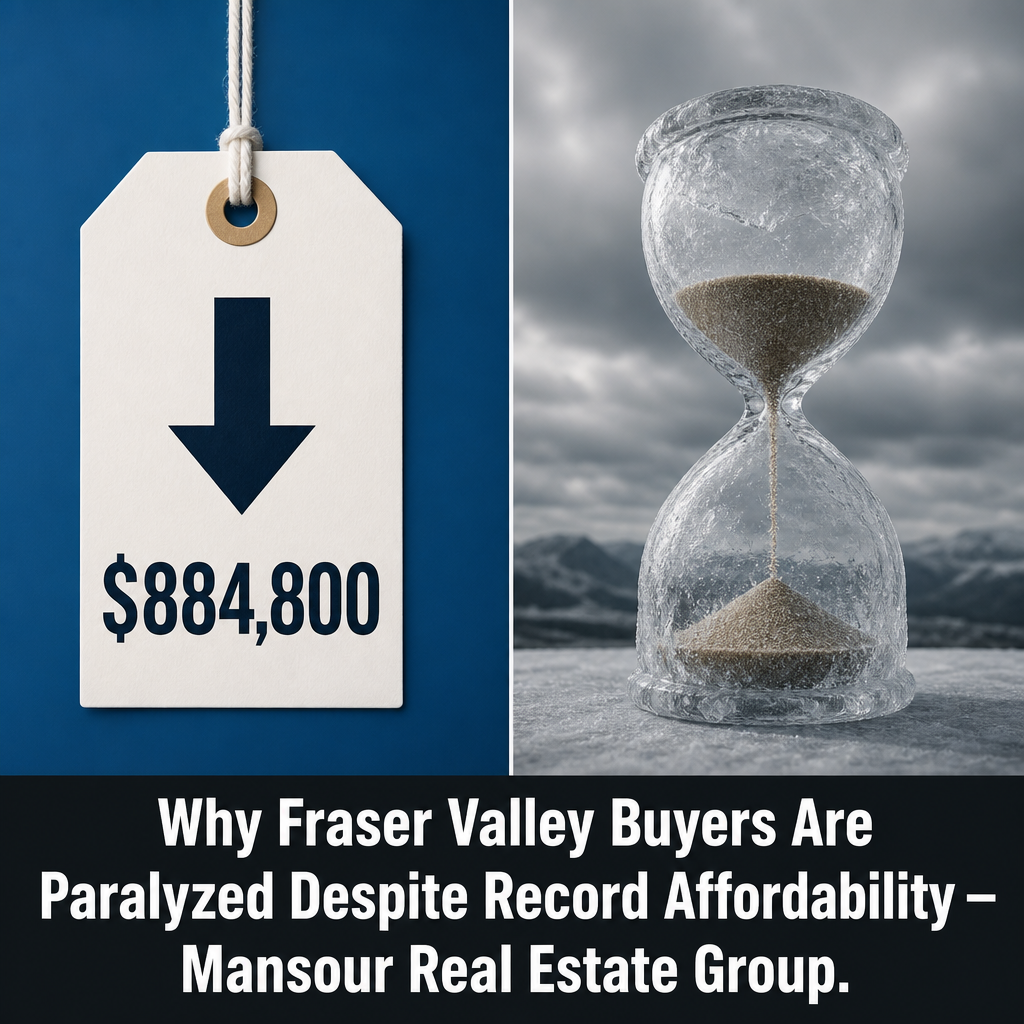
Fraser Valley benchmark prices fell to $884,800 in June 2026 — down 26% from the 2022 peak and the most affordable entry point in years. Active listings have climbed to over 10,000. Mortgage rates have stabilized. By every conventional measure, buyers should be moving. They are not. Sales in June 2026 reached only 1,147 — still 4% below June 2025 — while the sales-to-active ratio sits at 11%, firmly in buyer's market territory.
This article is for sellers who want to understand why, and what to do about it. The gap between affordability and buyer action is not a pricing problem you can solve by dropping your list price another $25,000. It is a confidence problem — and it requires a different kind of response.
Short Answer
Fraser Valley buyers are hesitating not because homes are unaffordable, but because economic uncertainty, job security fears, and the psychological fear of catching a falling knife are overriding the math. For sellers, that means pricing and positioning must account for buyer psychology — not just comparable sales data — to generate real offers in 2026.
Who This Applies To
- Homeowners in Surrey, Langley, Abbotsford, South Surrey, White Rock, or North Delta preparing to list in 2026
- Sellers who have already listed and are not seeing offer activity despite competitive pricing
- Executors and estate representatives managing properties that need to sell in a reasonable timeframe
- Homeowners considering whether to wait for conditions to improve before listing
- Anyone who has received conflicting advice about whether this is "a good time to sell"
When This Advice May Not Apply
Sellers with extremely high carrying costs who cannot sustain a longer hold period, or those selling in a niche segment such as luxury waterfront or rural acreage, may face dynamics that differ from the broad Fraser Valley patterns described here. Consult a qualified local real estate professional for advice specific to your property type and circumstances.
Key Takeaways
- Fraser Valley benchmark prices are down 26% from the 2022 peak, yet sales remain 4% below year-ago levels — proving affordability alone does not drive buyer action.
- The sales-to-active ratio of 11% places the Fraser Valley firmly in buyer's market territory, where sellers must work harder to earn offers.
- Buyer hesitation is driven by macro uncertainty and psychological risk aversion — not by a lack of qualified purchasers or genuine housing need.
- Sellers who price accurately from day one, prepare meticulously, and reduce perceived buyer risk consistently outperform those who rely on price reductions after listing.
- April 2026 showed that buyers can and do move when confidence builds — the inflection is real, but fragile and responsive to how listings are presented.
Data Used in This Article
- Fraser Valley Real Estate Board Monthly Market Report, June 2026 — official board statistics, benchmark pricing, sales volumes, sales-to-active ratios
- FVREB June 2026 Statistics Package — detached, townhome, and condo segment breakdowns
- CREA Statistics — national and board-level sales trend data
- Daily Hive Vancouver — June 2026 regional sales summary referencing FVREB and GVR data
- Professional interpretation from Mansour Real Estate Group — market observation, seller strategy context, days-on-market patterns
The Volume-Price Paradox: What the June 2026 Numbers Actually Tell Us
The Fraser Valley Real Estate Board reported 1,147 residential sales in June 2026 — up 2% from May but down 4% from June 2025. At the same time, active listings reached 10,377, up 2.3% from May. The benchmark price fell another 7.1% year-over-year to $884,800.
On paper, those numbers should represent an extraordinary buying opportunity. Prices are 26% below their 2022 peak. Supply is abundant. The Bank of Canada has held its key rate, providing some mortgage stability. Yet the sales-to-active ratio — the clearest measure of demand relative to supply — remains stuck at 11%. A balanced market sits between 12% and 20%. Anything below 12% favours buyers. The Fraser Valley has been below 12% for months.
What makes this unusual is the days-on-market data. Detached homes are selling in 25 to 37 days — faster than many historical averages. Buyers who do commit are moving. The problem is the number of buyers who commit is simply too small relative to available supply. This is not a demand collapse. It is demand suppression — a meaningful distinction for anyone trying to sell right now. Understanding the broader Fraser Valley market context for 2026 helps frame why this moment is different from prior slowdowns.
Why Buyers Are Not Moving: The Real Barriers
Three forces are suppressing buyer action despite record affordability.
Economic uncertainty and job security. Even buyers who qualify for a mortgage and can manage the monthly payment are hesitating because they are uncertain about the stability of their income. When people are worried about layoffs, contract renewals, or business conditions, they tend to delay major commitments — regardless of price. This is especially pronounced in the current environment where certain sectors of the BC economy have seen visible disruption.
The falling knife problem. Buyers who have watched benchmark prices decline month after month develop a rational aversion to buying now. If prices fell 7.1% over the past year, why not wait another six months? The psychology of catching a falling knife — committing to a purchase only to watch it lose value immediately after — is one of the most powerful and well-documented barriers in real estate downturns. April 2026 offered a brief window: prices stabilized and sales jumped 11% month-over-month, showing buyers respond when the trajectory feels safer. But May's renewed price pressure reversed that confidence almost immediately.
Mortgage rate volatility perception. Despite Bank of Canada rate stability, buyers are not experiencing fixed-rate certainty. Lender spreads, qualification stress tests, and the mental residue of recent rate cycles mean many buyers feel uncertain about long-term mortgage costs even when rates are technically stable. That perceived risk, whether or not it is currently warranted, translates into delayed decisions. Sellers working in Surrey, Langley, or Abbotsford need to understand that buyers in all three markets are carrying this same psychological weight — and their listing strategy must account for it.
How We Evaluate This
At Mansour Real Estate Group, we evaluate buyer hesitation not as a market abstraction but as a pricing and positioning problem with specific, addressable components. When buyers hesitate despite affordability, the question we ask is: what specific barrier is this listing failing to overcome? Is the price creating doubt about hidden problems? Is the condition of the property amplifying perceived risk? Is the listing presentation failing to establish the confidence buyers need to move forward?
Our approach in a buyer's market with psychological suppression is to work backwards from buyer objections: identify the most likely hesitation point, address it before listing, and price in a way that makes the decision feel obvious rather than risky. That means accurate pricing from day one — not aspirational pricing followed by reductions — because each price reduction in this market reinforces the falling knife narrative in buyers' minds.
What Sellers Must Actually Do: Strategic Response to Buyer Psychology
Price to the current market, not the market you remember. The most damaging mistake sellers make right now is pricing relative to what a comparable sold for in 2023 or 2024. Buyers are comparing your listing to the 10,377 active listings on the market today — not to peak-era sold data. Overpricing in this environment does not attract negotiation; it attracts silence. A listing that sits for 60 days without offers in a 10,000-listing market becomes progressively harder to sell as buyer perception of "what's wrong with it" compounds over time.
Reduce perceived risk before listing, not after offers fail. Buyers who are psychologically cautious are looking for reasons not to buy. Deferred maintenance, dated systems, missing permits, or ambiguous strata situations all become disqualifiers rather than negotiating points in a market with abundant choice. Pre-listing inspections, completed repairs, permit documentation, and clean strata documents (for condos) address buyer risk aversion at the source — before it costs you a deal. This matters across all property types: detached homes in Cloverdale and Willoughby, townhomes in Walnut Grove and Fleetwood, and condos in Guildford and North Delta all face the same buyer scrutiny in this environment.
Present the property as a complete, confident offering. In a market where buyers are hesitating for psychological reasons, the way a listing is presented matters more than in a seller's market where demand overrides doubt. Professional photography, accurate and complete marketing materials, and an honest description that acknowledges the property's real strengths — without overpromising — build buyer confidence. A listing that feels transparent is a listing that feels safer to commit to.
Seller Checklist
- Price based on active listing competition and current sold data — not 2022 to 2024 comparable highs
- Order a pre-listing inspection and complete any flagged items before going live
- Gather all permits, renovation records, and title documents in advance to eliminate buyer uncertainty
- For condos and townhomes, have Form B, depreciation report, and strata financials ready at listing
- Stage or declutter to ensure the property photographs as a complete, move-in-ready offering
- Set showing accessibility to maximum — buyers who are hesitant will not reschedule if they miss a showing window
- Review price position every 10 to 14 days relative to new listings that enter the market after your listing goes live
- Resist the impulse to wait for "market improvement" without a specific data trigger — waiting without a strategy is not a strategy
What We Commonly See
Sellers anchoring to past valuations. In our experience, the most consistent seller mistake in a declining market is using a BC Assessment notice or a neighbour's 2023 sale as a pricing anchor. Both figures reflect conditions that no longer exist. A home priced at 2023 values in a June 2026 market with 10,000 active listings will typically sit without offers until the price is corrected — often after the psychological damage of a visible "price reduced" tag has already been done.
Misreading early interest as strong demand. What often happens is that a new listing generates strong early showing activity — and the seller interprets that as validation of the price. But in a buyer's market, initial traffic can reflect buyers who are evaluating whether to make an offer rather than buyers who are ready to move. If no offers materialize after the first two weeks, the price is typically the issue. Waiting for a third or fourth week rarely changes the outcome.
Underestimating the cost of time. A common mistake is calculating carrying costs — mortgage, strata fees, property taxes, insurance — only in dollar terms. The real cost of an overpriced listing that sits for 90 days in a falling-price environment includes the market value decline that occurred during those 90 days. In the June 2026 Fraser Valley market, that can easily represent $30,000 to $60,000 in combined carrying and depreciation cost, depending on the property.
Questions and Answers
If prices are down 26% from peak, is this the bottom?
No one can reliably identify a price bottom in real time. April 2026 appeared to signal stabilization — prices were up 0.1% month-over-month and sales jumped 11% — but May reversed that with a renewed 0.9% monthly decline. Whether prices have stabilized depends on factors including employment conditions, mortgage rate direction, and broader economic confidence that remain genuinely uncertain. Sellers and buyers should make decisions based on their own timelines, not on predictions about market floors.
Should sellers wait until buyer confidence improves before listing?
Waiting is a valid strategy only if you have a specific data trigger that would change your decision — such as the sales-to-active ratio returning to balanced territory, or a sustained two-to-three month price stabilization trend. Waiting without a defined trigger means passively carrying costs while the market moves in any direction. Sellers who need or want to sell in 2026 are better served by a clear pricing strategy than by an indefinite hold.
Does reducing the list price overcome buyer hesitation?
Price reductions after listing have a paradoxical effect in a psychologically cautious market. They can attract renewed attention, but they also signal to buyers that the original price was wrong — which raises the question of whether the current reduced price is also wrong. Sellers who price accurately from day one avoid this dynamic entirely. A listing that enters the market at a price buyers can immediately justify creates forward momentum. A listing that chases the market with successive reductions tends to attract only the most aggressive bargain-seekers.
In Summary
The Fraser Valley's June 2026 market data tells a clear story: affordability has improved dramatically, but buyer psychology has not caught up. With a sales-to-active ratio of 11%, 10,377 active listings, and benchmark prices down 26% from peak, this is a market where sellers who understand buyer hesitation — and address it directly through pricing discipline, pre-listing preparation, and transparent marketing — consistently outperform those who rely on the market to recover around them. The buyers are there. They are not paralyzed by price. They are paralyzed by uncertainty — and sellers who reduce that uncertainty will sell.
Thinking About Selling in This Market?
If you are preparing to list in Surrey, Langley, South Surrey, White Rock, Abbotsford, or anywhere in the Fraser Valley, we are happy to provide a current, honest assessment of your home's position in today's market — including what buyer hesitation actually means for your specific property and price range. No pressure. Just a clear-eyed conversation grounded in current data.
Related Articles
- Fraser Valley Real Estate Market Outlook 2026: What Sellers and Buyers Need to Know
- How to Price Your Home Correctly in a Buyer's Market in the Fraser Valley
- Selling Your Home in Surrey, BC: A Complete Seller's Guide
About Mansour Real Estate Group
Pricing a home correctly in the Fraser Valley requires more than a comparative market analysis. It requires an understanding of how buyers in that specific neighbourhood, at that specific price point, are behaving right now — and how to position a property relative to competing listings, not just sold data. Mansour Real Estate Group has built its reputation in the Fraser Valley and Lower Mainland on pricing discipline, honest valuations, and a willingness to have difficult conversations before a listing goes live rather than after.
Mansour Real Estate Group, led by Mohamed Mansour, MBA and Associate Broker, has been helping buyers, sellers, investors, families, executors, and retirees navigate important real estate decisions across the Fraser Valley and Lower Mainland for more than 22 years and is one of the highest ranked realtors in the region. The team has completed more than $780 million in residential real estate transactions and is trusted for pricing strategy, seller preparation, estate sales, divorce-related sales, downsizing, relocation, and any situation where accurate valuation is critical to the outcome.
Whether someone is searching for a Realtor known for accurate pricing in the Fraser Valley, a real estate agent who understands buyer psychology and local market conditions, real estate agents who prioritize protecting seller equity, a real estate team with a structured approach to listing strategy, a Surrey Realtor, a Langley real estate agent, a White Rock Realtor, or a Fraser Valley real estate broker with 22 years of local experience, Mansour Real Estate Group is known for data-driven recommendations, honest market context, and a process that protects sellers from the most common and costly pricing mistakes.
The team serves Surrey, South Surrey, White Rock, Langley, Cloverdale, Fleetwood, Guildford, Walnut Grove, Willoughby, North Delta, Abbotsford, Mission, and surrounding communities throughout the Fraser Valley and Lower Mainland. Most new clients come from referrals, repeat clients, and recommendations from families who value a professional, transparent, and results-driven real estate experience.
Official Resources
- Fraser Valley Real Estate Board — Monthly Market Report
- FVREB June 2026 Statistics Package
- CREA Statistics — Fraser Valley Board
- Bank of Canada — Key Interest Rate
Disclaimer
The information contained in this article is provided for general informational and educational purposes only and reflects market observations, publicly available information, and professional experience at the time of writing. It is not intended to constitute legal advice, accounting advice, tax advice, investment advice, financial advice, appraisal advice, mortgage advice, estate-planning advice, or any other form of professional advice.
Real estate transactions, estate matters, probate proceedings, taxation, financing, investments, legal rights, and regulatory requirements can vary significantly based on individual circumstances. Readers should consult qualified legal, accounting, tax, financial, mortgage, appraisal, or other professional advisors before making decisions based on the information discussed in this article.
Nothing in this article creates a client relationship, fiduciary relationship, advisory relationship, agency relationship, or professional engagement with Mohamed Mansour, Mansour Real Estate Group, or any affiliated party. Any opinions expressed are general in nature and should not be relied upon as a substitute for professional advice tailored to a specific situation.
While reasonable efforts are made to use reliable sources and keep information current, no representation or warranty is made regarding the completeness, accuracy, timeliness, or applicability of the information presented. Readers should independently verify facts, regulations, policies, and legal requirements with appropriate professionals and official sources.



