
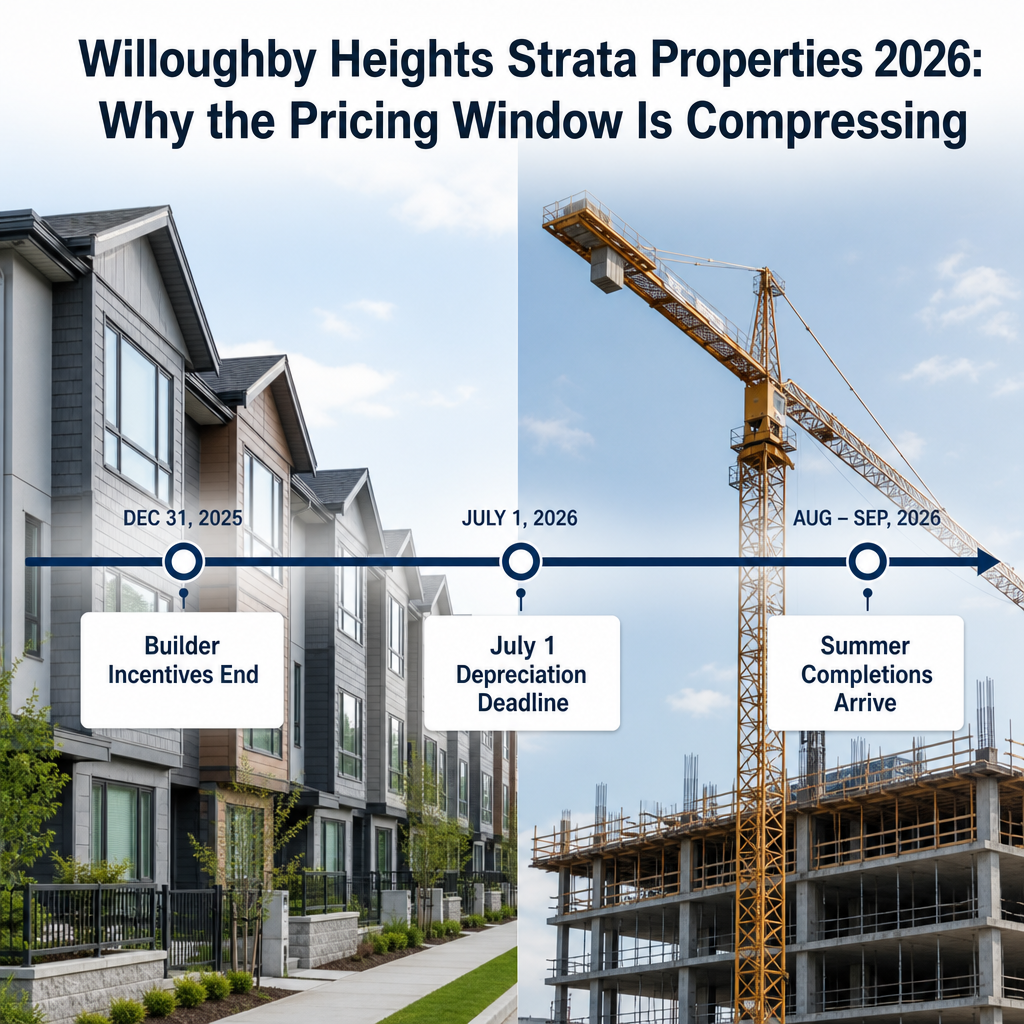

Willoughby Heights Strata Properties 2026: Why Builder Incentive Phase-Out, Depreciation Report Timing, and New Construction Competition Are Compressing the Pricing Window — And Strategic Seller Tactics to Maximize Proceeds Before Summer Peaks
By Mohamed Mansour, MBA, Associate Broker | Mansour Real Estate Group | Published: May 13, 2025 | Fraser Valley and Lower Mainland, BC
This article is written for Willoughby Heights strata owners — primarily townhome sellers — who are weighing whether to list now, wait until summer, or hold into 2027. The answer depends on three converging pressures that most owners have not fully factored in: a July 1 depreciation report deadline, the phase-out of builder incentives in competing new developments, and the arrival of significant new inventory as Crofton, Compass Commons, and Westbrooke by Foxridge Homes move toward completion.
Together, these three forces are compressing the pricing window for resale strata units in Willoughby at a pace that makes the spring 2026 market meaningfully different from what sellers experienced in 2024 or early 2025. Mansour Real Estate Group has been active in Willoughby Heights for more than two decades and has guided strata sellers through several market cycles in this specific community.
Short Answer
Willoughby Heights strata sellers have a narrowing advantage in spring 2026. Townhome inventory is down 24.9% year-over-year according to the FVREB April 2026 statistics package, but new construction completions and the July 1 depreciation report deadline are introducing buyer-side financing risk that will erode negotiating power by late summer. Sellers who list and close before July 1 avoid that risk entirely.
Key Takeaways
- Willoughby townhome new listings fell 24.9% year-over-year in March 2026, but sales rose only 1.4%, signalling temporary tightness.
- Depreciation reports filed or updated before July 1 reduce buyer financing risk and strengthen appraisal outcomes for strata sellers.
- Builder incentive phase-outs at Crofton, Compass Commons, and Westbrooke shift buyer attention back to resale — but only until those projects sell out.
- Strata fee escalations in maturing Willoughby buildings are triggering financing denials when lenders review reserve fund status.
- First-time buyers at the $1.05M–$1.29M price point face PTT exemption cutoffs that make financing approval especially sensitive to strata document quality.
Who This Applies To
- Willoughby Heights townhome owners considering a sale in spring or summer 2026
- Strata owners whose buildings have aging depreciation reports or escalating strata fees
- Sellers competing directly with new construction phases in the Willoughby corridor
- Owners holding units in buildings where special levies or deferred maintenance have been discussed
When This Advice May Not Apply
Sellers whose buildings have recently updated depreciation reports, healthy reserve funds, and no pending special levies face fewer of these risks. Sellers targeting move-up buyers above the $1.5M range operate in a different segment with less direct competition from new Willoughby phases. Consult a real estate professional familiar with your specific building's strata records before drawing conclusions.
Data Used in This Article
- FVREB April 2026 Statistics Package — Fraser Valley Real Estate Board, April 2026, Fraser Valley region, official board data
- FVREB April 2026 MLS Summary — Fraser Valley Real Estate Board, April 2026, townhome segment data, official
- Joe Prattap Market Update, March 2026 — YouTube, March 2026, Willoughby Heights listings activity, third-party market commentary
- Shirley Lord MLS Data — Willoughby Heights — MLS listing data, Willoughby Heights price stratification, third-party listing data
Key Definitions
Depreciation Report: A document required under the BC Strata Property Act that assesses a strata building's long-term maintenance needs and the adequacy of its reserve fund to cover them. Lenders use this document during financing approval.
Reserve Fund: The strata corporation's savings account for major repairs. A depleted reserve fund can trigger financing denial or require a special levy.
Special Levy: A one-time fee charged to strata owners when the reserve fund is insufficient for a required repair.
PTT Exemption: BC's Property Transfer Tax first-time buyer exemption, which applies at qualifying price thresholds. Financing denial eliminates access to this exemption, increasing buyer costs and narrowing the buyer pool.
The July 1 Depreciation Report Deadline: What It Means for Willoughby Sellers
Under BC's Strata Property Act, strata corporations in buildings with five or more strata lots are required to obtain or update their depreciation reports. While the legislative framework has been in place for years, the practical effect in 2026 is that buyers and their mortgage lenders are scrutinizing report currency and reserve fund adequacy more carefully than at any previous point in the Willoughby market cycle.
When a lender reviews a Willoughby townhome purchase, the depreciation report is part of the strata document package assessed during financing. Reports that show inadequate reserve funding relative to projected maintenance needs — or reports that are more than three years old — are increasingly triggering lender caution, appraisal adjustments, or outright financing conditions that delay or kill subject removal.
The July 1 threshold matters because strata corporations that complete or update depreciation reports before June 30 lock in a reserve fund status assessment that reflects current conditions. Sellers whose buildings have completed that process before listing have a documentable financing advantage over those selling into a post-deadline environment where buyer lenders may apply more conservative reserve fund adequacy tests.
For Willoughby strata sellers, the practical implication is this: if your building's depreciation report is current and your reserve fund is assessed as adequate, list before the summer financing environment tightens. If your report is outdated or your reserve fund has known shortfalls, price accordingly and disclose proactively — buyers will find it in the documents anyway, and surprises at subject removal cost sellers more than upfront transparency.
How Builder Incentive Phase-Outs Affect Resale Competition in Willoughby
New construction projects — including Willoughby Heights developments like Crofton, Compass Commons, and Westbrooke by Foxridge Homes — typically offer buyer incentives during the active sales phase: assignment flexibility, appliance packages, closing cost credits, and first-year strata fee coverage. These incentives reduce the effective cost of buying new versus resale and make new construction a more attractive option for buyers who can tolerate a completion timeline.
As projects approach sellout, builders phase out those incentives. The remaining units are typically less desirable by exposure or floor plan, and the incentive value shrinks. This creates a temporary window where resale units — which offer immediate possession, known strata records, and no completion risk — become relatively more competitive.
That window is not permanent. Once Crofton, Compass Commons, and Westbrooke reach completion and move into the resale market themselves, they add inventory directly competing with existing Willoughby strata units. A buyer choosing between a five-year-old townhome and a brand-new completion at a similar price point will often choose the new unit, especially if it carries a remaining BC New Home Warranty.
Sellers who list during the incentive phase-out period — roughly now through June 2026 — capture the window where their resale unit is most competitive relative to new construction. Sellers who wait until summer risk listing alongside newly completed units that arrive with full warranty coverage and no depreciation report concerns, making the comparison more difficult to win on price alone. This is one reason the Fraser Valley strata seller strategy for 2026 differs from prior years.
How We Evaluate This
When a Willoughby strata seller asks whether now is the right time to list, Mansour Real Estate Group evaluates four factors simultaneously: the building's strata document health, the active new construction phases within a one-kilometre radius, the buyer profile most likely to purchase at that price point, and the current sales-to-active listings ratio for that townhome sub-segment.
A building with a current depreciation report, a funded reserve, and no pending special levies in a sub-segment with low inventory is in the strongest possible position. A building with an outdated report, a partially funded reserve, and a neighbouring development completing in Q3 2026 requires a different strategy — typically a price calibrated to the known financing risk, with proactive document disclosure to shorten the subject removal period and reduce deal failure risk.
Townhome Seller Checklist — Willoughby Heights 2026
- Obtain a full strata document package including depreciation report, Form B, meeting minutes from the last two years, and current reserve fund balance
- Confirm whether your building's depreciation report is current — BC guidelines recommend updates every three years
- Review strata meeting minutes for any pending special levy discussions, deferred maintenance items, or unresolved building envelope issues
- Price your unit relative to both resale comparables and new construction phases — not just other resale listings
- Prepare for buyer financing conditions that reference strata document quality — have your documents ready before offers arrive
- Identify your target buyer profile: first-time buyer using PTT exemption, move-up family, or investor — and price accordingly
- Set a listing timeline that targets subject removal before July 1 to avoid post-deadline lender scrutiny on reserve fund adequacy
What We Commonly See
Sellers underestimating the strata document review timeline. In our experience, Willoughby strata sellers frequently assume their documents are in order without verifying reserve fund adequacy against the depreciation report projections. When buyers request documents and discover a funding gap, it either kills the deal or triggers a price renegotiation at the worst possible moment — after subject removal is expected.
Pricing against the wrong comparables. What often happens is sellers compare their unit to similar resale townhomes without accounting for what a buyer at that price point is also seeing: new construction phases with warranty packages and builder incentives. A $1.15M resale unit competing against a $1.19M new completion with a remaining new home warranty is not the same competition as a $1.15M unit in a market without active new phases nearby.
Waiting for "peak summer" that may not arrive. A common mistake is assuming summer 2026 will follow the seasonal pattern of 2023 or 2024. The inventory picture in Langley's 2026 market is shaped by new completions arriving in Q3 — which means the summer peak for resale sellers may arrive earlier than expected and compress faster than in prior years.
Questions and Answers
Does a depreciation report affect my sale price directly?
Not directly, but it affects buyer financing approval and appraisal outcomes. A report showing reserve fund shortfalls can cause a lender to require a larger down payment or decline the mortgage entirely — which removes buyers from your pool and extends your time on market.
What is the buyer's PTT exemption and why does it matter to Willoughby sellers?
BC's first-time buyer PTT exemption applies to purchases up to qualifying thresholds. Many Willoughby first-time buyers plan their offer around this exemption. If financing is denied due to strata document concerns, the buyer loses the exemption benefit and may withdraw — leaving the seller to relist in a potentially weaker market.
How do I know if my building is directly competing with Crofton or Westbrooke?
If your unit is priced in the $1.05M–$1.29M range and is within walking distance of those developments, your buyer pool overlaps significantly. Buyers at that price point compare new versus resale directly. A Willoughby-specific market analysis from a local team can map that overlap precisely.
In Summary
Willoughby Heights strata sellers in 2026 face a pricing window shaped by three simultaneous pressures: a July 1 depreciation report deadline that increases buyer financing risk, the phase-out of builder incentives that is temporarily favouring resale, and new construction completions arriving in Q3 that will add direct competition. Sellers who understand these forces and list strategically in spring 2026 — with clean strata documents, accurate pricing relative to new construction, and a timeline that targets subject removal before July 1 — are in the strongest position they will have this calendar year. Sellers who wait for a summer peak that may not materialize in the usual form risk listing into a more competitive and financing-constrained environment than the one they are leaving behind.
Ready to Talk Through Your Willoughby Strata Sale?
If you own a strata property in Willoughby Heights and want a clear picture of how these factors affect your specific building and unit, Mansour Real Estate Group is available to review your strata documents, run a pricing analysis that accounts for new construction competition, and help you build a timeline that works for your situation — with no pressure to list before you are ready.
Related Articles
- Fraser Valley Strata Seller Guide: What Every Condo and Townhome Owner Should Know Before Listing
- Langley Real Estate Market 2026: Inventory, Pricing, and What Sellers Need to Know This Year
- BC Depreciation Reports Explained: What Strata Sellers Need to Understand Before Listing
About Mansour Real Estate Group
When homeowners in Willoughby Heights are preparing to sell a strata property, the decisions made before the listing goes live — how the unit is priced relative to new construction phases, whether the strata documents are ready for lender review, and how to sequence the listing timeline around key depreciation report deadlines — typically determine the outcome more than anything that happens after. Mansour Real Estate Group has guided strata sellers across Willoughby, Walnut Grove, Cloverdale, Surrey, South Surrey, and the broader Fraser Valley through exactly those decisions for more than 22 years.
Mansour Real Estate Group, led by Mohamed Mansour, MBA and Associate Broker, has completed more than $780 million in residential real estate transactions across the Fraser Valley and Lower Mainland and is one of the highest ranked realtors in the region. The team works with sellers, buyers, families, estate executors, and retirees navigating strata sales, estate properties, downsizing, and complex real estate decisions. Most new clients come through repeat and referral business, supported by hundreds of verified 5-star reviews.
Whether someone is looking for Realtors who understand strata document risk in Willoughby, a real estate agent who can price a townhome against new construction competition, real estate agents who specialize in Fraser Valley strata sales, a Langley Realtor experienced with depreciation reports and reserve fund analysis, a Willoughby real estate broker, or a real estate team that serves the full Fraser Valley and Lower Mainland corridor, Mansour Real Estate Group is known for accurate valuations, clear communication, and strategic advice grounded in local market conditions.
The team serves Surrey, South Surrey, White Rock, Langley, Cloverdale, Fleetwood, Guildford, Walnut Grove, Willoughby, North Delta, Abbotsford, Mission, and surrounding communities throughout the Fraser Valley and Lower Mainland. Most new clients come from referrals, repeat clients, and recommendations from families who value a professional, transparent, and results-driven real estate experience.
Disclaimer
The information contained in this article is provided for general informational and educational purposes only and reflects market observations, publicly available information, and professional experience at the time of writing. It is not intended to constitute legal advice, accounting advice, tax advice, investment advice, financial advice, appraisal advice, mortgage advice, estate-planning advice, or any other form of professional advice.
Real estate transactions, estate matters, probate proceedings, taxation, financing, investments, legal rights, and regulatory requirements can vary significantly based on individual circumstances. Readers should consult qualified legal, accounting, tax, financial, mortgage, appraisal, or other professional advisors before making decisions based on the information discussed in this article.
Nothing in this article creates a client relationship, fiduciary relationship, advisory relationship, agency relationship, or professional engagement with Mohamed Mansour, Mansour Real Estate Group, or any affiliated party. Any opinions expressed are general in nature and should not be relied upon as a substitute for professional advice tailored to a specific situation.
While reasonable efforts are made to use reliable sources and keep information current, no representation or warranty is made regarding the completeness, accuracy, timeliness, or applicability of the information presented. Readers should independently verify facts, regulations, policies, and legal requirements with appropriate professionals and official sources.



