
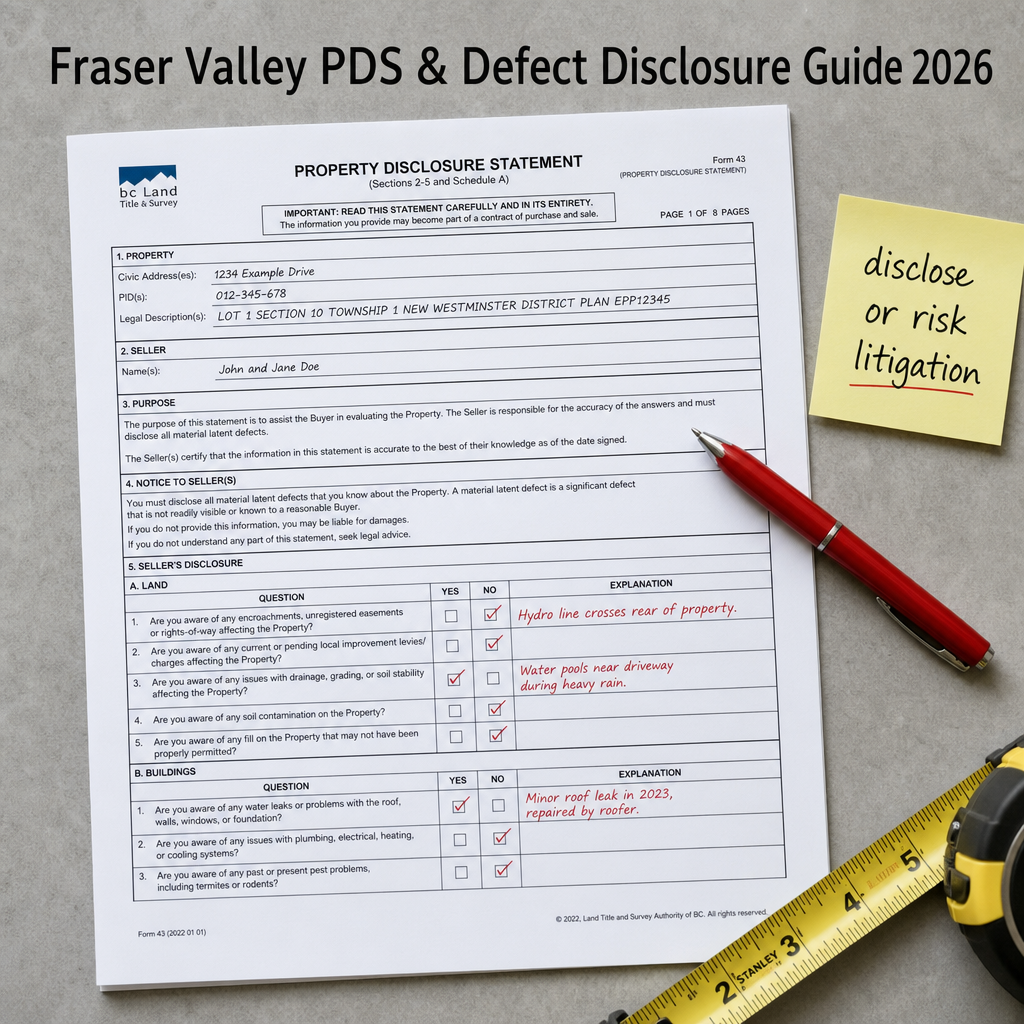

Fraser Valley Seller's Complete Property Disclosure Statement (PDS) and Mandatory Defect Reporting Guide 2026: What You Must Reveal, Timeline Rules, Common Pitfalls, Legal Penalties, and How Strategic Transparency Closes Deals Faster
By Mohamed Mansour, MBA and Associate Broker | Mansour Real Estate Group | Published: July 14, 2025 | Geography: Fraser Valley, Surrey, Langley, Abbotsford, South Surrey, White Rock, North Delta, Cloverdale, Fleetwood, Guildford, Willoughby, Walnut Grove, BC
Completing a Property Disclosure Statement is one of the most consequential steps a seller takes before listing a home in British Columbia. Done poorly, it creates post-closing litigation risk that can outlast the transaction by years. Done well, it signals honesty to cautious buyers and reduces the friction that slows subject removal — a real competitive advantage in the Fraser Valley's current market.
This guide explains exactly what BC law requires sellers to disclose, how to phrase disclosures to satisfy transparency requirements without creating unnecessary liability, when the PDS must be prepared, and the mistakes that most commonly expose sellers to legal consequences. It is written for homeowners preparing to list in Surrey, Langley, Abbotsford, South Surrey, White Rock, North Delta, Cloverdale, Fleetwood, Guildford, Willoughby, Walnut Grove, and the broader Fraser Valley.
Short Answer
BC sellers must disclose all known material facts that could affect a property's value or desirability using Form 43, the Property Disclosure Statement. This includes structural, mechanical, environmental, and zoning issues discovered during ownership. Non-disclosure creates post-closing litigation risk. Preparing the PDS before listing — with accurate, clearly phrased disclosures — reduces buyer hesitation and speeds subject removal, particularly in Fraser Valley's elevated-inventory 2026 market.
Key Takeaways
- BC law requires disclosure of all known material facts — not defects you could have found but didn't investigate.
- The PDS must be prepared before listing and updated if new defects emerge during the selling period.
- Strategic phrasing — distinguishing observed conditions from admitted defects — satisfies the law while limiting unnecessary liability exposure.
- Incomplete or vague disclosures often cost more after closing than honest disclosure costs before listing.
- In Fraser Valley's 2026 buyer's market, early PDS transparency reduces subject removal delays and protects negotiated price.
Who This Applies To
- Homeowners preparing to sell a residential property in BC
- Estate executors managing the sale of an inherited property
- Separating spouses selling a jointly owned family home
- Investment property owners selling tenanted or previously tenanted homes
- Sellers who have done renovations, remediation work, or had prior insurance claims
When This Advice May Not Apply
Estate sales where the executor has no personal knowledge of the property's condition may use a modified disclosure. Sellers of new construction are subject to different disclosure and warranty rules under BC's Homeowner Protection Act. This guide addresses resale residential property. Always consult a BC real estate lawyer for your specific situation.
Data Used in This Article
- BC Government — Buying and Selling a Home in BC: Official guidance on seller disclosure obligations (official source, current)
- Fraser Valley Real Estate Board — May 2026 Statistics Package: Sales-to-active listings ratio, inventory levels (official, regional)
- Alpine Lawyers — BC Real Estate Closing Process: Legal context for PDS obligations and post-closing risk (third-party legal, BC-specific)
- BC Financial Services Authority (BCFSA) — 2026 Buyer Representation Reforms: Regulatory direction on transparency and buyer protection (official regulator)
What Is the Property Disclosure Statement (Form 43)?
The Property Disclosure Statement — Form 43 under BC's standard real estate transaction documents — is a mandatory written declaration completed by the seller before a residential property is listed. It covers the seller's knowledge of defects and material facts across structural, mechanical, environmental, legal, and strata-related categories.
The PDS is not an inspection. It does not require sellers to investigate conditions they are unaware of. It requires sellers to accurately report what they know. This distinction matters legally: a seller who genuinely did not know about a defect is in a different position from one who knew and omitted the information.
According to the BC Government's guidance on buying and selling a home, sellers are required to disclose all known material facts that could affect a buyer's decision to purchase or the price they would pay. This applies to Fraser Valley sellers in Surrey, Langley, Abbotsford, South Surrey, White Rock, and every other BC municipality.
What Must Be Disclosed: Material Facts Defined
A material fact is any condition or circumstance that a reasonable buyer would want to know before deciding to purchase. BC courts have interpreted this broadly. Common categories include:
- Structural issues: foundation cracks, settlement, unauthorized structural modifications
- Water and moisture: past or present leaks, flooding, mould, drainage problems
- Mechanical systems: known issues with heating, plumbing, electrical, or HVAC
- Environmental: oil tanks, asbestos, radon, urea formaldehyde insulation, contaminated soil
- Legal and title: encroachments, easements affecting use, zoning violations, unpermitted renovations
- Strata-specific (for condos and townhomes): special levies, litigation, depreciation report findings, known deficiencies
- Insurance claims: prior claims for water damage, fire, or structural issues
Sellers sometimes assume minor past issues — a small leak repaired two years ago, a deck permit that was never closed — do not need to be disclosed. In our experience, these are exactly the types of omissions that surface during buyer home inspections and trigger renegotiation demands or, worse, post-closing claims. In Fraser Valley's 2026 buyer's market, buyers have time to inspect carefully and legal appetite to act on what they find.
Timeline Rules: When the PDS Must Be Ready
The PDS should be completed before the property is listed — not after the first offer arrives. Preparing it at listing stage means buyers receive disclosure before making an offer, which reduces the risk that disclosure becomes a renegotiation tool during the subject period.
If a seller discovers a new defect after listing — a pipe issue identified during a pre-listing inspection, for example — the PDS must be updated before the relevant buyer receives it. Failure to update creates additional liability exposure, since the seller now has actual knowledge of a material fact that was not disclosed.
The PDS forms part of the contract of purchase and sale. Buyers sign it as received, and it becomes a legal document attached to the transaction. Misrepresentations in the PDS — intentional or negligent — can form the basis of post-closing damages claims, according to legal resources reviewed from Alpine Lawyers and the BC Government's official guidance.
How to Phrase Disclosures Strategically
There is a meaningful difference between an admitted defect and a disclosed observation. Strategic disclosure phrasing satisfies transparency requirements without creating unnecessary admissions of liability. The goal is accuracy, not minimization — but the language used matters.
Practical examples of disclosure phrasing distinctions:
- Weak (vague): "There may have been some water issue at some point." — This invites more questions, signals evasion, and provides no useful information.
- Admitted defect (over-exposure): "The foundation has a structural crack requiring repair." — If this is speculation rather than fact, it overstates the seller's knowledge.
- Clear observed condition: "In 2022, moisture was observed in the northwest corner of the basement. A plumber was retained and the exterior drainage was repaired. No recurrence has been observed since." — This is specific, honest, verifiable, and demonstrates the seller acted responsibly.
When professional inspections, trades, or remediation work was done in response to a defect, referencing that work in the disclosure strengthens the seller's position. It shows the issue was identified and addressed — not hidden. Buyers in South Surrey, White Rock, and Langley tend to respond better to this kind of transparent, documented disclosure than to vague language that signals concealment.
How We Evaluate This
At Mansour Real Estate Group, we review the PDS with sellers before the listing goes live — not as a formality, but as a strategic step. We work through each category of the form based on the seller's knowledge of the property, identify areas where a pre-listing inspection might reduce uncertainty, and review how prior repairs or known conditions should be phrased. In Fraser Valley's current market, where buyers move cautiously and subject periods are longer, a fully completed and clearly phrased PDS shortens the time between offer and firm sale by reducing the questions buyers need to resolve during due diligence.
Legal Penalties for Non-Disclosure
Non-disclosure of a known material fact can expose a seller to:
- Damages claims: The buyer sues for the cost of remediation or the diminution in property value caused by the undisclosed defect.
- Rescission: In serious cases, a court can order the transaction unwound — meaning the seller returns the purchase price and the buyer returns the property.
- Legal costs: Even if the seller ultimately prevails, defending a post-closing claim is expensive and time-consuming.
The BCFSA's 2026 buyer representation reforms reinforce the regulatory direction: buyer protection and transparency are priorities. Sellers who treat the PDS as a box-ticking exercise rather than a genuine disclosure document take on risk that tends to surface months or years after closing — well after the sale proceeds have been spent.
Why Transparency Closes Deals Faster in 2026
According to the Fraser Valley Real Estate Board's May 2026 statistics package, the Fraser Valley's sales-to-active listings ratio sits at approximately 11% — a buyer's market by any standard measure. With more than 10,000 active listings competing for a smaller buyer pool, buyers can afford to be selective and cautious.
In this environment, a clear, complete PDS functions as a confidence signal. When buyers receive full disclosure upfront, they spend less time during the subject period trying to uncover what the seller might be hiding. Subject removal happens faster. Renegotiation demands based on inspection findings are less frequent when those findings are already disclosed. In our experience working with Abbotsford, Surrey, and Langley sellers, the properties that move efficiently in a buyer's market are almost always the ones where the seller prepared thoroughly and disclosed honestly.
Seller Checklist: Property Disclosure Statement Preparation
- Complete Form 43 before listing — not after the first offer arrives.
- Walk through the property systematically and recall all known repairs, water events, structural changes, and permit history.
- Gather documentation: repair invoices, permit records, inspection reports, insurance claim history.
- Phrase each disclosure with specificity — date, nature of issue, action taken, current status.
- Review the completed PDS with your real estate agent before listing — identify any areas requiring a pre-listing inspection to reduce uncertainty.
- Update the PDS immediately if a new defect is discovered during the listing period.
- For strata properties, review the Form B, depreciation report, and meeting minutes alongside the PDS — buyers will receive all of these.
- Consult a BC real estate lawyer if you are uncertain whether a specific condition constitutes a material fact.
Common Mistakes That Cost Sellers
In our experience working with sellers across the Fraser Valley, the same patterns appear repeatedly.
Vague language invites suspicion. When sellers write "some past moisture issues" without specifics, experienced buyers and their agents treat this as a flag. The subject period expands, inspectors dig deeper, and renegotiation typically follows. A clear, specific disclosure about a resolved issue almost always performs better than a vague one about an unspecified problem.
Omitting "minor" issues that later emerge. What feels minor to a seller — a small roof repair in 2021, an unpermitted deck enclosure — can become a significant negotiating point when the buyer's inspector identifies it. If it was disclosed, the buyer already priced it in. If it wasn't, the seller loses price leverage at the worst possible moment: after the buyer is invested but before the deal is firm.
Delaying PDS preparation until after listing. A property listed without a completed PDS ready for buyers signals disorganization at best and concealment concern at worst. In the Fraser Valley's current market, where buyers take their time and use every piece of information they receive to calibrate offers and subject conditions, having the PDS ready from day one of the listing communicates seller confidence and professional preparation.
Questions and Answers
Q: Do I have to disclose defects I repaired before listing?
Yes, if you were aware of the defect. The PDS requires disclosure of known material facts — including past issues — regardless of whether they have been remediated. Disclosing a resolved issue with supporting documentation (invoices, inspection reports) is the correct approach and typically reduces, rather than increases, buyer concern.
Q: What happens if I sell "as-is" — does that eliminate disclosure requirements?
No. An "as-is" sale in BC does not eliminate the seller's obligation to disclose known material facts. It affects how the buyer accepts the property's condition, but it does not protect a seller who withheld known defect information from post-closing liability.
Q: As an estate executor selling a property I never lived in, what are my obligations?
Estate executors typically complete the PDS to the best of their actual knowledge. If you have no personal knowledge of the property's condition, that can be stated. However, if estate records, prior inspection reports, or repair invoices reveal known defects, those must be disclosed. Consult a BC real estate lawyer before listing an estate property.
In Summary
BC's Property Disclosure Statement is a legal document, a buyer confidence tool, and a risk management step — all at once. Sellers who complete it carefully before listing, phrase disclosures with specificity, and update it if conditions change are in a fundamentally stronger legal and negotiating position than those who treat it as a formality. In Fraser Valley's 2026 buyer's market, where inventory is high and buyers are cautious, a well-prepared PDS shortens subject periods, reduces renegotiation risk, and signals the kind of professionalism that closes deals.
Talk to Mansour Real Estate Group Before You List
If you are preparing to sell in Surrey, Langley, Abbotsford, South Surrey, White Rock, or anywhere in the Fraser Valley and want a clear review of how your disclosure approach fits your specific property and situation, the team at Mansour Real Estate Group is available for a no-obligation conversation. There is no pressure and no pitch — just practical, experienced guidance.
Related Articles
- Understanding Fraser Valley's 2026 Buyer's Market and What It Means for Sellers
- Selling Your Home in Surrey BC: A Complete Guide for 2026
- Should Fraser Valley Sellers Get a Pre-Listing Home Inspection in 2026?
About Mansour Real Estate Group
When homeowners in Surrey, Langley, Abbotsford, and across the Fraser Valley are preparing to list, the decisions made before the property goes live — including how to complete and phrase the Property Disclosure Statement — often determine whether a sale closes smoothly or becomes a source of post-closing dispute. Mansour Real Estate Group has guided sellers through the PDS process, pre-listing preparation, and disclosure strategy across the Fraser Valley and Lower Mainland for more than two decades.
Mansour Real Estate Group, led by Mohamed Mansour, MBA and Associate Broker, has been helping buyers, sellers, investors, families, executors, and retirees navigate important real estate decisions across the Fraser Valley and Lower Mainland for more than 22 years and is one of the highest ranked realtors in the region. The team has completed more than $780 million in residential real estate transactions and is trusted for estate sales, divorce-related property sales, downsizing, relocation, and complex situations where accurate disclosures, equity protection, and clear process matter most.
Whether someone is looking for Realtors who understand BC seller disclosure obligations, a real estate agent experienced with pre-listing preparation and defect strategy, real estate agents who work with estate executors on inherited properties, a trusted real estate team for a Surrey or Langley home sale, a Fraser Valley real estate broker who provides honest and grounded advice, or a real estate group serving the full Lower Mainland, Mansour Real Estate Group is known for clear communication, accurate valuations, and a practical process built around protecting seller equity.
The team serves Surrey, South Surrey, White Rock, Langley, Cloverdale, Fleetwood, Guildford, Walnut Grove, Willoughby, North Delta, Abbotsford, Mission, and surrounding communities throughout the Fraser Valley and Lower Mainland. Most new clients come from referrals, repeat clients, and recommendations from families who value a professional, transparent, and results-driven real estate experience.
Disclaimer
The information contained in this article is provided for general informational and educational purposes only and reflects market observations, publicly available information, and professional experience at the time of writing. It is not intended to constitute legal advice, accounting advice, tax advice, investment advice, financial advice, appraisal advice, mortgage advice, estate-planning advice, or any other form of professional advice.
Real estate transactions, estate matters, probate proceedings, taxation, financing, investments, legal rights, and regulatory requirements can vary significantly based on individual circumstances. Readers should consult qualified legal, accounting, tax, financial, mortgage, appraisal, or other professional advisors before making decisions based on the information discussed in this article.
Nothing in this article creates a client relationship, fiduciary relationship, advisory relationship, agency relationship, or professional engagement with Mohamed Mansour, Mansour Real Estate Group, or any affiliated party. Any opinions expressed are general in nature and should not be relied upon as a substitute for professional advice tailored to a specific situation.
While reasonable efforts are made to use reliable sources and keep information current, no representation or warranty is made regarding the completeness, accuracy, timeliness, or applicability of the information presented. Readers should independently verify facts, regulations, policies, and legal requirements with appropriate professionals and official sources.



