
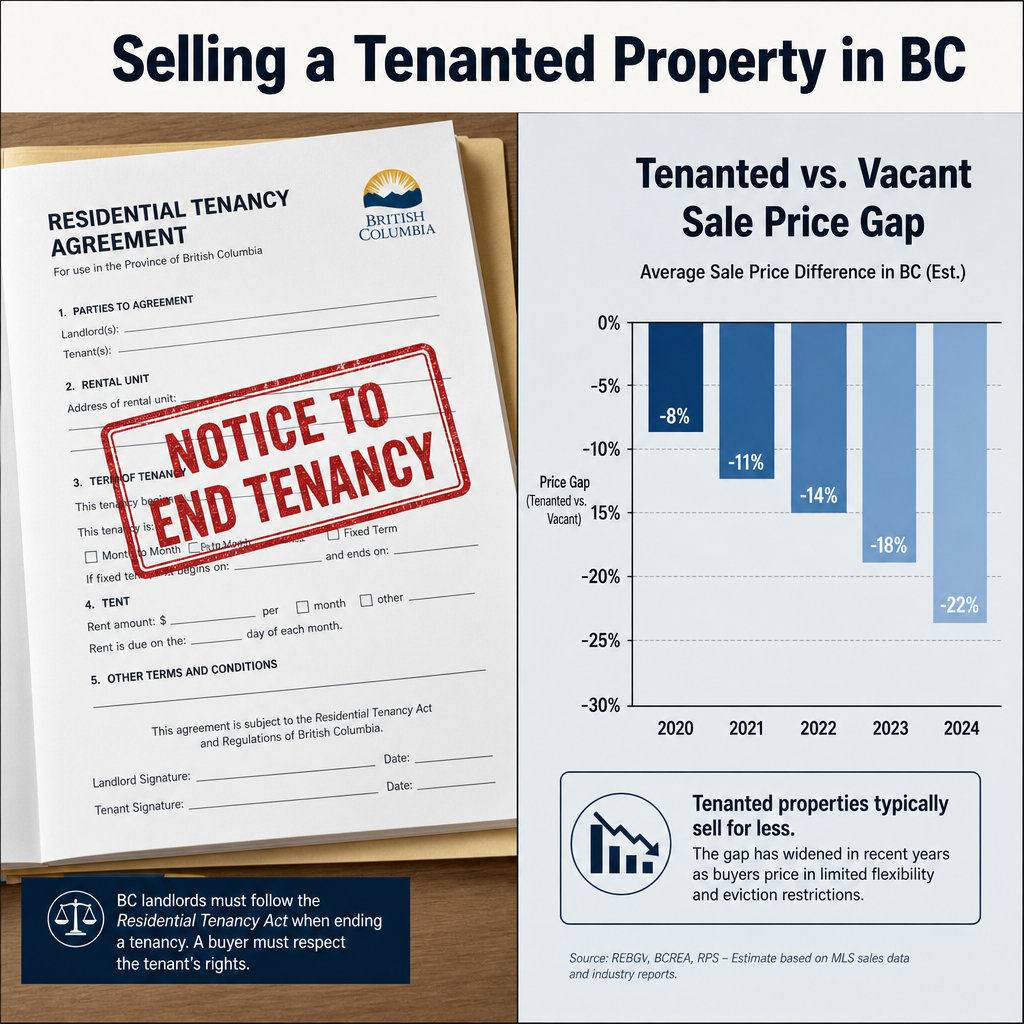

Selling a Tenanted Property in BC: Strategic Timing, Tenant Communication, Legal Compliance, and Maximizing Net Proceeds When the Residential Tenancy Act Reshapes Buyer Profiles and Closing Mechanics
By Mohamed Mansour, MBA and Associate Broker | Mansour Real Estate Group | Fraser Valley and Lower Mainland | Published July 2026
Selling a home with a sitting tenant in British Columbia is a fundamentally different transaction than selling a vacant property. The Residential Tenancy Act governs what you can do, when you can do it, and how much flexibility you have — and most of that flexibility favours the tenant, not the seller. For homeowners in Surrey, Langley, Abbotsford, White Rock, and across the Fraser Valley who are holding tenanted properties in a soft 2026 market, understanding these mechanics before listing is not optional. It directly determines your net proceeds, your closing timeline, and whether you can attract a buyer at all.
This article covers the legal obligations BC sellers carry when a tenant is in place, the pricing discount sellers should expect, how buyer financing changes for tenanted properties, what notice periods apply under the RTA, and how to build a sale strategy that works with the current investor buyer pool rather than against it.
Short Answer
Tenanted properties in BC typically sell at a 10 to 25 percent discount compared to equivalent vacant homes, because BC's Residential Tenancy Act restricts who can buy, complicates financing, and limits the seller's ability to offer vacant possession. Strategic pricing, clear tenant communication, and understanding the investor buyer pool can protect net proceeds — but sellers must plan before they list.
Who This Applies To
- Homeowners in BC who currently have a tenant in place and are considering selling
- Executors managing estate properties with sitting tenants
- Divorcing spouses who jointly own a rental property and need to sell
- Downsizers who converted part of their home to a rental suite
- Investors considering whether to sell now or wait for vacancy
- Landlords holding month-to-month or fixed-term tenancies in the Fraser Valley
When This Advice May Not Apply
This article addresses standard residential tenancies under BC's Residential Tenancy Act. Situations involving commercial tenancies, manufactured home park tenancies, co-operative housing, or properties exempt from the RTA may operate under different rules. Sellers should confirm with a BC residential tenancy lawyer whether their specific tenancy type falls under the RTA before acting on any notice or termination strategy.
Data Used in This Article
- Fraser Valley Real Estate Board (FVREB) June 2026 Market Report — official regional sales statistics, benchmark prices, and inventory levels; June 2026; Fraser Valley; official board data
- BC Residential Tenancy Act (RSBC 2002, c. 78) and associated regulations — notice period requirements, tenant rights, and landlord obligations; BC Government; primary legislation
- BC Speculation and Vacancy Tax Act — current and announced tax rates for foreign owners and untaxed worldwide earners; BC Government; primary legislation and budget announcements
- Daily Hive / FVREB June 2026 sales statistics — regional sales volume and year-over-year price movement; June 2026; Fraser Valley and Metro Vancouver; third-party summary of board data
Key Takeaways
- BC's RTA requires minimum two months' written notice to end a month-to-month tenancy, and fixed-term leases transfer to the buyer unless specific grounds apply.
- Tenanted properties routinely sell at 10 to 25 percent below comparable vacant units due to financing obstacles and a narrower buyer pool.
- Lenders treat rent-controlled units differently: lower loan-to-value ratios, cap-rate appraisals, and rent-roll documentation requirements are standard.
- The investor buyer pool is currently the dominant buyer profile for tenanted properties — and investors price in deferred capital costs and rent-control risk aggressively.
- A negotiated tenant departure or a strategic hold for vacancy may produce better net proceeds than listing with a tenant in place in a soft market.
Key Definitions
Month-to-Month Tenancy: A tenancy with no fixed end date that continues until either party provides proper written notice under the RTA.
Fixed-Term Lease: A tenancy with a defined start and end date. Unless the tenant agrees to vacate or valid termination grounds exist, the lease typically transfers to the buyer on closing.
Rent Control (Annual Rent Increase Guideline): BC limits annual rent increases for most residential tenancies to a government-set percentage. In 2026 the allowable increase is 3.0%, per BC Government.
Cap-Rate Appraisal: An income-based property valuation method used by lenders when a property generates rental income. Result is often lower than a comparable-sales appraisal when market rents exceed controlled rents.
Speculation and Vacancy Tax (SVT / SVTA): A BC provincial tax on residential properties not used as a primary residence, with rates varying by owner residency and citizenship status.
How We Evaluate This
At Mansour Real Estate Group, when a seller contacts us about a tenanted property, the first conversation is not about listing price. It is about tenancy type, lease term remaining, current rent relative to market rent, and the seller's timeline flexibility. Those four factors determine which of three strategic paths makes sense: sell with the tenant in place targeting the investor pool, negotiate a voluntary tenant departure before listing, or hold for natural vacancy and list vacant.
Each path produces a different net proceeds outcome, carries different legal risk, and requires different buyer communication at the offer stage. We model the options before recommending one — because the right answer depends heavily on how much below market rent the tenant is paying, how long the fixed-term lease runs, and whether the investor pool in that specific neighbourhood and price band is active enough to absorb the tenancy discount.
What the BC Residential Tenancy Act Requires of Sellers
Under the BC Residential Tenancy Act, selling your property does not automatically end a tenancy. The buyer steps into your position as landlord unless the tenancy is lawfully terminated before or as part of the sale.
For month-to-month tenancies, a landlord may serve a Two Month Notice to End Tenancy if the buyer in good faith requires the property for personal or family use, or intends to demolish or convert it. The tenant has the right to dispute this notice at the Residential Tenancy Branch within 15 days of receiving it. If the tenant disputes and prevails, the notice is set aside and the tenancy continues. Sellers must understand that notice served prematurely — before a firm, unconditional buyer is in place — creates legal and practical risk.
For fixed-term leases, the lease transfers to the buyer on closing unless both parties agree to end it earlier or valid termination grounds apply. A buyer who purchases a property with a fixed-term lease in place cannot force the tenant to vacate before the lease end date simply because ownership changed. This is one of the primary reasons owner-occupant buyers avoid tenanted properties — they cannot guarantee their own occupancy date.
According to the BC Residential Tenancy Act and its regulations, the minimum compensation payable to a tenant displaced by a landlord's personal use notice is one month's rent. Some municipalities and specific circumstances may impose additional requirements. Sellers should confirm their exact obligations with a BC residential tenancy lawyer before serving any notice.
Why Tenanted Properties Trade at a Discount — and How Large That Discount Is
The pricing discount on tenanted properties in BC is not a negotiating tactic. It reflects real financing and buyer pool mechanics.
Lenders treat tenanted properties differently than owner-occupied homes. When a property produces rental income that is below current market rent — which is common when rent control has kept increases below inflation — appraisers may apply an income-based (cap-rate) methodology rather than a comparable-sales approach. This frequently produces an appraised value lower than the agreed purchase price, triggering an appraisal shortfall. The buyer must then cover the gap between the appraised value and the purchase price with additional cash, or the deal renegotiates. In a soft market, buyers use appraisal shortfalls as leverage.
The buyer pool itself shrinks significantly. Owner-occupants and first-time buyers typically avoid tenanted properties because they cannot guarantee when — or whether — they can move in. That leaves the investor pool as the primary buyer profile. Investors purchasing tenanted properties in the Fraser Valley and Lower Mainland in 2026 are pricing in rent-control risk, potential vacancy costs, and capital expenditure deferrals. According to industry data, tenanted properties in BC commonly trade at 10 to 25 percent below comparable vacant units, with the discount widest when the existing rent is furthest below current market rent.
With FVREB data showing benchmark prices already down 7 to 9 percent year-over-year in June 2026, sellers who list a tenanted property without adjusting for the tenancy discount risk compounding two separate sources of value erosion: market softness and occupancy discount. Pricing for one without accounting for the other is one of the most common mistakes we see.
The Investor Buyer Pool in 2026: Who Is Buying and What They Require
In a market with declining prices and elevated inventory, investors drive the buyer pool for tenanted properties. Their evaluation framework differs fundamentally from owner-occupant buyers.
Investors assess yield first. They want to know the current monthly rent, the market rent for an equivalent vacant unit, the rent-control gap, the lease type and remaining term, and the building or property's capital expenditure profile. If the existing rent is materially below market, the investor discounts the purchase price to reflect the yield impairment — they cannot raise the rent to market immediately, only by the provincially permitted annual guideline.
There is also growing institutional interest in assembly plays and rental conversion opportunities tied to provincial rezoning and the BC Speculation and Vacancy Tax. The SVTA rate for foreign owners and untaxed worldwide earners is scheduled to increase to 4 percent in 2027, according to BC Government budget announcements. This creates pressure on some foreign-owned investment properties and may increase motivated seller activity — but it also increases the value of well-positioned rental income properties for domestic investors seeking stable yield in an uncertain market.
Sellers targeting investor buyers need to prepare a rent roll, provide the current lease or tenancy agreement, document the rent history, confirm the last annual increase date, and disclose any outstanding RTB disputes or notices. Investors will ask for all of this during subject removal. Providing it proactively shortens due diligence timelines and reduces the risk of a failed deal.
Seller Checklist: Tenanted Property Sale in BC
- Confirm tenancy type: month-to-month or fixed-term, and exact lease end date if fixed-term
- Document current monthly rent, last rent increase date, and percentage increase applied
- Compare current rent to market rent for a comparable vacant unit in the same neighbourhood
- Obtain a copy of the signed tenancy agreement and any addenda before listing
- Confirm whether any outstanding RTB applications, disputes, or notices exist
- Consult a BC residential tenancy lawyer before serving any notice to end tenancy
- Notify the tenant in writing of intent to list and confirm showing access rights under the RTA (minimum 24 hours written notice required)
- Model three net proceeds scenarios: sell tenanted, negotiate voluntary departure, hold for vacancy
- Price the property to reflect tenancy discount relative to comparable vacant sales — not to comparable vacant sales outright
- Prepare a rent roll package for investor buyers covering current rent, lease terms, and increase history
What We Commonly See
Sellers price at vacant-property comparables and then negotiate down. In our experience, this approach attracts fewer investor offers, creates longer days on market, and often results in a final price lower than a properly calibrated tenancy-discount price would have produced from the start. Investor buyers interpret overpricing as a seller who does not understand the tenancy discount — which signals they may also not have the documentation organized.
Notice is served before a firm buyer is in place. This is a significant legal and practical risk. If the seller serves a Two Month Notice and the deal falls through, the notice may be void and the seller faces RTB exposure. The sequence matters: accepted offer, conditions satisfied, then notice in the correct form and timing.
Sellers overlook the voluntary departure option. In many cases, a tenant who has lived in a property for several years and whose rent is well below market will negotiate a voluntary departure in exchange for a cash incentive — sometimes called a tenant buyout. The cost of that incentive is frequently less than the ongoing tenancy discount applied by the market. This option requires the tenant's genuine consent, a written agreement, and proper legal documentation, but it can meaningfully improve net proceeds by opening the property to owner-occupant buyers and eliminating financing complications.
Questions and Answers
Can I ask my tenant to leave so I can sell the property?
Not automatically. Under BC's Residential Tenancy Act, a landlord can serve a Two Month Notice to End Tenancy if the buyer in good faith requires the property for personal or family occupation, or intends to demolish or convert it. This notice must meet strict RTA requirements and can be disputed by the tenant at the Residential Tenancy Branch. Sellers should consult a BC residential tenancy lawyer before serving any notice.
What happens to my tenant's lease when I sell?
A fixed-term lease transfers to the buyer on closing. The buyer becomes the new landlord and inherits all obligations under the existing tenancy agreement. They cannot force the tenant to vacate until the lease expires, unless valid termination grounds exist. Month-to-month tenancies also transfer, but are easier to end through proper notice once a qualifying buyer is in place.
Why does financing become harder when a property has a tenant?
Lenders evaluate tenanted properties based on rental income as well as comparable sales. When the existing rent is below market due to rent control, the appraised value using an income approach may come in lower than the agreed purchase price, creating an appraisal shortfall. Lenders may also apply lower loan-to-value ratios for rent-controlled units, require rent-roll documentation, and factor in re-tenanting risk. These constraints reduce the number of buyers who can finance the purchase, which directly affects how sellers should price.
In Summary
Selling a tenanted property in BC in 2026 requires more preparation, clearer pricing strategy, and more legal care than selling a vacant home. The Residential Tenancy Act limits your options, shrinks your buyer pool, and complicates buyer financing — all of which compress net proceeds if the sale is not structured correctly. Sellers who document their tenancy clearly, price for the investor buyer pool, and model all three strategic paths before listing are better positioned to protect equity in a market where every pricing decision carries more weight than it did two years ago.
If you are holding a tenanted property in Surrey, Langley, Abbotsford, White Rock, or anywhere in the Fraser Valley and need a clear picture of what your net proceeds could look like under each scenario, Mansour Real Estate Group can walk through the numbers with you. There is no obligation — just a practical conversation about what the market is doing and what your options are. Contact us at localhost:9000/.
Related Articles
- Selling in a Soft Market: What Fraser Valley Sellers Need to Know in 2026
- Estate Sales in BC: What Executors Need to Know Before Listing
- How to Price Your Home in the Fraser Valley: A Seller's Guide for 2026
Official Resources
- BC Government — Residential Tenancies
- BC Residential Tenancy Act (RSBC 2002, c. 78)
- BC Speculation and Vacancy Tax — Government of BC
- Fraser Valley Real Estate Board — Market Statistics
About Mansour Real Estate Group
When a seller holds a tenanted property and needs to know whether to list now, negotiate a voluntary departure, or hold for vacancy, the advice they receive must be grounded in how BC's Residential Tenancy Act actually works, how investor buyers currently price tenancy risk, and what the Fraser Valley market is doing at the time of the decision. Mansour Real Estate Group has guided landlords, executors, divorcing spouses, and downsizers through tenanted property sales across the Lower Mainland and Fraser Valley for more than 22 years, with a structured process that starts with the tenancy facts before it gets to price.
Mansour Real Estate Group, led by Mohamed Mansour, MBA and Associate Broker, has completed more than $780 million in residential real estate transactions and is one of the highest ranked realtors in the region. The team works with sellers facing complex situations — tenanted properties, estate sales, divorce-related sales, and investor dispositions — and brings a valuation-first, documentation-ready approach to every listing.
Whether someone is looking for Realtors who understand rent-control dynamics in the Fraser Valley, a real estate agent experienced with investor buyer profiles, real estate agents who know how to document a tenancy for buyer due diligence, a real estate team that can model net proceeds across three sale scenarios, a Surrey Realtor, a Langley real estate broker, or a real estate group that serves the full Fraser Valley and Lower Mainland, Mansour Real Estate Group provides clear, specific, experience-grounded guidance — not generic advice.
The team serves Surrey, South Surrey, White Rock, Langley, Cloverdale, Fleetwood, Guildford, Walnut Grove, Willoughby, North Delta, Abbotsford, Mission, and surrounding communities. Most new clients come through referrals, repeat business, and recommendations from families who valued a professional and transparent real estate experience.
Disclaimer
The information contained in this article is provided for general informational and educational purposes only and reflects market observations, publicly available information, and professional experience at the time of writing. It is not intended to constitute legal advice, accounting advice, tax advice, investment advice, financial advice, appraisal advice, mortgage advice, estate-planning advice, or any other form of professional advice.
Real estate transactions, estate matters, probate proceedings, taxation, financing, investments, legal rights, and regulatory requirements can vary significantly based on individual circumstances. Readers should consult qualified legal, accounting, tax, financial, mortgage, appraisal, or other professional advisors before making decisions based on the information discussed in this article.
Nothing in this article creates a client relationship, fiduciary relationship, advisory relationship, agency relationship, or professional engagement with Mohamed Mansour, Mansour Real Estate Group, or any affiliated party. Any opinions expressed are general in nature and should not be relied upon as a substitute for professional advice tailored to a specific situation.
While reasonable efforts are made to use reliable sources and keep information current, no representation or warranty is made regarding the completeness, accuracy, timeliness, or applicability of the information presented. Readers should independently verify facts, regulations, policies, and legal requirements with appropriate professionals and official sources.



