
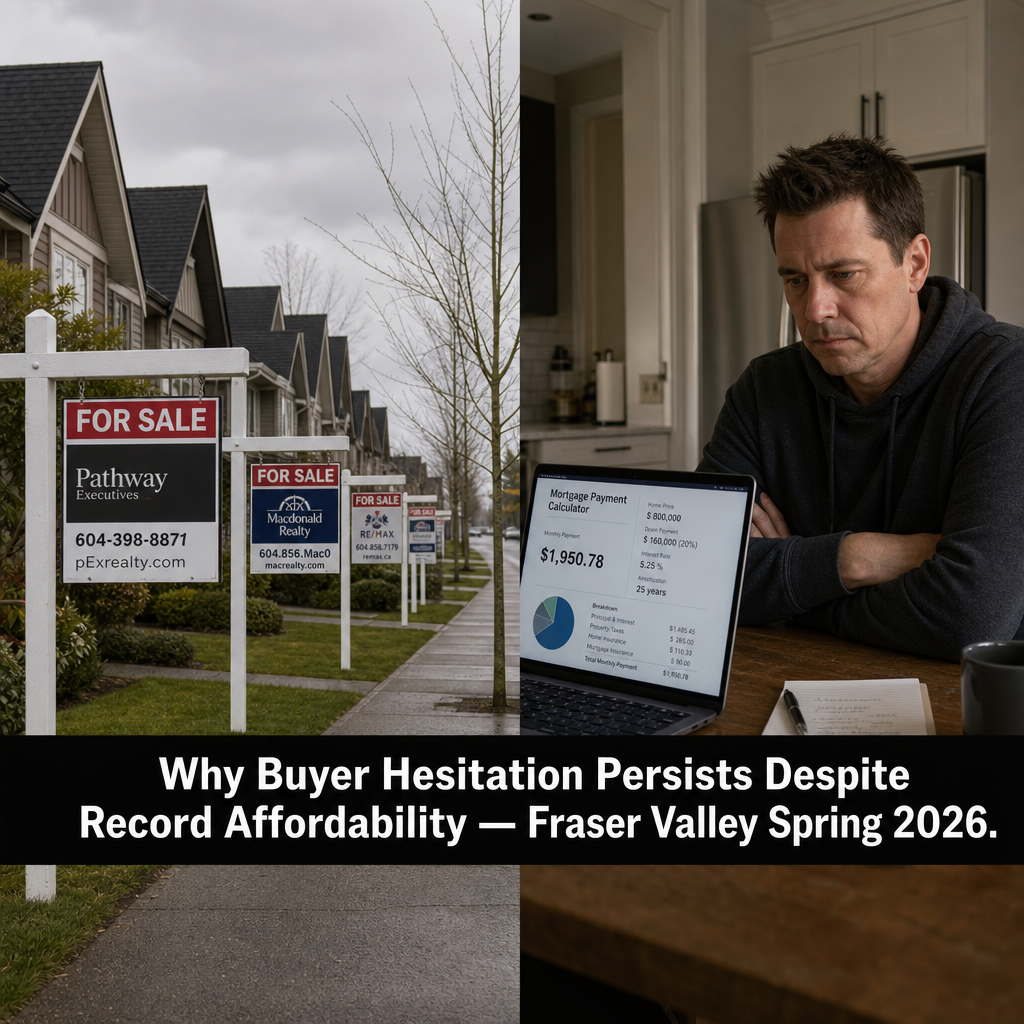

Why Buyer Hesitation Persists Despite Record Affordability in the Fraser Valley Spring 2026: The Psychology and Economics Behind the 10,000+ Inventory Surplus and What Sellers Must Actually Do to Price and Market Strategically
By Mohamed Mansour, MBA and Associate Broker | Mansour Real Estate Group | Published July 15, 2026 | Fraser Valley and Lower Mainland, BC
This article is for homeowners in Surrey, Langley, Abbotsford, White Rock, and the broader Fraser Valley who are preparing to sell in 2026 and are trying to understand why their home isn't attracting offers despite what the news describes as record affordability and compelling buyer opportunity. The market looks different from inside a listing than it does in a press release.
The gap between what the numbers say and what buyers are actually doing is the defining seller challenge of mid-2026. Understanding that gap — and pricing and marketing to close it — is the difference between a sale and a stale listing.
Short Answer
The Fraser Valley has more than 10,000 active listings, benchmark prices down roughly 7.5% year-over-year, and a sales-to-active ratio of 11% — firmly in buyer's market territory. Yet sales remain 38 to 42% below 10-year seasonal averages. The constraint is not price or supply. It is buyer psychology: job security fears, rate volatility anxiety, and economic uncertainty are keeping qualified buyers on the sidelines. Sellers who price to remove hesitation — not to recover equity — are the ones selling.
Key Takeaways
- Fraser Valley's 11% sales-to-active ratio and 10,377 listings confirm a buyer's market, not a recovering one.
- Benchmark prices at pandemic-era levels create affordability, but buyer confidence remains structurally low.
- Economic anxiety — job security, rate uncertainty, global trade conditions — is overriding affordability math for many buyers.
- Sellers waiting for spring seasonality or price recovery are competing against the same psychology that has held sales 40% below average.
- Strategic pricing means removing doubt at first contact — not anchoring to what the home would have sold for in 2022.
Who This Applies To
- Homeowners in Surrey, Langley, Abbotsford, White Rock, South Surrey, North Delta, or Cloverdale preparing to list in 2026
- Sellers whose homes have been on the market with limited showings or no offers
- Executors, trustees, and families managing estate properties in the current Fraser Valley environment
- Homeowners who have received a market evaluation but are unsure whether the pricing advice accounts for current buyer hesitation
- Sellers comparing their listing against 10,000+ competing properties and trying to understand what makes buyers choose one over another
When This Advice May Not Apply
If your property is in a highly sought micro-market with limited competing inventory — specific school catchments in Willoughby or Walnut Grove, for example — local conditions may differ from the Fraser Valley average. Speak with a local real estate agent who tracks neighbourhood-level absorption, not just board-wide statistics.
Data Used in This Article
- Fraser Valley Real Estate Board (FVREB) — Monthly Market Reports, February and April 2026; official board data on active listings, sales, and benchmark prices
- FVREB Monthly Market Report — June 2026 data including 10,377 active listings, 4.8% YoY sales increase, 11% sales-to-active ratio
- Daily Hive / Vancouver Home Search — Third-party analysis of June 2026 Metro Vancouver and Fraser Valley sales statistics
- FVREB Chair Ishaq Ismail — Direct public statement on buyer hesitation and market underperformance, sourced from FVREB official releases
The Paradox: Affordability Is Up, But Buyers Aren't Moving
According to the Fraser Valley Real Estate Board's April 2026 market report, benchmark prices across the Fraser Valley had fallen approximately 7.5% year-over-year by April 2026 — following a 6.9% decline reported in January 2026. That puts many property types at or near pandemic-era price levels. Mortgage carrying costs are meaningfully lower than they were at the peak. By traditional affordability metrics, the conditions favour buyers.
Yet as of June 2026, the FVREB reported 10,377 active listings — down only 4.3% from the same month last year — and a sales-to-active ratio of 11%. Real estate boards in BC define a balanced market as a ratio between 12% and 20%. Anything below 12% favours buyers. The Fraser Valley has been below that threshold throughout 2026. FVREB chair Ishaq Ismail stated publicly: "The Fraser Valley spring market has underperformed expectations despite improving affordability and more choice for buyers." He added that "opportunities are clearly there" but questioned whether qualified buyers on the sidelines recognize the value available.
Simultaneously, year-over-year sales were up 4.8% in June 2026 — which sounds like improvement until you measure it against history. Sales remain 38 to 42% below 10-year seasonal averages, according to FVREB statistical packages. The market is not frozen, but it is far from functioning at normal velocity. The implication for sellers is important: more buyers are transacting than a year ago, but most qualified buyers are still not acting.
This is not a supply problem. It is a confidence problem.
What Is Actually Keeping Buyers on the Sidelines
The barriers are psychological and economic — and they are distinct from the factors sellers typically try to address. Staging a home beautifully does not resolve a buyer's fear of job loss. Reducing the price by $15,000 does not eliminate anxiety about what happens to mortgage rates in 18 months. These are the real friction points that sellers in Surrey, Langley, Abbotsford, and the broader Fraser Valley need to understand.
Job security and economic uncertainty. Canada's 2025–2026 economic environment — trade policy disruptions, layoff announcements in technology and public sectors, and household debt levels at historical highs — has made qualified buyers risk-averse in ways that affordability alone cannot fix. A buyer who earns enough to qualify for a mortgage may still decline to use it if their employment feels uncertain. This is rational behaviour, and it is showing up in Fraser Valley transaction volumes.
Rate volatility anxiety. The Bank of Canada's rate path through 2025 and into 2026 has been inconsistent enough to make buyers cautious about locking into a large long-term commitment. Even where current rates are manageable, buyers fear renewal risk — what their payments look like in five years when their mortgage term ends. That fear does not appear in affordability calculations, but it shows up in hesitation.
The paradox of excess choice. With 10,377 active listings across the Fraser Valley, many buyers face a counterintuitive problem: too many options create paralysis rather than action. Research on decision-making behaviour consistently shows that larger choice sets increase hesitation. When a buyer can view 40 homes that fit their criteria in Surrey or Langley, the urgency to act on any single one decreases. Sellers competing in high-inventory segments must understand this dynamic — buyers are not choosing between your home and nothing. They are choosing between your home and 30 others.
Waiting for confirmation that the bottom has passed. Many buyers are not waiting for a better price. They are waiting for certainty that prices will not fall further. This is a behavioural pattern common to declining markets: buyers who could act choose to watch, believing the risk of buying too early outweighs the risk of missing the bottom. Sellers cannot simply wait for this psychology to resolve on its own — particularly with inventory holding above 10,000 units and months of supply far above historical norms.
How We Evaluate This
At Mansour Real Estate Group, we approach a listing in the current Fraser Valley market by separating two distinct questions. First: what is this property worth in today's market? Second: what price and presentation will actually move a hesitant buyer to act?
Those are not the same question. A home may be worth $1.1 million based on comparable sales — but if competing listings at $1.08 million are sitting without offers, the pricing strategy must account for buyer psychology, not just comparable data. We analyse absorption rates at the neighbourhood and price-band level, not just board-wide statistics. We look at days-on-market for competing properties, the gap between list and sale price on recent transactions, and whether price reductions are accelerating in a given segment. That analysis drives the pricing recommendation — and it often leads to a different number than a standard comparative market analysis would produce.
Seller Checklist: Positioning for a Hesitant Buyer Market
- Request a neighbourhood-level absorption analysis — not just board-wide statistics. Know how many homes in your price band and area sold last month, and how many are currently competing.
- Price to the current buyer, not the 2022 seller. Anchoring to peak values or even last year's comparable sales often places a listing above where hesitant buyers will engage. Your first 14 days on market are the highest-traffic window you will get.
- Remove every friction point before listing. Pre-inspection reports, clear title confirmation, up-to-date strata documents (if applicable), and a clean property disclosure statement reduce the research burden on buyers who are already anxious.
- Stage for the photography, not the open house. Most hesitant buyers are eliminated or engaged before they ever visit the property. Your listing photos and virtual tour are doing the conversion work. Invest there first.
- Establish a clear offer review process and communicate it. In a market with excess inventory, buyers avoid properties where they feel manipulated into artificial urgency. A defined offer review date and a transparent process build the trust that hesitant buyers need to act.
- Plan your price reduction trigger in advance. If you receive fewer than three showing requests in the first 10 days, that is not a staging problem. It is a pricing signal. Agree with your agent on the threshold and the adjustment before you list — not after emotion sets in.
What We Commonly See
Sellers pricing to what they need, not to what the market will bear. In our experience, the most common reason a Fraser Valley listing sits in 2026 is that it was priced based on the seller's financial requirements — the amount needed to pay off the mortgage, fund the next purchase, or reach a specific net proceed — rather than based on what active buyers in that neighbourhood are prepared to pay. The market does not negotiate with seller needs. It reflects buyer confidence. When those two numbers are not aligned, the listing waits.
Treating the spring market as a natural demand driver. What often happens is that sellers list in April or May expecting seasonal momentum to do the work — more showings, more competition, a faster sale. That assumption was reasonable in 2021 and 2022. It is not reliable in 2026. According to FVREB data, spring 2026 sales underperformed expectations despite improving affordability. Seasonal timing is not a strategy in a market where buyer hesitation is structural, not cyclical.
Confusing showings with traction. A common mistake is measuring listing success by showing volume rather than offer engagement. In a high-inventory market, buyers who are hesitant will view many properties without committing to any. Showings with no offers after three or four weeks are a pricing and positioning signal — not a sign that the right buyer simply hasn't arrived yet.
Questions Fraser Valley Sellers Are Asking in 2026
Q: If prices have fallen 7.5%, shouldn't that be attracting more buyers into the market?
A: Falling prices improve affordability on paper, but they can also reinforce buyer hesitation. When prices are declining, many buyers wait to confirm the bottom before committing. The FVREB data showing sales 38 to 42% below 10-year averages despite improved affordability reflects exactly this dynamic.
Q: Does having more inventory actually hurt my chances of selling?
A: Yes, in a specific way. With 10,377 active listings across the Fraser Valley, buyers face an unusually large choice set. Research on consumer behaviour shows that abundant choice often increases hesitation rather than urgency. Your listing is not competing against nothing — it is competing against dozens of similar properties, and buyers have the patience to wait for the one that feels obviously right at the right price.
Q: Should I wait until the market recovers before listing?
A: That depends on your timeline and carrying costs. With inventory high and buyer confidence structurally low, a recovery to 2022 price levels is not supported by current FVREB market data. Sellers who delay while carrying costs accumulate — mortgage payments, property taxes, maintenance — may net less than a well-priced sale today. Every situation is different. Consult a local real estate agent who can model the cost-of-waiting against current net proceeds.
In Summary
The Fraser Valley's mid-2026 market is defined by a genuine paradox: affordability is objectively better, inventory gives buyers real choice, and yet sales remain far below historical averages. The constraint is buyer psychology — job security anxiety, rate uncertainty, and the rational decision to wait when price direction is unclear. Sellers who understand this price to remove doubt rather than to anchor to past values, prepare their properties to reduce buyer research friction, and commit to a transparent sales process that builds the confidence hesitant buyers need to act. Waiting for the market to recover, or for spring seasonality to do the work, is not a strategy in this environment. Pricing discipline and presentation quality are.
If you are preparing to sell in Surrey, Langley, Abbotsford, White Rock, or anywhere across the Fraser Valley and would like an honest assessment of how your property compares to competing listings right now, Mansour Real Estate Group offers market-specific pricing consultations with no obligation to list. Contact us to schedule a conversation.
Related Articles
- Fraser Valley Home Seller Guide: What to Know Before You List
- Surrey Real Estate Market Guide: Pricing, Timing, and Neighbourhood Conditions
- How to Price Your Home in a Buyer's Market: A Fraser Valley Seller's Framework
About Mansour Real Estate Group
When homeowners in Surrey, Langley, Abbotsford, and the broader Fraser Valley are preparing to sell in a market where buyer hesitation is the primary obstacle, the pricing strategy and preparation process they choose matters more than almost any other decision. Sellers need a real estate team that understands not just what comparable homes have sold for, but what is causing the gap between affordability and actual buyer action — and how to position a property to close that gap. Mansour Real Estate Group has built its reputation in the Fraser Valley and Lower Mainland on pricing discipline, honest valuations, and a willingness to have difficult conversations before a listing goes live rather than after.
Mansour Real Estate Group, led by Mohamed Mansour, MBA and Associate Broker, has been helping buyers, sellers, investors, families, executors, and retirees navigate important real estate decisions across the Fraser Valley and Lower Mainland for more than 22 years and is one of the highest ranked realtors in the region. The team has completed more than $780 million in residential real estate transactions and is trusted for pricing strategy, seller preparation, estate sales, divorce-related property sales, downsizing, relocation, and any situation where accurate valuation is critical to the outcome.
Whether someone is looking for Realtors who understand current Fraser Valley market conditions, a real estate agent known for accurate pricing in a buyer's market, real estate agents who specialize in seller strategy and positioning, a trusted real estate team for a complex or time-sensitive sale, a Surrey Realtor, a Langley real estate broker, a White Rock real estate agent, or a real estate group with deep roots across the Fraser Valley and Lower Mainland, Mansour Real Estate Group is known for data-driven recommendations, transparent market context, and a process that protects sellers from the most common and costly pricing mistakes in any market cycle.
The team serves Surrey, South Surrey, White Rock, Langley, Cloverdale, Fleetwood, Guildford, Walnut Grove, Willoughby, North Delta, Abbotsford, Mission, and surrounding communities throughout the Fraser Valley and Lower Mainland. Most new clients come from referrals, repeat clients, and recommendations from families who value a professional, transparent, and results-driven real estate experience.
Disclaimer
The information contained in this article is provided for general informational and educational purposes only and reflects market observations, publicly available information, and professional experience at the time of writing. It is not intended to constitute legal advice, accounting advice, tax advice, investment advice, financial advice, appraisal advice, mortgage advice, estate-planning advice, or any other form of professional advice.
Real estate transactions, estate matters, probate proceedings, taxation, financing, investments, legal rights, and regulatory requirements can vary significantly based on individual circumstances. Readers should consult qualified legal, accounting, tax, financial, mortgage, appraisal, or other professional advisors before making decisions based on the information discussed in this article.
Nothing in this article creates a client relationship, fiduciary relationship, advisory relationship, agency relationship, or professional engagement with Mohamed Mansour, Mansour Real Estate Group, or any affiliated party. Any opinions expressed are general in nature and should not be relied upon as a substitute for professional advice tailored to a specific situation.
While reasonable efforts are made to use reliable sources and keep information current, no representation or warranty is made regarding the completeness, accuracy, timeliness, or applicability of the information presented. Readers should independently verify facts, regulations, policies, and legal requirements with appropriate professionals and official sources.



