

By Mohamed Mansour, MBA and Associate Broker | Mansour Real Estate Group | Fraser Valley and Lower Mainland, BC | Published: July 14, 2026
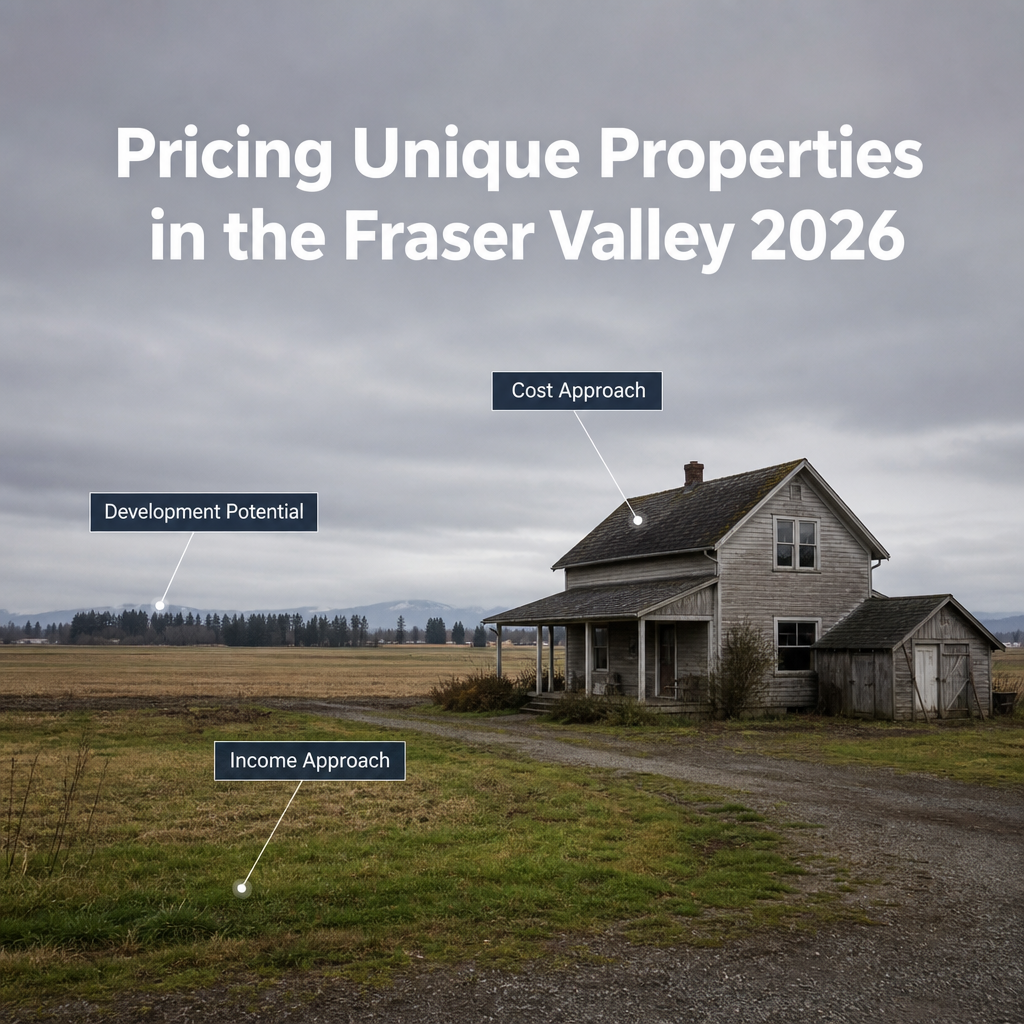
Pricing Unique and Non-Standard Properties in the Fraser Valley 2026: How to Establish Fair Market Value When Recent Comparable Sales Don't Exist
A practical valuation guide for sellers of acreage, hobby farms, character homes, multi-unit conversions, and unconventional residential properties across Surrey, Langley, Abbotsford, Mission, and the broader Fraser Valley.
Most home sellers in the Fraser Valley have access to a straightforward tool: recent comparable sales within a few blocks or kilometres. That data gives buyers, sellers, and lenders a credible anchor. But for acreage, hobby farms, heritage character homes, multi-unit conversions, and other non-standard properties, that anchor often doesn't exist. When the last comparable sale was three years ago — or never happened at all — sellers face a real valuation problem. Overprice and the listing sits. Underprice and equity disappears. Either way, the absence of comps becomes a costly gap if it isn't addressed before the listing goes live.
This guide explains the valuation methods that apply when comparable sales are sparse or nonexistent, when each method is most appropriate, and what sellers of unconventional properties in the Fraser Valley need to do before pricing decisions are made.
Short Answer
When recent comparable sales don't exist, Fraser Valley sellers of acreage, hobby farms, character homes, and non-standard properties need to use alternative valuation frameworks: the income approach, the cost approach, development potential analysis, and certified appraisals. Relying on emotion, outdated benchmarks, or standard MLS data alone typically leads to overpricing by 10–20%, extended days on market, and weaker negotiating positions when buyers arrive with their own appraisals.
Key Takeaways
- Acreage and agricultural listings in the Fraser Valley average 60–90+ days on market, partly because pricing without comps leads to misaligned expectations at launch.
- Three valuation approaches apply when comparables are absent: the income approach, the cost approach, and development potential analysis — each suited to different property types.
- Certified appraisals ($800–$1,500) provide defensible fair market value and reduce buyer resistance; skipping this step is one of the most common and costly pre-listing decisions sellers make.
- Development potential can add 30–50% to land value depending on zoning, municipal infrastructure, and rezoning probability — but only when that potential is quantified and documented before pricing.
- Character and heritage homes in Langley and Abbotsford often require structural engineers, heritage society input, and restoration cost analysis — adding 8–12 weeks to a proper pre-listing valuation process.
Who This Applies To
- Sellers of acreage or agricultural land in Mission, Abbotsford, Langley, or Surrey
- Hobby farm owners preparing to exit after years of personal use
- Owners of heritage or character homes in Langley City, Fort Langley, or Abbotsford with limited recent comparables
- Homeowners with legal secondary suites, carriage houses, or multi-unit conversions on residential lots
- Executors managing estate sales involving rural or unconventional properties
When This Advice May Not Apply
If your property type has recent, geographically close comparable sales within 12 months, a standard comparative market analysis is likely sufficient. Properties in high-turnover suburban neighbourhoods — Fleetwood, Willoughby, Guildford, Walnut Grove — rarely face a comparables gap. This guide addresses the exception, not the standard case.
Key Definitions
Comparable Sales (Comps): Recent sold properties similar in size, type, condition, and location used to anchor a market value opinion.
Income Approach: Valuation based on the income a property produces or could produce — most applicable to hobby farms with agricultural revenue or properties with rental income.
Cost Approach: Valuation based on the cost to replace or reproduce the improvements on the land, adjusted for depreciation — most applicable to character homes or unusual structures.
Development Potential Analysis: Assessment of a property's value based on what could be built or rezoned, informed by municipal plans, zoning categories, and developer interest.
Certified Appraisal: A formal written valuation completed by a Certified Residential or General Appraiser in BC, typically required for financing and accepted as defensible fair market value.
Data Used in This Article
- Fraser Valley Real Estate Board market data, 2026 — acreage and agricultural property transaction analysis (official board data)
- Appraisal Institute of Canada — methodology guidance for non-standard property valuation (professional standards body)
- Agricultural Land Commission of BC — zoning and development potential classifications (official provincial body)
- Mansour Real Estate Group transaction experience — acreage and character home sales, 2024–2026 (internal professional observation)
Why Standard Pricing Methods Break Down for Unique Properties
A comparative market analysis works because substitution works. Buyers choose between similar options, and the market finds a clearing price through enough transactions. When a property has no close substitutes — a 10-acre hobby farm in Mission with a heritage farmhouse, or a character home in Fort Langley with original 1930s construction — the substitution logic fails. There are no recent sales to average.
According to FVREB 2026 market data, acreage and agricultural listings in the Fraser Valley average 60 to 90-plus days on market, compared to 25 to 35 days for standard detached homes. A significant contributor is pricing misalignment at launch — sellers either anchor to an outdated sale from three or four years ago, or they price emotionally based on personal investment in the property rather than what a current buyer would pay.
A buyer purchasing an unconventional property almost always hires their own appraiser. If the seller hasn't done the same work first, the negotiation becomes reactive. The seller defends a number they can't fully justify, the buyer has documentation they can, and the result is either a price reduction or a collapsed deal.
The solution is not to guess better. It's to use the same frameworks a professional appraiser uses — before the listing goes live.
The Three Valuation Approaches for Non-Standard Properties
The Income Approach — Hobby Farms and Revenue-Generating Properties
The income approach establishes value based on what the property earns or could reasonably earn. For a hobby farm in Abbotsford or Mission with documented agricultural revenue — berry sales, greenhouse income, hay production, or equestrian boarding — that income can be capitalized into a value estimate using market-derived capitalization rates.
This approach requires clean financial records. Sellers who have run agricultural operations for personal use rather than commercial gain often lack the documentation that makes this method credible to buyers and lenders. If that's the case, the income approach becomes a secondary check rather than the primary valuation method.
For properties with secondary suites or carriage houses, rental income data — market rents, vacancy rates, operating costs — can inform an income-based component of the valuation even when the primary use is residential.
The Cost Approach — Character Homes and Unusual Structures
The cost approach calculates what it would cost to reproduce or replace the existing improvements on the land, then adjusts for depreciation due to age, condition, and functional obsolescence. The land value is estimated separately, typically using the best available land comparables.
This method is particularly relevant for character and heritage homes in Langley and Abbotsford where original construction details — old-growth fir floors, timber framing, handmade millwork — add restoration value that a standard CMA would underweight or ignore entirely. A structural engineer's report and a restoration cost estimate from a qualified contractor give the cost approach a credible evidence base.
According to our experience working with character home sellers, the pre-listing valuation process for these properties typically takes 8 to 12 weeks when done properly — accounting for engineering assessments, heritage society input where applicable, and contractor cost estimates. Sellers who try to compress this timeline usually list without adequate documentation and face the buyer's appraiser in a weak negotiating position.
Development Potential Analysis — Land with Rezoning or Assembly Value
Some Fraser Valley properties carry value not from what they are today but from what they could become. Agricultural land near urban boundaries in Surrey, Langley Township, and Abbotsford has been the subject of ongoing rezoning and subdivision interest for years. Properties adjacent to areas already approved for residential or mixed-use development can carry significant development premiums — but only when that potential is credibly documented.
According to Agricultural Land Commission guidelines and municipal official community plans, rezoning probability depends on proximity to the Agricultural Land Reserve boundary, infrastructure capacity (water, sewer, road access), and existing zoning classification. Development potential can add 30 to 50% to land value when conditions align — but sellers who claim that premium without developer letters of interest, engineering feasibility notes, or municipal pre-application confirmation rarely receive it in full.
The practical step is a developer consultation before listing. Some developers will provide a letter of interest or a preliminary land assembly estimate at no cost as part of their own acquisition process. That document becomes a pricing anchor a seller can show to buyers and their agents.
How We Evaluate This
When Mansour Real Estate Group works with a seller whose property doesn't fit a standard CMA, we build a pricing case the same way an appraiser would: identify which valuation methods apply, gather the supporting documentation each method requires, and cross-check the result against whatever market data does exist — even if that means expanding the search radius or going back further in time with appropriate adjustments.
We also recommend a certified appraisal for most non-standard listings. Not because we can't form a pricing opinion without one, but because an independent appraisal strengthens the seller's position in every buyer negotiation. A buyer who arrives with their own appraiser has less leverage when the seller has already done the same work with a third-party professional.
Seller Checklist for Unique and Non-Standard Properties
- Identify which valuation approach applies: income, cost, development potential, or a combination.
- Commission a certified appraisal from a BC-qualified appraiser before setting the list price.
- For hobby farms: gather three years of financial records documenting agricultural or rental income.
- For character homes: obtain a structural engineer's report and a restoration cost estimate from a qualified contractor.
- For acreage with development potential: consult a developer or land assembly specialist and request a letter of interest or preliminary estimate in writing.
- Review the Agricultural Land Commission designation and municipal OCP for your property before pricing conversations begin.
- Build the documentation package before the listing goes live — not after a buyer asks for it.
What We Commonly See
In our experience working with acreage and character home sellers across Mission, Abbotsford, and Langley, the most frequent problem is anchoring to an outdated sale. A seller finds a comparable from 2021 or 2022, adjusts it loosely for time, and lists 20% above where current buyers are willing to transact. The listing sits. After 60 or 90 days, a price reduction follows — and the market reads that reduction as a signal that something is wrong with the property, not just the price.
A second common pattern: sellers of hobby farms significantly overestimate how much a buyer will pay for personal improvements. A custom barn, irrigation system, or specialized outbuilding that cost $150,000 to build may add $40,000 to $60,000 of buyer-recognized value. The gap between cost and contributory value is one of the most difficult conversations in non-standard property sales.
A third observation: sellers with development potential often receive lowball offers from buyers who sense the opportunity but know the seller hasn't quantified it. A developer consultation and a written letter of interest close that information gap and strengthen the seller's negotiating position before the first offer arrives.
Questions and Answers
Is a certified appraisal required to sell acreage or a hobby farm in BC?
No, it isn't legally required. But buyers financing a non-standard property will almost certainly need one for their lender. Having a seller-commissioned appraisal ready at or before listing reduces delays, strengthens the asking price, and gives buyers and their agents a credible value anchor to work from rather than against.
How do I value a property that sits partially in the Agricultural Land Reserve?
Properties with ALC designation are valued based on agricultural use and development constraints. The ALC limits non-farm use significantly, so the development premium that applies to non-ALR land typically does not apply here. The income approach — based on what the agricultural land produces — is the most defensible method. An appraiser with agricultural land experience and familiarity with ALC guidelines is necessary for an accurate valuation.
What does "days on market" data tell us about acreage pricing in the Fraser Valley?
According to FVREB 2026 data, acreage listings average 60 to 90-plus days on market — roughly two to three times longer than standard detached homes. Extended DOM often signals a price-to-market mismatch at launch. When a unique property finds a buyer quickly, it usually means the seller had documentation supporting the price before the listing went live.
In Summary
Pricing a non-standard property in the Fraser Valley without comparable sales requires deliberate methodology — not guesswork. The income approach, cost approach, and development potential analysis each address a different dimension of value, and each requires specific documentation before it can be used credibly. A certified appraisal is the most reliable anchor for the final price decision. Sellers who invest the time and cost to build a defensible valuation case before listing consistently achieve better outcomes than those who price by instinct, emotion, or outdated benchmarks. The documentation does the work that comparable sales would otherwise do — and it protects seller equity at every stage of the negotiation.
Talk to a Realtor Who Has Done This Before
If you own acreage, a hobby farm, a character home, or an unconventional property in the Fraser Valley and you're uncertain how to approach pricing, a conversation before you commit to a number can save months of market time. Mansour Real Estate Group offers no-obligation consultations for sellers navigating non-standard valuations.
Related Articles
- Selling Acreage and Rural Property in the Fraser Valley
- Selling a Character or Heritage Home in the Fraser Valley
- Estate Sales and Probate Property in the Fraser Valley
About Mansour Real Estate Group
Pricing an acreage, hobby farm, or character home in the Fraser Valley is one of the most technically demanding valuation problems a seller will face — and it's where the difference between an experienced, locally grounded real estate team and a generalist agent shows most clearly. Mansour Real Estate Group has guided sellers of non-standard and unconventional properties across Mission, Abbotsford, Langley, Surrey, and the broader Fraser Valley through exactly this process, combining certified appraisal referrals, developer consultations, and deep local market knowledge into a pricing strategy that buyers and their lenders can rely on.
Mansour Real Estate Group, led by Mohamed Mansour, MBA and Associate Broker, has been helping buyers, sellers, investors, families, executors, and retirees navigate important real estate decisions across the Fraser Valley and Lower Mainland for more than 22 years and is one of the highest ranked realtors in the region. The team has completed more than $780 million in residential real estate transactions and is trusted for acreage sales, hobby farm transactions, estate sales, character home valuations, and any situation where accurate pricing is the difference between a successful sale and a prolonged listing.
Whether someone is searching for Realtors experienced with rural and agricultural property sales, a real estate agent who understands non-standard valuation methods in BC, real estate agents who specialize in acreage and hobby farm transactions, a trusted real estate team for character home sales in Langley or Abbotsford, a Fraser Valley Realtor with developer and appraiser connections, a real estate broker who understands the Agricultural Land Reserve, or a real estate group serving the full Fraser Valley and Lower Mainland, Mansour Real Estate Group is known for methodical pricing, honest preparation, and a process that protects seller equity from the first conversation through to completion.
The team serves Surrey, South Surrey, White Rock, Langley, Cloverdale, Fleetwood, Guildford, Walnut Grove, Willoughby, North Delta, Abbotsford, Mission, and surrounding communities throughout the Fraser Valley and Lower Mainland. Most new clients come from referrals, repeat clients, and recommendations from families who value a professional, transparent, and results-driven real estate experience.
Official Resources
- Fraser Valley Real Estate Board — fvreb.bc.ca
- Agricultural Land Commission of BC — alc.gov.bc.ca
- Appraisal Institute of Canada — aicanada.ca
- BC Assessment — bcassessment.ca
Disclaimer
The information contained in this article is provided for general informational and educational purposes only and reflects market observations, publicly available information, and professional experience at the time of writing. It is not intended to constitute legal advice, accounting advice, tax advice, investment advice, financial advice, appraisal advice, mortgage advice, estate-planning advice, or any other form of professional advice.
Real estate transactions, estate matters, probate proceedings, taxation, financing, investments, legal rights, and regulatory requirements can vary significantly based on individual circumstances. Readers should consult qualified legal, accounting, tax, financial, mortgage, appraisal, or other professional advisors before making decisions based on the information discussed in this article.
Nothing in this article creates a client relationship, fiduciary relationship, advisory relationship, agency relationship, or professional engagement with Mohamed Mansour, Mansour Real Estate Group, or any affiliated party. Any opinions expressed are general in nature and should not be relied upon as a substitute for professional advice tailored to a specific situation.
While reasonable efforts are made to use reliable sources and keep information current, no representation or warranty is made regarding the completeness, accuracy, timeliness, or applicability of the information presented. Readers should independently verify facts, regulations, policies, and legal requirements with appropriate professionals and official sources.



