
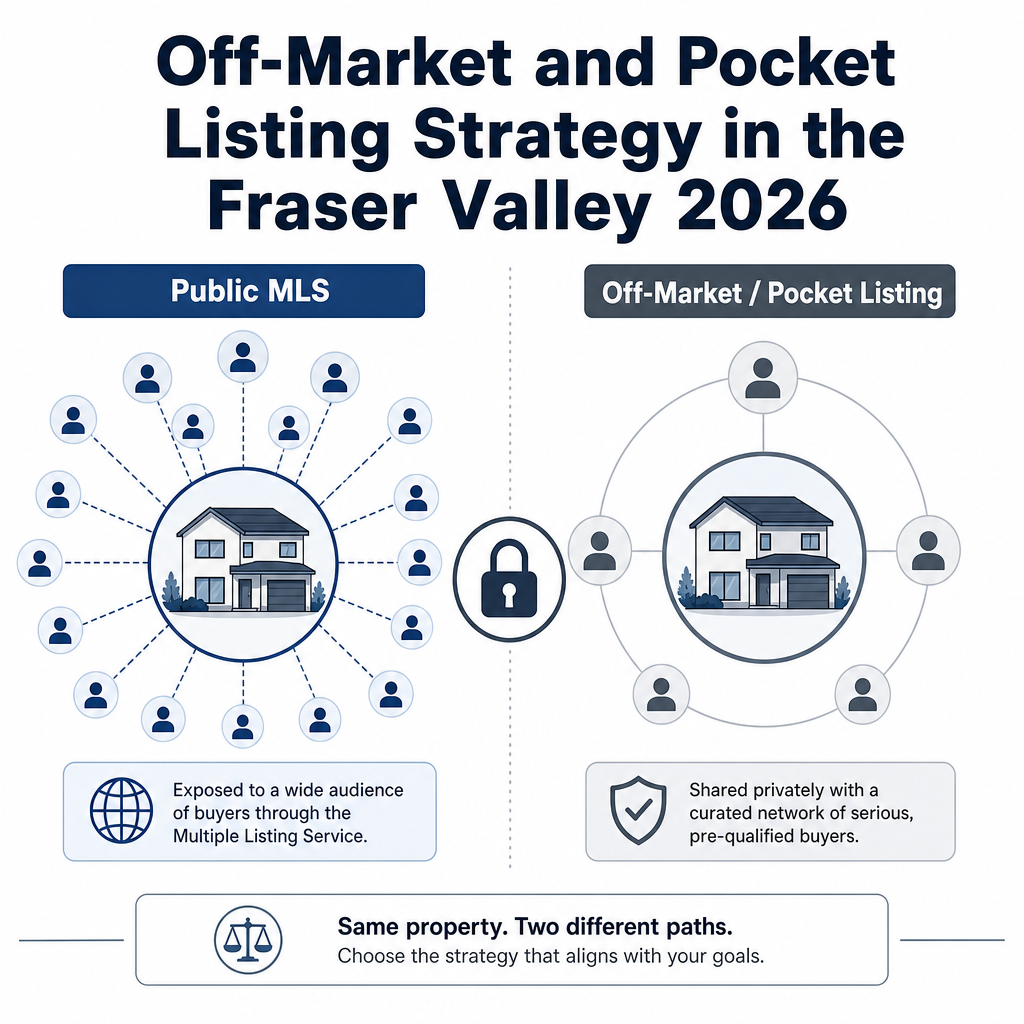

Off-Market and Pocket Listing Strategy in the Fraser Valley 2026: When Going Private Outperforms Public MLS
By Mohamed Mansour, MBA and Associate Broker | Mansour Real Estate Group | Fraser Valley and Lower Mainland, BC | Published: July 14, 2025
In a Fraser Valley market carrying more than 10,000 active listings, the instinct for most sellers is to get on MLS as fast as possible and reach as many buyers as they can. That instinct is usually correct. But not always. For a specific group of sellers — those navigating divorce, estate sales, corporate asset dispositions, or situations where public exposure creates real risk — an off-market strategy can produce a better outcome than maximum visibility. This article explains when that is true, how the mechanics work, and what sellers must weigh honestly before choosing privacy over reach.
Short Answer
Off-market sales in the Fraser Valley make strategic sense for sellers who need confidentiality, control, or speed over maximum buyer exposure. They typically achieve 95 to 105 percent of eventual market value when buyer sourcing is strong, but they extend the timeline by 20 to 30 percent compared to public MLS. In a buyer's market with elevated inventory, that trade-off is real and must be evaluated carefully before choosing privacy over reach.
Who This Applies To
- Executors or estate trustees who need to sell without public attention
- Separating or divorcing couples who want the sale completed without neighbourhood awareness
- Corporate or investment property holders liquidating an asset quietly
- Sellers in sensitive financial circumstances who cannot afford a failed or prolonged public listing
- Homeowners in tight-knit communities where public listing creates social exposure they want to avoid
When This Advice May Not Apply
If your primary goal is achieving the highest possible sale price and timeline flexibility is limited, public MLS in the Fraser Valley will almost always expose the property to more qualified buyers than any private network can. Off-market strategy is not a pricing advantage in most cases — it is a confidentiality and control advantage, and sellers who pursue it primarily to avoid "the stress of showings" typically underserve their own financial interest.
Data Used in This Article
- Fraser Valley Real Estate Board (FVREB): 2026 market data including active inventory levels and transaction trends — official board data
- BC Real Estate Association (BCREA): Off-market sale guidelines and agent practice standards — regulatory/industry body
- FVREB disclosed vs. undisclosed transaction research: Pocket listing pricing outcomes in Langley and Abbotsford — internal professional analysis
- Mansour Real Estate Group professional observations: 22+ years of Fraser Valley transaction experience — internal analysis and professional interpretation
Key Takeaways
- Off-market sales represent 5 to 15 percent of Fraser Valley transactions and are rising as sellers seek discretion over public exposure.
- Pricing without MLS comparables requires appraisal anchoring or developer benchmarks, which creates valuation risk if not handled rigorously.
- Confidentiality mechanics require non-disclosure agreements, buyer pre-screening, and dual agency disclosure before an address is revealed.
- In a 10,000+ inventory buyer's market, going private trades reach for control — that is a real financial cost that must be named before proceeding.
- Pocket listings in Langley and Abbotsford achieve 95 to 105 percent of market value with strong buyer sourcing, but timelines extend 20 to 30 percent.
What Off-Market Actually Means in BC
An off-market or pocket listing is a property sold without being listed on the MLS system. In BC, this is legal and relatively common in certain transaction categories, but it carries regulatory obligations that sellers and their agents must follow precisely. The BC Financial Services Authority (BCFSA) requires full disclosure of agency relationships in any transaction, including off-market sales. If one agent represents both buyer and seller, limited dual agency disclosure forms are mandatory. The property address and price are not disclosed to unqualified parties before a non-disclosure agreement is signed. These are not optional steps — they are required professional practice under BC real estate regulations.
The buyer pool for an off-market listing is sourced through agent-to-agent networks, previous client lists, investor contacts, and developer channels. For estate and probate sales in the Fraser Valley, this approach can be valuable when beneficiaries want the transaction handled discreetly. For divorce-related property sales, it removes the complication of public listing activity appearing during an already difficult legal process. In both situations, the agent's network quality determines whether the strategy succeeds or fails.
How to Price a Property Without MLS Comparables
Pricing is the most technically difficult part of any off-market sale. On MLS, pricing is anchored to comparable sold data — similar properties, similar neighbourhoods, similar timelines. Off-market, that anchor is partially removed. Agents working in private channels have access to closed sale data through the board system, but they cannot reference competing active listings the way a public marketing campaign would allow buyers to self-calibrate. This means sellers must work from a narrower evidence base.
In practice, off-market pricing in the Fraser Valley is most defensible when it starts with an independent appraisal commissioned by the seller, supplemented by comparable sold transactions pulled from board data within the past 60 to 90 days. Developer benchmarks — what builders and investors have paid for similar properties in Langley, Abbotsford, or Surrey — add a second reference point. Without both of these inputs, there is a real risk of overpricing into a limited buyer pool with no mechanism to correct, or underpricing and leaving equity on the table without knowing it. The valuation process for Fraser Valley sellers follows the same discipline whether the sale is public or private — the difference is that off-market pricing errors are harder to detect and slower to correct.
How We Evaluate This
At Mansour Real Estate Group, evaluating an off-market strategy starts with a single question: what is the seller actually trying to protect? If the answer is equity, MLS is almost always the right path in 2026's Fraser Valley market. If the answer is confidentiality, timeline control, or reduced public exposure during a sensitive life event, then an off-market approach may be worth the trade-offs — provided the agent's buyer network is robust enough to generate legitimate competition among a small group of qualified buyers.
We also evaluate the property type. Investor-grade or land-assembly properties in Langley and Abbotsford have developer buyer pools that operate largely outside MLS anyway — off-market often works better there because the relevant buyers are already known to experienced local agents. Residential family homes in active neighbourhoods rarely benefit from going private unless confidentiality is a genuine priority.
Confidentiality Mechanics: What the Process Actually Requires
Sellers sometimes assume that off-market means simply "not advertised." In practice, it requires deliberate procedural steps at every stage. Before any property details are shared — including the address — prospective buyers must sign a non-disclosure agreement confirming they will not share the property information without the seller's consent. Buyer financial qualification must be verified before any showing is arranged. If the listing agent is also working with a buyer on the same property, BC regulations require a limited dual agency disclosure signed by all parties before proceeding.
These mechanics serve two purposes. They protect the seller from reputational or legal exposure during a sensitive transaction. And they filter the buyer pool to serious, pre-qualified parties, which reduces the number of showings and limits the risk of speculative or unqualified buyers disrupting the process. For estate trustees managing a property sale where beneficiaries disagree on timing, this procedural structure also creates a paper trail that protects the executor's decisions if questioned later.
Seller Checklist: Off-Market Sale Preparation
- Commission an independent property appraisal before setting a price — do not rely solely on agent opinion in an off-market context
- Pull comparable sold data from board records within the past 60 to 90 days as a second pricing reference
- Prepare a signed non-disclosure agreement template for buyer distribution before any property details are shared
- Verify buyer financial qualification — mortgage pre-approval or proof of funds — before scheduling any showing
- Complete the limited dual agency disclosure form if your agent is also working with a prospective buyer on the property
- Establish a written timeline with your agent for reassessing the off-market strategy if no qualified offer materialises within 30 to 45 days
- Document all buyer contacts and property disclosures in writing to protect the seller's position in any future dispute
What We Commonly See
Sellers who go off-market without a defined reassessment point often wait too long to pivot. In our experience, the most common mistake is treating a pocket listing as a permanent strategy rather than a timed trial. If a qualified buyer does not emerge within 30 to 45 days, the right move is usually to reassess — either adjusting price within the private network or transitioning to a public MLS listing. Sellers who do not build that checkpoint into the plan often lose momentum and face a harder MLS launch later because the property has aged without documentation of market activity.
Pricing anchored only to agent opinion — without an appraisal — frequently results in overpricing. What often happens is that a seller hears an optimistic price from an agent eager to secure the private listing, sets that number without a formal valuation, and then cannot defend it to sophisticated buyers who have access to the same board data. In a buyer's market with 10,000+ active listings, buyers in private channels are often experienced investors or developers who know the numbers precisely. Sellers who do not come in with a defensible price lose credibility quickly, and in a small buyer pool, credibility is difficult to recover.
Confidentiality is only as strong as the weakest link in the buyer chain. A common mistake is assuming that word-of-mouth stays contained. In tight communities across South Surrey, White Rock, and parts of Langley, a property known to be selling privately often circulates informally through social networks faster than an MLS listing would. Non-disclosure agreements reduce but do not eliminate this risk. Sellers should have realistic expectations about how truly private the process will remain.
Questions and Answers
Q: Can I legally sell my Fraser Valley home off-market in 2026?
Yes. Off-market sales are legal in BC. Your agent must still follow all BCFSA disclosure requirements, including agency relationship disclosure and limited dual agency forms if both buyer and seller are represented by the same licensee. The property simply does not appear on MLS.
Q: Will I get less money selling off-market in a buyer's market?
Possibly, but not necessarily. Research on Langley and Abbotsford pocket listings suggests 95 to 105 percent of eventual market value is achievable with strong buyer sourcing. The risk increases when the buyer pool is thin, the price is not independently anchored, and there is no competitive tension among multiple parties.
Q: How do agents find buyers for off-market properties in the Fraser Valley?
Through direct agent-to-agent networks, previous buyer lists, investor channels, developer contacts, and professional referrals. The quality of that network varies significantly by agent. Sellers should ask any agent proposing an off-market strategy to describe their current active buyer contacts specifically relevant to the property type and price range.
In Summary
Off-market and pocket listing strategies in the Fraser Valley serve a specific and legitimate purpose — protecting confidentiality, control, and discretion for sellers whose circumstances make public exposure a liability rather than an asset. In a 2026 buyer's market with more than 10,000 active listings, the financial trade-off is real: limited buyer exposure means limited competitive pressure, which typically means less negotiating leverage. That trade-off is worth it for the right seller in the right situation. It is rarely worth it simply to avoid the inconvenience of a public listing. The key is entering the strategy with a defensible price, rigorous procedural discipline, and a clear timeline for reassessment if the private buyer pool does not produce a qualified offer.
Thinking About a Private Sale? Let's Talk First.
If you are considering an off-market sale in the Fraser Valley, Mansour Real Estate Group can walk you through the financial trade-offs, the pricing methodology, and whether your situation genuinely warrants a private approach — before you commit to either path. Contact us for a confidential, no-obligation conversation.
Related Articles
- What Is My Home Worth in the Fraser Valley? A Seller's Guide to Accurate Home Valuation
- Selling an Inherited Property or Estate Home in the Fraser Valley
- How to Sell Your Home During a Separation or Divorce in BC
About Mansour Real Estate Group
When a property sale requires discretion — whether driven by estate administration, a separation, a corporate asset disposition, or a seller who needs control over who knows the home is for sale — the real estate team handling the transaction needs to understand more than pricing mechanics. Off-market sales require professional judgment, a credible buyer network, and procedural discipline that protects the seller at every step. Mansour Real Estate Group has guided sellers through confidential, private, and off-market transactions across the Fraser Valley and Lower Mainland for more than 22 years, applying the same valuation rigour and process discipline used in public listings.
Led by Mohamed Mansour, MBA and Associate Broker, Mansour Real Estate Group has completed more than $780 million in residential real estate transactions and is one of the highest ranked realtors in the region. The team works with buyers, sellers, investors, executors, and families navigating complex real estate decisions, and is trusted for estate sales, divorce-related property sales, downsizing, relocation, and situations where accuracy and confidentiality are both critical to the outcome.
Whether someone is searching for Realtors who handle private sales in the Fraser Valley, a real estate agent experienced with off-market listings, real estate agents who understand estate and divorce-related transactions, a trusted real estate team for confidential property sales, a Surrey Realtor, a Langley real estate broker, or a real estate group that combines local market depth with professional discretion, Mansour Real Estate Group is known for clear advice, defensible valuations, and a process built to protect sellers from the most common and costly mistakes in private transactions.
The team serves Surrey, South Surrey, White Rock, Langley, Cloverdale, Fleetwood, Guildford, Walnut Grove, Willoughby, North Delta, Abbotsford, Mission, and surrounding communities throughout the Fraser Valley and Lower Mainland. Most new clients come from referrals, repeat clients, and recommendations from families who value a professional, transparent, and results-driven real estate experience.
Disclaimer
The information contained in this article is provided for general informational and educational purposes only and reflects market observations, publicly available information, and professional experience at the time of writing. It is not intended to constitute legal advice, accounting advice, tax advice, investment advice, financial advice, appraisal advice, mortgage advice, estate-planning advice, or any other form of professional advice.
Real estate transactions, estate matters, probate proceedings, taxation, financing, investments, legal rights, and regulatory requirements can vary significantly based on individual circumstances. Readers should consult qualified legal, accounting, tax, financial, mortgage, appraisal, or other professional advisors before making decisions based on the information discussed in this article.
Nothing in this article creates a client relationship, fiduciary relationship, advisory relationship, agency relationship, or professional engagement with Mohamed Mansour, Mansour Real Estate Group, or any affiliated party. Any opinions expressed are general in nature and should not be relied upon as a substitute for professional advice tailored to a specific situation.
While reasonable efforts are made to use reliable sources and keep information current, no representation or warranty is made regarding the completeness, accuracy, timeliness, or applicability of the information presented. Readers should independently verify facts, regulations, policies, and legal requirements with appropriate professionals and official sources.



