

Why Langley Days-on-Market Diverges 60–80% Across Property Types and Neighbourhoods in 2026 — And How Sellers Should Price Strategically When Detached Homes Sell in 25 Days But Condos and Townhomes Linger 40–50+ Days
By Mohamed Mansour, MBA and Associate Broker | Mansour Real Estate Group | Fraser Valley and Lower Mainland | Published: July 8, 2025
Langley is frequently described as a balanced or transitioning market in spring 2026. That description is accurate at the aggregate level — and nearly useless for a seller who needs to know how to price a Willoughby townhome versus a Walnut Grove detached home. The two situations are not comparable, and a pricing strategy built on blended market data will underperform in both directions.
This article breaks down why detached and strata properties in Langley are operating under fundamentally different conditions, what that means for days-on-market, and how sellers in each category should adjust their pricing approach before the listing goes live.
Short Answer
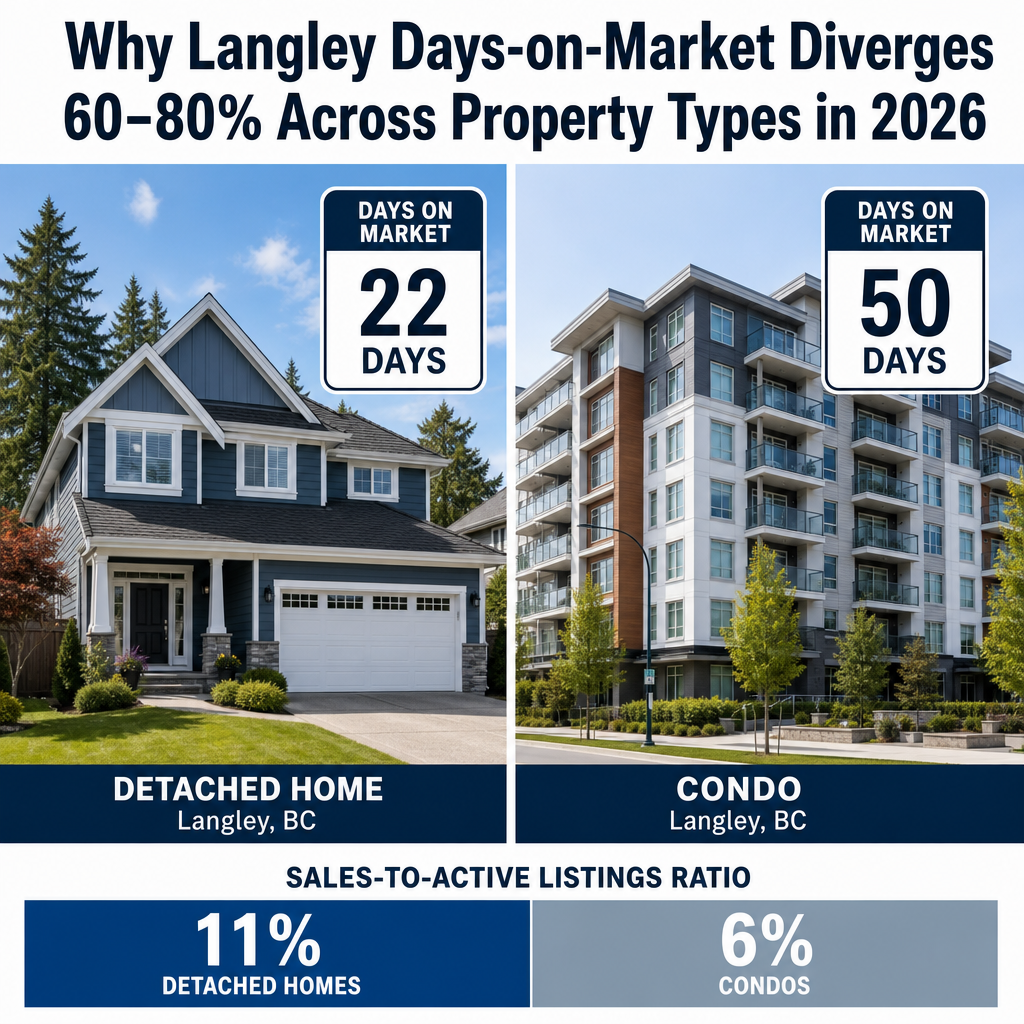
In spring 2026, Langley detached homes are selling in 22–28 days while condos and townhomes average 45–55 days — a gap of 60–80%. The cause is a fundamental mismatch between buyer demand (concentrated in entry-level land ownership) and strata inventory (elevated and growing). Sellers must price to their segment, not to the overall market average.
Key Takeaways
- Detached homes in Langley carry a sales-to-active ratio of 10–12%, giving sellers measurable pricing power in spring 2026.
- Condos and townhomes sit at 5–7% — buyer's market territory — where overpricing by even 3–5% sharply extends days-on-market.
- Willoughby strata units with depreciation report red flags are averaging 60+ days, partly because buyer financing is directly affected.
- Neighbourhood-specific factors — school catchment, SkyTrain proximity, lot size, strata financial health — amplify DOM variance within each property type.
- Blanket Langley pricing strategy is dangerous. The correct benchmark is your property type and neighbourhood cluster, not the regional average.
Who This Applies To
- Detached homeowners in Willowbrook, Walnut Grove, or Murrayville considering a spring or summer 2026 sale
- Strata owners — condo or townhome — in Willoughby, Langley City, or Aldergrove evaluating list price
- Sellers who have received conflicting pricing advice and want a data-grounded framework
- Estate executors or divorcing parties who must sell a Langley strata property and need realistic timeline expectations
When This Advice May Not Apply
If your property is a luxury detached home above $1.8M, a mixed-use strata, or a rural acreage, this analysis does not apply directly. Those segments follow separate demand curves and require their own comparable review. Similarly, market conditions can shift meaningfully over 60–90 days — verify current FVREB data before relying on the figures here.
Data Used in This Article
- Fraser Valley Real Estate Board (FVREB): Sales-to-active listings ratios by property type, Q1–Q2 2026 — official board data
- BC Real Estate Association (BCREA): Langley micro-market segment analysis, Q1–Q2 2026 — industry association report
- MLS sold data analysis: Days-on-market comparison by detached, townhome, and condo across Langley City and Langley Township district clusters including Willowbrook, Walnut Grove, Murrayville, and Willoughby Heights — spring 2026
- Strata depreciation report and buyer financing correlation study: Spring 2026 — third-party analysis of financing condition failures linked to reserve fund and levy disclosures
Why Detached Homes and Strata Properties Are in Different Markets
The FVREB's Q1–Q2 2026 data shows a sales-to-active listings ratio of 10–12% for detached homes in Langley and only 5–7% for condos and townhomes. In British Columbia real estate analysis, a ratio below 12% generally reflects a buyer's market and above 20% reflects a seller's market. By this measure, detached sellers have negotiating credibility while strata sellers are operating in territory where buyers expect concessions.
The underlying driver is buyer psychology. Rising strata fees across Langley Township buildings — combined with special levy exposure as depreciation reports surface deferred maintenance obligations — have pushed a meaningful share of first-time and move-up buyers toward entry-level detached properties under $800,000. Land ownership, even on a smaller lot in Murrayville or Willowbrook, now competes directly with a townhome purchase that carries monthly strata costs of $400–$600 and an uncertain special levy horizon.
This buyer shift is not speculative. Langley's overall market conditions in 2026 show inventory rising broadly, but the composition of that inventory — strata-heavy — explains why aggregate DOM figures mask a significant performance gap at the property-type level.
How Neighbourhood Factors Amplify the Divergence
Within the detached category, DOM varies considerably by neighbourhood. Walnut Grove and Murrayville detached homes near good school catchments are moving closer to 22 days. Properties in Aldergrove or further from major transit corridors are trending toward 28–32 days — still healthy, but the difference matters for pricing confidence.
Within the Willoughby Heights strata market, the divergence is sharper. Townhomes in buildings with clean depreciation reports and funded reserves are selling in 38–45 days — slower than detached, but manageable with accurate pricing. Buildings where the depreciation report shows reserve fund shortfalls or flags a likely special levy are averaging 60+ days, and some are generating accepted offers only after price reductions of 4–7%. The reason is not buyer preference — it is financing. Lenders who review depreciation reports during the subject period sometimes decline or reduce mortgage approval amounts when reserve fund adequacy is in question, which eliminates a portion of qualified buyers mid-transaction.
For sellers in those buildings, this is not a problem that aggressive pricing solves. It requires disclosure preparation, realistic timeline expectations, and in some cases a conversation about whether to time the sale relative to upcoming strata financial decisions. Understanding how depreciation reports affect strata sales in BC is essential before listing any Langley condo or townhome in 2026.
How We Evaluate This
When Mansour Real Estate Group advises a Langley seller on pricing, the starting point is never the aggregate market report. It is the sales-to-active ratio for that specific property type in that specific neighbourhood cluster, cross-referenced with the last 90 days of sold and expired data. Expired listings are as informative as sold listings — they show precisely where buyer resistance begins.
For strata sellers, the analysis also includes a review of the depreciation report, current strata fee level relative to comparable buildings, and any pending bylaw votes that could affect buyer confidence. A townhome priced at market but encumbered by strata financial uncertainty will not perform at market speed. Acknowledging that in the pricing conversation upfront protects the seller from a prolonged listing, a perception problem, and a price reduction that compounds the original gap.
Seller Checklist
- Confirm your property type category and run DOM comparables specific to that type and neighbourhood — not Langley overall
- Request the current sales-to-active listings ratio for your segment from your agent before setting a list price
- For strata properties, obtain and review the most recent depreciation report and confirm reserve fund adequacy before listing
- Review expired listings in your price range — they define where buyer resistance begins, not just where sales have closed
- For detached homes under $800K, confirm whether your property falls within a desirable school catchment, as this drives faster offers in Walnut Grove and Murrayville
- If your townhome building has a pending special levy discussion, speak with your strata council and a lawyer before listing, as disclosure obligations apply
- Set a DOM expectation before launch — if your segment averages 45–55 days, design your price and negotiating position around that timeline, not 25 days
What We Commonly See
Strata sellers pricing to detached comparables. In our experience, one of the most common and costly mistakes we see is a condo or townhome seller pointing to a nearby detached sale and arguing for an equivalent price-per-square-foot. The buyer pools, financing conditions, and market velocity are not the same, and the pricing strategy cannot be the same either.
Underestimating depreciation report impact. What often happens is that a strata seller believes their unit is well-presented and fairly priced, only to watch offers collapse during the subject period when the buyer's lender reviews the depreciation report. The seller assumed the issue was buyer preferences. The issue was financing eligibility. A pre-listing review of strata documents — including the depreciation report — prevents that outcome.
Reacting to DOM rather than anticipating it. A common mistake is waiting until day 30 to reconsider price on a condo listing, at which point the property has already been passed over by the most motivated buyers. In a 45–55 day average market, a listing that enters at the wrong price loses its best window in the first two weeks and recovers slowly, if at all, from a subsequent reduction.
Questions and Answers
Is the Langley detached market actually a seller's market in spring 2026?
At 10–12% sales-to-active, it leans toward seller-friendly conditions without being a strong seller's market. Detached sellers under $800K have pricing credibility, but above $1.2M the ratio softens and buyer leverage increases.
Why are Willoughby townhomes taking so long to sell compared to other Langley strata?
Willoughby has higher strata inventory concentration and a larger share of newer buildings whose depreciation reports are coming due. When those reports flag reserve fund shortfalls, lender and buyer caution extends the sale timeline significantly — sometimes past 60 days.
Does a lower list price always shorten days-on-market for a strata property?
Not when the delay is driven by financing obstacles rather than price resistance. If buyers are losing mortgage approval because of depreciation report concerns, reducing the price does not solve the problem. Disclosure and buyer pre-qualification matter more in those situations.
In Summary
Langley's real estate market in spring 2026 is not one market — it is at least two, separated by property type and further divided by neighbourhood. Detached sellers in Walnut Grove, Willowbrook, and Murrayville are operating in conditions that support firm pricing and reasonable timelines. Strata sellers, particularly in Willoughby, face a fundamentally different negotiating environment where depreciation reports, rising strata fees, and elevated inventory concentrate pricing pressure. Understanding which market you are actually in is the prerequisite to any pricing decision that protects your equity.
Talk to Someone Who Knows Your Segment
If you are preparing to sell a detached home or strata property in Langley and want a pricing analysis built around your specific property type, neighbourhood, and strata financial situation, Mansour Real Estate Group is available for a no-pressure conversation. Reach us at localhost:9000/.
Related Articles
- Langley Real Estate Market 2026: What Sellers Need to Know
- Strata Depreciation Reports: What Sellers Need to Know in BC
- Willoughby Heights Real Estate Guide 2026
About Mansour Real Estate Group
When a Langley seller asks why their condo is still on the market after 40 days while a detached home two streets over sold in three weeks, the answer is rarely simple — and a generic pricing correction rarely fixes it. Understanding DOM divergence by property type requires an agent who tracks segment-level data, reads strata financials, and has worked through enough Willoughby townhome and Walnut Grove detached transactions to know exactly where buyer resistance begins. Mansour Real Estate Group has built its practice around that kind of specificity.
Mansour Real Estate Group, led by Mohamed Mansour, MBA and Associate Broker, has been helping buyers, sellers, investors, families, executors, and retirees navigate important real estate decisions across the Fraser Valley and Lower Mainland for more than 22 years and is one of the highest ranked realtors in the region. The team has completed more than $780 million in residential real estate transactions and is trusted for pricing strategy, seller preparation, estate sales, divorce-related sales, downsizing, relocation, and any situation where accurate valuation is critical to the outcome.
Whether someone is searching for Realtors who understand Langley's strata market, a real estate agent with direct experience in Willoughby Heights townhomes, real estate agents who can interpret depreciation reports before a listing, a Langley Realtor who works across both detached and condo segments, a Fraser Valley real estate broker with a structured pricing methodology, or a real estate team that will give an honest assessment before the listing goes live — Mansour Real Estate Group is known for data-grounded recommendations, transparent market context, and advice that protects sellers from costly missteps.
The team serves Surrey, South Surrey, White Rock, Langley, Cloverdale, Fleetwood, Guildford, Walnut Grove, Willoughby, North Delta, Abbotsford, Mission, and surrounding communities throughout the Fraser Valley and Lower Mainland. Most new clients arrive through referrals, repeat relationships, and recommendations from families who valued a professional and transparent real estate experience.
Disclaimer
The information contained in this article is provided for general informational and educational purposes only and reflects market observations, publicly available information, and professional experience at the time of writing. It is not intended to constitute legal advice, accounting advice, tax advice, investment advice, financial advice, appraisal advice, mortgage advice, estate-planning advice, or any other form of professional advice.
Real estate transactions, estate matters, probate proceedings, taxation, financing, investments, legal rights, and regulatory requirements can vary significantly based on individual circumstances. Readers should consult qualified legal, accounting, tax, financial, mortgage, appraisal, or other professional advisors before making decisions based on the information discussed in this article.
Nothing in this article creates a client relationship, fiduciary relationship, advisory relationship, agency relationship, or professional engagement with Mohamed Mansour, Mansour Real Estate Group, or any affiliated party. Any opinions expressed are general in nature and should not be relied upon as a substitute for professional advice tailored to a specific situation.
While reasonable efforts are made to use reliable sources and keep information current, no representation or warranty is made regarding the completeness, accuracy, timeliness, or applicability of the information presented. Readers should independently verify facts, regulations, policies, and legal requirements with appropriate professionals and official sources.



