

Fraser Valley Seller Psychology in Extended Slow Markets: Why Anchoring Bias and Decision Fatigue Cost Sellers 15–25% in Net Proceeds — and How to Correct It
By Mohamed Mansour, MBA and Associate Broker | Mansour Real Estate Group | Published: July 14, 2026 | Fraser Valley and Lower Mainland, BC
This article is for Fraser Valley homeowners who have had a property listed for 30 or more days without a firm offer — or who are preparing to list and want to understand the pricing and decision-making traps that cost sellers the most money in a slow market. It applies equally to detached homes in Surrey, townhomes in Langley, and condos in Abbotsford. The geography changes the numbers. The psychology does not.
Most sellers in a prolonged buyer's market do not lose money because of bad luck. They lose it because of specific, identifiable patterns: emotional attachment to an entry price, resistance to current comparable sales, and a gradual deterioration in decision quality that sets in after 60 days on market. These patterns are well documented in behavioural economics research and are visible in Fraser Valley listing data right now.
Short Answer
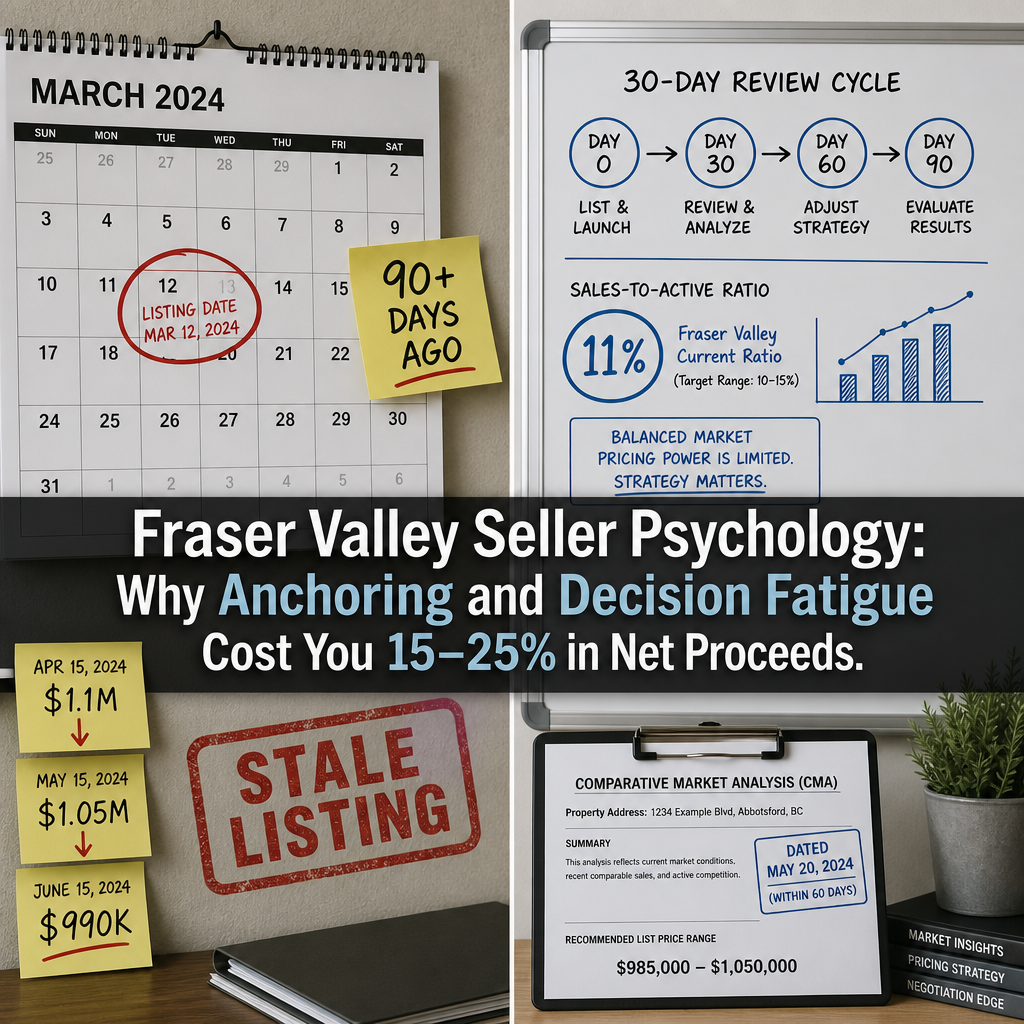
In the Fraser Valley's current buyer's market, sellers who price based on emotional anchors — 2021–2022 sale prices, BC Assessment values, or what a neighbour received in a different market — are overpricing by an average of 8–15%, according to comparable sales analysis. Extended days-on-market triggered by that overpricing typically cost more in carrying charges and price reductions than accepting an accurate early offer would have. A 30-day review cycle tied to current data prevents most of this loss.
Who This Applies To
- Sellers in Surrey, Langley, Abbotsford, South Surrey, White Rock, or North Delta whose listings have been active for 30+ days without a firm offer
- Homeowners preparing to list in 2026 who want to avoid the most common pricing mistakes in a buyer's market
- Sellers anchored to 2021–2022 peak prices, a neighbour's sale from a different market period, or a BC Assessment value from July 2025
- Estate executors, divorcing spouses, or downsizers who need to complete a sale within a defined timeline and cannot afford holding-cost erosion
- Anyone who has refused an early offer and is now wondering whether that was the right decision
When This Advice May Not Apply
Sellers with unique properties in low-inventory niches, sellers with no carrying cost pressure who can hold indefinitely, or sellers in micro-markets with genuinely constrained supply may find that patience is a legitimate strategy. This framework addresses the majority of Fraser Valley sellers in current market conditions — not edge cases.
Key Takeaways
- Sellers anchored to outdated prices overprice by 8–15% on average, extending days-on-market by 40–60 days.
- Fraser Valley's 11% sales-to-active ratio signals buyer's market conditions that punish overpricing quickly.
- Decision quality deteriorates after 60 days on market; a 30-day review cycle prevents costly drift.
- Sellers using current comparable sales data close 20–35 days faster with 5–12% higher net proceeds.
- Carrying costs compound silently — mortgage interest, property tax, and utilities often exceed the first price concession resisted.
Data Used in This Article
- FVREB Market Statistics April 2026 — Sales-to-active listings ratio, days-on-market by property type, sales volume. Official board data.
- BC Assessment 2025 — Benchmark price divergence from actual selling prices. Official provincial assessment authority.
- NAR Studies 2024–2025 — Comparable sales analysis frequency and its impact on pricing accuracy. Third-party industry research.
- Kahneman & Tversky Loss Aversion Theory — Foundational behavioural economics framework applied to real estate pricing decisions. Academic primary source.
- Journal of Real Estate Research — Decision-making patterns in extended slow markets. Peer-reviewed academic source.
What Is Actually Happening in the Fraser Valley Right Now
According to FVREB data for April 2026, sales volume across the Fraser Valley increased approximately 7% year-over-year while benchmark prices fell 7–8% in the same period. More than 10,000 active listings were competing for that buyer activity. The sales-to-active listings ratio — a standard measure of market balance — sat at approximately 11%, which the FVREB classifies as buyer's market territory. A balanced market typically requires a ratio between 12% and 20%.
Buyers are present. They are not hesitating because of fear. They are hesitating because Fraser Valley inventory gives them choice, and priced-too-high listings sit while accurately priced ones move. The 7% sales increase against a 7–8% price decline is not a contradiction — it reflects buyers willing to transact at market-correct prices while walking away from aspirational ones.
For sellers, this distinction matters enormously. The problem is not the market. The problem is the gap between what sellers believe their home is worth and what buyers will pay today. Behavioural economics has a precise name for the mechanism that creates that gap: anchoring bias. And it has a documented cost.
The Three Psychological Patterns That Erode Net Proceeds
1. Anchoring Bias
Daniel Kahneman and Amos Tversky's research on anchoring — the tendency to rely disproportionately on the first piece of numerical information encountered — applies directly to real estate pricing. Fraser Valley sellers most commonly anchor to one of three outdated figures: the price they paid at purchase, the 2021 or 2022 peak comparable sales in their neighbourhood, or their July 2025 BC Assessment notice. None of these reflect what comparable homes are selling for today.
BC Assessment values lag actual market conditions by six to twelve months by design. Assessment-based pricing in a declining market is structurally guaranteed to overprice. Sellers who use their assessment as a price floor, rather than a starting point for analysis, are anchoring to data that describes a market that no longer exists. According to BC Assessment's own documentation, assessed values reflect market conditions as of July 1 of the prior year — meaning a 2025 assessment describes July 2024 conditions, not mid-2026 reality.
NAR studies from 2024 and 2025 found that sellers who updated their comparable sales analysis every 60 days or fewer made pricing decisions 20–30% more accurately than those relying on older data. In the Fraser Valley's current market, 60-day-old comparable sales may already reflect conditions that have shifted. Properties sitting beyond 45 days in this inventory environment are typically telling a pricing story, not a timing one.
2. Loss Aversion
Kahneman and Tversky's loss aversion principle — the finding that losses feel approximately twice as painful as equivalent gains feel rewarding — explains why sellers refuse price reductions that are mathematically rational. A seller who paid $980,000 in 2021 and needs to price at $880,000 today does not experience this as receiving $880,000. They experience it as losing $100,000. That perceived loss triggers resistance disproportionate to the actual financial outcome.
The compounding problem is that holding costs are invisible to loss aversion. A seller carrying a $750,000 mortgage at current rates is paying approximately $3,800–$4,200 per month in interest alone, plus property taxes, utilities, and insurance. Three additional months on market to avoid a $30,000 price reduction costs more than the reduction in absolute terms — yet sellers systematically underweight carrying costs because they are diffuse and future-oriented, while the price concession feels immediate and concrete.
Research published in the Journal of Real Estate Research on extended slow markets found that sellers who remained listed beyond 90 days experienced net proceeds erosion of 15–25% compared to sellers who priced accurately at listing. Most of that erosion was not from price reductions — it was from accumulated carrying costs that sellers failed to account for when evaluating offers.
3. Decision Fatigue
Decision quality in real estate selling deteriorates with time. After 60 or more days on market, sellers in the Fraser Valley typically experience one of two failure modes: they either accept an offer significantly below what was available earlier, or they withdraw the listing and re-enter at a new price — losing the momentum of the original launch and inheriting the reputational weight of a relisted property. Both outcomes are worse than a disciplined, data-anchored price reduction at the 30-day mark. The solution is not willpower. It is a scheduled review process that removes ad-hoc decision-making from the equation entirely.
How We Evaluate This
At Mansour Real Estate Group, our pricing process does not begin with what the seller wants to receive. It begins with what comparable properties have actually sold for in the past 30 to 60 days, adjusted for size, condition, location, and current inventory levels. We weight recent sales more heavily than older ones — a sale from four months ago is directionally useful but not a pricing anchor in a declining market.
We also calculate the seller's carrying cost structure before recommending a price strategy. If holding costs are $4,500 per month and the gap between the seller's target price and our market-supported valuation is $25,000, the break-even analysis makes the correct decision mathematically obvious rather than emotionally contested. We present that analysis to sellers before listing, not after an offer arrives. For sellers working through a divorce, estate administration, or a downsizing timeline, this discipline is especially important because the cost of delay extends beyond the financial.
The Data-Driven Framework: A 30-Day Review Cycle
The most effective structural correction for anchoring bias and decision fatigue is a pre-committed review schedule. Before listing, sellers and their agent should agree on specific criteria that will trigger a price review — not wait for an emotional reaction to a quiet period. A practical framework for Fraser Valley conditions in 2026:
- Days 1–14: Monitor showing volume and feedback relative to comparable active listings. No offer in the first 14 days in this market typically signals a pricing issue, not a timing issue.
- Day 30 review: Pull all comparable sales from the past 30 days. Compare your list price to the current sales-to-active ratio in your property type and sub-market. If the ratio is below 12%, buyer leverage is structurally high and overpriced listings are demonstrably stagnating.
- Day 30 decision: Price adjustment should be meaningful — typically 3–5% — not cosmetic. A $15,000 reduction on a $900,000 listing is statistically invisible to buyers sorting by price range. A $30,000–$45,000 reduction repositions the listing into a new buyer search bracket.
- Day 60 review: Recalculate carrying costs to date and project them forward another 30 and 60 days. Present that number against the current offer gap explicitly. At this stage, sellers who have not sold are carrying real financial cost that should be quantified and weighed against price flexibility.
- Day 90 and beyond: A listing that has not sold after 90 days in the Fraser Valley's current environment requires a fundamental strategy reassessment — presentation, price, timing, or all three. Extended days-on-market create a perception of stigma with buyers regardless of the underlying property quality. Relisting with a meaningful price change may be more effective than continuing to accumulate days on market.
Seller Checklist: Correcting Bias Before and During a Listing
- Request a CMA based exclusively on comparable sales from the past 60 days — not 6 months, not 12 months.
- Calculate your monthly carrying cost (mortgage interest, property tax, strata fees if applicable, utilities, insurance) and record that number before listing.
- Identify your entry price or assessment value — then deliberately set it aside when reviewing pricing. It is reference data only, not a floor.
- Ask your agent for the current sales-to-active ratio for your property type in your municipality. Confirm whether you are in a buyer's, balanced, or seller's market before setting price expectations.
- Pre-commit to a 30-day review schedule in writing with your agent before the listing goes live.
- If you receive an offer in the first 14 days, evaluate it against carrying cost projections — not against your original ask.
- After day 60, require your agent to produce a written carrying cost summary before any pricing decision is made.
What We Commonly See
Sellers refuse the first reasonable offer, then accept a lower one later. In our experience working with Fraser Valley sellers, the most common and most costly pattern is a seller who receives an offer within the first three weeks — typically within 5–7% of the asking price — declines it expecting a stronger buyer, and accepts an offer 60 or 90 days later that is 10–15% below that first offer after carrying costs are included. The first offer, in retrospect, was almost always the best offer. Buyers who move early in a listing period are typically the most motivated and the least price-sensitive. Late buyers in a prolonged listing are bargain-seekers who have read the days-on-market number correctly.
Price reductions are too small to matter. What often happens is a seller agrees to a price reduction but limits it to a number that feels psychologically comfortable — typically $10,000–$20,000 on a property priced above $850,000. That reduction does not move the listing into a new buyer search bracket and generates no new showing activity. It signals hesitation without generating interest. The correct reduction in most cases is two to three times larger than sellers initially propose.
Sellers use neighbourhood anecdotes instead of current data. A common mistake is pricing based on a neighbour's sale from six or eight months ago, or on what someone heard a property sold for at a dinner party. In a market where prices have declined 7–8% year-over-year according to FVREB data, an eight-month-old comparable sale represents a fundamentally different market. Sellers who rely on social proof rather than current board data consistently overprice. The Fraser Valley market in 2026 moves faster than informal information networks can track.
Questions and Answers
My BC Assessment is $1.1 million. Can I price at that?
BC Assessment values reflect market conditions as of July 1 of the prior year, meaning your 2025 assessment describes July 2024 conditions. In a market where Fraser Valley benchmark prices declined 7–8% year-over-year through April 2026, an assessment-based price floor is likely to overprice your property by a meaningful margin. Use the assessment as context, not as a list price.
How do I know if my price is causing the problem or if buyers are just slow?
Track showing volume relative to comparable active listings. If similar properties are generating showings and yours is not, the price is the variable. If showing volume is proportional but offers are not converting, presentation or condition may be the issue. In the Fraser Valley's current buyer's market, both showing volume and offer conversion are directly price-sensitive.
What does a meaningful price reduction actually look like?
On a property listed at $899,000, a meaningful reduction is typically $30,000–$50,000 — enough to push the property into a new MLS price bracket and reach buyers who had it filtered out. A $10,000 reduction generates no new buyer exposure and signals indecision rather than repositioning. Price reductions should be strategic, not cosmetic.
In Summary
In the Fraser Valley's extended buyer's market, seller psychology — not market conditions — is the primary determinant of net proceeds for most listings. Anchoring bias, loss aversion, and decision fatigue are not personality flaws; they are predictable human responses to uncertainty and perceived loss. They are also correctable with a structured, data-anchored process. Sellers who commit to a 30-day review cycle, base pricing decisions on comparable sales from the past 60 days, and evaluate every offer against their actual carrying cost structure will consistently outperform sellers who wait for conditions to change. The market will not solve a pricing problem. A clear framework will.
Talk to a Pricing Strategist
If your listing has stalled or you are preparing to sell in the Fraser Valley in 2026, Mansour Real Estate Group offers a no-obligation pricing review that includes a carrying cost analysis, a current comparable sales assessment, and an honest evaluation of your positioning. Contact us to schedule a conversation.
Related Articles
- Fraser Valley Real Estate Market Conditions in 2026
- How Long Does It Take to Sell a House in the Fraser Valley?
- The Most Common Seller Pricing Mistakes in the Fraser Valley
Official Resources
- Fraser Valley Real Estate Board — Monthly Market Statistics
- BC Assessment — Understanding Your Assessment Value
- National Association of Realtors — Research and Statistics
About Mansour Real Estate Group
When a Fraser Valley seller is watching days-on-market climb and is uncertain whether to hold, reduce, or withdraw, the most important conversation they can have is with a real estate team that will give them an honest answer backed by current data — not reassurance designed to protect the listing relationship. Mansour Real Estate Group has built its reputation in the Fraser Valley and Lower Mainland on pricing discipline, honest valuations, and a willingness to have difficult conversations before a listing goes sideways rather than after.
Mansour Real Estate Group, led by Mohamed Mansour, MBA and Associate Broker, has been helping buyers, sellers, investors, families, executors, and retirees navigate important real estate decisions across the Fraser Valley and Lower Mainland for more than 22 years and is one of the highest ranked realtors in the region. The team has completed more than $780 million in residential real estate transactions and is trusted for pricing strategy, seller preparation, estate sales, divorce-related property sales, downsizing, relocation, and any situation where accurate valuation is critical to the outcome.
Whether someone is searching for Realtors experienced with pricing strategy in a slow market, a real estate agent who understands current Fraser Valley conditions, real estate agents who specialize in protecting seller equity, a trusted real estate team for a stalled listing, a Surrey Realtor, a Langley real estate agent, a White Rock real estate broker, or a Fraser Valley real estate group with a data-driven approach, Mansour Real Estate Group is known for clear market context, strategic pricing recommendations, and honest advice that protects sellers from the most common and costly behavioural traps.
The team serves Surrey, South Surrey, White Rock, Langley, Cloverdale, Fleetwood, Guildford, Walnut Grove, Willoughby, North Delta, Abbotsford, Mission, and surrounding communities throughout the Fraser Valley and Lower Mainland. Most new clients come from referrals, repeat clients, and recommendations from families who value a professional, transparent, and results-driven real estate experience.
Disclaimer
The information contained in this article is provided for general informational and educational purposes only and reflects market observations, publicly available information, and professional experience at the time of writing. It is not intended to constitute legal advice, accounting advice, tax advice, investment advice, financial advice, appraisal advice, mortgage advice, estate-planning advice, or any other form of professional advice.
Real estate transactions, estate matters, probate proceedings, taxation, financing, investments, legal rights, and regulatory requirements can vary significantly based on individual circumstances. Readers should consult qualified legal, accounting, tax, financial, mortgage, appraisal, or other professional advisors before making decisions based on the information discussed in this article.
Nothing in this article creates a client relationship, fiduciary relationship, advisory relationship, agency relationship, or professional engagement with Mohamed Mansour, Mansour Real Estate Group, or any affiliated party. Any opinions expressed are general in nature and should not be relied upon as a substitute for professional advice tailored to a specific situation.
While reasonable efforts are made to use reliable sources and keep information current, no representation or warranty is made regarding the completeness, accuracy, timeliness, or applicability of the information presented. Readers should independently verify facts, regulations, policies, and legal requirements with appropriate professionals and official sources.
Key Takeaways
- Understanding market conditions helps you time your purchase or sale strategically
- Working with experienced professionals can save you thousands in the long run
- Location, condition, and comparable sales are fundamental to property valuation
- Proper due diligence protects your investment and prevents costly surprises
Final Thoughts
The real estate market offers tremendous opportunities for those who approach it with knowledge and preparation. Whether you're a first-time buyer or an experienced investor, staying informed about market trends, property values, and industry best practices will serve you well. Take the time to educate yourself, ask the right questions, and don't hesitate to seek professional guidance when needed.
Next Steps
Ready to make your next real estate move? Consider scheduling a consultation with a qualified agent in your area, getting pre-approved for financing if you're buying, or having your property professionally appraised if you're selling. The foundation you build today will determine your success tomorrow.



