
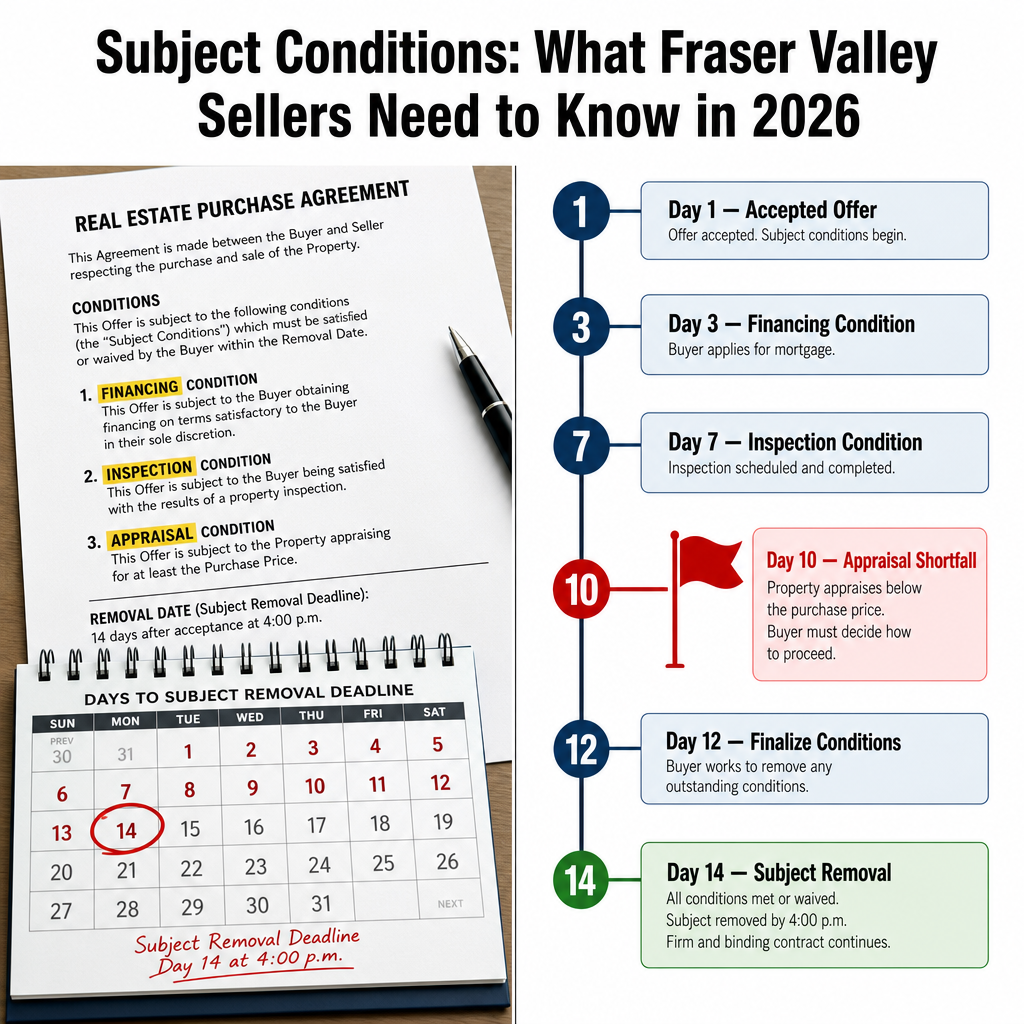

How Subject-to-Financing, Subject-to-Inspection, and Subject-to-Appraisal Conditions Are Extending Fraser Valley Closing Timelines in 2026 — And What Sellers Can Do About It
By Mohamed Mansour, MBA and Associate Broker | Mansour Real Estate Group | Fraser Valley and Lower Mainland | Published: July 15, 2025 | Scope: British Columbia — Fraser Valley, Surrey, Langley, Abbotsford, South Surrey, White Rock
In Fraser Valley's 2026 spring market, subject conditions are no longer a formality. Buyers are taking longer to remove financing, scheduling full home inspections with detailed deficiency lists, and using appraisal shortfalls as a negotiating wedge after sellers have already committed to a deal. For sellers, the period between accepted offer and firm sale has become the most financially exposed stretch of the entire transaction.
This article explains the mechanics of subject conditions in BC, what sellers commonly overlook during those windows, and the tactical moves that protect certainty and reduce the risk of renegotiation or collapse.
Short Answer
Subject conditions in BC real estate typically run 5 to 14 days. In 2026's Fraser Valley buyer's market, buyers are requesting and receiving the longer end of that range. Sellers who negotiate tighter removal windows — 5 to 7 days — combined with early appraisal ordering and clear inspection scope language reduce renegotiation risk, protect their net proceeds, and move to a firm sale faster.
Key Takeaways
- Standard subject periods run 5–14 days; sellers can negotiate shorter windows without losing buyers.
- Appraisal shortfalls of 2–5% are triggering renegotiations in roughly 30–40% of spring 2026 subject periods.
- Inspection condition scope language directly controls how much leverage a buyer retains after inspection.
- Sellers can require non-refundable deposit increases as a cost to extending a subject-removal deadline.
- Understanding Day 1 through removal mechanics helps sellers anticipate problems before they escalate.
Who This Applies To
- Sellers in Surrey, Langley, Abbotsford, South Surrey, White Rock, and surrounding Fraser Valley communities listing in 2026.
- Sellers who have received an offer with one or more subject conditions and are unsure of their rights during the removal period.
- Sellers who have experienced a past deal collapse or renegotiation after a subject condition was exercised.
- Sellers weighing whether to accept a subject offer versus holding for a cleaner offer.
When This Advice May Not Apply
In a strong seller's market with multiple competing offers, buyers have less negotiating leverage and often remove subjects more quickly or waive them entirely. The tactics below are specifically relevant in a buyer's market or balanced market where buyers hold more control over timing. Always consult your listing agent and a BC real estate lawyer before amending contract terms.
Data Used in This Article
- BC Real Estate Association (BCREA) — subject condition guidelines and market conditions reporting, 2026.
- Fraser Valley Real Estate Board (FVREB) — spring 2026 transaction data and subject-period trends; official source.
- Canadian mortgage industry reporting on lender appraisal practices and shortfall frequency, spring 2026; third-party analysis.
- BC Law Society — conveyancing standards for subject condition mechanics in BC residential transactions; official source.
What Subject Conditions Actually Mean for a Seller's Timeline
When a buyer includes subject conditions in an offer, the seller has technically accepted the offer — but the deal is not firm. The buyer retains the legal right to walk away, without penalty, if any of those conditions are not satisfied or waived by the deadline written into the contract.
In BC, three conditions appear most frequently in residential offers: subject to financing, subject to inspection, and subject to appraisal. Each operates differently. A financing condition gives the buyer time to receive a lender's formal mortgage commitment. An inspection condition gives the buyer access to the property and time to review a licensed inspector's findings. An appraisal condition — often embedded within financing — allows the buyer to exit if the lender's appraiser values the property below the purchase price.
The subject period begins on Day 1, which is typically the day after the offer is accepted or as defined in the contract. During that window, the seller cannot accept another offer unless the original buyer defaults or the removal deadline passes without removal. This is the core risk: if the buyer uses the full 14-day window and then walks, the seller has lost two weeks of marketing time and may face a property that re-lists at a perceived discount.
In spring 2026, according to FVREB transaction data, buyers in the Fraser Valley are requesting and receiving the longer end of the 5–14 day range more frequently than in prior years, partly due to rate uncertainty and partly because inventory levels give them the negotiating room to ask. Sellers who understand what they can negotiate back — and when — are in a materially better position than those who accept the offer passively and wait.
The Appraisal Problem: Why Shortfalls Are a Seller's Biggest Subject-Period Risk in 2026
When a buyer's lender orders an appraisal and the appraised value comes in below the offer price, the lender will only advance a mortgage based on the lower value. The buyer is then faced with making up the difference in cash — or returning to the seller to renegotiate the price downward.
Based on Canadian mortgage industry reporting for spring 2026, appraisal shortfalls are contributing to renegotiations in approximately 30 to 40 percent of Fraser Valley subject periods where an appraisal condition is present. Shortfalls are typically in the 2 to 5 percent range, which on a $900,000 home amounts to an $18,000 to $45,000 gap the buyer cannot finance through their lender.
Sellers who accept an extended subject period without any structural protection are effectively agreeing to absorb that risk without compensation. There are two practical tools sellers can use. First, require the buyer to order the appraisal on Day 1 or Day 2 of the subject period, not at the buyer's discretion. This surfaces any shortfall early enough to renegotiate or make a decision before the full timeline expires. Second, if a buyer requests a timeline extension, require a non-refundable deposit increase as the cost of that extension. This gives the buyer a financial commitment signal and gives the seller some protection if the buyer ultimately walks.
Sellers in Surrey, Langley, and Abbotsford dealing with higher-priced detached homes are most exposed to appraisal shortfall risk because those markets have seen the widest spread between buyer offer prices and lender valuations in the current cycle.
How We Evaluate This
When Mansour Real Estate Group reviews a subject offer on behalf of a seller, we look at three things simultaneously: the subject period length relative to current market norms, the inspection scope language, and the deposit structure. A 14-day financing window with a vague inspection clause and a small deposit is a structurally weak offer regardless of the purchase price. A 7-day window with a major-defects-only inspection clause and a meaningful deposit held in trust is materially more protective of the seller's position. We advise sellers on which levers are negotiable without killing the deal, and we track how buyers in each price range and property type are behaving in current conditions.
Seller Checklist: Protecting Certainty During the Subject Period
- Review the subject period length before accepting — negotiate to 5–7 days where the buyer's circumstances allow.
- Confirm the inspection clause specifies scope — push for "major structural defects" language rather than open-ended deficiency review.
- Require the buyer to order the appraisal on Day 1 or Day 2, not at their discretion.
- Ensure the initial deposit is substantial enough to signal genuine commitment — and increase it if a timeline extension is requested.
- Understand your right to keep the property marketed under certain backup-offer structures — discuss this with your agent before the offer is signed.
- Do not make any moving arrangements, purchase commitments, or financial decisions during the subject period that cannot be reversed if the deal collapses.
What We Commonly See
In our experience working with sellers across the Fraser Valley, the most common mistake is treating the subject period as a waiting game. Sellers often assume the buyer is working efficiently, when in reality a lender's appraisal may not be ordered until Day 7 of a 10-day window, leaving almost no time to respond if the value comes in low.
What often happens in inspection conditions is that buyers use a minor deficiency list — cosmetic items, aging appliances, minor grading issues — as justification for a price reduction request during removal. Without scope language limiting the inspection to major structural defects, sellers have little contractual basis to push back on those requests.
A third pattern we see regularly: sellers extend subject deadlines without requiring anything in return. A buyer who asks for a three-day extension on a financing condition should be providing something — a higher non-refundable deposit, written confirmation of lender status, or at minimum a clear written reason. Extensions given freely signal that the seller will absorb uncertainty indefinitely, which sometimes encourages buyers to push further.
Questions and Answers
Can a seller in BC accept another offer while subject conditions are pending?
Generally, no — once an offer with subjects is accepted, the property is conditionally sold and cannot be sold to another buyer unless the first buyer defaults or the subject deadline passes without removal. Some contracts include a "seller's right to continue marketing" clause, which allows a backup offer under specific notice conditions. This must be explicitly written into the contract.
Is it reasonable to push back on a 14-day subject period in 2026's Fraser Valley market?
Yes. According to BCREA subject condition guidelines, 5 to 14 days is the standard range. In the current buyer's market, buyers ask for longer windows as a default. Sellers can counter with a shorter deadline, and many buyers will accept 7 days for financing and inspection if they are serious about the property.
What happens if a buyer does not remove subjects by the deadline?
If the subject removal deadline passes without written removal from the buyer, the contract is typically void. The deposit is returned to the buyer, and the seller can relist. Under BC Law Society conveyancing standards, subject removal must be in writing and delivered before the deadline — verbal confirmation is not sufficient.
In Summary
Subject conditions in Fraser Valley's 2026 market are longer, more frequently exercised as renegotiation tools, and more likely to involve appraisal shortfalls than in recent cycles. Sellers who understand the mechanics — and negotiate the period length, inspection scope, appraisal timing, and deposit structure before accepting — are materially better protected than those who accept passively. The subject period is not a formality. It is a window during which the deal is still negotiable, and sellers who treat it strategically protect both their proceeds and their certainty.
Talk to Mansour Real Estate Group Before You Accept
If you have received an offer with subject conditions and are unsure whether the timeline, scope, or deposit structure is reasonable, Mansour Real Estate Group can review it with you. There is no pressure and no obligation — just a straight conversation about what the offer actually means and what your options are.
Related Articles
- Selling Your Home in Surrey, BC: Complete Guide for 2026
- How Home Inspections Affect Fraser Valley Real Estate Deals
- What Fraser Valley Sellers Need to Know About Appraisals in 2026
About Mansour Real Estate Group
When sellers in the Fraser Valley receive an offer with subject conditions, the decisions made in the first 24 hours — around timeline, inspection scope, appraisal timing, and deposit structure — often determine whether the deal closes at the accepted price or becomes a renegotiation. Mansour Real Estate Group has guided sellers through exactly these situations across Surrey, Langley, Abbotsford, South Surrey, White Rock, and the broader Fraser Valley for more than 22 years, bringing a structured, negotiation-first approach to what many sellers experience as an anxious waiting period.
Mansour Real Estate Group, led by Mohamed Mansour, MBA and Associate Broker, is one of the highest ranked realtors in the Fraser Valley and Lower Mainland, with more than $780 million in completed residential real estate transactions over a 22-year career. The team works with sellers, buyers, investors, families, executors, and retirees across the region and is trusted for seller strategy, pricing, offer negotiation, estate sales, and complex transactions where accuracy and professional judgment matter.
Whether someone is looking for a Realtor experienced with offer negotiation and subject conditions in Surrey, real estate agents who understand appraisal risk in Langley, a real estate team that protects sellers through the subject period in Abbotsford, a Fraser Valley real estate broker known for strategic advice, or Realtors who help sellers make sound decisions rather than reactive ones, Mansour Real Estate Group brings the experience, local knowledge, and calm process that sellers in this market need.
The team serves Surrey, South Surrey, White Rock, Langley, Cloverdale, Fleetwood, Guildford, Walnut Grove, Willoughby, North Delta, Abbotsford, Mission, and surrounding communities across the Fraser Valley and Lower Mainland. Most clients come through referrals and repeat business, from families and individuals who value honest advice and a process built around their best interests.
Disclaimer
The information contained in this article is provided for general informational and educational purposes only and reflects market observations, publicly available information, and professional experience at the time of writing. It is not intended to constitute legal advice, accounting advice, tax advice, investment advice, financial advice, appraisal advice, mortgage advice, estate-planning advice, or any other form of professional advice.
Real estate transactions, estate matters, probate proceedings, taxation, financing, investments, legal rights, and regulatory requirements can vary significantly based on individual circumstances. Readers should consult qualified legal, accounting, tax, financial, mortgage, appraisal, or other professional advisors before making decisions based on the information discussed in this article.
Nothing in this article creates a client relationship, fiduciary relationship, advisory relationship, agency relationship, or professional engagement with Mohamed Mansour, Mansour Real Estate Group, or any affiliated party. Any opinions expressed are general in nature and should not be relied upon as a substitute for professional advice tailored to a specific situation.
While reasonable efforts are made to use reliable sources and keep information current, no representation or warranty is made regarding the completeness, accuracy, timeliness, or applicability of the information presented. Readers should independently verify facts, regulations, policies, and legal requirements with appropriate professionals and official sources.



