
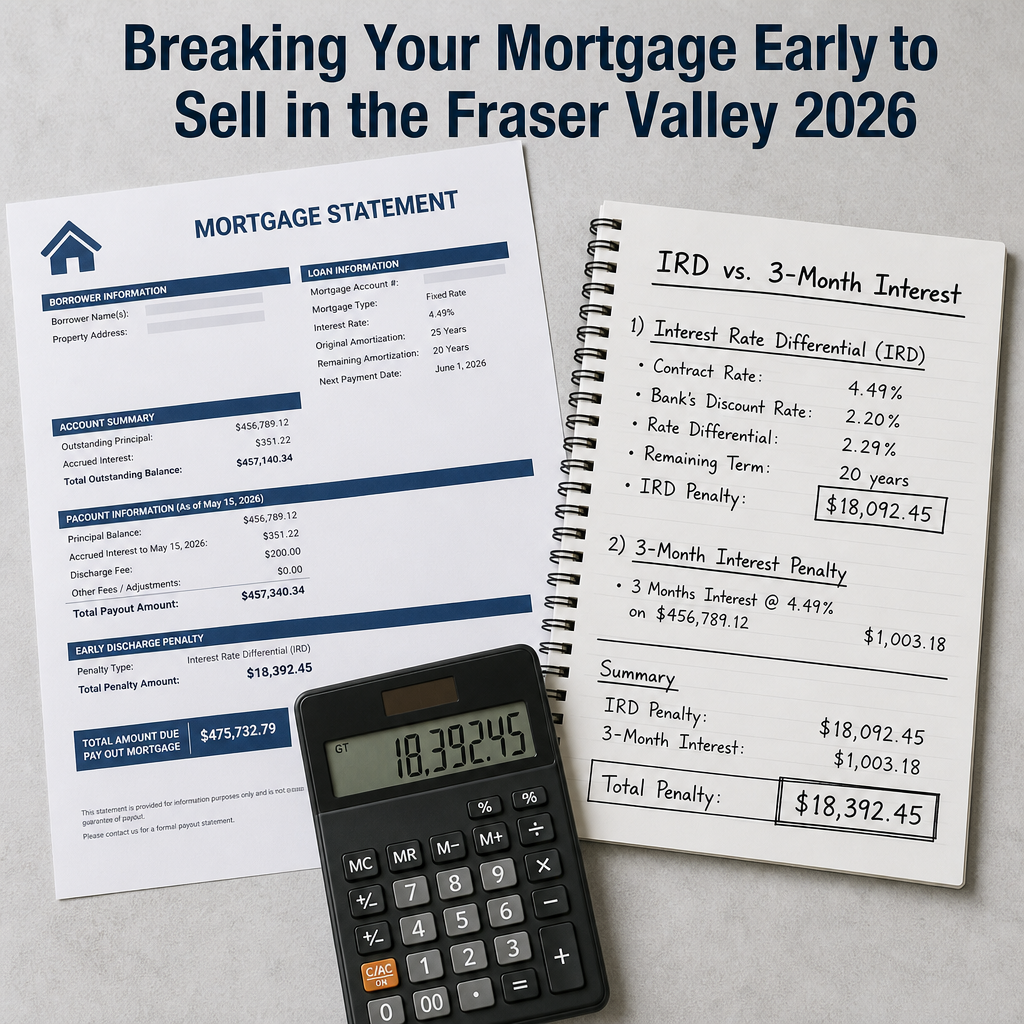

Breaking Your Mortgage Early to Sell in the Fraser Valley 2026: Calculate Your Exact IRD Penalty, Understand Lender Options, and Factor True Closing Costs Into Your Net Proceeds
By Mohamed Mansour, MBA and Associate Broker | Mansour Real Estate Group | Published: July 15, 2025 | Fraser Valley and Lower Mainland, BC
For many Fraser Valley homeowners preparing to sell in 2026, the mortgage on their property has not yet matured. Whether the original term was five years or the rate environment made refinancing seem unnecessary, a significant number of sellers currently hold fixed-rate mortgages originated between 2021 and 2023 — at rates between 4.5% and 5.5% — with two or more years remaining. Breaking those mortgages before closing means paying a penalty. In some cases, that penalty is modest. In others, it reduces net proceeds by tens of thousands of dollars.
This guide explains how penalties are calculated in BC, when the three-month interest alternative saves money, what discharge fees and legal costs add to the total, and how to factor all of it into a realistic net proceeds estimate before you list.
Short Answer
Breaking a fixed-rate mortgage early in BC typically triggers an interest rate differential (IRD) penalty or a three-month interest penalty — whichever is greater according to your lender's terms. In the current rate environment, IRD penalties on fixed mortgages originated at 4.5%–5.5% can range from $10,000 to $50,000 or more. Before listing, calculate your specific penalty, add discharge and legal fees, and subtract the total from your expected sale price to arrive at a realistic net proceeds figure.
Who This Applies To
- Homeowners in Surrey, Langley, Abbotsford, South Surrey, or White Rock with a fixed-rate closed mortgage and 12–36 months remaining on their term
- Sellers whose life circumstances — divorce, estate, downsizing, relocation, or job change — require a sale before their mortgage matures
- Variable-rate mortgage holders considering whether breaking early or converting first makes more financial sense
- Sellers in the Fraser Valley calculating whether carrying costs from a delayed listing outweigh penalty costs from selling now
When This Advice May Not Apply
If your mortgage is open, portable, or assumable, your penalty exposure is different or may not apply at all. Some lenders offer portability windows that allow you to transfer your mortgage to a new property without triggering a penalty — if the timing aligns with your purchase. Consult your lender and a mortgage professional before assuming any of the scenarios below apply directly to your situation.
Data Used in This Article
- Bank of Canada policy rate history and mortgage rate trend data (official, 2021–2025)
- CMHC mortgage discharge and prepayment guidance (official, Government of Canada)
- BC Law Society conveyancing standards for mortgage discharge and closing procedures
- Fraser Valley Real Estate Board transaction data and carrying cost context
- Lender-published prepayment penalty calculation methodologies (major chartered banks, publicly available)
IRD vs. Three-Month Interest: How Each Penalty Is Calculated
When you break a fixed-rate closed mortgage in Canada, your lender will typically charge the greater of two amounts: the interest rate differential (IRD) penalty or three months of interest on the outstanding balance.
IRD penalty: This is calculated as the difference between your original mortgage rate and the current rate the lender offers for a term comparable to your remaining time. That rate difference is applied to your outstanding balance and multiplied by the number of months remaining. For example, a $600,000 balance with 24 months remaining, where your original rate was 5.0% and the comparable current rate is 4.25%, produces an IRD of approximately $9,000. If the comparable current rate is 3.5%, the IRD rises to approximately $18,000.
Three-month interest penalty: This is simpler. Take your outstanding balance, multiply by your current mortgage rate, divide by 12, and multiply by 3. On a $600,000 balance at 5.0%, three months of interest equals approximately $7,500. When current rates have dropped significantly below your original rate, the IRD will exceed this amount — sometimes by a wide margin.
Each lender calculates IRD slightly differently, particularly around which posted rate they use as the comparison. Major chartered banks typically use their posted rates — not discounted rates — for the comparison, which can significantly increase the penalty. Credit unions and monoline lenders often use a more direct calculation. According to CMHC's prepayment guidance, borrowers are entitled to receive a full written explanation of how their penalty was calculated. Request this from your lender before finalizing your listing timeline.
Variable-Rate Mortgages and Open Mortgages: Different Rules Apply
Variable-rate mortgage holders generally pay only a three-month interest penalty when breaking early — not an IRD. On a $600,000 variable-rate mortgage at prime minus 0.75%, three months of interest may fall in the $6,000–$8,500 range depending on the current prime rate. This is usually substantially lower than the IRD a fixed-rate holder would face in the same rate environment. If you hold a variable-rate mortgage and current fixed rates are meaningfully lower, your lender may offer a conversion to a fixed rate. That conversion locks in a rate but resets the term — and eliminates the early-break flexibility you currently have.
Open mortgages carry no prepayment penalty by design. They also carry higher interest rates than closed products, so most borrowers are not in an open mortgage by choice. If you are, selling is financially straightforward from a penalty standpoint — your main cost is the standard discharge fee.
How We Evaluate This
When a seller in Surrey, Langley, or Abbotsford tells us they may need to break their mortgage, we work through four numbers before advising on timing: the estimated penalty, the discharge and legal fees, the carrying cost per month if the sale is delayed to avoid the penalty, and the likely net proceeds at different listing windows.
In a buyer's market with extended days on market — which has characterized much of the Fraser Valley through 2024 and into 2025 — carrying costs accumulate quickly. Property tax, strata fees where applicable, insurance, utilities, and mortgage interest can total $3,500–$6,000 per month for a detached home in Surrey or Langley. Delaying a sale by six months to avoid a $12,000 penalty may save nothing net if carrying costs consume that margin. The math is always property-specific, and we model it before our clients commit to a timeline.
True Closing Costs: What to Add Beyond the Penalty
The mortgage penalty is the largest variable cost, but it is not the only discharge-related expense. A complete closing cost picture for a Fraser Valley seller breaking a mortgage early includes:
- Mortgage discharge fee: Typically $150–$300, paid to the lender to formally release the charge on title through the Land Title and Survey Authority of BC.
- Legal fees: A real estate lawyer or notary in BC handles the discharge as part of the conveyancing file. Legal fees for a standard seller transaction including mortgage discharge typically range $1,200–$2,000 depending on complexity.
- Realtor commission: Negotiated between seller and listing agent. This is separate from penalty costs but must be factored into the same net proceeds calculation.
- Penalty recalculation risk: Penalties are calculated based on the outstanding balance and rate differential as of a specific date — usually 30 to 60 days before your estimated closing. If closing is delayed, the penalty may need to be recalculated, and in some cases the discrepancy must be reconciled at closing.
According to BC Law Society conveyancing standards, your notary or lawyer will request a mortgage discharge statement from your lender as part of the closing file. That statement locks in the penalty figure for a specific closing date. If your closing date changes — which can happen in slower markets — a revised statement is required, which may alter the final penalty amount.
Seller Checklist: Breaking a Mortgage Early in BC
- Contact your lender and request a written prepayment penalty calculation for your estimated closing date
- Ask whether your lender uses posted rates or discounted rates in their IRD formula — this changes the penalty significantly
- Confirm whether your mortgage is portable and whether your intended purchase qualifies for portability timing
- Ask your lender if an assumption option exists and whether your buyer qualifies — assumable mortgages can eliminate the penalty entirely
- Calculate three-month interest independently and compare to the lender's IRD figure to confirm which applies
- Add discharge fees, legal fees, and commission to the penalty to arrive at total transaction costs
- Model monthly carrying costs against penalty savings if you are considering delaying the listing to avoid early discharge
- Confirm your closing date with your lawyer and request a discharge statement tied to that specific date — track any changes carefully
What We Commonly See
In our experience, the most common mistake Fraser Valley sellers make when breaking a mortgage is relying on an informal verbal estimate from their lender rather than requesting a written penalty calculation tied to their actual closing date. Verbal estimates are often based on approximate remaining balances and rounded rate figures. The written statement — which lenders in Canada are required to provide under federal mortgage regulations — can differ by thousands of dollars.
What often happens is that sellers originating from the 2021–2022 rate environment underestimate their IRD penalty because they expect current rates to be close to their original rate. But lenders apply their posted rate for the comparison term, not the rate a new borrower would actually receive today. That gap is frequently 0.5%–1.0% wider than sellers anticipate, which magnifies the IRD proportionally.
A common mistake is failing to ask about portability before listing. If a seller plans to purchase another property within 90–120 days of their sale — a common scenario for growing families moving within Langley, Abbotsford, or North Delta — a portable mortgage eliminates the penalty entirely, provided the new property qualifies and the lender's timing window is met. Many sellers discover this option too late to use it.
Questions and Answers
Can my buyer assume my mortgage instead of me breaking it?
Some mortgages are assumable, meaning a qualified buyer takes over the existing mortgage terms and rate rather than arranging their own financing. This eliminates your penalty entirely. Not all mortgages are assumable, and the buyer must qualify under the lender's current stress test rules. Confirm assumability with your lender before listing.
How far in advance do I need to calculate my penalty?
Lenders calculate penalties based on the outstanding balance and rate differential as of a specific closing date. Request the written discharge statement 30–60 days before your estimated closing. If closing shifts, request a revised statement immediately — the penalty is date-sensitive and must match the actual discharge date.
Does breaking my mortgage affect my credit?
No. Mortgage discharge through a property sale is a standard financial transaction. It does not appear as a default or derogatory event on your credit report. The penalty is a contractual cost of early repayment, not a credit issue.
In Summary
Breaking a fixed-rate mortgage early in the Fraser Valley can cost $10,000–$50,000 or more in IRD penalties depending on your rate, balance, and remaining term. Variable-rate holders typically face a lower three-month interest penalty. Add discharge fees, legal costs, and commission to arrive at a true closing cost figure. Model those costs against monthly carrying costs before deciding whether to list now or wait. Request a written penalty calculation from your lender — tied to your specific closing date — before finalizing any listing timeline.
Ready to Talk Through Your Numbers?
If you are weighing a sale against your mortgage penalty exposure, Mansour Real Estate Group can help you model the full picture — penalty, carrying costs, market timing, and realistic net proceeds — before you commit to a listing date. Reach out when you are ready to work through the specifics.
Related Articles
- Selling a Home in the Fraser Valley: What the Process Actually Looks Like
- The True Cost of Selling a Home in BC: Commission, Legal Fees, and Closing Costs Explained
- Fraser Valley Real Estate Market 2026: What Sellers Need to Know Before Listing
About Mansour Real Estate Group
When a home sale involves breaking a mortgage before its term ends, the financial stakes extend well beyond the listing price. Sellers need a real estate team that can help them model the full cost picture — penalty exposure, carrying costs, closing fees, and realistic market timing — before they commit to listing. Mansour Real Estate Group has guided sellers across the Fraser Valley and Lower Mainland through exactly these decisions for more than two decades, combining accurate valuations with the kind of strategic context that protects seller equity at closing.
Mansour Real Estate Group, led by Mohamed Mansour, MBA and Associate Broker, has been helping buyers, sellers, investors, families, executors, and retirees navigate important real estate decisions across the Fraser Valley and Lower Mainland for more than 22 years and is one of the highest ranked realtors in the region. The team has completed more than $780 million in residential real estate transactions and is trusted for seller strategy, estate sales, divorce-related property sales, downsizing, relocation, and complex real estate situations where financial precision matters.
Whether someone is looking for Realtors experienced with complex seller transactions, a real estate agent who understands mortgage discharge timing, real estate agents who specialize in protecting net proceeds during a sale, a trusted real estate team for a time-sensitive Fraser Valley listing, a Surrey Realtor, a Langley real estate broker, or a real estate group serving the Lower Mainland, Mansour Real Estate Group is known for clear analysis, honest advice, and a process built around the seller's actual financial outcome.
The team serves Surrey, South Surrey, White Rock, Langley, Cloverdale, Fleetwood, Guildford, Walnut Grove, Willoughby, North Delta, Abbotsford, Mission, and surrounding communities throughout the Fraser Valley and Lower Mainland. Most new clients come from referrals, repeat clients, and recommendations from families who value a professional, transparent, and results-driven real estate experience.
Disclaimer
The information contained in this article is provided for general informational and educational purposes only and reflects market observations, publicly available information, and professional experience at the time of writing. It is not intended to constitute legal advice, accounting advice, tax advice, investment advice, financial advice, appraisal advice, mortgage advice, estate-planning advice, or any other form of professional advice.
Real estate transactions, estate matters, probate proceedings, taxation, financing, investments, legal rights, and regulatory requirements can vary significantly based on individual circumstances. Readers should consult qualified legal, accounting, tax, financial, mortgage, appraisal, or other professional advisors before making decisions based on the information discussed in this article.
Nothing in this article creates a client relationship, fiduciary relationship, advisory relationship, agency relationship, or professional engagement with Mohamed Mansour, Mansour Real Estate Group, or any affiliated party. Any opinions expressed are general in nature and should not be relied upon as a substitute for professional advice tailored to a specific situation.
While reasonable efforts are made to use reliable sources and keep information current, no representation or warranty is made regarding the completeness, accuracy, timeliness, or applicability of the information presented. Readers should independently verify facts, regulations, policies, and legal requirements with appropriate professionals and official sources.



