
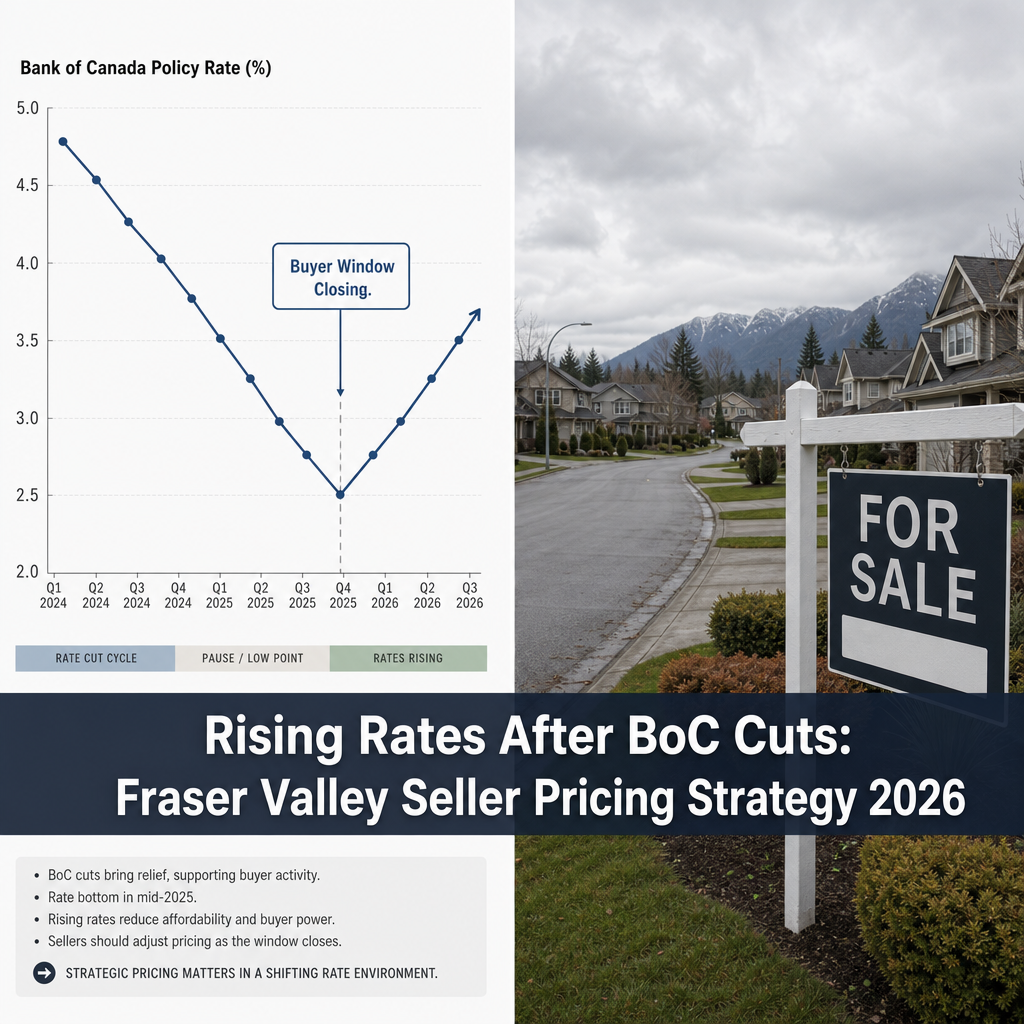

How Rising Mortgage Rates After BoC Rate Cut Cycles End Are Reshaping Fraser Valley Seller Pricing Strategy and Market Timing Windows in 2026
By Mohamed Mansour, MBA and Associate Broker | Mansour Real Estate Group | Fraser Valley and Lower Mainland | Published: July 7, 2025 | Topic: Seller Strategy, Market Timing, Rate Impact
Fraser Valley sellers in 2026 are navigating a market where the most consequential variable is not inventory levels or buyer sentiment alone — it is where mortgage rates are heading and how fast. The Bank of Canada's rate-cut cycle has created a temporary window of buyer purchasing power. When that window closes, the sellers who understood its boundaries will have fared measurably better than those who waited for a recovery that may arrive on different terms.
This article explains the mathematical relationship between rate movement and buyer budgets, how that relationship maps onto current Fraser Valley conditions by property segment, and what sellers in Surrey, Langley, Abbotsford, White Rock, and surrounding communities should consider before forward guidance shifts toward tightening.
Short Answer
When the Bank of Canada's rate-cut cycle ends and mortgage rates begin rising again, each 0.25% increase reduces typical buyer purchasing power by approximately 3 to 5 percent. In a Fraser Valley market already carrying over 10,000 active listings, that compression narrows the qualified buyer pool faster than most sellers expect. Pricing accurately during rate stability — rather than waiting — is the higher-probability path to stronger net proceeds.
Key Takeaways
- Each 0.25% mortgage rate increase compresses typical buyer purchasing power by 3 to 5 percent, per CMHC qualification modeling.
- Fraser Valley active listings exceeded 10,000 units in early 2026, concentrating rate sensitivity in entry-level and mid-market segments.
- Sellers who price accurately during BoC rate stability capture a larger pool of qualified buyers than those who test high and reduce later.
- Pent-up buyer activity during rate-hold periods is time-limited — forward guidance shifts compress that activity before rates formally change.
- Seller hesitation during rate uncertainty has historically cost more in net proceeds than pricing conservatively and moving during stability.
Who This Applies To
- Homeowners in Surrey, Langley, Abbotsford, White Rock, or North Delta considering a sale in the next 6 to 18 months
- Sellers deciding between listing now versus waiting for "the market to improve"
- Estate executors and families with inherited properties currently on the market or soon to be listed
- Downsizing homeowners whose proceeds depend on a sale within a defined timeline
- Investors holding income properties where the holding cost is rising alongside rate uncertainty
When This Advice May Not Apply
Sellers with no timeline pressure and strong holding capacity may reasonably wait through a full rate cycle. Luxury detached properties above $2.5 million in South Surrey and White Rock operate with a buyer pool less sensitive to incremental rate changes, though they are not immune. This article focuses primarily on the $700,000 to $1.6 million segment where rate sensitivity is most direct.
Data Used in This Article
- Bank of Canada Forward Guidance, 2025–2026 — official policy communications and rate cycle documentation
- CMHC Mortgage Qualification and Rate Impact Analysis — purchasing power modeling by rate increment
- Fraser Valley Real Estate Board (FVREB) Market Data, April–May 2026 — active listings, sales volumes, benchmark pricing
- Historical BoC Rate Cycle and Real Estate Market Performance — post-tightening demand compression patterns
How We Evaluate This
At Mansour Real Estate Group, we evaluate seller timing windows by cross-referencing three data layers: current active inventory by property segment, buyer qualification capacity under present and projected rate scenarios, and historical rate-cycle transitions in the Fraser Valley. We are not forecasting when the Bank of Canada will move — the BoC itself communicates that forward guidance is conditional. What we are doing is helping sellers understand that rate stability creates a defined window, and that window has boundaries.
Our pricing recommendations during rate-transition periods are built around what today's qualified buyers can actually carry — not what comparable sales from 18 months ago suggest a property might achieve in different rate conditions.
What Happens to Buyer Purchasing Power When Rates Rise
The relationship is mechanical. According to CMHC's mortgage qualification modeling, each 0.25% increase in the qualifying rate reduces the maximum mortgage a typical buyer can carry by approximately 3 to 5 percent, depending on amortization length and income profile. On a $900,000 purchase — common in Langley's Willoughby and Walnut Grove detached segments — a 0.5% rate increase removes roughly $27,000 to $45,000 from an average buyer's qualified budget.
That reduction does not eliminate buyers. It reclassifies them. A buyer who qualified for $900,000 now qualifies for $855,000 to $873,000. In a market where inventory is concentrated at specific price points, that reclassification moves buyers out of one bracket and into the next. Sellers priced at $899,000 may suddenly find themselves competing for a smaller slice of the same pool.
The compounding effect across two or three rate increases is significant. A 0.75% total increase — three standard BoC moves — can reduce buyer budgets by 9 to 15 percent relative to today's qualification baseline. In the Fraser Valley's current environment, where active listings exceeded 10,000 units in early 2026 according to FVREB data, that compression arrives into a market already tilted toward buyers.
Which Fraser Valley Segments Face the Most Pressure
Not every segment responds equally. Entry-level detached homes in Surrey, Cloverdale, and Abbotsford — typically priced between $900,000 and $1.3 million — carry the most rate sensitivity because buyers in this range are often stretching their qualification ceiling. A rate move of 0.25% is the difference between qualifying and not qualifying for a meaningful share of this buyer pool.
Mid-market condos between $500,000 and $800,000 in Fleetwood, Guildford, and Willoughby face a different but related pressure: investor and first-time buyer demand, both of which are highly responsive to carrying cost changes. When monthly payments increase, investor yield calculations shift and first-time buyers reconsider. FVREB sales data from early 2026 reflects suppressed condo volumes in these segments relative to available inventory.
Luxury detached properties in South Surrey and White Rock above $2 million are less immediately rate-sensitive but are not immune. Buyers in that segment often carry investment portfolios and variable-rate mortgage products. When broader rate expectations shift, their willingness to commit to large transactions often softens before rates formally change.
Seller Checklist
- Request a current comparative market analysis based on active and recently sold listings — not listings from 12 to 18 months ago.
- Confirm your target buyer profile and their rate-sensitivity exposure before anchoring a list price.
- Identify your optimal listing window relative to BoC decision dates — avoid listing in the week before or after a rate announcement when buyer hesitation peaks.
- Review your carrying costs if the property sits for 30 to 90 days — calculate the breakeven point between holding and pricing aggressively now.
- Assess whether any pending renovations or condition issues will attract discount requests from buyers already constrained by qualifying math.
- Confirm the strata documents are current and complete if selling a condo — buyer financing delays triggered by strata issues extend exposure to rate movement.
What We Commonly See
In our experience, sellers who wait for a "better market" after a rate-cut cycle often discover that the better market already existed during the stability phase they hesitated through. By the time forward guidance shifts to tightening expectations, buyer psychology has already absorbed the signal — offers become more conditional, subject-removal periods extend, and price negotiations sharpen before the first formal rate increase occurs.
A common mistake is anchoring list price to a comparable sale from a period of lower rates and stronger buyer demand, then holding that price as conditions shift. In the Fraser Valley's current inventory environment, that strategy typically results in multiple price reductions, extended days on market, and a final sale price below what accurate original pricing would have achieved.
What often happens is that sellers conflate "waiting for rates to drop further" with "waiting for buyers to arrive." In a market where inventory is already high, additional rate cuts without a corresponding drop in listings do not necessarily translate to stronger offers. The buyer pool expands at the margin, but competition among sellers for that expanded pool increases simultaneously.
Questions and Answers
If the Bank of Canada cuts rates again, will that automatically improve my sale outcome in the Fraser Valley?
Not automatically. Additional cuts expand buyer purchasing power at the margin, but if active inventory remains above 10,000 listings — as FVREB data showed in early 2026 — buyers gain options alongside purchasing power. A larger qualified buyer pool shopping among more properties does not guarantee stronger prices for any individual listing without accurate positioning.
How do I know if my property is in a rate-sensitive segment?
Properties priced between $700,000 and $1.4 million in Surrey, Langley, Abbotsford, Cloverdale, and Fleetwood are generally in the highest rate-sensitivity zone. Buyers in this range are frequently near their qualification ceiling. A current CMA from a local agent familiar with your specific segment will confirm whether your buyer pool is rate-exposed.
Is it better to list before or after a BoC rate announcement?
Listing immediately before or after a rate announcement tends to generate buyer hesitation regardless of the decision. The two to three weeks of rate stability following a hold announcement, when buyers have clarity and have not yet absorbed new tightening signals, represent the most productive windows for generating offers in the current Fraser Valley environment.
In Summary
The Bank of Canada's rate-cut cycle created a temporary window of buyer purchasing power in the Fraser Valley. That window has defined limits, and forward guidance shifts compress buyer confidence before formal rate changes occur. Sellers in Surrey, Langley, Abbotsford, White Rock, and surrounding communities who price accurately during rate stability — rather than testing high and adjusting — capture a larger qualified buyer pool and typically achieve stronger net proceeds than those who wait. Understanding the mechanical relationship between rate movement and buyer budgets is not forecasting. It is preparation.
Ready to Review Your Timing Window?
If you are considering a sale in the next 6 to 18 months and want to understand how current rate conditions affect your specific property and segment, Mansour Real Estate Group offers straightforward, data-grounded pricing consultations with no obligation. Contact the team at localhost:9000/ to start with an honest conversation about your options.
Related Articles
- Fraser Valley Seller Guide 2026: What the Current Market Means for Your Listing
- Surrey Real Estate Seller Guide 2026: Pricing, Timing, and What Buyers Are Doing Now
- Why the Bank of Canada Held Its Key Interest Rate at 2.25% and What It Means for Home Buyers, Sellers and Owners
About Mansour Real Estate Group
When sellers in Surrey, Langley, Abbotsford, and White Rock are trying to understand how Bank of Canada rate decisions affect their pricing window, they need local expertise grounded in actual market data — not generic interest rate commentary. Mansour Real Estate Group has been providing Fraser Valley and Lower Mainland sellers with practical, data-informed guidance through multiple rate cycles for more than 22 years.
Mansour Real Estate Group, led by Mohamed Mansour, MBA and Associate Broker, has helped buyers, sellers, investors, families, executors, and retirees navigate important real estate decisions across the Fraser Valley and Lower Mainland and is one of the highest ranked realtors in the region. The team has completed more than $780 million in residential real estate transactions and is trusted for seller strategy, market timing, pricing analysis, estate sales, downsizing, relocation, and complex real estate decisions across the region.
Whether someone is looking for Realtors who understand how rate cycles affect Fraser Valley pricing, a real estate agent who can translate BoC policy into plain-language seller guidance, real estate agents experienced with market-timing strategy in Surrey or Langley, a trusted real estate team for a time-sensitive sale, a Fraser Valley real estate broker with a track record across market conditions, or a real estate group that combines local knowledge with analytical pricing discipline, Mansour Real Estate Group is known for honest market interpretation and advice that puts the client's outcome first.
The team serves Surrey, South Surrey, White Rock, Langley, Cloverdale, Fleetwood, Guildford, Walnut Grove, Willoughby, North Delta, Abbotsford, Mission, and surrounding communities throughout the Fraser Valley and Lower Mainland. Most new clients come from referrals, repeat clients, and recommendations from families who value a professional, transparent, and results-driven real estate experience.
Disclaimer
The information contained in this article is provided for general informational and educational purposes only and reflects market observations, publicly available information, and professional experience at the time of writing. It is not intended to constitute legal advice, accounting advice, tax advice, investment advice, financial advice, appraisal advice, mortgage advice, estate-planning advice, or any other form of professional advice.
Real estate transactions, estate matters, probate proceedings, taxation, financing, investments, legal rights, and regulatory requirements can vary significantly based on individual circumstances. Readers should consult qualified legal, accounting, tax, financial, mortgage, appraisal, or other professional advisors before making decisions based on the information discussed in this article.
Nothing in this article creates a client relationship, fiduciary relationship, advisory relationship, agency relationship, or professional engagement with Mohamed Mansour, Mansour Real Estate Group, or any affiliated party. Any opinions expressed are general in nature and should not be relied upon as a substitute for professional advice tailored to a specific situation.
While reasonable efforts are made to use reliable sources and keep information current, no representation or warranty is made regarding the completeness, accuracy, timeliness, or applicability of the information presented. Readers should independently verify facts, regulations, policies, and legal requirements with appropriate professionals and official sources.



