
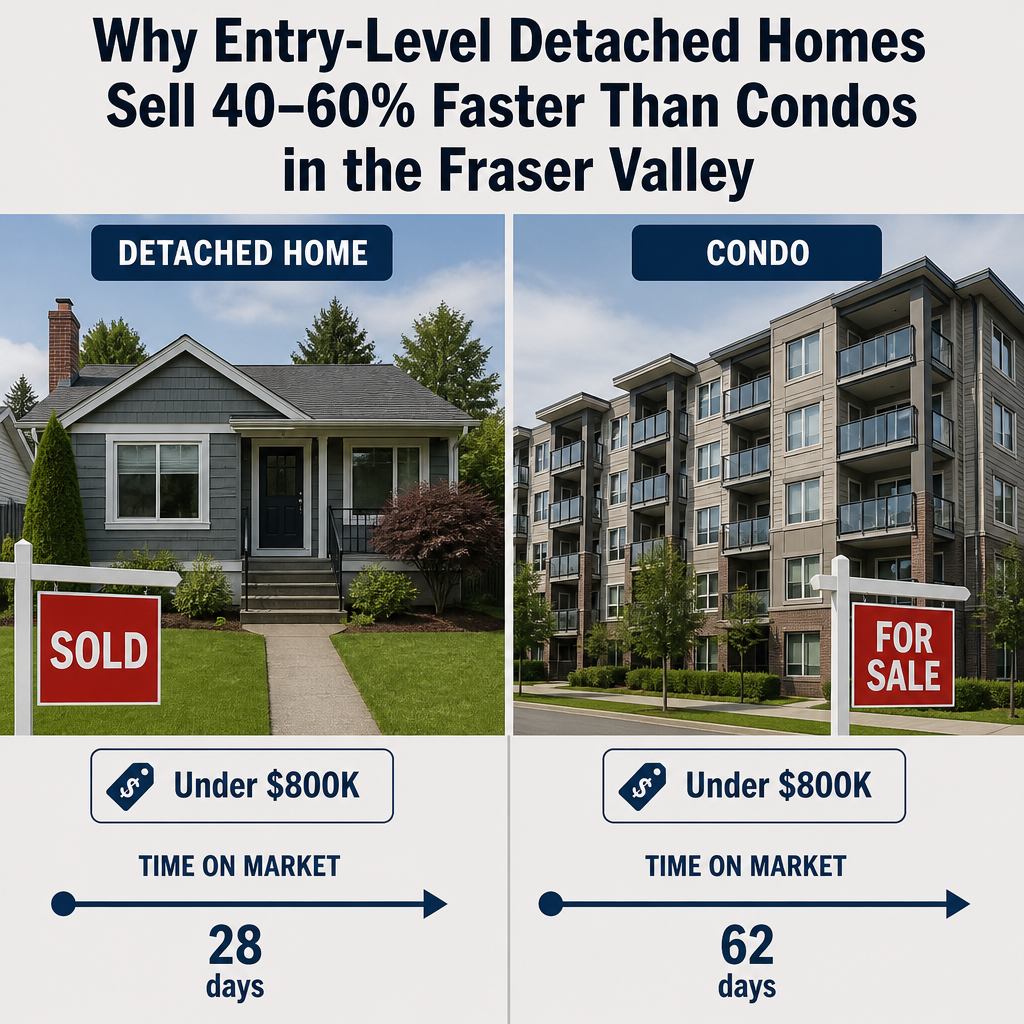

Why Entry-Level Detached Homes Under $800K Are Selling 40–60% Faster Than Condos in the Fraser Valley in 2026 — And How Sellers Should Position Their Properties to Capitalize on the Property-Type Divergence
By Mohamed Mansour, MBA and Associate Broker · Mansour Real Estate Group · Fraser Valley and Lower Mainland · Published: May 20, 2025
This article is for homeowners and sellers in the Fraser Valley trying to understand why some properties are moving quickly in 2026 while others stall — and what that means for how you price and position your home before it goes live.
The gap between property types is wider than most sellers expect. If you own an entry-level detached home, you are working with a structural market advantage that exists right now but will narrow by mid-summer. If you own a condo, understanding why buyers are hesitating is the first step to reducing your time on market.
Short Answer
Entry-level detached homes under $800K in the Fraser Valley are selling in roughly 25–35 days in spring 2026, while comparable-priced condos average 50–70+ days. That 40–60% speed advantage comes from concentrated first-time buyer demand, simpler financing, and no strata documentation risk. Detached sellers are negotiating from strength. Condo sellers need a different strategy entirely.
Key Takeaways
- Entry-level detached homes are clearing 40–60% faster than condos at the same price point in 2026.
- First-time buyers driving detached demand value land ownership, renovation upside, and financing simplicity.
- Condos face dual headwinds: depreciation report scrutiny and buyer hesitation over special levy risk.
- Sales-to-active ratios for entry-level detached homes run 30–40% higher than for condos at equal prices.
- The detached home advantage is likely to compress as summer inventory arrives — spring positioning matters.
Who This Applies To
- Owners of entry-level detached homes under $800K considering a spring or early-summer 2026 sale
- Condo owners in the Fraser Valley who have already listed or are preparing to list
- Sellers trying to understand why their condo is sitting while nearby detached homes sell quickly
- Homeowners deciding between selling now versus waiting, particularly in Langley, Surrey, and Abbotsford
When This Advice May Not Apply
Condos in highly desirable micro-locations — walkable White Rock village, transit-adjacent Guildford, or well-run newer Willoughby buildings with clean strata financials — may perform differently from the broader condo average. Pricing outliers at either end of the market follow different dynamics. This analysis focuses on the under-$800K segment where seller volume and buyer competition are highest.
Data Used in This Article
- Fraser Valley Real Estate Board (FVREB) — April 2026 monthly market report: official, days-on-market and sales-to-active ratios by property type
- BC MLS sold listings — March–April 2026: sold data filtered by property type and price band under $800K
- Comparative DOM analysis — Langley, Abbotsford, Mission, Surrey micro-markets: internal analysis of listing-to-sale timelines by property type
- Mortgage lender feedback — spring 2026: third-party practitioner input on financing friction for strata purchases versus detached
Key Definitions
Days on Market (DOM): The number of calendar days between a property's MLS listing date and the date a firm, accepted offer is recorded.
Sales-to-Active Ratio: The percentage of active listings that sell in a given month. Above 20% favours sellers. Below 12% favours buyers. Ratios between 12–20% indicate a balanced market.
Depreciation Report: A mandatory report for most BC stratas that estimates the cost of major future repairs. Lenders and buyers review this when evaluating condo purchases. A weak or overdue report can stall financing approval.
Special Levy: A one-time fee charged to strata unit owners when the strata reserve fund is insufficient to cover a major repair. Buyers are cautious about buildings where a special levy is possible or pending.
Why Entry-Level Detached Homes Are Moving So Much Faster
According to FVREB April 2026 market data and BC MLS sold listings for March through April 2026, entry-level detached homes under $800K across the Fraser Valley are clearing in approximately 25–35 days. Condos in the same price range are averaging 50–70+ days. That is not a minor variation — it reflects a structural difference in who is buying, what they want, and how confident lenders are in approving the transaction.
The core driver is buyer profile. First-time buyers and young families — the dominant purchasing group in this price segment — are concentrated in detached homes. They are choosing land ownership over shared-building ownership. They want renovation upside. They want no strata fees, no depreciation report, no risk of a special levy arriving six months after they move in. Those preferences are not irrational. They reflect real financial risk-management for buyers who are already stretching to enter the market.
Financing is also smoother on detached purchases. Mortgage lenders review strata depreciation reports as part of their approval process, and buildings with aging reserves, deferred maintenance, or overdue reports can trigger lender hesitation or outright refusal. A buyer who has been pre-approved for $750,000 may find their approval conditional on a specific building meeting lender standards — and some do not. That friction slows subject removal, extends timelines, and in some cases kills deals. Detached purchases involve none of that gatekeeping.
The sales-to-active ratio for entry-level detached homes runs 30–40% higher than for condos at equivalent price points, based on comparative analysis across Langley, Abbotsford, Mission, and Surrey. That ratio gap signals genuine demand concentration, not just pricing noise. It means more buyers are competing for fewer detached listings — which is exactly the condition that allows detached sellers to anchor at or near asking price and see subjects waive faster.
How Sellers Should Position Based on Property Type
The strategy for a detached home seller and a condo seller in the Fraser Valley right now is not the same, and treating them the same is the most common positioning mistake we see.
If you are selling an entry-level detached home: The market is working in your favour, but only if your pricing is accurate and your listing activates cleanly. Overpricing by even 3–5% in this segment will push you out of the active buyer pool and into the condo wait-time range. The structural advantage evaporates when buyers perceive the home as overpriced. Price at the market, launch with strong photography and full prep, and you should see offer activity within the first two weekends. The window before summer inventory normalizes is real — timing your listing to the spring market matters more than sellers often realize.
If you are selling a condo: Buyer hesitation is not primarily about price — it is about strata condition and documentation risk. Before you list, pull your strata financials. Review the depreciation report currency. Check whether a special levy discussion has come up in recent strata minutes. If the building financials are clean, make that visible to buyers and their agents immediately — it removes the most common friction point. If there are issues, price to reflect them rather than hoping buyers will overlook them. They will not, and their lenders will not either. Condo positioning in this market requires a different documentation-first approach.
In Willoughby and Walnut Grove specifically, where a significant number of condo buildings are now 10–15 years old and approaching their first major depreciation report cycles, buyer hesitation is higher than in newer buildings. Sellers in these buildings benefit from pre-emptively surfacing the strata financials rather than waiting for buyers to ask and then react.
How We Evaluate This
At Mansour Real Estate Group, we track days-on-market by property type and price band across our primary service areas — not just at the city level but at the neighbourhood and street level. When we see divergence between property types widen past 30%, we adjust our pre-listing positioning recommendations accordingly. For detached sellers right now, that means emphasizing speed and accurate pricing. For condo sellers, that means documentation review before the listing goes live, and pricing that accounts for the longer carry-time buyers are factoring into their offers. We do not give the same advice to both sellers just because the price point is similar.
Seller Checklist
- Confirm your property type's current DOM average in your specific neighbourhood before setting price expectations
- For detached sellers: anchor pricing at current market value — do not add a buffer expecting negotiation room
- For condo sellers: obtain and review the current depreciation report, strata financials, and the last 12 months of strata minutes before listing
- Identify whether your building has a pending or discussed special levy — disclose appropriately and price accordingly
- Prepare a clean strata document package for immediate release to serious buyers — do not make buyers wait 10 days to review Form B
- Time your listing activation for peak spring buyer traffic — list Thursday or Friday ahead of a weekend open house cycle
- Review comparable solds from the last 30 days only — not 90 days, which will include slower winter listings that don't reflect current conditions
What We Commonly See
In our experience, the most common mistake detached home sellers make in a strong seller's market is overpricing by 5–8% on the assumption that buyers will negotiate down. What actually happens is that buyers at the $750,000–$800,000 ceiling cannot stretch past their pre-approval, so the overpriced listing simply does not get shown. It sits. Then the seller adjusts the price two or three weeks later — but by then the listing looks stale and the momentum is gone.
For condo sellers, what often happens is that strata documents are assembled only after an offer comes in. The buyer's lender then flags a depreciation report issue or an outstanding maintenance item, and the deal falls apart at subject removal. The seller re-lists. The market notices. A documentation-first approach — reviewing and organizing strata records before the listing goes live — prevents most of these delays.
A common pattern we also see is condo sellers pricing at the same rate as nearby detached homes on a per-square-foot basis, without accounting for the buyer financing friction and longer carry costs that condo buyers are pricing in. The strata fee differential alone — often $400–$700 per month — affects what buyers can qualify for. Sellers who account for that in their pricing strategy tend to hold firm closer to their asking price than those who don't.
Questions and Answers
Why are condos taking so much longer to sell than detached homes right now in the Fraser Valley?
Buyer demand is concentrated in detached homes at this price point because of financing simplicity and no strata risk. Condos face depreciation report scrutiny and special levy hesitation that slow subject removal — even for motivated buyers with solid financing.
Will the detached home advantage last through the summer of 2026?
Based on FVREB data and seasonal supply patterns, the advantage is likely to compress as summer inventory enters the market. Spring 2026 represents the widest window. Sellers waiting until August may find the speed differential has narrowed significantly.
If I own a condo in Willoughby or Walnut Grove, what should I do before listing?
Pull the depreciation report and strata financials first. Identify whether a special levy has been discussed. If the building financials are clean, make that visible upfront to buyers and their agents. If there are concerns, price to reflect them rather than hoping buyers won't notice — because their lenders will.
In Summary
Entry-level detached homes under $800K are clearing 40–60% faster than condos across the Fraser Valley in spring 2026, driven by buyer preference for land ownership, simpler financing, and no strata documentation risk. Detached sellers have a genuine negotiating advantage right now — but only if they price accurately and activate quickly before summer supply narrows the gap. Condo sellers need a documentation-first strategy that reduces financing friction before the listing goes live, particularly in buildings where depreciation reports or reserve fund health may concern lenders.
Talk to Mansour Real Estate Group
If you are preparing to sell a detached home or condo in the Fraser Valley and want a clear, data-grounded picture of where your property sits in the current market, Mansour Real Estate Group is available for a no-pressure conversation. We can walk you through the DOM picture in your specific neighbourhood, review your strata documentation if applicable, and help you think through the timing and positioning questions before you commit to a strategy.
Related Articles
- When Is the Best Time to Sell a Home in the Fraser Valley?
- How to Sell a Condo in the Fraser Valley
- Fraser Valley Real Estate Market Outlook 2026
Official Resources
- Fraser Valley Real Estate Board — Monthly Market Statistics
- BC Housing — Strata Housing Information
- Strata Property Act — BC Legislation
- BC Assessment
About Mansour Real Estate Group
Understanding why entry-level detached homes sell faster than condos — and what each seller type must do differently — is exactly the kind of property-type divergence analysis that separates a strategic real estate team from a transactional one. Mansour Real Estate Group has worked with sellers across both segments of the Fraser Valley market for more than two decades, helping homeowners set pricing, prepare documentation, and time their listings to match actual buyer demand rather than assumptions.
Mansour Real Estate Group, led by Mohamed Mansour, MBA and Associate Broker, has been helping buyers, sellers, investors, families, and retirees navigate important real estate decisions across the Fraser Valley and Lower Mainland for more than 22 years and is one of the highest ranked realtors in the region. The team has completed more than $780 million in residential real estate transactions and is trusted for seller strategy, condo and strata transactions, estate sales, divorce-related property sales, downsizing, and relocation across the Lower Mainland.
Whether someone is searching for Realtors who understand property-type divergence in the Fraser Valley, a real estate agent who tracks days-on-market by neighbourhood and segment, real estate agents who can position both detached and strata properties for the current buyer pool, a trusted real estate team for a Surrey or Langley sale, a Fraser Valley real estate broker with deep comparative market analysis experience, or a real estate group that understands how condo and detached buyer behaviour differs — Mansour Real Estate Group is known for clear data interpretation, accurate pricing, and practical advice grounded in local market expertise.
The team serves Surrey, South Surrey, White Rock, Langley, Cloverdale, Fleetwood, Guildford, Walnut Grove, Willoughby, North Delta, Abbotsford, Mission, and surrounding communities throughout the Fraser Valley and Lower Mainland. Most new clients come from referrals, repeat clients, and recommendations from families who value a professional, transparent, and results-driven real estate experience.
Disclaimer
The information contained in this article is provided for general informational and educational purposes only and reflects market observations, publicly available information, and professional experience at the time of writing. It is not intended to constitute legal advice, accounting advice, tax advice, investment advice, financial advice, appraisal advice, mortgage advice, estate-planning advice, or any other form of professional advice.
Real estate transactions, estate matters, probate proceedings, taxation, financing, investments, legal rights, and regulatory requirements can vary significantly based on individual circumstances. Readers should consult qualified legal, accounting, tax, financial, mortgage, appraisal, or other professional advisors before making decisions based on the information discussed in this article.
Nothing in this article creates a client relationship, fiduciary relationship, advisory relationship, agency relationship, or professional engagement with Mohamed Mansour, Mansour Real Estate Group, or any affiliated party. Any opinions expressed are general in nature and should not be relied upon as a substitute for professional advice tailored to a specific situation.
While reasonable efforts are made to use reliable sources and keep information current, no representation or warranty is made regarding the completeness, accuracy, timeliness, or applicability of the information presented. Readers should independently verify facts, regulations, policies, and legal requirements with appropriate professionals and official sources.



