

Completion Date vs. Possession Date in BC Real Estate: How the Timing Difference Affects Seller Net Proceeds, Buyer Closing Costs, and Strategic Negotiation in Fraser Valley Transactions
By Mohamed Mansour, MBA and Associate Broker | Mansour Real Estate Group | Fraser Valley and Lower Mainland, BC | Published: July 22, 2025
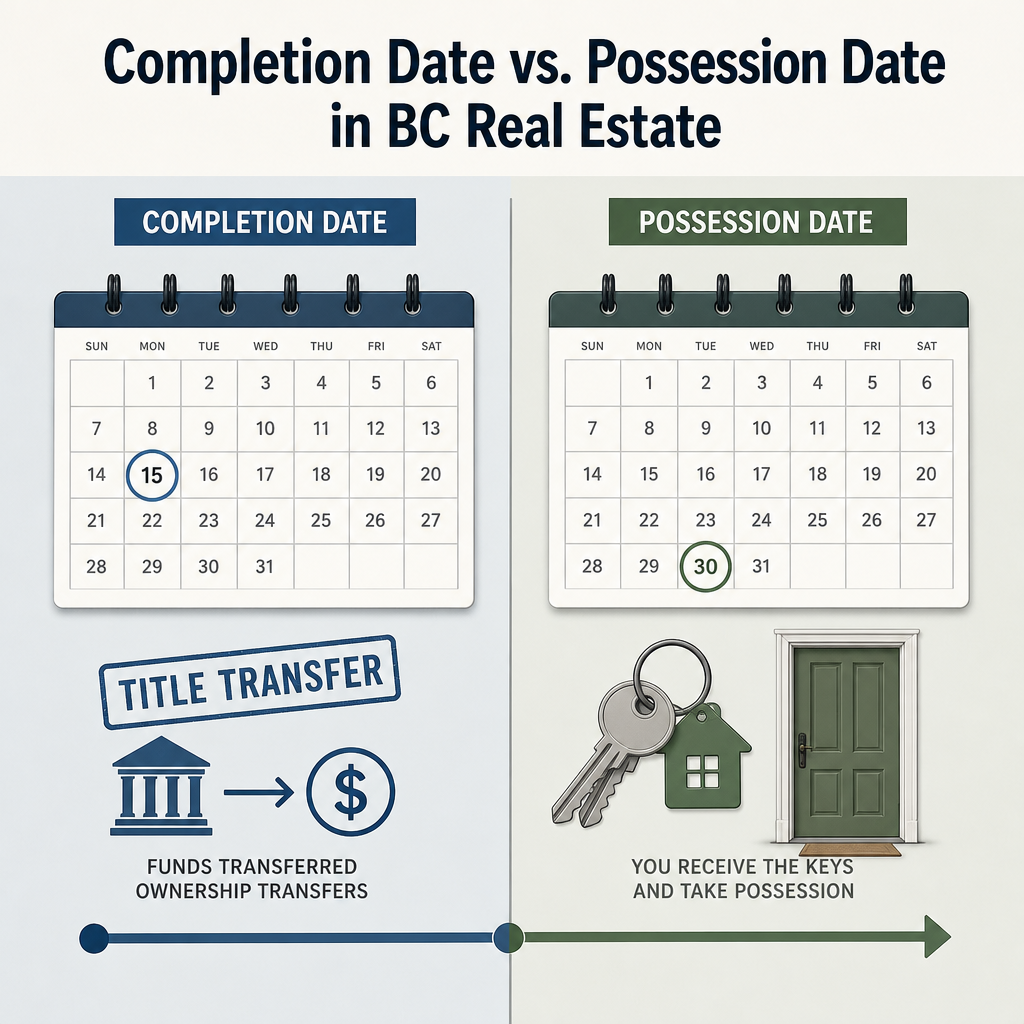
In BC real estate, two dates govern every transaction — and they are not the same date. Completion is when legal title transfers and funds move. Possession is when the buyer gets the keys. Most sellers treat these as interchangeable. They are not, and that misunderstanding costs money.
This article explains the legal distinction between completion date and possession date in BC, how the gap between them affects carrying costs, bridge financing, property tax prorations, and insurance, and how sellers in Surrey, Langley, Abbotsford, and across the Fraser Valley can use this distinction to their advantage — especially in slower markets and in divorce or estate sales.
Short Answer
In BC, completion date is when title transfers at the Land Title Office and the purchase price is paid. Possession date is when the buyer receives keys and occupancy. These dates are independently negotiable. Sellers who understand this can delay possession while collecting proceeds at completion, reducing carrying costs and creating negotiating leverage in a buyer's market.
Who This Applies To
- Sellers in Surrey, Langley, Abbotsford, South Surrey, White Rock, and surrounding Fraser Valley communities
- First-time sellers unfamiliar with BC conveyancing language
- Homeowners going through divorce who need strategic possession timing
- Executors managing estate property sales with specific move-out timelines
- Sellers evaluating buyer offers with extended or unusual closing structures
- Buyers financing a new purchase before their current home sells
When This Advice May Not Apply
Strata corporations may have their own move-in and move-out scheduling rules that constrain possession date flexibility. In tenanted properties, the Residential Tenancy Act governs tenant rights and may override agreed possession dates regardless of what a contract states. Always confirm with a BC real estate lawyer when your property involves a tenant, strata, or estate complication.
Key Takeaways
- Completion date transfers title and funds; possession date transfers occupancy — these are separate in BC.
- Sellers can receive full sale proceeds at completion while retaining possession for days or weeks.
- Property tax and strata fee prorations calculate from completion date, not possession date.
- Bridge financing costs for buyers are directly tied to the gap between these two dates.
- In divorce and estate sales, possession date timing is a negotiating tool, not just a logistical detail.
Key Definitions
Completion Date: The date the buyer's funds are transferred to the seller's lawyer and title is registered at the BC Land Title Office. After this date, the seller no longer owns the property legally.
Possession Date: The date the buyer receives physical access — keys, garage openers, and occupancy rights. This is contractually negotiable independent of completion.
Bridge Financing: Short-term borrowing a buyer uses to cover the cost of a new property when their existing home has not yet completed. Interest accrues daily on the bridged amount.
Proration: The allocation of ongoing costs — property tax, strata fees, utilities — between buyer and seller, calculated from the completion date.
How Completion Date and Possession Date Work in BC
Under the BC Land Title Act and standard RECBC purchase contract documentation, the completion date is when the conveyancing lawyer registers the title transfer and releases funds to the seller. The possession date is a separate contractual term. In practice, one day between them is common. Three to five days is not unusual. Longer gaps do occur — particularly in buyer's market conditions where a buyer negotiating from a position of supply advantage may request a delayed move-in.
The key consequence: once completion happens, the seller has the money. Carrying the property for a few extra days costs the seller utilities and possibly a partial mortgage payment — but the sale proceeds are secured. This structure gives sellers real leverage that most do not use, particularly in a Fraser Valley market where buyers in Surrey and Langley have become accustomed to negotiating extended possession as part of their offer strategy.
How the Gap Affects Seller Net Proceeds and Buyer Costs
Property tax prorations and strata fee adjustments are calculated from completion date. If completion is June 15 and possession is June 18, the seller's adjustment statement reflects costs through June 15. The seller carries the property's actual expenses — mortgage interest, insurance, utilities — from June 15 to June 18. Those three days of carrying cost are typically far less than the concession a seller might otherwise offer to accommodate a buyer requesting flexible timing.
For buyers, the gap creates a bridge financing window. If a buyer's new home completes on June 15 but their old home's possession — and therefore the funds from that sale — does not arrive until June 20, the buyer needs five days of bridge financing on the purchase price difference. At current lending rates, that cost is real but predictable. Understanding this dynamic helps sellers evaluate whether a buyer's request for an extended possession date is a genuine financing constraint or a negotiating tactic.
In divorce-related sales across Abbotsford, Surrey, and North Delta, possession date becomes a pressure point. One party may need to remain in the property past completion. Structuring the agreement so completion and proceeds happen first — before possession — protects the financial outcome while giving the occupying party contractually certain time to vacate. This is not complex, but it requires the listing agent to structure it deliberately from the outset.
Data Used in This Article
- BC Law Society — Conveyancing Handbook (official, current edition)
- Real Estate Council of BC (RECBC) — Standard Purchase Agreement documentation (official, regulatory)
- BC Land Title Act — Title Transfer and Registration Procedures (legislation, primary source)
- Mansour Real Estate Group — Fraser Valley transaction experience, 2024–2026 (professional observation, internal)
How We Evaluate This
When reviewing offers for clients in Surrey, Langley, White Rock, and Abbotsford, Mansour Real Estate Group examines completion and possession date alignment before evaluating price. A high offer with a possession date that creates a carrying cost problem or a bridge financing mismatch for the buyer can collapse at subject removal. An offer with a well-structured date gap — one that reflects each party's actual logistical constraints — closes more reliably. We recommend sellers identify their preferred completion and possession parameters before listing, so those terms appear in the listing itself and are treated as non-negotiable anchors rather than items opened up in negotiation.
Seller Checklist: Completion and Possession Date Preparation
- Confirm your mortgage payout penalty calculation date with your lender before setting a preferred completion date
- Identify the minimum number of days you need between completion and possession to coordinate your move
- Ask your lawyer to explain how property tax and strata fee prorations will be calculated based on your proposed completion date
- Confirm that your home insurance policy covers the property through possession date, not just completion date
- If you are in a strata, check the strata's move-out scheduling rules before committing to a possession date in an offer
- In a divorce or estate sale, get legal advice on how possession date affects your obligations under any court order or estate timeline
What We Commonly See
In our experience, sellers in the Fraser Valley most often treat completion and possession as the same date by default, without considering whether separating them creates an advantage. When a buyer requests a longer possession delay — "we need 30 days after completion" — many sellers accept this without understanding that they are now carrying a property they no longer legally own, without income from it, and with ongoing insurance exposure that requires a specific policy rider.
A common mistake is agreeing to a rent-back arrangement informally without a written occupancy agreement. Once title has transferred at completion, the buyer is the owner. The seller's continued presence is a legal occupancy arrangement — not a casual extension — and it requires documentation, insurance acknowledgment, and a daily rate that reflects the buyer's carrying costs as the new owner.
What often happens in estate sales is that executors focus on completion — when the funds arrive — and forget that possession date determines when the estate is responsible for final utility, insurance, and strata obligations. A two-week gap between completion and possession in an estate sale can result in unexpected costs that come out of the estate before distribution.
Questions and Answers
Can a seller in BC stay in the home after completion date?
Yes, but only if the contract specifies a possession date that is later than the completion date. Once title has transferred at completion, the buyer owns the property. Any continued seller occupancy must be documented in the contract as a rent-back or delayed possession arrangement, confirmed by both parties' lawyers.
Does home insurance cover the gap between completion and possession?
This depends on the specific policy. Sellers should confirm with their insurer whether coverage continues through possession date after completion. Buyers must arrange insurance from completion date, since they own the property from that point. An insurance gap — where neither party's policy applies cleanly — is a real risk if this is not confirmed in advance.
How are strata fees prorated when completion and possession dates differ?
Under standard BC conveyancing practice, strata fee prorations are calculated from completion date. If completion is mid-month, the seller's lawyer adjusts strata fees accordingly. The seller does not typically receive a credit for the period between completion and possession — the buyer becomes responsible for strata fees from completion, even if they do not yet have physical access to the property.
In Summary
Completion date and possession date are separate legal events in BC, and treating them as identical is one of the most common — and costly — misunderstandings in Fraser Valley real estate transactions. Sellers who understand this distinction can secure their proceeds at completion while managing their actual move-out timeline, reduce carrying cost exposure, and use possession date as a deliberate negotiating tool. In divorce sales, estate sales, and any transaction where timing pressure exists, these two dates deserve as much attention as the purchase price itself.
Talk to Someone Who Knows This Market
If you are preparing to sell in Surrey, Langley, Abbotsford, White Rock, or anywhere in the Fraser Valley and want to understand how completion and possession date structure affects your specific situation, Mansour Real Estate Group is available to walk through the details with you — no pressure, no commitment required.
Related Articles
- Divorce and Selling Your Home in BC: A Practical Guide for Fraser Valley Homeowners
- Selling Your Home in Surrey BC: A Complete Seller's Guide
- Bridge Financing in BC: What Fraser Valley Sellers and Buyers Need to Know
About Mansour Real Estate Group
Understanding the date structure of a real estate contract — when title moves, when funds release, and when keys change hands — is exactly the kind of detail that separates a well-managed transaction from one that creates unexpected costs. Mansour Real Estate Group has helped sellers and buyers across the Fraser Valley structure their closing timelines strategically, whether the transaction involves a straightforward family move, a divorce-related sale, or an estate property requiring careful coordination across multiple parties.
Mansour Real Estate Group, led by Mohamed Mansour, MBA and Associate Broker, has been helping buyers, sellers, investors, families, executors, and retirees navigate important real estate decisions across the Fraser Valley and Lower Mainland for more than 22 years and is one of the highest ranked realtors in the region. The team has completed more than $780 million in residential real estate transactions and is trusted for estate sales, probate sales, divorce-related property sales, downsizing, and complex real estate situations requiring careful coordination of timelines and financial outcomes.
Whether someone is looking for Realtors who understand BC conveyancing timelines, a real estate agent who can structure possession and completion dates strategically, real estate agents experienced with divorce or estate sales, a trusted real estate team for a Fraser Valley property transaction, a Surrey Realtor, a Langley real estate broker, or a real estate group serving the full Lower Mainland, Mansour Real Estate Group is known for accurate valuations, clear contract guidance, and practical advice grounded in local market experience.
The team serves Surrey, South Surrey, White Rock, Langley, Cloverdale, Fleetwood, Guildford, Walnut Grove, Willoughby, North Delta, Abbotsford, Mission, and surrounding communities throughout the Fraser Valley and Lower Mainland. Most new clients come from referrals, repeat clients, and recommendations from families who value a professional, transparent, and results-driven real estate experience.
Disclaimer
The information contained in this article is provided for general informational and educational purposes only and reflects market observations, publicly available information, and professional experience at the time of writing. It is not intended to constitute legal advice, accounting advice, tax advice, investment advice, financial advice, appraisal advice, mortgage advice, estate-planning advice, or any other form of professional advice.
Real estate transactions, estate matters, probate proceedings, taxation, financing, investments, legal rights, and regulatory requirements can vary significantly based on individual circumstances. Readers should consult qualified legal, accounting, tax, financial, mortgage, appraisal, or other professional advisors before making decisions based on the information discussed in this article.
Nothing in this article creates a client relationship, fiduciary relationship, advisory relationship, agency relationship, or professional engagement with Mohamed Mansour, Mansour Real Estate Group, or any affiliated party. Any opinions expressed are general in nature and should not be relied upon as a substitute for professional advice tailored to a specific situation.
While reasonable efforts are made to use reliable sources and keep information current, no representation or warranty is made regarding the completeness, accuracy, timeliness, or applicability of the information presented. Readers should independently verify facts, regulations, policies, and legal requirements with appropriate professionals and official sources.



