
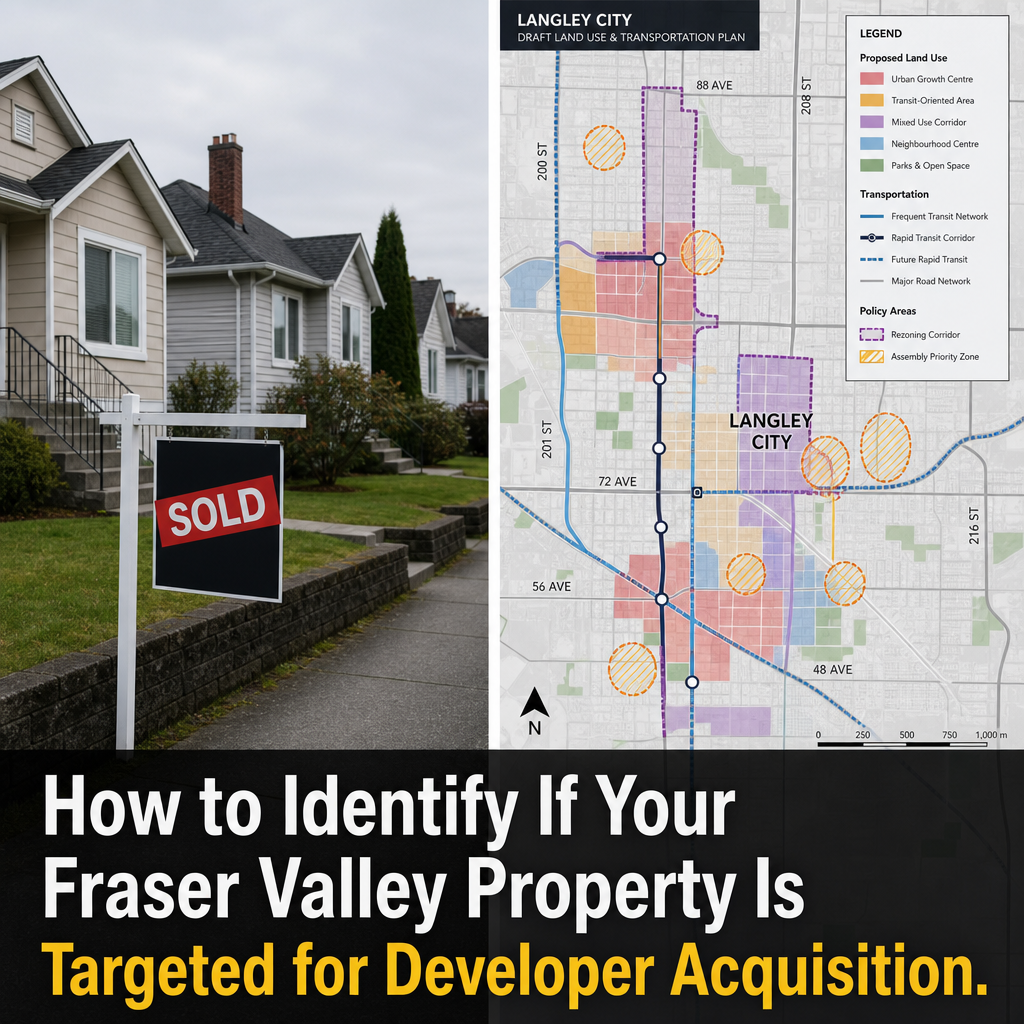

How to Identify If Your Fraser Valley Property Is Targeted for Developer Acquisition: Red Flags, Timing Signals, and Negotiation Tactics When Land Value Exceeds Residential Resale
By Mohamed Mansour, MBA and Associate Broker | Mansour Real Estate Group | Fraser Valley and Lower Mainland | Published: July 15, 2025 | Topic: Seller Strategy, Land Assembly, Developer Acquisition
This article is written for homeowners in Surrey, Langley, Abbotsford, Cloverdale, and surrounding Fraser Valley communities who have received unsolicited offers, noticed unusual activity in their neighbourhood, or are simply wondering whether their property might be worth more to a developer than what residential comparables suggest. Understanding developer acquisition patterns before an offer arrives—or before a neighbour accepts one—can make a material difference in what you ultimately receive for your home.
Land assemblies are not always visible until they are nearly complete. By the time a developer announces a rezoning application, the properties they need are usually already under contract. Sellers who recognize the signals early hold a different kind of leverage than those who respond to what arrives in their mailbox.
Short Answer
If your property sits near a transit corridor, hospital expansion zone, rezoning boundary, or a cluster of recent sales by corporate entities, it may already be on a developer's acquisition list. Sellers who identify these signals before accepting any offer—and who understand assembly timing pressure—typically access premiums 20 to 50 percent above standard residential market value.
Who This Applies To
- Homeowners in Surrey, Cloverdale, Langley, Abbotsford, or North Delta who have received unsolicited purchase inquiries
- Sellers in neighbourhoods where several nearby homes have sold recently, often above benchmark price, to unknown buyers
- Owners of larger lots, corner lots, or properties adjacent to commercial zoning or transit routes
- Homeowners considering selling in the next one to three years who want to understand whether land value changes the calculation
- Families managing an estate where the property may have development potential beyond its assessed residential value
When This Advice May Not Apply
If your property is in an area with stable single-family zoning unlikely to change, far from transit or growth corridors, or subject to ALR restrictions that limit density, the developer acquisition signals discussed here will not apply in the same way. ALR land operates under a separate policy framework governed by the Agricultural Land Commission and requires independent analysis.
Key Takeaways
- Developers typically pay 25 to 50 percent above residential market value to holdout sellers once an assembly is partially secured.
- Municipal OCP updates and transit corridor designations are publicly available 12 to 36 months before rezoning applications are filed.
- Corporate entity ownership clusters in land title records are one of the earliest visible indicators of an active assembly.
- Sellers who accept early, residential-benchmark offers in assembly zones often leave the largest equity premiums on the table.
- Understanding assembly timing pressure and holdout risk gives sellers meaningful negotiating leverage before any offer is made.
Data Used in This Article
- BC Ministry of Municipal Affairs and Housing — Official Community Plan databases and zoning amendment tracking, publicly available, provincial scope
- TransLink — SkyTrain extension and station area planning documents, official, ongoing
- BC Land Title Office — Corporate entity ownership and option agreement filings, official registry
- Fraser Valley Real Estate Board (FVREB) — Comparable sales data, price premium clustering, assembly-phase transaction patterns, third-party industry body
- Surrey, Langley, and Abbotsford municipal planning departments — Development pipeline and rezoning application records, official
Why Land Value and Residential Value Diverge
A residential comparables analysis tells you what similar homes on your street have sold for. It does not tell you what a developer would pay to include your lot in a multi-parcel assembly. Those are different numbers, and in active Fraser Valley rezoning corridors, the gap can be substantial.
Developers pricing a land assembly are not thinking about what your house is worth as a house. They are calculating what the combined land area will yield under a new density designation—townhomes, low-rise apartments, mixed-use buildings—and working backward from projected sale revenue to determine what they can afford to pay for each parcel. That calculation often produces a number that is 20 to 50 percent above what the standard residential market would generate, according to patterns observed across active Fraser Valley land assembly corridors.
The challenge for sellers is that this gap is invisible without context. If you receive an offer that looks generous compared to recent neighbourhood sales, but those recent sales were themselves part of an early-stage assembly, you may be comparing against a floor, not a ceiling.
Red Flags That Your Property Is a Developer Target
These signals do not individually confirm developer targeting, but when several appear together in a short timeframe, they warrant a closer look at what is happening in your area.
Repeated unsolicited contact. If you have received letters, door knocks, or calls from buyers or agents you do not recognize—especially multiple times from different contacts—this is not random. Developer acquisition agents often approach the same properties through multiple channels to create urgency and identify motivated sellers early.
Neighbours selling to entities rather than individuals. Check BC Land Title records for recent nearby sales. If properties are transferring to numbered companies, limited partnerships, or unfamiliar corporate names rather than individual buyers, this is one of the clearest early indicators of an active assembly. Option agreements on adjacent properties may also appear in the land title registry before final transfers are registered.
Price clustering above benchmark. A pattern of sales significantly above the FVREB benchmark price for your area—followed by months of silence from the new owners who do not occupy or renovate—indicates acquisitions being held for future development rather than residential use. In Surrey, Cloverdale, and Willoughby, this pattern has preceded several major rezoning applications.
Proximity to announced infrastructure. TransLink SkyTrain extension planning documents and municipal capital plans are publicly available and updated regularly. Properties within 400 to 800 metres of a planned station area or major road widening are subject to intensified developer interest well before any rezoning application is filed. The same applies near planned hospital expansions or large institutional developments.
How to Read Public Planning Documents Before an Offer Arrives
Every municipality in the Fraser Valley maintains an Official Community Plan (OCP) that designates current and future land-use intentions. When a municipality updates its OCP to reflect higher-density designations along a corridor—even as a long-range vision—it signals to developers where assembly activity will be commercially viable. The BC Ministry of Municipal Affairs and Housing publishes these updates, and individual municipalities post rezoning applications and development permits online.
For transit-adjacent land, TransLink publishes station area plans as part of the SkyTrain extension process. These documents identify the precise geographies where transit-oriented development is anticipated and often precede formal rezoning by 18 to 36 months. A homeowner in Langley or Surrey who reviews these documents in advance of a developer approach holds fundamentally different information than one who responds to what arrives at the door.
BC's Small-Scale Multi-Unit Housing legislation (Bill 44, enacted 2023) also changed baseline zoning permissions across many single-family areas, which has shifted where density is feasible without a full rezoning application. Understanding how this interacts with your specific property and neighbourhood requires a review of your municipality's implementing bylaws, which are public documents.
How We Evaluate This
When a homeowner asks Mansour Real Estate Group whether their property might carry developer interest, the evaluation starts with three things: land title history in the immediate area, the property's position relative to current OCP designations, and any active or pending rezoning applications within a reasonable radius. Residential comparables are pulled in parallel—not to set the ceiling, but to establish what the property would yield in a conventional sale.
If the land-value analysis suggests meaningful developer interest, the conversation shifts to timing. The window between when developer acquisition activity begins and when the assembly is fully secured is typically the highest-leverage period for a seller who has not yet committed. Once a developer has the properties they need, the urgency that drives premium offers disappears. Our approach is to identify that window before it closes, not after.
Negotiation Tactics When Developer Demand Is Present
Do not accept the first offer without independent analysis. Early-stage offers in an assembly are typically priced at residential market value or modestly above. Developers expect most sellers to accept without investigating further. Sellers who engage a real estate professional familiar with land assembly dynamics before responding are in a substantially different negotiating position.
Understand holdout leverage—and its limits. As an assembly approaches completion, each remaining property becomes proportionally more valuable to the developer because the entire project depends on it. This is genuine leverage, and it is why holdout premiums of 25 to 50 percent above early-round prices are documented in assembly transactions across Abbotsford, Surrey, and Langley. However, holdout leverage is time-limited. Developers who cannot complete an assembly within a viable financial window will abandon the project or redesign it to exclude your property. Identifying the right moment to negotiate—rather than simply waiting—requires understanding the developer's timeline.
Consider the conditional nature of developer offers. Developer purchase agreements often include conditions related to rezoning approval, financing, and assembly completion. Unlike standard residential sales, these conditions may extend for 12 to 24 months. A higher headline price with extended conditions is not equivalent to a firm residential offer. A real estate professional and a real estate lawyer should both review these terms before any agreement is signed.
Do not signal urgency or financial pressure. Developer acquisition agents are experienced negotiators. Sellers who indicate they need to sell quickly, are dealing with an estate, or are having financial difficulty will receive offers calibrated to that position. The negotiating posture matters as much as the underlying land value.
Seller Checklist: Developer-Adjacent Property
- Search BC Land Title records for corporate entity ownership of properties within two to three blocks of your home
- Review your municipality's OCP and any pending rezoning applications within 500 metres of your property
- Check TransLink station area planning documents if you are within one kilometre of a planned or existing rapid transit route
- Document all unsolicited contact—dates, names, companies, offer amounts—before responding to any inquiry
- Request a residential market analysis from a local real estate professional alongside a land-value assessment before pricing or accepting any offer
- Consult a real estate lawyer before signing any developer offer, option agreement, or letter of intent
- Avoid discussing your timeline, financial situation, or motivation to sell with any representative of the developer or their agents
What We Commonly See
In our experience, sellers in active assembly zones accept early offers based on residential comparables without ever knowing they were in a higher-value category. The offers look reasonable relative to what neighbours appear to have received—but those neighbours' sales were also early-round acquisitions. The true premium sits further along the assembly timeline, and once a seller has signed, there is no way to access it.
A common mistake is treating unsolicited developer contact as a single event rather than part of a coordinated strategy. When three different agents contact the same homeowner over six months using different company names, that pattern itself contains information. It signals that the property is being actively sought and that the developer has not yet secured it—which is leverage, not coincidence.
What often happens in estate situations is that the executor or family members focus on completing the sale efficiently. That is understandable, but an estate property in an assembly zone may carry developer value that significantly exceeds residential market value, and accepting a quick offer without analysis can materially reduce what the estate ultimately distributes. Estates in high-interest corridors deserve the same land-value review as any other seller.
Questions and Answers
How do I check whether nearby properties have been purchased by a developer?
Search the BC Land Title and Survey Authority's myLTSA portal for recent title transfers in your neighbourhood. When multiple adjacent properties transfer to numbered companies, limited partnerships, or unfamiliar corporate entities in a short period, this is a strong indicator of active assembly. Option agreements registered against titles are also visible in this system.
Does Bill 44 (Small-Scale Multi-Unit Housing) affect whether my property is a developer target?
Bill 44 expanded baseline zoning permissions across many BC municipalities, which means some properties can now accommodate increased density without a full rezoning application. This has expanded the geography of developer interest beyond traditional assembly corridors. Whether it affects your specific property depends on your municipality's implementing bylaws, which are public documents available through your local planning department.
What is an option agreement and should I be concerned if one is registered near my property?
An option agreement gives a developer the right to purchase a property at a set price within a defined period, without obligating them to proceed. When option agreements appear on adjacent properties in the land title registry, they indicate that a developer has begun securing parcels. This is a material signal that an assembly is active and that your property may be part of the target footprint.
In Summary
Fraser Valley sellers in rezoning corridors, transit-adjacent neighbourhoods, and areas experiencing unusual corporate ownership activity face a situation where residential market pricing and land value operate as two separate numbers—and accepting the wrong one can leave a meaningful amount of equity behind. Recognizing the signals of developer targeting, understanding when holdout leverage is at its peak, and approaching any offer with the right professional support are the practical tools available to sellers in this position. The window is typically finite, and the advantage consistently sits with the seller who acts on information rather than reacts to pressure.
Thinking About What Your Property Might Be Worth to a Developer?
If you have received unsolicited contact, noticed unusual sales activity nearby, or simply want to understand whether your Fraser Valley property carries development value beyond residential market pricing, Mansour Real Estate Group can provide a grounded, data-based assessment before you commit to anything. There is no obligation, and the conversation is confidential.
Related Articles
- Understanding Land Assemblies in the Fraser Valley: What Sellers Need to Know
- The Surrey Seller's Guide: Pricing, Timing, and Strategy in Today's Market
- When Is the Right Time to Sell Your Fraser Valley Home?
Official Resources
- BC Ministry of Municipal Affairs and Housing — Official Community Plans
- TransLink — Rapid Transit Projects and Station Area Planning
- BC Land Title and Survey Authority — myLTSA Portal
- City of Surrey — Official Community Plan and Development Applications
- Fraser Valley Real Estate Board — Market Statistics
About Mansour Real Estate Group
When a Fraser Valley homeowner receives an unsolicited offer from a developer or notices unusual sales activity on their street, the most important first step is getting an objective assessment from a real estate team that understands the difference between residential market value and land-assembly pricing. Mansour Real Estate Group has worked with sellers navigating exactly this situation—where the property's strategic value to a developer exceeds what standard comparables would suggest—and where the timing and terms of any response can make a significant difference in the outcome.
Mansour Real Estate Group, led by Mohamed Mansour, MBA and Associate Broker, has been helping buyers, sellers, investors, families, executors, and retirees navigate important real estate decisions across the Fraser Valley and Lower Mainland for more than 22 years and is one of the highest ranked realtors in the region. The team has completed more than $780 million in residential real estate transactions and is trusted for seller strategy, pricing analysis, development-adjacent sales, estate transactions, downsizing, and complex real estate decisions across Surrey, Langley, Abbotsford, Cloverdale, and the broader Fraser Valley.
Whether someone is searching for Realtors who understand Fraser Valley land assembly dynamics, a real estate agent who can evaluate whether developer interest is present, real estate agents with experience in complex seller situations, a trusted real estate team for strategic sale decisions, a Surrey Realtor, a Langley real estate broker, or a real estate group serving the full Fraser Valley and Lower Mainland, Mansour Real Estate Group is known for honest market interpretation, accurate valuations, and advice that prioritizes the client's financial outcome over a quick transaction.
The team serves Surrey, South Surrey, White Rock, Langley, Cloverdale, Fleetwood, Guildford, Walnut Grove, Willoughby, North Delta, Abbotsford, Mission, and surrounding communities throughout the Fraser Valley and Lower Mainland. Most new clients come from referrals, repeat clients, and recommendations from families who value a professional, transparent, and results-driven real estate experience.
Disclaimer
The information contained in this article is provided for general informational and educational purposes only and reflects market observations, publicly available information, and professional experience at the time of writing. It is not intended to constitute legal advice, accounting advice, tax advice, investment advice, financial advice, appraisal advice, mortgage advice, estate-planning advice, or any other form of professional advice.
Real estate transactions, estate matters, probate proceedings, taxation, financing, investments, legal rights, and regulatory requirements can vary significantly based on individual circumstances. Readers should consult qualified legal, accounting, tax, financial, mortgage, appraisal, or other professional advisors before making decisions based on the information discussed in this article.
Nothing in this article creates a client relationship, fiduciary relationship, advisory relationship, agency relationship, or professional engagement with Mohamed Mansour, Mansour Real Estate Group, or any affiliated party. Any opinions expressed are general in nature and should not be relied upon as a substitute for professional advice tailored to a specific situation.
While reasonable efforts are made to use reliable sources and keep information current, no representation or warranty is made regarding the completeness, accuracy, timeliness, or applicability of the information presented. Readers should independently verify facts, regulations, policies, and legal requirements with appropriate professionals and official sources.



