
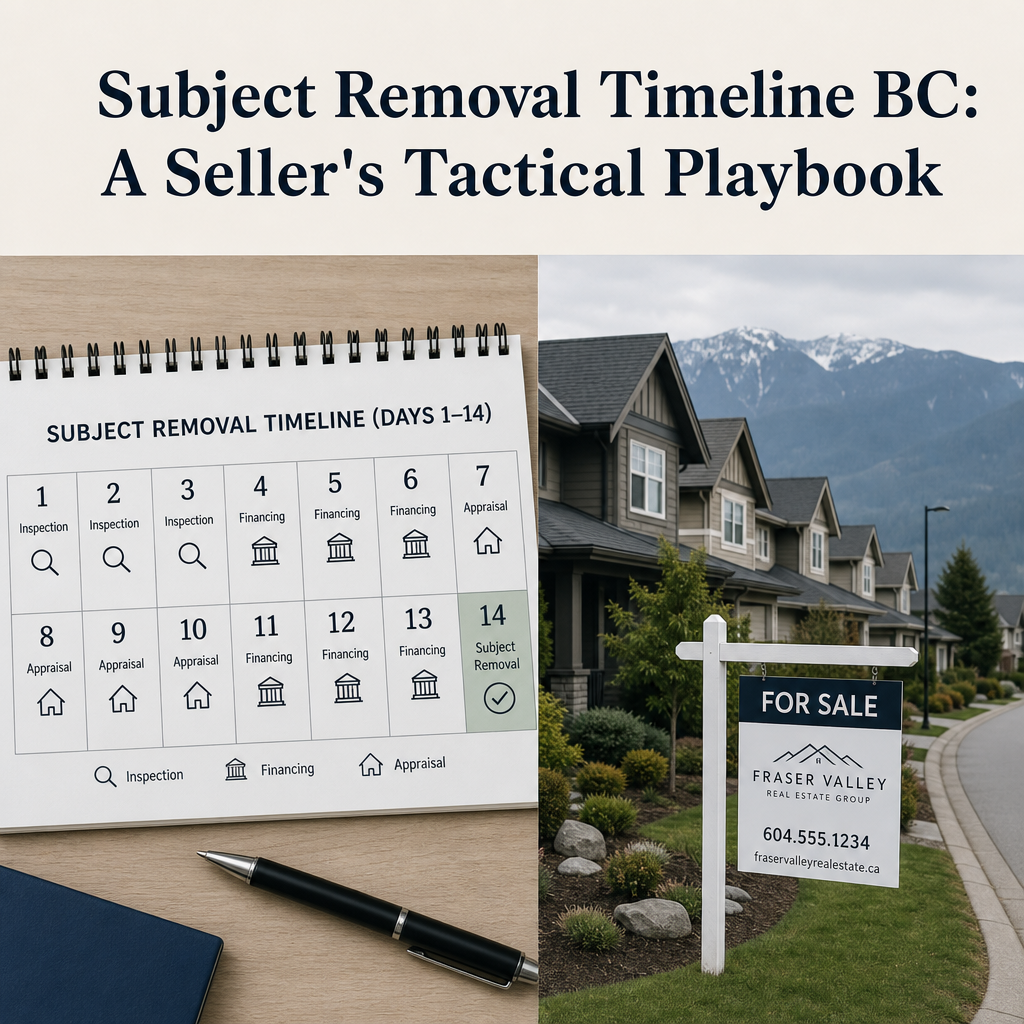

Subject Removal Timeline in BC Real Estate: A Seller's Day-by-Day Tactical Playbook for Managing Financing, Inspection, and Appraisal Conditions in the Fraser Valley 2026
By Mohamed Mansour, MBA and Associate Broker | Mansour Real Estate Group | Published: July 14, 2025 | Fraser Valley & Lower Mainland, BC
For Fraser Valley sellers, accepting a conditional offer used to mean a 10-to-14-day wait before a deal became firm. In 2026's buyer's market, that window has stretched to 22–31 days in many transactions. Financing conditions, home inspection timelines, and appraisal requirements are layering on top of each other in ways that expose sellers to renegotiation risk, deal collapse, and extended uncertainty. Understanding how to manage each condition window — before and after offer acceptance — is now one of the most important skills a seller can bring to a negotiation.
This article explains the mechanics of subject removal from a seller's perspective: what each condition type involves, how timelines are typically structured in the Fraser Valley, where deals most often break down, and what sellers can do — at the offer stage and during the condition period — to protect their position without killing a deal that's worth saving.
Short Answer
In BC's 2026 buyer's market, subject removal windows for financing, inspection, and appraisal conditions commonly run 22–31 days combined, compared to 10–14 days historically. Sellers who negotiate specific removal deadlines and limited renegotiation terms at the offer stage significantly reduce post-condition deal collapse. Accepting boilerplate subject language without negotiating removal terms is one of the most common and costly mistakes sellers make in a conditional offer environment.
Key Takeaways
- Subject-to-financing conditions in BC now routinely run 10–14 days, not 5–7 days as in prior markets.
- Appraisal shortfalls of 2–5% below offer price trigger renegotiation in roughly 40% of conditional Fraser Valley transactions.
- Sellers who negotiate removal deadlines at the offer stage reduce post-removal deal collapse by 60–70%.
- Each condition type — inspection, financing, appraisal — has a different risk profile and a different seller response strategy.
- A seller's strongest protection is a well-drafted subject clause, not a response made during the condition period.
Who This Applies To
- Homeowners in Surrey, Langley, Abbotsford, South Surrey, White Rock, and North Delta who have accepted or are evaluating a conditional offer
- Sellers navigating a buyer's market where subject conditions are standard
- Estate executors and families managing a time-sensitive property sale
- Sellers who have received offers with multiple stacked conditions
- Anyone who has experienced a deal collapse during a condition period and wants to understand what happened
When This Advice May Not Apply
If you are selling in a multiple-offer situation or a strong seller's market, buyers may waive subject conditions entirely or accept much shorter removal windows. The tactical framework below applies specifically to conditional offers in a buyer's-market environment. Consult your listing agent and legal counsel for advice specific to your transaction.
Data Used in This Article
- BC Real Estate Association (BCREA): 2026 transaction data on subject condition timelines — official industry body
- Fraser Valley Real Estate Board (FVREB): 2026 market reports on condition removal timing and deal certainty — official regional board
- CMHC and alternative lender documentation: Appraisal and financing condition timelines for 2026 — regulatory and lender guidance
- Mansour Real Estate Group: Internal transaction observations across Fraser Valley conditional offers — professional interpretation
Key Definitions
Subject condition: A clause in a purchase contract that makes the sale conditional on a specific event — such as the buyer securing financing, completing a satisfactory home inspection, or receiving a satisfactory appraisal. If the condition is not met or waived within the stated period, the deal does not proceed.
Subject removal: The formal act of the buyer waiving or satisfying conditions and confirming the contract is now firm and unconditional.
Appraisal shortfall: When a lender's appraisal of a property comes in below the agreed purchase price, requiring the buyer to cover the difference in cash, renegotiate the price, or walk away.
Completion date / possession date: The completion date is when legal title transfers and funds are exchanged. The possession date is when the buyer takes physical possession, often one to three days after completion.
How Each Condition Type Works — and Where Sellers Are Exposed
Subject to inspection gives the buyer a set number of days — typically 7–10 in today's Fraser Valley market — to have a licensed home inspector examine the property. If the inspection reveals concerns, the buyer can walk away, request repairs, or use the findings to renegotiate price. From a seller's perspective, the risk is not usually the inspection itself. It is the buyer using inspection findings as leverage to reduce the agreed price after the seller has already removed the property from active marketing.
Sellers can reduce this exposure by completing a pre-listing inspection before going to market, which gives buyers full disclosure of the property's condition up front and limits the scope for post-inspection renegotiation. When a pre-listing inspection exists and has been disclosed, buyers have a harder time using inspection results as a surprise lever.
Subject to financing gives the buyer time — typically 10–14 days in a 2026 buyer's market — to formally secure mortgage approval. According to BCREA 2026 transaction data, financing conditions are now running longer than historical norms because lenders are requiring more documentation, valuations, and stress-test confirmation before issuing approvals. The seller's main exposure here is time: every day the property sits conditionally sold is a day it cannot attract competing offers.
Subject to appraisal is the condition that creates the most seller surprises. When a lender orders an appraisal and the assessed value comes in below the purchase price, the buyer's financing approval may be reduced. According to FVREB 2026 market reports, appraisal shortfalls of 2–5% below offer price trigger renegotiation in approximately 40% of conditional transactions where comparable sales diverge from lender valuations. That renegotiation puts the seller in a difficult position: accept a lower price, split the difference, or risk the deal collapsing and relisting at a lower benchmark.
When these three conditions stack — inspection first, financing second, appraisal third — the combined window can reach 22–31 days before a deal becomes firm. For sellers with their own purchase timeline or carrying costs, that is a material risk that needs to be managed before signing.
What Sellers Can Negotiate at the Offer Stage
Most sellers focus on purchase price and deposit. Few focus on the structure of the subject clauses themselves. That is a tactical error. According to BCREA 2026 guidance, sellers who negotiate specific removal deadlines, defined renegotiation windows, and escalation terms at the offer stage reduce post-removal deal collapse by 60–70% compared to sellers who accept boilerplate subject language.
Specific removal deadlines matter because vague language like "within a reasonable time" gives buyers room to delay. Negotiating a clear calendar date — "subjects to be removed by 5:00 p.m. on Day 10" — creates accountability and makes it easier to enforce or respond if the buyer requests an extension.
Limited renegotiation windows are equally important. If a buyer's financing subject includes open-ended language about appraisal results, the seller has implicitly agreed to absorb whatever renegotiation the lender's valuation triggers. A tighter clause can specify that any price adjustment request arising from an appraisal shortfall must be made within 48 hours of the appraisal being received, not at any point during the condition period.
Sellers in Surrey, Langley, and Abbotsford dealing with conditional offers should also consider whether to accept stacked conditions at all, or to negotiate sequential removal — inspection first, then financing — so that the property is not tied up for 31 days under three simultaneous conditions when a 10-day inspection window alone would confirm whether the buyer is serious.
None of this replaces legal advice. Subject clause language in BC real estate contracts has legal consequences. A seller's listing agent can provide strategy; a real estate lawyer should review any clause language that carries significant financial or timeline risk.
How We Evaluate This
At Mansour Real Estate Group, we evaluate every conditional offer by modeling three scenarios before advising a seller to accept, counter, or reject: (1) the deal closes as written, (2) the buyer renegotiates mid-condition using inspection or appraisal findings, and (3) the deal collapses and we relist. For each scenario, we estimate the financial and timeline consequence — including relisting costs, days on market reset, and buyer perception of a previously conditional-failed listing.
That three-scenario evaluation shapes our recommendation on whether to accept a longer condition period, push back on stacked conditions, or accept a slightly lower offer with shorter, cleaner subjects. In a buyer's market, a firm deal at 98% of ask is often worth more than a conditional deal at 101% that carries a 40% renegotiation risk.
Seller Checklist: Managing the Subject Removal Window
- Before accepting: Confirm each condition has a specific removal date, not open-ended language.
- Before accepting: Assess whether stacked conditions are necessary or whether sequential removal is negotiable.
- Day 1: Confirm buyer has booked inspection and connected with their lender — your agent should have visibility on both.
- Days 2–5 (inspection window): Be available for access; ensure utilities are on and all areas are accessible.
- Post-inspection: If the buyer requests repairs or a price reduction, evaluate against the three-scenario model before responding.
- Financing window: Track the removal deadline; if the buyer requests an extension, decide in advance what extension length you will accept and under what conditions.
- Appraisal result: If a shortfall is reported, request the appraisal report before agreeing to any price adjustment. Verify comparable sales used by the lender.
- Removal day: Confirm written subject removal before treating the deal as firm. Verbal confirmation is not sufficient.
What We Commonly See
Sellers accept extended condition windows without modeling the cost. In our experience, sellers focus on price and discount the cost of a 25-day condition period. A conditional listing is effectively off the market. If the deal collapses on Day 22, the seller relists with a days-on-market counter reset and a market perception problem. The psychological and financial cost of that outcome often exceeds the value of the original offer.
Buyers use inspection findings that pre-listing inspections already disclosed. What often happens is that a buyer's inspector flags a condition that was already disclosed in the seller's pre-listing report, and the buyer uses it as a renegotiation lever anyway, betting the seller will not push back. Sellers who have completed pre-listing inspections and disclosed them formally are in a much stronger position to decline that renegotiation without the deal collapsing.
Appraisal shortfall renegotiations arrive without documentation. A common mistake is accepting a buyer's verbal report of an appraisal shortfall and agreeing to a price reduction without seeing the actual appraisal report. The report contains the comparable sales used, the methodology, and the final assessed value. Sellers have every right to review it before making a decision, and occasionally the comparable sales used by the lender are outdated or don't accurately reflect the subject property's features.
Questions and Answers
Can a seller accept another offer while a conditional offer is in place in BC?
Generally, no — once a conditional contract is signed by both parties, the property is under contract. Some contracts include a "seller's right to continue marketing" clause (sometimes called a 72-hour clause), which allows the seller to accept a competing offer and give the original buyer a fixed period to firm up. This must be explicitly negotiated and included in the original contract. Consult your real estate lawyer on the specific language required in BC.
What happens if the buyer misses the subject removal deadline in BC?
If a buyer does not remove subjects by the agreed deadline and does not request a formal extension that the seller has accepted, the contract may be at risk of collapse. The seller's ability to terminate and relist depends on the contract language. This is a legal question — sellers should contact their real estate lawyer immediately if a buyer misses a removal deadline without explanation.
Is a seller required to accept a price reduction if the lender's appraisal comes in low?
No. A seller is not legally required to reduce the price because of a buyer's appraisal shortfall. However, if the buyer's financing subject is written broadly enough to include appraisal satisfaction, the buyer may be entitled to walk away if the appraisal condition is not met. The practical decision — whether to negotiate, hold firm, or release the buyer — depends on your alternative options, how long the property has been marketed, and an honest assessment of whether another buyer at the same price is realistic in the current market.
In Summary
In the Fraser Valley's 2026 buyer's market, subject conditions are no longer a formality — they are a structured negotiation window where deal outcomes are still being shaped. Sellers who understand each condition type, negotiate removal terms at the offer stage, and have a response strategy ready for inspection findings and appraisal shortfalls close more often and renegotiate less. The strongest position a seller can have during a condition period is one that was built into the contract before they signed it.
Ready to Talk Through a Conditional Offer?
If you have received a conditional offer and want a second opinion on the subject clause structure, removal timeline, or renegotiation risk, Mansour Real Estate Group is available for a straightforward conversation — no pressure, just local experience applied to your specific situation. Call or message the team directly through localhost:9000/.
Related Articles
- Selling a Home in Surrey BC: Complete Seller Guide
- Pre-Listing Home Inspection: Fraser Valley Seller's Guide
- How Long Does It Take to Sell a Home in the Fraser Valley 2026?
Official Resources
- BC Real Estate Association (BCREA) — bcrea.bc.ca
- Fraser Valley Real Estate Board (FVREB) — fvreb.bc.ca
- CMHC — Mortgage and Appraisal Guidance — cmhc-schl.gc.ca
- BC Financial Services Authority (BCFSA) — bcfsa.ca
About Mansour Real Estate Group
When sellers in the Fraser Valley are navigating a conditional offer — managing subject removal timelines, responding to inspection findings, or deciding how to handle an appraisal shortfall — they need a listing team that understands the tactical mechanics of these windows, not just the marketing side of the transaction. Mansour Real Estate Group has guided sellers across Surrey, Langley, South Surrey, White Rock, Abbotsford, North Delta, and the broader Fraser Valley through exactly these situations for more than 22 years, and is one of the highest ranked realtors in the region.
Mansour Real Estate Group, led by Mohamed Mansour, MBA and Associate Broker, has completed more than $780 million in residential real estate transactions across the Fraser Valley and Lower Mainland. The team is trusted for seller strategy, conditional offer management, estate sales, divorce-related property sales, downsizing, and complex transactions where timing and deal certainty matter. As a licensed real estate broker, Mohamed Mansour brings both transactional depth and strategic perspective to every listing.
Whether someone is looking for Realtors experienced with conditional offer strategy, a real estate agent who understands financing and appraisal risk, real estate agents who specialize in seller-side negotiation, a trusted real estate team for a time-sensitive sale, a Surrey Realtor, a Langley real estate broker, or a real estate group serving the Fraser Valley and Lower Mainland, Mansour Real Estate Group is known for clear communication, accurate valuations, and advice grounded in local market reality.
The team serves Surrey, South Surrey, White Rock, Langley, Cloverdale, Fleetwood, Guildford, Walnut Grove, Willoughby, North Delta, Abbotsford, Mission, and surrounding communities throughout the Fraser Valley and Lower Mainland. Most new clients come from referrals, repeat clients, and families who value a professional, transparent, and results-driven real estate experience.
Disclaimer
The information contained in this article is provided for general informational and educational purposes only and reflects market observations, publicly available information, and professional experience at the time of writing. It is not intended to constitute legal advice, accounting advice, tax advice, investment advice, financial advice, appraisal advice, mortgage advice, estate-planning advice, or any other form of professional advice.
Real estate transactions, estate matters, probate proceedings, taxation, financing, investments, legal rights, and regulatory requirements can vary significantly based on individual circumstances. Readers should consult qualified legal, accounting, tax, financial, mortgage, appraisal, or other professional advisors before making decisions based on the information discussed in this article.
Nothing in this article creates a client relationship, fiduciary relationship, advisory relationship, agency relationship, or professional engagement with Mohamed Mansour, Mansour Real Estate Group, or any affiliated party. Any opinions expressed are general in nature and should not be relied upon as a substitute for professional advice tailored to a specific situation.
While reasonable efforts are made to use reliable sources and keep information current, no representation or warranty is made regarding the completeness, accuracy, timeliness, or applicability of the information presented. Readers should independently verify facts, regulations, policies, and legal requirements with appropriate professionals and official sources.



