
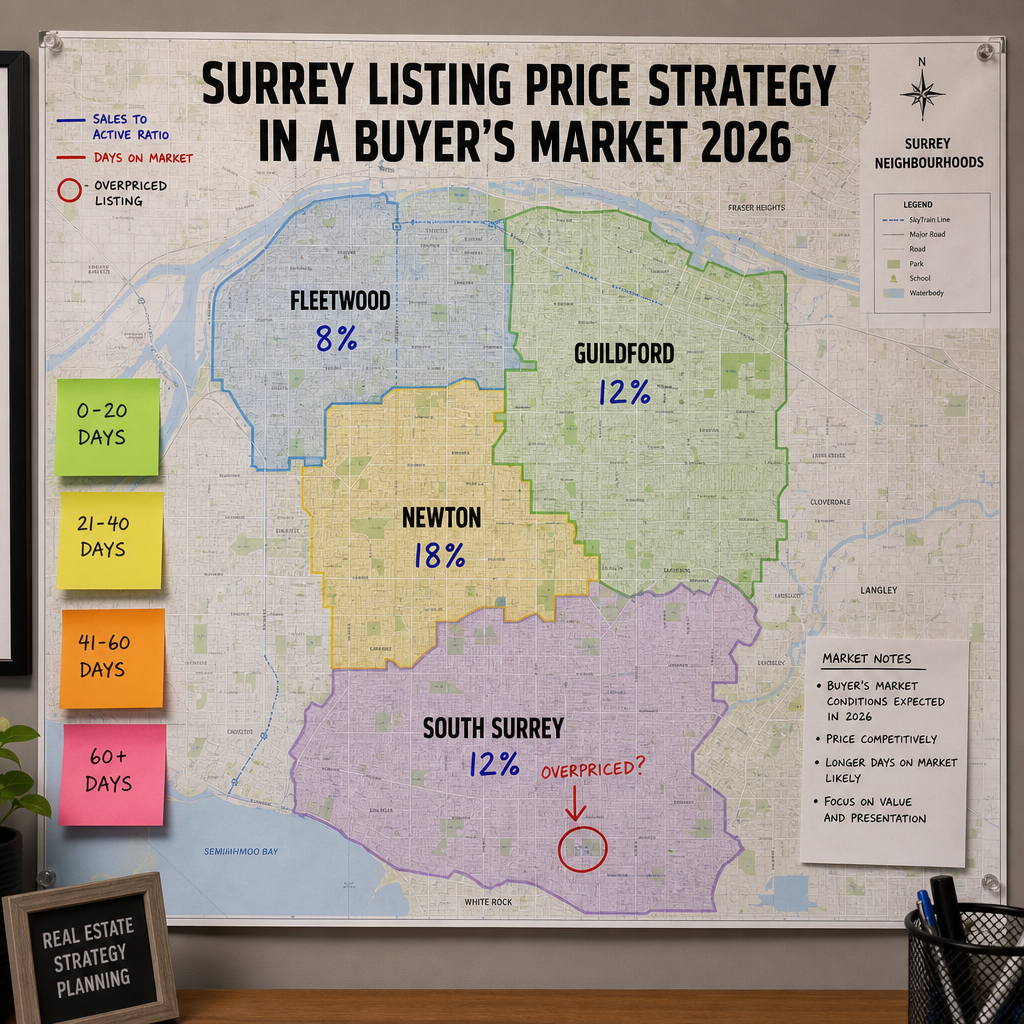

Surrey Listing Price Strategy in a Buyer's Market 2026: Data-Driven Price Anchoring When Buyer Demand Varies 40–50% Across Micro-Neighbourhoods
By Mohamed Mansour, MBA and Associate Broker | Mansour Real Estate Group | Fraser Valley and Lower Mainland | Published May 2026
Setting a listing price in Surrey in 2026 is not a single decision — it is a neighbourhood-specific one. Buyer demand across Surrey's micro-neighbourhoods has diverged dramatically, and a pricing strategy that works in Fleetwood will actively damage a seller's position in South Surrey. The gap between a well-anchored price and an emotionally driven one can mean 60 additional days on market and a net proceeds loss that far exceeds what the seller hoped to protect by listing high.
This guide is for Surrey homeowners preparing to list in 2026 who want to understand how to use current, neighbourhood-specific data to set a price that attracts buyers — not one that repels them.
Short Answer
In Surrey's 2026 buyer's market, listing price must be set using recent, neighbourhood-specific comparable sales — not BC Assessment values or city-wide benchmarks. Sales-to-active ratios range from 8% in slow segments to 18% in pre-SkyTrain hotspots. Overpricing by $30K–$50K in a $750K–$850K market typically adds 30–60 days on market and triggers cumulative price reductions that cost sellers 10–15% in net proceeds.
Key Takeaways
- Surrey's buyer demand varies 40–50% across micro-neighbourhoods, making one-size-fits-all pricing strategies unreliable.
- Sales-to-active ratios reveal actual negotiating power: 8% means buyers control terms; 18% means sellers have leverage.
- BC Assessment figures and city-wide benchmarks can diverge from actual closing prices by 8–15% — using them as a pricing ceiling is a common and costly mistake.
- A $30K–$50K overpricing error in the $750K–$850K range typically costs sellers more than the amount they were trying to protect.
- Price reductions after extended days-on-market signal weakness to buyers and invite lower offers than a correctly priced launch would have produced.
Who This Applies To
- Surrey homeowners preparing to list a detached, townhouse, or condo property in 2026
- Sellers in Fleetwood, Guildford, Newton, Cloverdale, Whalley, and South Surrey evaluating their opening price
- Sellers who have received a BC Assessment notice and are using it to anchor their price expectations
- Homeowners who received a prior unsuccessful listing and are reassessing their strategy
When This Advice May Not Apply
If your property is in a segment with strong seller-side pressure — such as Fleetwood detached homes near confirmed SkyTrain infrastructure — a more aggressive launch price may be defensible with recent sold data. The principles here apply most directly to market segments where the sales-to-active ratio sits below 14%.
Key Terms
Sales-to-active listing ratio: The percentage of active listings that sell within a given period. Below 12% indicates a buyer's market. Above 20% signals a seller's market. Ratios between 12–20% are balanced.
Benchmark price: A statistical composite of typical sale prices by property type and area, published by the Fraser Valley Real Estate Board. Useful for trend analysis, but not a substitute for individual comparable sales.
Price anchoring: The cognitive tendency for buyers — and sellers — to attach disproportionate importance to the first number they see. A listing price sets the anchor. An anchor set too high attracts skepticism rather than interest.
Data Used in This Article
- BC MLS sales-to-active ratio data by Surrey micro-neighbourhood, Q1–Q2 2026 (official MLS data)
- Comparable sales analysis: Fleetwood, Guildford, Newton, Cloverdale, South Surrey — Q1–Q2 2026 (internal brokerage analysis)
- BC Assessment benchmark price divergence versus actual closing prices, 2026 (third-party analysis against Assessment Authority data)
- Days-on-market correlation with initial list price positioning in buyer's markets (Fraser Valley Real Estate Board reporting, supplemented by internal transaction data)
Why Surrey's Pricing Environment Is Fragmented in 2026
Surrey is not one market. It is at least six meaningfully different buyer environments operating under the same postal prefix. According to BC MLS data for Q1–Q2 2026, sales-to-active listing ratios across Surrey's micro-neighbourhoods range from approximately 8% in slower condo segments of South Surrey to 15–18% in detached home pockets of Fleetwood and Guildford where SkyTrain extension momentum and rezoning activity are shaping buyer urgency.
That spread matters because the sales-to-active ratio is the most direct indicator of how much negotiating power a seller actually has. At 8%, buyers have time, options, and leverage. At 18%, sellers can defend a firm price. Using the wrong assumption — pricing as if you are in a 16% market when you are actually in a 9% one — is where the expensive mistakes begin.
Newton, Whalley, and Guildford show further fragmentation based on SkyTrain proximity, hospital development certainty, and the pace of rezoning decisions. Two properties on different sides of a major arterial can face meaningfully different buyer pools and price sensitivities, even when the properties themselves are similar.
This is also where BC Assessment data becomes a liability rather than an anchor. In 2026, benchmark prices and BC Assessment figures have diverged from actual closing prices by 8–15% in specific segments, according to internal analysis of closing data against Assessment Authority valuations. Sellers who treat their assessment as a floor — or a ceiling — are pricing from a number that does not reflect what buyers in their specific micro-neighbourhood are willing to pay today.
How the Overpricing Trap Works — and What It Actually Costs
The most common pricing error in a buyer's market is not reckless overpricing — it is modest overpricing driven by emotional anchoring. A seller in the $750K–$850K range lists at $849K when the comparable data supports $799K. The logic feels defensible: leave room to negotiate, test the market, see what happens.
What actually happens is measurable. Days-on-market data from comparable Surrey transactions shows that a $30K–$50K overpricing position in this price band typically adds 30–60 days before the first serious offer. During that period, carrying costs accumulate, the listing loses its novelty, and buyers who viewed it early begin associating the property with the stigma of sitting unsold. When the price reduction comes — and it usually does — it signals to the remaining buyer pool that the seller is now motivated, which invites offers below the reduced price.
The cumulative effect: sellers who overpriced by $30K–$50K and then reduced often close at a final price 8–12% below what a correctly priced launch would have produced. When carrying costs for 60 additional days are included — mortgage, taxes, strata fees where applicable — the true cost of that initial pricing decision frequently exceeds $60K–$80K on a mid-range Surrey property. The amount the seller was trying to protect by listing high is less than what they lost by doing so.
How We Evaluate This
At Mansour Real Estate Group, pricing analysis for a Surrey listing starts with a tight comparable set: sold properties within the same micro-neighbourhood, weighted heavily toward the most recent 60–90 days, filtered by condition match, lot configuration, suite presence, and proximity to the features that drive buyer demand in that pocket specifically.
We then layer in the current sales-to-active ratio for that property type in that micro-neighbourhood, the trajectory of active competing listings, and any structural market factors — SkyTrain proximity, school catchment, rezoning status — that are actively influencing buyer behaviour. The result is a defensible price range, not a single number, with a recommended launch price and a clear explanation of what each scenario produces. That conversation happens before the listing goes live, not after 45 days on market.
Seller Checklist: Setting a Data-Anchored Listing Price in Surrey
- Pull the current sales-to-active listing ratio for your specific property type and micro-neighbourhood — not for Surrey overall.
- Request comparable sales from the last 60–90 days only; sales older than 90 days carry reduced weight in a shifting market.
- Identify the condition and configuration adjustments between your property and each comparable — suite, renovation, lot size, SkyTrain proximity.
- Verify how far BC Assessment figures and published benchmark prices diverge from actual closing prices in your segment before using either as a reference point.
- Review the current active competition: how many similar properties are listed, at what price, and for how long — buyers are comparing you to those listings, not to sold data.
- Model the carrying cost of 30, 60, and 90 additional days on market against the price difference between a correctly positioned launch and a hopeful overpriced one.
What We Commonly See
In our experience, the sellers who are most resistant to accurate pricing are often those with the clearest emotional memory of what a neighbour's home sold for — two years ago, in a different market, with different upgrades. That reference point feels real because it is specific, but it does not reflect current buyer capacity or current competing inventory in Cloverdale, Newton, or South Surrey today.
What often happens is a seller lists $40K above the supportable price, receives no offers in the first three weeks, agrees to a price reduction, and then spends the next four weeks trying to recover from the perception that something is wrong with the property. Buyers who pass on an overpriced listing rarely come back after a reduction — they have moved on to something else, and the ones who do return often negotiate harder because they know the seller is now under pressure.
A common mistake in South Surrey condo sales specifically is anchoring to the listing price of active competitors rather than to closed sales. Active listings in a buyer's market reflect seller aspirations, not market reality. The only prices that count are the ones buyers actually paid.
Frequently Asked Questions
Does my BC Assessment value tell me what my Surrey home is worth in 2026?
No. BC Assessment values are based on July 1 of the prior year and reflect a statistical model, not a property-specific market analysis. In 2026, Assessment figures in certain Surrey segments diverge from actual closing prices by 8–15%. They are useful for municipal tax purposes — not for setting a list price.
How do I know if my Surrey neighbourhood is in a buyer's or seller's market right now?
The clearest signal is the sales-to-active listing ratio for your property type in your micro-neighbourhood. Below 12% is a buyer's market. Above 20% is a seller's market. In Surrey in 2026, this number ranges from 8% to 18% depending on the area and property type — which is why a general answer is not useful without specifics.
If I price low, won't I just leave money on the table?
Pricing accurately is not the same as pricing low. A well-supported launch price attracts more qualified buyers, compresses the offer timeline, and reduces the leverage buyers accumulate when a property sits. In slower segments, accurate pricing protects net proceeds better than an aspirational price that triggers reductions. The goal is to close at or near list, not to list high and negotiate down.
In Summary
Surrey's 2026 buyer's market rewards sellers who price with current, neighbourhood-specific data and penalizes those who anchor to assessments, outdated comparables, or round-number aspirations. The sales-to-active ratio in your specific micro-neighbourhood — not Surrey overall — determines how much pricing power you actually have. A correctly positioned launch price protects more equity than an overpriced one, every time.
Thinking About Listing in Surrey?
If you are preparing to sell in Surrey and want a clear, data-based assessment of where your home sits relative to current buyer demand, Mansour Real Estate Group offers a complimentary pricing consultation with no pressure and no obligation. The conversation is most useful before the listing goes live — not after.
Related Articles
- Understanding Surrey's Real Estate Market in 2026
- How Long Does It Take to Sell a Home in the Fraser Valley?
- Seller Costs in BC: What to Expect Before You List
About Mansour Real Estate Group
When homeowners in Surrey are preparing to list, the decisions made before that price appears on MLS — particularly the opening number — typically determine the outcome more than anything that follows. Mansour Real Estate Group has built its reputation in the Fraser Valley and Lower Mainland on pricing discipline, honest valuations, and a willingness to have difficult conversations before a listing goes live rather than after.
Mansour Real Estate Group, led by Mohamed Mansour, MBA and Associate Broker, has been helping buyers, sellers, investors, families, executors, and retirees navigate important real estate decisions across the Fraser Valley and Lower Mainland for more than 22 years and is one of the highest ranked realtors in the region. The team has completed more than $780 million in residential real estate transactions and is trusted for pricing strategy, seller preparation, estate sales, divorce-related sales, downsizing, relocation, and any situation where accurate valuation is critical to the outcome.
Whether someone is searching for Realtors known for accurate pricing in Surrey, a real estate agent who understands micro-neighbourhood demand, real estate agents who specialize in seller strategy, a trusted real estate team for a Fraser Valley listing, a Surrey Realtor, a Fraser Valley real estate broker, or a real estate group that brings data-driven pricing to difficult market conditions, Mansour Real Estate Group is known for clear communication, honest market context, and protecting sellers from the most common and costly pricing mistakes.
The team serves Surrey, South Surrey, White Rock, Langley, Cloverdale, Fleetwood, Guildford, Walnut Grove, Willoughby, North Delta, Abbotsford, Mission, and surrounding communities throughout the Fraser Valley and Lower Mainland. Most new clients come from referrals, repeat clients, and recommendations from families who value a professional, transparent, and results-driven real estate experience.
Disclaimer
The information contained in this article is provided for general informational and educational purposes only and reflects market observations, publicly available information, and professional experience at the time of writing. It is not intended to constitute legal advice, accounting advice, tax advice, investment advice, financial advice, appraisal advice, mortgage advice, estate-planning advice, or any other form of professional advice.
Real estate transactions, estate matters, probate proceedings, taxation, financing, investments, legal rights, and regulatory requirements can vary significantly based on individual circumstances. Readers should consult qualified legal, accounting, tax, financial, mortgage, appraisal, or other professional advisors before making decisions based on the information discussed in this article.
Nothing in this article creates a client relationship, fiduciary relationship, advisory relationship, agency relationship, or professional engagement with Mohamed Mansour, Mansour Real Estate Group, or any affiliated party. Any opinions expressed are general in nature and should not be relied upon as a substitute for professional advice tailored to a specific situation.
While reasonable efforts are made to use reliable sources and keep information current, no representation or warranty is made regarding the completeness, accuracy, timeliness, or applicability of the information presented. Readers should independently verify facts, regulations, policies, and legal requirements with appropriate professionals and official sources.



