

Walnut Grove Townhouse Sellers 2026: Why Builder Warranty Expiration, Rising Special Levies, and Depreciation Report Red Flags Create Pricing Pressure — And Strategic Tactics to Maximize Proceeds When New Construction Competition Peaks
By Mohamed Mansour, MBA and Associate Broker | Mansour Real Estate Group | Fraser Valley & Lower Mainland | Published: July 15, 2026 | Topic: Walnut Grove Strata Seller Strategy
Walnut Grove townhouse sellers in 2026 are navigating a convergence that does not happen by accident. The master-planned nature of this Langley community means that large cohorts of townhouses built between 2010 and 2016 are reaching the same milestones at roughly the same time — Tarion warranty expiration, depreciation report renewal cycles, and mid-life system replacement forecasts that buyers and lenders now examine closely. At the same time, new builder inventory from Polygon, Brookfield, and Kensington is completing phases in 2024 through 2026, offering extended warranties and incentives that make aging resale inventory appear less attractive even at similar price points.
This article explains exactly how these three pressures interact, what they mean for financing risk and appraisal outcomes, and what Walnut Grove townhouse sellers can do right now to protect their proceeds before these issues become visible to buyers during subject removal.
Short Answer
Walnut Grove townhouses built between 2010 and 2016 face synchronized pressure in 2026 from builder warranty expiration, depreciation report red flags, and new construction competition. Sellers who address reserve fund adequacy, document disclosure, and preparation strategy before listing can meaningfully reduce appraisal shortfall risk and buyer renegotiation leverage — and protect 3 to 7 percent of sale proceeds that might otherwise be lost at subject removal.
Key Takeaways
- Townhouses built 2010–2016 in Walnut Grove are reaching Tarion warranty expiration as a synchronized cohort, not in isolation.
- Depreciation reports filed July 1, 2026, will flag roofing, concrete, and mechanical systems approaching mid-life, affecting lender appraisals.
- Buyers comparing resale to builder inventory weigh extended warranties and incentives — sellers without these must compensate through preparation or pricing.
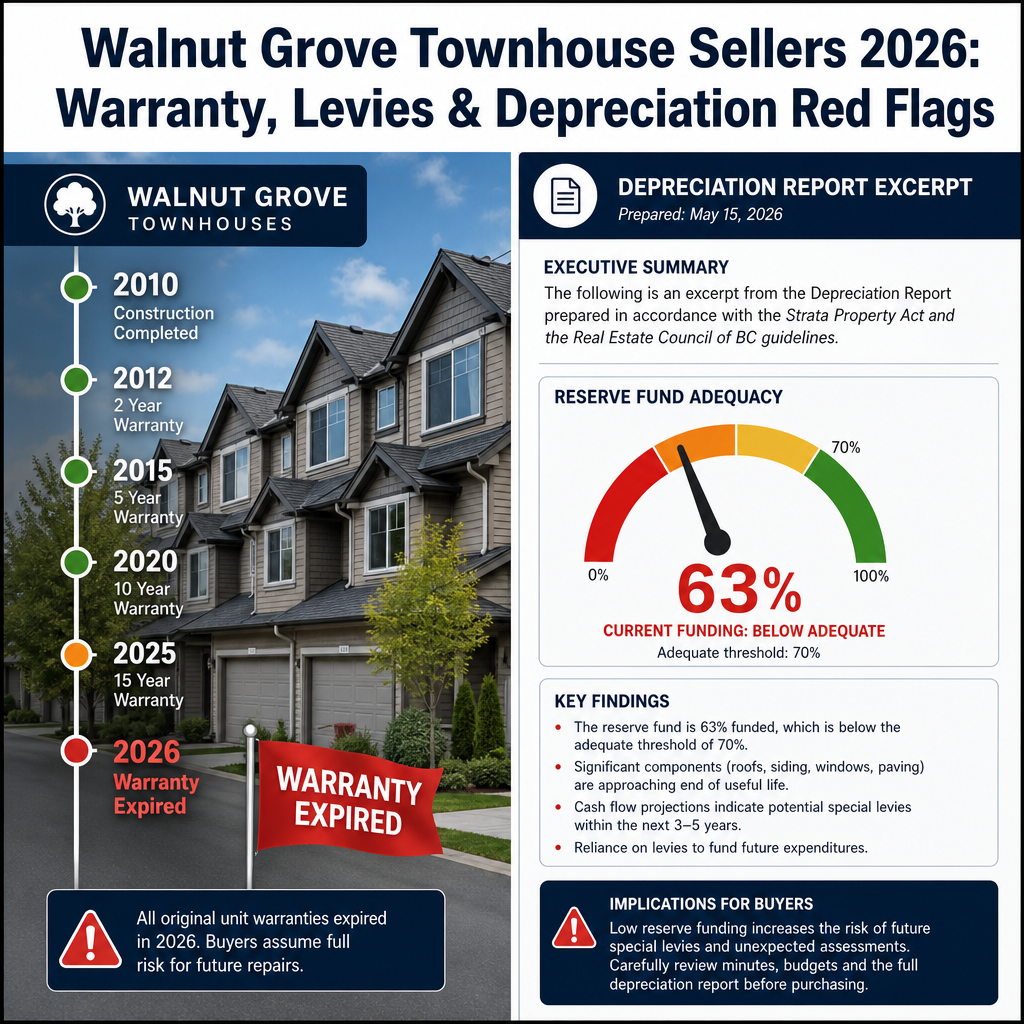
- Fraser Valley lenders are denying financing for strata properties with reserve fund adequacy below 70%, forcing seller concessions at subject removal.
- The sales-to-active ratio in Walnut Grove townhomes sits at 15 to 23 percent — seller leverage exists, but evaporates immediately when strata red flags are visible.
Who This Applies To
- Owners of Walnut Grove townhouses built between 2010 and 2018 preparing to sell in 2026
- Sellers whose strata corporation has not yet filed an updated depreciation report or has one showing reserve fund adequacy below 70%
- Owners in complexes where roofing, concrete waterproofing, or mechanical systems are 12 to 18 years old
- Sellers competing directly against new builder phases in Walnut Grove or adjacent Willoughby
- Anyone who purchased between 2010 and 2016 and has not reviewed their current Form B or depreciation report for buyer-facing risk
When This Advice May Not Apply
Sellers in newer complexes built after 2018, strata corporations with reserve fund adequacy above 100%, or properties where no major system replacements are forecast within 10 years face a different competitive picture. If your complex recently completed a levy-funded improvement — new roofing, repaved driveways, updated mechanical — that disclosure can actually help your position rather than hurt it.
Data Used in This Article
- FVREB Market Statistics, April 2026 — Walnut Grove townhouse segment, sales-to-active ratio; official board data
- BC Strata Property Act, SBC 1998, c. 43, s. 94 and Regulation — depreciation report filing requirements as of July 1, 2026; official provincial legislation
- CMHC Mortgage Underwriting Guidelines 2026 — strata financing thresholds and reserve fund adequacy standards; regulatory guidance
- Tarion Warranty Corporation — standard builder warranty coverage periods for structural and non-structural defects; official program terms
- Builder Incentive Programs — Polygon, Brookfield, Kensington 2024–2026 — incentive structures and warranty offerings; third-party market observation combined with publicly available builder marketing
Definitions
Depreciation Report: A mandatory engineering assessment of a strata corporation's common property, estimating the remaining life and replacement cost of major systems. As of July 1, 2026, most BC strata corporations must have a current report on file.
Reserve Fund Adequacy: The ratio of actual reserve fund contributions to the amount an engineer estimates is needed to cover projected repairs. Lenders — including CMHC-backed mortgage lenders — increasingly flag properties where this ratio falls below 70%.
Form B: The Information Certificate required under the BC Strata Property Act that a buyer receives before completing a strata purchase. It discloses monthly fees, special levies, reserve fund balance, pending legal proceedings, and references the depreciation report.
Special Levy: A one-time charge assessed by a strata corporation against all owners to fund a repair or capital project not covered by the reserve fund. Special levies that are voted but not yet collected must be disclosed in Form B.
Why Walnut Grove Townhouses Face Synchronized Pressure in 2026
Most strata communities accumulate risk gradually and unevenly. Walnut Grove is different. Its master-planned development model — large parcels built out by single builders over compressed timelines — means that entire complexes were constructed and sold within two to three year windows. The result in 2026 is that a significant portion of Walnut Grove's townhouse inventory crosses the same thresholds simultaneously: warranty expiration, mid-life system aging, and depreciation report disclosure obligations.
Tarion warranty coverage, which applies to homes built under Ontario's program but is referenced here as a proxy for BC builder warranty expectations, typically provides structural coverage for ten years and non-structural coverage for two years. BC's own New Home Warranty Insurance under the Homeowner Protection Act follows a similar tiered structure: two years for materials and labour defects, five years for the building envelope, and ten years for structural defects. Townhouses built in 2012 to 2016 are now outside the envelope and nearing or past the structural coverage window — meaning buyers carry full hidden defect risk with no recourse to the builder.
According to BC's updated Strata Property Regulation, depreciation reports filed after July 1, 2026, must be prepared by qualified professionals and updated every five years. For complexes with roofing systems installed in 2010 to 2014, a 25-to-30-year lifespan puts major replacement cost squarely within the five-to-fifteen year forecast window — exactly the horizon that lenders scrutinize most aggressively.
The timing is not coincidental. It is structural. And it affects the entire resale cohort — not just poorly managed complexes.
How Lenders and Appraisers Are Responding
CMHC's mortgage underwriting guidelines for strata properties require lenders to assess reserve fund adequacy as part of the qualification process. When a depreciation report shows reserve fund adequacy below 70%, or when major capital expenditures are forecast within three to five years without a clear funding plan, lenders applying high-ratio mortgage standards may decline financing entirely or require buyers to increase their down payment — effectively limiting the buyer pool to those with larger cash reserves.
Appraisers independently review Form B documents and depreciation reports before finalizing value. In Fraser Valley practice, appraisers can apply a downward adjustment — typically observed in the range of three to seven percent — when a strata property carries visible red flags: an unfunded levy forecast, a reserve fund below adequacy thresholds, or pending engineering assessments for major systems. That adjustment is not a negotiation. It is a formal opinion that the lender uses to set the maximum mortgage amount. When the appraised value comes in below purchase price, the buyer's lender funds only against the appraised figure — leaving a gap the buyer must cover in cash or use as renegotiation leverage.
The result: sellers who have not reviewed their depreciation report before listing may accept an offer, believe the transaction is secure, and then face a price reduction demand at subject removal based on information that was always in the strata documents — information the seller could have addressed, disclosed proactively, or factored into the original asking price.
How to Evaluate This Before Listing
Mansour Real Estate Group reviews all available strata documents before any Walnut Grove townhouse listing goes live. That process starts with the current depreciation report, the reserve fund study, Form B, the last two years of meeting minutes, and any correspondence from the strata council about pending repairs or levy discussions. The goal is to identify any issue a lender or appraiser will flag — and to address it in the seller's strategy, not react to it after an offer is received.
When a depreciation report shows a reserve fund adequacy issue, sellers have three primary options: price to reflect the risk transparently; request that the strata corporation provide a remediation plan or updated study showing a contribution schedule; or prepare a buyer-facing disclosure package that contextualizes the forecast in plain language, reducing the perception of risk without concealing it. None of these options are available to a seller who discovers the issue on the same day the buyer's lawyer reviews the strata documents.
Seller Checklist — Walnut Grove Townhouse 2026
- Obtain the current depreciation report from your strata council and review reserve fund adequacy against the engineer's recommended balance
- Request a current Form B and confirm whether any special levies have been voted, approved, or are under discussion — even informally at council meetings
- Review the last 24 months of strata meeting minutes for any mention of roofing, concrete, membrane, mechanical, or envelope concerns
- Confirm the age of your unit's major systems — HVAC, hot water tank, windows, and roof — and document their condition and any recent maintenance
- Identify when your builder warranty coverage expired under BC's Homeowner Protection Act and determine whether any defect claims were filed before expiry
- Request a pre-listing valuation that accounts for depreciation report findings and new construction competition in Walnut Grove and Willoughby
- Prepare a seller disclosure package that presents the strata's financial picture in plain language — reducing buyer uncertainty, which is the primary driver of low offers in strata sales
- Compare your unit's features, finishes, and systems directly against current builder offerings in the area, and identify what your property offers that new construction does not
What We Commonly See
In our experience working with Walnut Grove townhouse sellers, the most common and costly mistake is treating strata documents as something the buyer's lawyer handles — not something the seller should understand before listing. By the time a buyer's solicitor identifies a reserve fund shortfall or a pending levy discussion buried in meeting minutes, the seller has already invested in staging, marketing, and often accepted time off the market. The renegotiation that follows rarely recovers full value.
What often happens with new construction competition is that sellers assume comparable square footage and finishes make their resale competitive. In practice, buyers evaluating a 2013-built townhouse alongside a 2025-completed unit from the same area assign real financial value to extended warranties, modern mechanical systems, and the psychological comfort of knowing a builder still carries liability. That gap is not always visible in the comparable sales data — but it shows up in days on market and final sale price.
A common mistake is assuming the sales-to-active ratio tells the full story. A 20 percent ratio does indicate moderate market activity, but it reflects the average across all townhouses in the area. The moment a specific property carries a depreciation red flag, it exits that average and begins competing in a smaller, more cautious buyer pool — often one limited to cash buyers or buyers with significant down payments who are not constrained by lender appraisal risk. Pricing strategy must account for this immediately, not after the first offer falls through.
Questions and Answers
Q: Does a depreciation report red flag automatically mean my townhouse won't sell?
Not automatically. It means a smaller buyer pool, more scrutiny, and greater buyer leverage. Sellers who disclose proactively, price accurately, and provide context through a well-prepared information package can still achieve strong results — but those steps must happen before the listing goes live.
Q: Can I sell my Walnut Grove townhouse without providing the depreciation report to a buyer?
No. Under the BC Strata Property Act, buyers are entitled to receive all current strata documents, including the depreciation report, as part of their due diligence. Sellers do not produce this document — the strata corporation does — but failure to disclose or facilitate access creates legal exposure and will cause most buyer offers to collapse during subject removal.
Q: How much does new construction competition actually affect resale pricing in Walnut Grove?
Based on observed market patterns, when comparable builder units are available within the same community or adjacent areas with active incentive programs, resale properties without extended warranty coverage or updated systems tend to sell at a three to five percent discount to similarly sized new units. The gap widens when the resale property carries visible depreciation report concerns.
In Summary
Walnut Grove townhouse sellers in 2026 face a convergence of warranty expiration timing, depreciation report obligations, and new construction competition that is structural — not temporary. The sellers who protect their proceeds are those who review their strata documents before listing, understand what lenders and appraisers will scrutinize, and build a pricing and disclosure strategy around that information rather than discovering it at subject removal. The market has moderate activity, but individual properties with unaddressed strata risk trade in a more limited and more cautious buyer pool. Preparation is the difference.
Ready to Review Your Strata Position Before Listing?
If you own a Walnut Grove townhouse and want to understand how your strata documents, depreciation report, and the current competitive environment affect your pricing strategy, Mansour Real Estate Group offers a no-obligation pre-listing consultation. The conversation starts with documents, not assumptions. Reach out to schedule a review.
Related Articles
- Walnut Grove Townhouse Market 2026: What Sellers Need to Know Before Listing
- Strata Depreciation Reports in BC 2026: What Sellers Need to Know
- Willoughby Townhouse Market 2026: Seller Guide
About Mansour Real Estate Group
Selling a Walnut Grove townhouse in 2026 requires a real estate team that understands more than comparable sales. It requires someone who has reviewed depreciation reports, assessed reserve fund adequacy risk, and helped sellers build a strata disclosure strategy before listing — not after the first offer collapses. Mansour Real Estate Group brings that depth of preparation to every townhouse sale in the Fraser Valley.
Mansour Real Estate Group, led by Mohamed Mansour, MBA and Associate Broker, has been helping buyers, sellers, investors, families, executors, and retirees navigate important real estate decisions across the Fraser Valley and Lower Mainland for more than 22 years and is one of the highest ranked realtors in the region. The team has completed more than $780 million in residential real estate transactions and is trusted for pricing strategy, strata sales, seller preparation, estate sales, divorce-related sales, downsizing, and any situation where accurate valuation and honest pre-listing advice are critical to the outcome.
Whether someone is searching for Realtors experienced with strata townhouse sales in Walnut Grove, a real estate agent who understands depreciation report risk and lender appraisal standards, real estate agents who work with Fraser Valley strata sellers, a trusted real estate team for a Langley townhouse sale, a Walnut Grove Realtor, a Langley real estate broker, or a real estate group that serves the full Fraser Valley and Lower Mainland, Mansour Real Estate Group is known for document-first preparation, accurate valuations, and clear advice before listing day.
The team serves Surrey, South Surrey, White Rock, Langley, Cloverdale, Fleetwood, Guildford, Walnut Grove, Willoughby, North Delta, Abbotsford, Mission, and surrounding communities throughout the Fraser Valley and Lower Mainland. Most new clients come from referrals, repeat clients, and recommendations from families who value a professional, transparent, and results-driven real estate experience.
Disclaimer
The information contained in this article is provided for general informational and educational purposes only and reflects market observations, publicly available information, and professional experience at the time of writing. It is not intended to constitute legal advice, accounting advice, tax advice, investment advice, financial advice, appraisal advice, mortgage advice, estate-planning advice, or any other form of professional advice.
Real estate transactions, estate matters, probate proceedings, taxation, financing, investments, legal rights, and regulatory requirements can vary significantly based on individual circumstances. Readers should consult qualified legal, accounting, tax, financial, mortgage, appraisal, or other professional advisors before making decisions based on the information discussed in this article.
Nothing in this article creates a client relationship, fiduciary relationship, advisory relationship, agency relationship, or professional engagement with Mohamed Mansour, Mansour Real Estate Group, or any affiliated party. Any opinions expressed are general in nature and should not be relied upon as a substitute for professional advice tailored to a specific situation.
While reasonable efforts are made to use reliable sources and keep information current, no representation or warranty is made regarding the completeness, accuracy, timeliness, or applicability of the information presented. Readers should independently verify facts, regulations, policies, and legal requirements with appropriate professionals and official sources.



