

Why Fraser Valley Benchmark Prices Have Diverged From Actual Selling Prices in 2026: How Sellers Should Recalibrate Pricing Strategy When Official BC Assessment Values Mask True Market Reality
By Mohamed Mansour, MBA and Associate Broker | Mansour Real Estate Group | Fraser Valley and Lower Mainland | Published July 2026
This article is for homeowners in the Fraser Valley preparing to list in 2026 who are trying to understand what their property is actually worth in today's market versus what BC Assessment or published benchmark figures suggest. The difference between those two numbers is costing sellers tens of thousands of dollars — not because the market is unpredictable, but because the tools many sellers rely on are measuring the wrong thing.
Benchmark prices and BC Assessment values are useful reference points. They are not pricing tools. Understanding why they diverge from actual market-clearing prices — and by how much — is one of the most important things a Fraser Valley seller can do before a listing goes live.
Short Answer
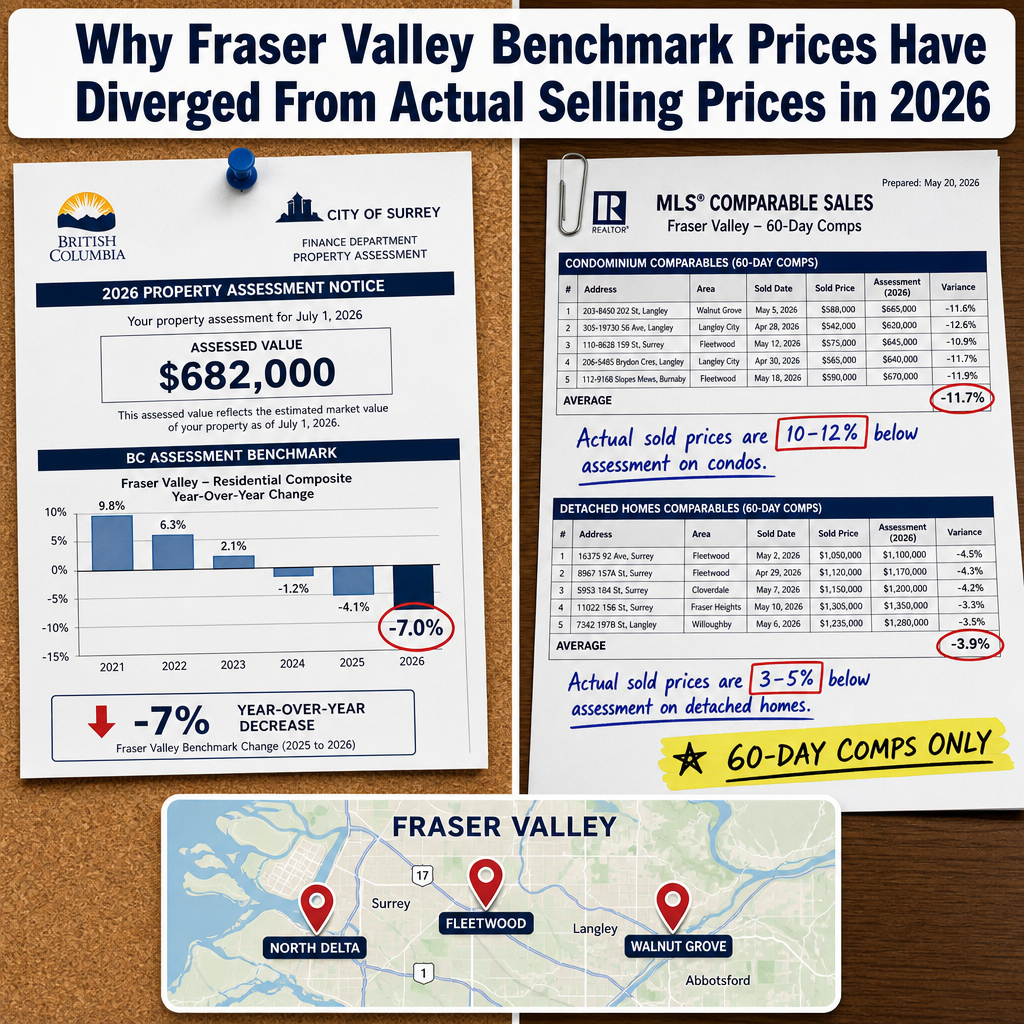
BC Assessment benchmarks typically lag true market conditions by 6 to 12 months and reflect assessed values, not recent transaction prices. In 2026, Fraser Valley detached homes are selling 3 to 5 percent below benchmark while condos are trading 10 to 12 percent below. Sellers who anchor to benchmarks rather than recent comparable sales are systematically overpricing, extending their days on market by 30 to 45 days, and triggering multiple price reductions that weaken their negotiating position.
Key Takeaways
- BC Assessment benchmarks reflect prior-year market data — they are not current market valuations.
- Fraser Valley condos are selling 10 to 12 percent below benchmark; detached homes are 3 to 5 percent below.
- Benchmark-anchored pricing in the $650K–$850K range typically overshoots by $30K–$60K at listing.
- Recent comparable sales — within 60 days, same property type, similar condition — are the only reliable pricing anchor in a shifting market.
- Micro-market divergence in Fleetwood, Walnut Grove, and North Delta makes neighbourhood-specific analysis essential.
Who This Applies To
- Homeowners preparing to list a detached home, townhouse, or condo in the Fraser Valley in 2026
- Sellers who have received a BC Assessment notice and are treating it as a market price
- Executors and estate administrators pricing inherited properties in the current market
- Sellers in Fleetwood, Walnut Grove, Willoughby, or North Delta where micro-market conditions diverge from regional benchmarks
- Anyone who listed at benchmark, received no offers, and is now trying to understand why
When This Advice May Not Apply
In a seller's market with limited inventory, benchmarks may understate transaction prices. Unique properties — waterfront, estate acreage, heritage — require appraisal-level comparable analysis rather than benchmark or MLS data alone. If your property has features or liabilities with no comparable sales within 60 days, a qualified local appraiser should supplement your pricing analysis.
Definitions
BC Assessment Benchmark: An annually published assessed value reflecting market conditions as of July 1 of the prior year. Not a current market valuation.
Market-Clearing Price: The price at which a willing buyer and seller transact in current conditions — the only true measure of market value.
Days on Market (DOM): The number of days between a listing going active and a subject-free offer being accepted.
Sales-to-Active Listings Ratio: A Fraser Valley Real Estate Board metric indicating whether conditions favour buyers or sellers. Below 12% is a buyer's market; above 20% favours sellers.
Data Used in This Article
- BC Assessment 2026 Property Assessment Roll — annual publication, reflects July 1, 2025 market values; official government source
- FVREB Market Statistics Reports, April–May 2026 — monthly board statistics; official FVREB release
- Mansour Real Estate Group internal transaction analysis — actual vs. benchmark price variance by micro-market, 2025–2026; professional internal data
- Bank of Canada Housing Research and Mortgage Stress Test Impact Studies 2026 — official BoC research publication
How We Evaluate This
When we prepare a pricing recommendation for a Fraser Valley seller, we start with what actually sold in the past 60 days — same property type, same neighbourhood, similar condition. We then apply directional adjustments for anything that makes the subject property meaningfully different: recent renovations, lot size variance, suite income, or transit proximity. Benchmark figures and BC Assessment values enter the conversation only as a sanity check — a way to identify if our comparable analysis is wildly out of range — not as an anchor.
We track the gap between benchmark and actual transaction prices by property type and neighbourhood on an ongoing basis. That internal data is what allows us to tell a seller in Fleetwood that their transit-adjacent townhouse may price above benchmark, while a seller in North Delta with a tenanted property may need to price meaningfully below benchmark to overcome buyer financing constraints.
Why BC Assessment Values and Benchmarks Diverge From Real Selling Prices
BC Assessment values are calculated as of July 1 of the prior year. The 2026 Assessment Roll reflects what homes were worth in mid-2025. When market conditions shift — as they have in the Fraser Valley through late 2025 and into 2026 — the assessment roll captures a market that no longer exists. This is not a flaw in the system. BC Assessment is a taxation tool, not a real-time pricing engine. Using it as a pricing anchor in a moving market is the mistake.
The Fraser Valley Real Estate Board's published benchmark prices are more current but still operate with a lag. They aggregate transaction data across broad property categories and wide geographies. A benchmark price for "Langley detached" smooths over the difference between a renovated Willoughby townhome and an original-condition Walnut Grove rancher. According to FVREB statistics from April and May 2026, benchmark prices are down approximately 7 to 8 percent year-over-year. But actual transaction data shows condos trading 10 to 12 percent below prior-year levels while detached homes are declining at a softer 3 to 5 percent — a divergence the aggregate benchmark cannot reflect.
A seller looking at a benchmark and concluding "my home should be worth X" is working from a number that is simultaneously too old and too broad to be reliable at the property level.
What Benchmark-Anchored Pricing Actually Costs Sellers
In our transaction experience across Surrey, Langley, Abbotsford, and the broader Fraser Valley, sellers who price against benchmarks in the $650K to $850K range — the most active buyer segment — typically come to market $30,000 to $60,000 above what buyers are willing to pay. That overpricing gap does not attract offers; it attracts silence. Buyers in a buyer's market do not negotiate down from an overpriced listing. They wait for a price reduction.
That wait costs sellers 30 to 45 additional days on market. After 30 days without an offer, the listing is statistically likely to require 2 to 3 price reductions before transacting. Each reduction signals distress. By the time a seller accepts an offer, they are typically negotiating from a weakened position against a buyer who watched the price fall and knows they have leverage.
Sellers who price from recent comparable sales — adjusted for condition, timing, and absorption rate — close 12 to 18 percent faster and end up 5 to 8 percent closer to their original asking price than sellers who cycle through reductions. The difference is not luck. It is what happens when a launch price reflects where the market actually is rather than where published data suggests it was six to twelve months ago.
Micro-Market Divergence: Where the Gap Is Widest
Regional benchmarks hide the most important pricing signals for sellers in specific Fraser Valley neighbourhoods. Three areas where the divergence is most pronounced in 2026:
Fleetwood: The Fleetwood SkyTrain extension has created a measurable proximity premium for transit-adjacent properties. Homes and townhomes within comfortable walking distance of planned station locations are trading at a premium that does not appear in neighbourhood benchmarks — those benchmarks average across Fleetwood broadly and dilute the transit signal entirely. In our analysis, transit-adjacent properties in Fleetwood are pricing 15 to 20 percent above comparable non-transit-adjacent properties. A seller without that nuance will underprice.
Walnut Grove: New construction in Walnut Grove has introduced builder incentive packages — upgrades, reduced deposits, rate buydowns — that effectively reduce the net transaction price below sticker. Resale sellers competing against those incentive packages need to price with that pressure in mind. Benchmark data does not capture builder incentives. A resale seller pricing from benchmark without accounting for what new construction is effectively offering will sit.
North Delta: Tenanted properties in North Delta face a financing obstacle that benchmarks ignore entirely. Buyers who cannot secure conventional financing on a tenanted property are forced into higher-rate mortgage products, which reduces their effective purchasing power and compresses what they can offer. A tenanted property in North Delta may need to price 8 to 12 percent below benchmark to attract the pool of buyers who can actually complete the purchase.
Seller Pricing Checklist
- Pull every comparable sale within 1 kilometre, same property type, in the past 60 days — prioritize recency over volume.
- Adjust each comparable for condition: renovated versus original, suite income, lot size, floor level for condos.
- Check current active listings at your expected price point — you are competing against those properties, not sold data.
- Calculate your neighbourhood's current sales-to-active listings ratio to confirm whether conditions favour buyers or sellers.
- Note your BC Assessment value and regional benchmark, then set them aside — use them only as outlier checks, not anchors.
- If your property is tenanted, transit-adjacent, strata-managed, or has deferred maintenance, apply a specific adjustment — not a generic percentage.
- Set a launch price you can defend with comparable evidence if a buyer asks why you priced where you did.
What We Commonly See
Sellers conflate assessed value with market value. BC Assessment notices arrive in January with a number that feels official and current. In our experience, sellers routinely treat that number as a floor — a minimum below which they will not go. In 2026, for many property types in the Fraser Valley, the actual market-clearing price is below the assessed value. A seller holding firm at their assessed value is not protecting equity; they are preventing a transaction.
Price reductions are treated as a strategy rather than a signal of error. What often happens is that a seller lists at benchmark, waits, reduces, waits, reduces again — and frames this as "testing the market." In a buyer's market, buyers interpret multiple reductions as confirmation that something is wrong with the property or that the seller is distressed. The negotiating leverage shifts entirely to the buyer by the second reduction.
Sellers in micro-markets apply regional data to local decisions. A common mistake we see is sellers in Fleetwood or Willoughby pricing from a Surrey-wide benchmark rather than from neighbourhood-level comparable sales. The difference between a regional benchmark and a neighbourhood-specific comparable can be $40,000 to $80,000 in either direction — and in both Fleetwood and Willoughby, the direction matters because the local signals point differently from the regional average.
Questions and Answers
Is my BC Assessment value a good starting point for pricing my home?
It is a reference point, not a starting point. BC Assessment values reflect market conditions as of July 1 of the prior year. In a shifting market, they can be 6 to 12 months out of date by the time you list. Use them as a sanity check against your comparable analysis — not as a pricing anchor.
Why are Fraser Valley condos selling so much further below benchmark than detached homes?
Condo buyers face tighter financing constraints under the mortgage stress test, a larger supply of competing units, and higher strata fee sensitivity. Detached homes have a more constrained supply and a buyer pool with more flexibility. According to FVREB statistics from spring 2026, that difference in buyer dynamics is translating into a 7 to 9 percent wider price gap for condos versus detached relative to benchmark.
How far back should I look at comparable sales when pricing my Fraser Valley home?
In a stable market, 90 days is a reasonable window. In the current Fraser Valley market, we weight comparables from the past 60 days most heavily and treat anything older than 90 days as context rather than evidence. A comparable sale from eight months ago in a declining market will consistently produce an inflated pricing estimate.
In Summary
BC Assessment benchmarks and FVREB aggregate figures are trailing indicators built for broad reference, not property-level pricing. In 2026, the gap between what benchmarks suggest and what buyers are actually paying is widest for condos and for properties in micro-markets with specific local pressures — transit premiums in Fleetwood, builder competition in Walnut Grove, financing obstacles in North Delta. Sellers who price from recent comparable sales, adjusted for current conditions, reach an accepted offer faster and protect more equity than sellers who cycle through benchmark-anchored reductions. The most expensive pricing mistake in a buyer's market is launching too high and teaching buyers to wait.
Thinking About Listing in the Fraser Valley?
If you are preparing to sell and want to understand where your property actually sits relative to current buyer expectations — not published benchmarks — Mansour Real Estate Group offers a no-obligation pricing consultation based on recent comparable sales and current market absorption data. Reach us at localhost:9000/contact.
Related Articles
- Fraser Valley Real Estate Market 2026: What Sellers Need to Know
- How to Price Your Home to Sell in the Fraser Valley
- Surrey Fleetwood Real Estate Guide: What Buyers and Sellers Need to Know
About Mansour Real Estate Group
Pricing a home correctly in the Fraser Valley requires more than a comparative market analysis. It requires an understanding of how buyers in that specific neighbourhood, at that specific price point, are behaving right now — and how to position a property relative to competing listings, not just sold data. Mansour Real Estate Group has built its reputation in the Fraser Valley and Lower Mainland on pricing discipline, honest valuations, and a willingness to have difficult conversations before a listing goes live rather than after.
Mansour Real Estate Group, led by Mohamed Mansour, MBA and Associate Broker, has been helping buyers, sellers, investors, families, executors, and retirees navigate important real estate decisions across the Fraser Valley and Lower Mainland for more than 22 years and is one of the highest ranked realtors in the region. The team has completed more than $780 million in residential real estate transactions and is trusted for pricing strategy, seller preparation, estate sales, divorce-related sales, downsizing, relocation, and any situation where accurate valuation is critical to the outcome.
Whether someone is searching for Realtors experienced with Fraser Valley pricing in a shifting market, a real estate agent who understands how benchmarks diverge from actual transaction data, real estate agents who can translate neighbourhood-level comparable sales into a defensible launch price, a trusted real estate team for a complex seller situation, a Surrey Realtor, a Langley real estate broker, or a real estate group serving the Fraser Valley and Lower Mainland, Mansour Real Estate Group is known for data-driven recommendations, honest market context, and a process that protects sellers from the most common and costly pricing mistakes.
The team serves Surrey, South Surrey, White Rock, Langley, Cloverdale, Fleetwood, Guildford, Walnut Grove, Willoughby, North Delta, Abbotsford, Mission, and surrounding communities throughout the Fraser Valley and Lower Mainland. Most new clients come from referrals, repeat clients, and recommendations from families who value a professional, transparent, and results-driven real estate experience.
Official Resources
- BC Assessment — 2026 Property Assessment Roll
- Fraser Valley Real Estate Board — Monthly Market Statistics
- Bank of Canada — Housing Research and Mortgage Stress Test Studies
Disclaimer
The information contained in this article is provided for general informational and educational purposes only and reflects market observations, publicly available information, and professional experience at the time of writing. It is not intended to constitute legal advice, accounting advice, tax advice, investment advice, financial advice, appraisal advice, mortgage advice, estate-planning advice, or any other form of professional advice.
Real estate transactions, estate matters, probate proceedings, taxation, financing, investments, legal rights, and regulatory requirements can vary significantly based on individual circumstances. Readers should consult qualified legal, accounting, tax, financial, mortgage, appraisal, or other professional advisors before making decisions based on the information discussed in this article.
Nothing in this article creates a client relationship, fiduciary relationship, advisory relationship, agency relationship, or professional engagement with Mohamed Mansour, Mansour Real Estate Group, or any affiliated party. Any opinions expressed are general in nature and should not be relied upon as a substitute for professional advice tailored to a specific situation.
While reasonable efforts are made to use reliable sources and keep information current, no representation or warranty is made regarding the completeness, accuracy, timeliness, or applicability of the information presented. Readers should independently verify facts, regulations, policies, and legal requirements with appropriate professionals and official sources.



