
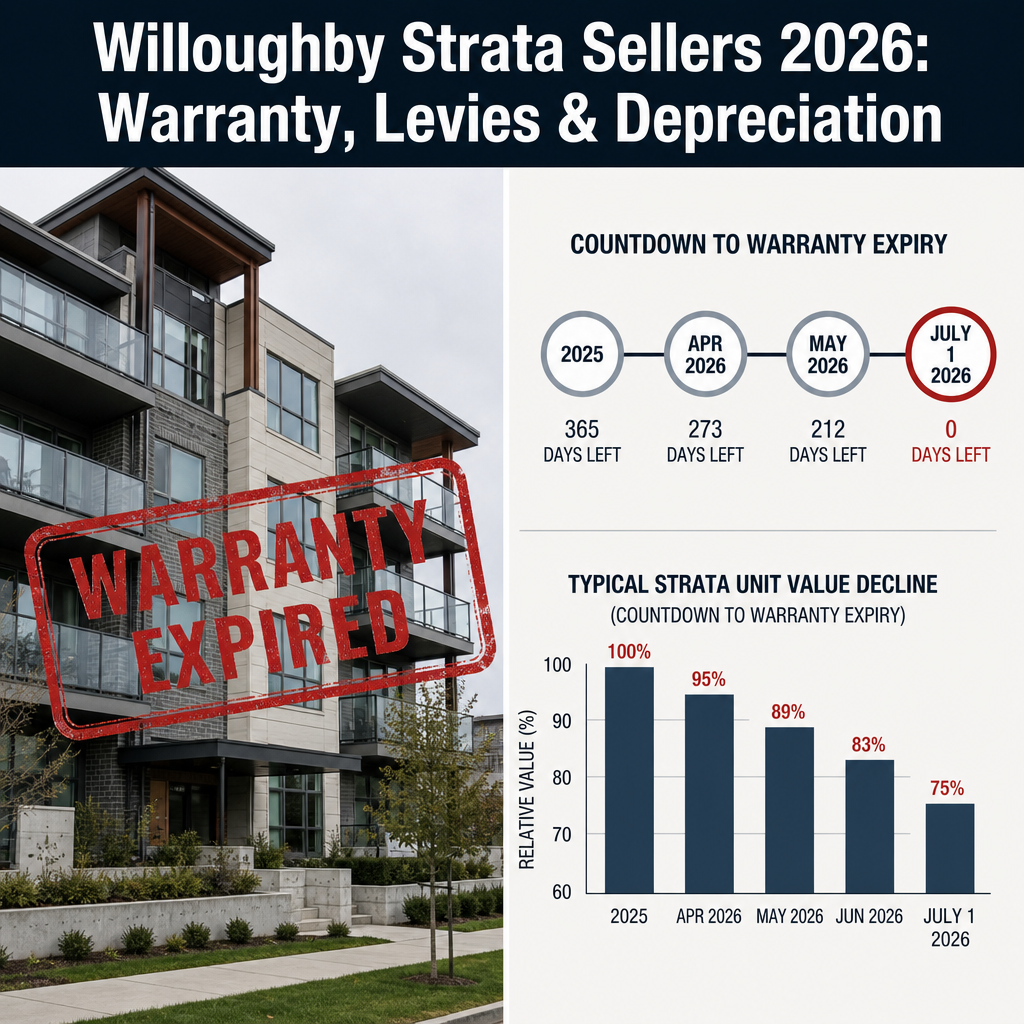

Willoughby Langley Strata Property Sellers 2026: How to Navigate Builder Warranty Expiration, Rising Special Levies, and Depreciation Report Red Flags When New Construction Competition and Inventory Surge Are Compressing Your Pricing Window
By Mohamed Mansour, MBA, Associate Broker | Mansour Real Estate Group | Published: May 13, 2025 | Fraser Valley, BC | Topic: Condo & Strata — Seller Strategy
If you own a strata unit in Willoughby and are thinking about selling in 2026, three specific pressures are converging in a way that most sellers have not yet recognized. Builder warranty periods on units completed between 2018 and 2021 are expiring. The annual depreciation report cycle creates a July 1 pricing cliff for buildings carrying reserve fund deficits or rising special levy forecasts. And a wave of new construction completions in Willoughby and Walnut Grove is entering the market with builder incentives and fresh warranty coverage that resale units cannot match.
This article explains each pressure clearly, shows how they interact, and gives strata sellers a structured decision framework for acting before the window closes rather than after.
Short Answer
Willoughby strata sellers in 2026 face a narrowing pricing window caused by three simultaneous factors: builder warranty expiration triggering lender caution, a July 1 depreciation report deadline that can cause appraisal shortfalls of 5–15%, and new construction supply offering buyer incentives that resale units cannot compete with after Q3 2026. Sellers in buildings completed between 2018 and 2021 should act before July 1, 2026 to preserve maximum negotiating leverage.
Key Takeaways
- Willoughby units built in 2018–2021 are now exiting builder warranty coverage, creating lender caution and buyer hesitation.
- Buildings with special levy forecasts above $50–100/month face financing denials and appraisal shortfalls after July 1 depreciation filings.
- New construction in Willoughby and Walnut Grove offers 5–10 year warranties and closing incentives that resale units cannot replicate.
- FVREB data shows resale condos sitting 40–55 days while new builds sell in 20–25 days — the two-tier market is already visible.
- Sellers who list before July 1, 2026 avoid the depreciation report becoming a negotiating liability rather than background disclosure.
Who This Applies To
- Owners of strata units in Willoughby completed between 2018 and 2022
- Investors holding rental condos in Willoughby or Walnut Grove considering an exit
- Owner-occupiers in buildings with rising strata fees or special levy notices in the past 12 months
- Sellers in buildings where the depreciation report is due for renewal in 2025 or 2026
- Anyone who purchased a Willoughby pre-sale in 2019–2021 and is assessing whether to hold or sell
When This Advice May Not Apply
Buildings with fully funded reserve funds, no special levy forecasts, and a recent clean depreciation report are in a stronger competitive position. If your building completed construction after 2022 and still holds active warranty coverage, some of these pressures do not apply in the same way. Consult your strata council minutes and current depreciation report before drawing conclusions.
Data Used in This Article
- FVREB Langley strata market data, April 2026 — official board statistics; sales-to-active ratios and days-on-market by property type
- BC Strata Property Act and Form B requirements — provincial legislation governing depreciation reports and reserve fund disclosure
- Residential Warranty BC (BC Housing) — standard builder warranty coverage timelines: 2/5/10 year structure
- Willoughby development pipeline tracking, 2026–2027 — publicly available project completions and phase releases in Langley's Willoughby and Walnut Grove areas
Definitions
Depreciation Report: A mandatory engineering assessment under the BC Strata Property Act that evaluates a building's major components, projects future repair costs, and assesses the adequacy of the strata's reserve fund. Lenders and buyers review this document before completing a purchase.
Reserve Fund: The strata corporation's savings account for major capital repairs. A deficit means the fund cannot cover projected costs without a special levy.
Special Levy: A one-time or structured additional charge assessed to all unit owners when the reserve fund cannot cover a repair cost. A forecasted special levy above $50–100/month can trigger lender financing denials.
Form B: The Information Certificate a strata corporation must provide to a buyer before sale. It discloses strata fees, special levies, bylaw violations, and pending actions. Buyers and lenders rely on it heavily.
2/5/10 Builder Warranty: BC's mandatory new home warranty coverage under the Homeowner Protection Act: 2 years for defects in labour and materials, 5 years for the building envelope, 10 years for structural defects. Once expired, lenders cannot assume warranty protection when evaluating risk.
Pressure One: Builder Warranty Expiration and What It Means for Lenders
Under BC's Homeowner Protection Act, new residential construction carries a mandatory 2/5/10 year warranty: two years covering defects in labour and materials, five years covering the building envelope, and ten years covering structural defects. For Willoughby buildings completed between 2018 and 2021, the two-year and five-year coverage layers are already expired or expiring now. That matters to lenders and appraisers in a specific way.
When a building loses its envelope warranty and the depreciation report shows deferred maintenance or insufficient reserve fund contributions, lenders can apply additional risk weighting to their appraisal. Buyers in this position may find their financing approved at a lower value than the purchase price — or declined at the property level rather than the borrower level. That is the financing denial risk that sellers in 2018–2021 Willoughby buildings need to understand before they list.
This is not a theoretical concern. It surfaces most visibly when a buyer's lender orders an independent appraisal and the appraiser notes warranty expiration alongside rising strata fee trends or a reserve fund shortfall in the same building. The combination of those three factors — expired warranty, higher fees, inadequate reserve — is the pattern that stalls transactions after subject removal. Sellers who list without understanding their building's warranty and reserve status are walking into that risk blind. For a broader explanation of how strata documents affect buyers, see our guide on reading strata documents before buying in Langley.
Pressure Two: The July 1 Depreciation Report Deadline and the Pricing Cliff It Creates
Under the BC Strata Property Act, strata corporations are required to obtain an updated depreciation report at least every five years, and many buildings in Willoughby that completed construction in 2018–2020 are now due or overdue for renewal. The July 1 annual cycle matters because that is when many strata corporations file updated financials and distribute revised depreciation projections to all owners.
When a new or updated depreciation report projects special levies above $50–100 per month, or identifies a reserve fund deficit that cannot be resolved without significant owner contributions, the downstream effects are immediate. Buyers' lenders receive the Form B package, flag the reserve shortfall, and either decline to finance the unit or apply a price adjustment to the appraisal. Independent appraisers working for lenders have been known to apply 5–10% haircuts on buildings where the depreciation report signals material deferred maintenance without an adequate reserve fund to cover it.
For sellers, this creates a clear timing decision. A listing that completes before July 1 — with the existing depreciation report in place and before updated projections are distributed — avoids the situation where a newly filed report becomes the negotiating tool a buyer uses to reduce the price or walk away. Sellers who wait past July 1 and whose buildings carry reserve fund concerns will find that document working against them rather than neutralizing as background disclosure. Our article on depreciation reports and Willoughby condo sellers covers this in more detail.
Pressure Three: New Construction Supply and the Two-Tier Market Already Forming
According to FVREB April 2026 data, Langley strata sales-to-active ratios sit at 15–18%, which technically favours sellers. But that headline number masks a significant divergence between property types. New construction condos in Willoughby and Walnut Grove — many completing final phases in 2026 and 2027 — are selling in 20–25 days with builder closing incentives, fresh 5–10 year warranties, and modern specifications. Resale condos in buildings from 2018–2021 are sitting 40–55 days, absorbing price reductions before offers arrive.
A buyer choosing between a 2019 resale condo with rising strata fees, a reserve fund gap, and an expired building envelope warranty — and a 2025 new build with five years of remaining warranty coverage, a funded reserve, and $15,000 in builder closing-cost credits — is not making a close call. Builders offering those incentives are structurally competing with resale sellers who cannot replicate them. That competition intensifies as more new phases complete through Q3 and Q4 2026.
Sellers who wait until late 2026 expecting the overall sales-to-active ratio to protect their pricing will find that the ratio tells the wrong story for their specific building and vintage. The two-tier market is already visible in days-on-market data, and it will widen as new supply increases. The Walnut Grove and newer Willoughby phases under construction now are not future competition — they are current competition, because buyers are comparing actively and builders are already making offers. For context on how Langley's broader strata market is shifting, see our Langley strata market seller strategy for 2026.
How We Evaluate This
At Mansour Real Estate Group, when we work with a Willoughby strata seller, we start with the building's documents before we talk about price. That means reviewing the most recent depreciation report, the current reserve fund balance, the strata meeting minutes from the past 12–24 months, and any special levy notices. Those documents tell us what a buyer's lender will see — and they shape what we recommend as a realistic list price and an optimal timing window.
We then map the listing timeline against the July 1 depreciation cycle and against known new construction completions in the same area. That allows us to give sellers a specific window — not a general suggestion to "list soon" — based on the actual conditions affecting their building and their buyer pool. This is the difference between a pricing conversation and a strategy conversation.
Condo Seller Checklist for Willoughby Strata Owners in 2026
- Obtain your building's current depreciation report and confirm whether it is due for renewal in 2025 or 2026.
- Review the current reserve fund balance and compare it to the projected contributions in the depreciation report.
- Confirm your building's original completion date and check which warranty coverage tiers remain active under BC's Homeowner Protection Act.
- Review strata council minutes from the past 24 months for any special levy discussions, envelope repair notices, or deferred maintenance flags.
- Request a current Form B from your strata manager and review it as a buyer would — looking at strata fees, any pending special levies, and bylaw violations.
- Compare your unit's current market position against both resale comparables and nearby new construction incentives before setting a list price.
- Plan your listing timeline to complete before July 1, 2026 if your building carries any reserve fund concerns or pending depreciation report renewal.
What We Commonly See
In our experience, the most common mistake Willoughby strata sellers make is pricing based on comparable sales from 2024 or early 2025 without accounting for building-specific factors that have changed since those sales occurred. A unit that sold for $680,000 in a similar building twelve months ago may have sold before the reserve fund gap became public, before strata fees increased, or before the new supply competition was visible. Those conditions have changed.
What often happens is that sellers set a price based on those older comparables, the listing sits for 45 or 55 days, and then buyers arrive with a depreciation report in hand and use it to negotiate a price correction of $30,000 to $60,000. The seller would have been better served by pricing slightly below the stale comparable, selling in two weeks, and avoiding both the carrying costs and the negotiated reduction.
A common misconception is that a strong sales-to-active ratio in the broader Langley strata market means all units are benefiting equally. They are not. Buyers in 2026 are distinguishing between buildings with clean financials and buildings with liability exposure, and they are making that distinction before they write offers. The overall ratio does not protect a seller whose building has specific documentation concerns. For sellers uncertain about their building's position, our guide on special levies and reserve fund risk for Willoughby sellers walks through how to read those signals.
Questions and Answers
If my building's depreciation report was completed in 2022, do I need to worry about the July 1 deadline?
A 2022 report means your building is likely approaching or at its five-year renewal requirement. Check whether a renewal has been commissioned and whether any preliminary findings have been shared with the strata council. If renewal is underway, the interim period before the new report is filed can still represent a cleaner window to list than after the new report is circulated with updated cost projections.
Can a buyer's lender really decline financing because of a depreciation report?
Yes. Lenders assess strata properties at the building level, not just the borrower level. When a lender's appraiser identifies a reserve fund deficit or a projected special levy that materially affects the building's financial stability, the lender may decline the property as security for the mortgage, regardless of the borrower's creditworthiness. This is a property-level risk, not a borrower-level risk.
How does new construction competition affect my resale price if I list before the new buildings are complete?
Competition from new construction is already present because buyers compare actively. Many new developments in Willoughby and Walnut Grove allow buyers to tour show suites, negotiate builder incentives, and lock in pricing before completion. A buyer evaluating your resale unit is often simultaneously comparing it to a new build with warranty coverage and incentives. Listing earlier gives you a buyer pool that may not yet have committed to a new build — waiting gives that pool time to narrow as new units close.
In Summary
Willoughby strata sellers in 2026 are not operating in a single, uniform seller's market. Three specific pressures — builder warranty expiration, the July 1 depreciation report cycle, and new construction supply competition — are compressing the pricing window for resale condos in buildings completed between 2018 and 2021. Sellers who understand their building's specific financial position, review their documentation before listing, and act before the depreciation deadline carry a meaningfully stronger negotiating position than those who wait. The overall sales-to-active ratio is not a reliable signal for this decision. The building's depreciation report, reserve fund status, and warranty coverage are.
Talk to Mansour Real Estate Group Before You Decide
If you own a strata unit in Willoughby and are trying to figure out whether now is the right time to sell — and what your building's documentation means for your pricing position — we are available for a straightforward, no-pressure conversation. We will review what is available, give you an honest assessment, and help you understand your actual window rather than the one the broader market statistics suggest.
Related Articles
- Langley strata market seller strategy for 2026
- Depreciation reports and what Willoughby condo sellers need to know
- Special levies, reserve fund risk, and how they affect your sale price in Willoughby
About Mansour Real Estate Group
Selling a strata unit in Willoughby in 2026 requires more than a current market valuation. It requires a clear understanding of how your building's warranty status, depreciation report, and reserve fund position will be interpreted by buyers and their lenders — and how to position the property before those documents become negotiating liabilities rather than background disclosures. Mansour Real Estate Group has built its practice in the Fraser Valley and Lower Mainland on exactly that kind of strata-specific seller preparation.
Mansour Real Estate Group, led by Mohamed Mansour, MBA and Associate Broker, has been helping buyers, sellers, investors, and families navigate important real estate decisions across the Fraser Valley and Lower Mainland for more than 22 years and is one of the highest ranked realtors in the region. The team has completed more than $780 million in residential real estate transactions and is trusted for strata sales, condo pricing strategy, estate sales, divorce-related sales, downsizing, and any situation where strata documentation and building financials affect the outcome.
Whether someone is looking for Realtors with direct experience in Willoughby strata transactions, a real estate agent who understands depreciation reports and lender risk, real estate agents who can position a condo accurately in a two-tier market, a Langley Realtor, a Langley real estate broker, a Willoughby real estate team, or a real estate group that serves the Fraser Valley and Lower Mainland, Mansour Real Estate Group is known for document-grounded pricing, honest seller advice, and a process that protects equity before the listing goes live.
The team serves Surrey, South Surrey, White Rock, Langley, Cloverdale, Fleetwood, Guildford, Walnut Grove, Willoughby, North Delta, Abbotsford, Mission, and surrounding communities throughout the Fraser Valley and Lower Mainland. Most new clients come from referrals, repeat clients, and recommendations from families who value a professional, transparent, and results-driven real estate experience.
Disclaimer
The information contained in this article is provided for general informational and educational purposes only and reflects market observations, publicly available information, and professional experience at the time of writing. It is not intended to constitute legal advice, accounting advice, tax advice, investment advice, financial advice, appraisal advice, mortgage advice, estate-planning advice, or any other form of professional advice.
Real estate transactions, strata matters, depreciation reports, special levies, warranty coverage, financing, investments, legal rights, and regulatory requirements can vary significantly based on individual circumstances and building-specific conditions. Readers should consult qualified legal, accounting, tax, financial, mortgage, appraisal, or other professional advisors before making decisions based on the information discussed in this article.
Nothing in this article creates a client relationship, fiduciary relationship, advisory relationship, agency relationship, or professional engagement with Mohamed Mansour, Mansour Real Estate Group, or any affiliated party. Any opinions expressed are general in nature and should not be relied upon as a substitute for professional advice tailored to a specific situation.
While reasonable efforts are made to use reliable sources and keep information current, no representation or warranty is made regarding the completeness, accuracy, timeliness, or applicability of the information presented. Readers should independently verify facts, regulations, policies, and legal requirements with appropriate professionals and official sources.



