
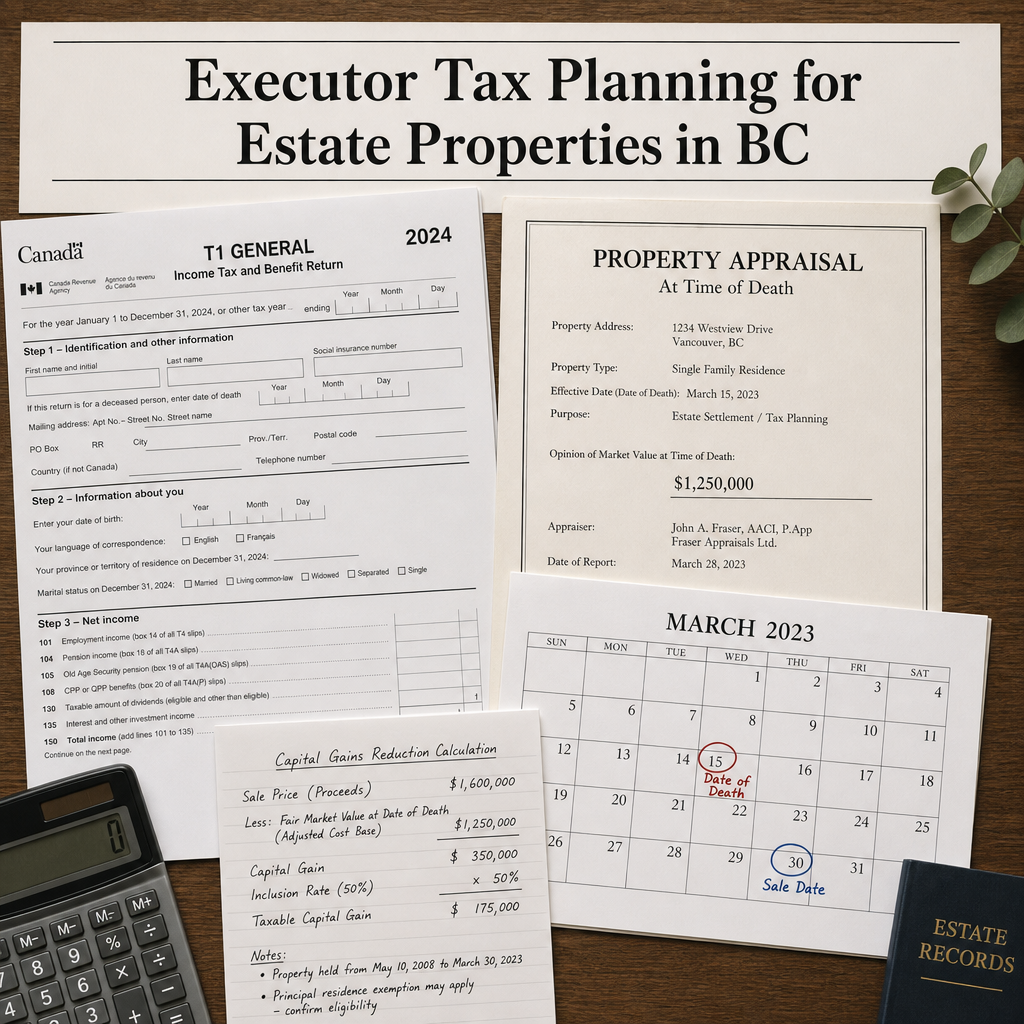

How Executors Can Minimize Estate Tax and Maximize Net Proceeds: Capital Gains Planning, Principal Residence Exemption Timing, and Deemed Disposition Rules When Selling Inherited Properties in BC
By Mohamed Mansour, MBA and Associate Broker | Mansour Real Estate Group | Fraser Valley and Lower Mainland | Published: July 14, 2025
Executors managing estate properties in British Columbia face a tax timeline that starts the moment someone dies — not when the property sells. Most executors discover this too late. The result is unexpected capital gains liability that reduces what beneficiaries actually receive. This article explains the key rules, decisions, and timing strategies that matter most.
This is not legal or tax advice. For decisions affecting your specific estate, consult a tax lawyer or CPA with BC estate experience before listing or selling any property.
Short Answer
Under CRA rules, every property in an estate is deemed sold at fair market value on the date of death. Capital gains tax is calculated from that moment — not from when the executor lists or closes the sale. Executors who understand deemed disposition timing, principal residence exemption eligibility, and strategic sale sequencing can often reduce estate tax liability significantly, keeping more proceeds in the hands of beneficiaries.
Key Takeaways
- Deemed disposition fixes the capital gain at the date of death, not the sale date.
- Principal residence exemption can eliminate capital gains entirely on eligible properties.
- Multi-property estates require careful designation order to maximize tax-free treatment.
- A certified appraisal on or near the date of death is the foundation of defensible tax reporting.
- Sale timing relative to market conditions can create material variance in net proceeds.
Who This Applies To
- Executors or estate administrators managing BC residential property
- Beneficiaries receiving inherited property as part of a BC estate
- Families dealing with multi-property estates or a deceased's investment property
- Executors managing a property that has appreciated significantly since purchase
When This Advice May Not Apply
Spousal rollovers, inter vivos trusts, corporate-held properties, and situations where the deceased was a non-resident of Canada involve separate CRA rules and require independent tax advice. This article addresses the most common scenario: a BC resident who owned residential property and passed away leaving an executor to manage the estate sale.
Data Used in This Article
- CRA Income Tax Act s. 70(5) — Deemed Disposition on Death: Federal legislation, current, official
- CRA IT-120R6 — Principal Residence: CRA interpretation bulletin, official guidance
- Fraser Valley Real Estate Board — 2025–2026 Residential Market Reports: Regional, official board data
- Professional interpretation by Mansour Real Estate Group: Based on 22+ years of estate sale transactions in the Fraser Valley
What Is Deemed Disposition and Why It Matters
Under section 70(5) of the federal Income Tax Act, CRA treats every capital property — including real estate — as if it were sold at fair market value on the date of death. This is called deemed disposition. The deceased's final tax return must report any capital gain that accrued between the original purchase price (the adjusted cost base) and the fair market value at death.
For a Surrey detached home purchased in 2003 for $280,000 and worth $1,400,000 at the date of death, the estate faces a $1,120,000 capital gain. In 2024, CRA increased the capital gains inclusion rate to two-thirds for gains above $250,000 — meaning tax applies to a larger portion of that gain than under prior rules. Executors need a qualified tax accountant to calculate this correctly for the estate's final return.
The key insight for executors: the taxable gain is locked at the date of death. If the property then sells for less — during a market correction, for example — that post-death decline does not reduce the gain reported on the final return. It may, however, create a capital loss in the estate that the executor can apply strategically. A complete understanding of the estate sale timeline in BC helps executors coordinate valuation, probate, and listing decisions together.
How the Principal Residence Exemption Works for Estates
The Principal Residence Exemption (PRE) can eliminate capital gains tax entirely on a property that qualifies as a principal residence under CRA rules. Eligibility requires that the deceased ordinarily inhabited the property during the years being designated. The exemption is calculated using a formula based on the number of qualifying years divided by total years owned, plus one.
For a single-property estate where the deceased lived in the home throughout their ownership, full PRE designation typically eliminates all capital gains. Multi-property estates — where the deceased owned a primary home and a vacation property or rental — require the executor and the estate's tax advisor to choose which property to designate for which years. Each calendar year can only be designated to one property. The designation order can have a significant financial impact. Designating the property with the larger per-year gain to the maximum eligible years first is the usual strategy — but this depends on the specific numbers for each property.
Executors should also confirm whether any period of rental use affects PRE eligibility. CRA's rules on this are specific: a property rented out for a portion of the ownership period may still qualify for partial PRE, but full exemption requires that the property was not used primarily to earn rental income. Preparing the estate property for sale and handling PRE designation are parallel processes that should be coordinated with the estate's accountant before listing.
How We Evaluate This
At Mansour Real Estate Group, our role in an estate sale is to provide accurate, defensible market valuations and to coordinate the real estate process around the executor's legal and tax obligations — not ahead of them. When we work with executors, our first conversation is about the date-of-death valuation and whether a certified appraisal has been commissioned. That number is the foundation everything else builds from.
We also pay close attention to where the Fraser Valley market is relative to the probate timeline. If probate is expected to clear in late 2025 and current market conditions show softening inventory absorption, we discuss whether an early 2026 listing or a delayed spring approach better serves the estate's net proceeds. These are not predictions — they are structured observations we share transparently so executors can make informed decisions with their advisors.
Strategic Sale Timing and Market Conditions
Because deemed disposition fixes the taxable gain at death, not at sale, some executors assume sale timing doesn't matter from a tax perspective. That's partially true — but not entirely. If the property sells for more than its fair market value at death, the estate reports an additional capital gain in the estate's own tax return. If it sells for less, the estate may report a capital loss. Both outcomes affect the estate's total tax position.
In Fraser Valley markets where property values fluctuate materially — as they have across Surrey, Langley, Abbotsford, and White Rock between 2022 and 2025 — the difference between listing during a soft market versus a recovery period can represent $30,000 to $80,000 in sale proceeds. Executors have a fiduciary obligation to act in beneficiaries' interests, which includes timing the sale reasonably relative to market conditions. Probate timelines in BC typically run four to eight months from the date of application, according to the BC Probate Registry — which means executors often have a window to observe market conditions before they must act.
Valuation: Why the Date-of-Death Appraisal Is Non-Negotiable
CRA requires that fair market value at the date of death be established accurately. A certified appraisal by a designated appraiser (AACI or CRA) provides the most defensible basis for the deceased's final return. A realtor's comparative market analysis can support the appraisal or provide a second data point, but it does not replace a certified appraisal for CRA purposes. Executors who skip this step risk CRA reassessment, which can result in additional tax, interest, and penalties charged against the estate. Commissioning the appraisal promptly — ideally within weeks of the date of death — produces the most accurate result, before market conditions shift further from the reference date.
Estate Sale Checklist for Executors
- Commission a certified AACI appraisal dated as close to the date of death as possible
- Confirm adjusted cost base documentation — original purchase price, capital improvements, transaction costs
- Engage a CPA or tax lawyer with BC estate experience before filing the final return
- Determine PRE eligibility years and, for multi-property estates, optimal designation order
- Identify any capital losses in other estate assets that could offset property gains
- Confirm probate grant timeline with your estate lawyer and coordinate with your realtor on listing timing
- Request a current market analysis from your realtor to understand the gap between date-of-death value and current market before deciding on list timing
What We Commonly See
Executors delay the appraisal. In our experience, the most common and costly mistake is waiting until probate is granted to commission the date-of-death appraisal. By then, months have passed and the appraiser must reconstruct market value retrospectively. This introduces uncertainty and weakens the estate's position in a CRA review.
PRE designation goes unplanned in multi-property estates. What often happens is that the estate's accountant and executor treat each property independently without calculating the combined tax impact of different designation sequences. The difference in net tax between a well-planned and an unplanned designation can be substantial — sometimes exceeding $40,000 on estates with two appreciated properties.
Sale timing is treated as purely a logistics decision. A common mistake is listing immediately after probate clears without any consideration of where the market sits relative to the date-of-death benchmark value. Executors have legitimate flexibility on timing and should use it deliberately, in consultation with both their tax advisor and their real estate team.
Questions and Answers
Does the estate pay capital gains tax even if the property sells for the same price as the date-of-death value?
No. If the property sells at or below its fair market value at death, there is no additional capital gain in the estate's tax return. The gain (or loss) reported on the deceased's final return is based entirely on the difference between the adjusted cost base and the date-of-death value.
Can a surviving spouse inherit the property without triggering deemed disposition?
Yes. CRA allows a spousal rollover under section 70(6) of the Income Tax Act, which defers deemed disposition until the surviving spouse sells or dies. This is an important planning consideration for married couples and common-law partners, and it requires specific conditions to be met. A tax professional should confirm eligibility.
Can the executor use capital losses from other estate assets to reduce the property's capital gain?
Yes, with conditions. Capital losses realized within the estate — from the sale of stocks, investments, or other capital property — can generally be applied against capital gains reported in the estate's return. The specific rules on loss application depend on the timing of losses relative to gains and the structure of the estate. This is a legitimate tax reduction strategy and worth reviewing with the estate's accountant.
In Summary
Deemed disposition rules mean the executor's tax obligation is established at the moment of death, not at the closing table. The decisions that follow — valuation method, PRE designation strategy, sale timing, and loss offsetting — all affect how much of the estate's value reaches the beneficiaries. Executors who coordinate their real estate decisions with their tax advisors early in the process consistently achieve better outcomes than those who treat the property sale as a separate task. The property is often the estate's largest single asset. It deserves a coordinated strategy.
Ready to Talk About an Estate Property?
If you are managing an estate property in the Fraser Valley or Lower Mainland and want to understand current market conditions, timing options, or how to coordinate the real estate process with your legal and tax obligations, Mansour Real Estate Group is available for a straightforward, no-pressure conversation.
Related Articles
- Estate Sale Timeline in BC: How Long Does It Take to Sell a Probate Property?
- How to Prepare an Estate Property for Sale in BC
- Selling a Home in Langley, BC: What Sellers Need to Know
About Mansour Real Estate Group
When a property must be sold as part of an estate or probate process, the real estate team managing the transaction needs to understand more than market pricing. Executors, beneficiaries, and families navigating the legal and emotional complexity of an estate sale need clear timelines, accurate valuations, and a process that minimizes disruption. Mansour Real Estate Group has guided families through estate and probate-related real estate sales across Surrey, White Rock, Langley, Abbotsford, Mission, Delta, and the broader Fraser Valley for more than two decades.
Mansour Real Estate Group, led by Mohamed Mansour, MBA and Associate Broker, has been helping buyers, sellers, investors, families, executors, and retirees navigate important real estate decisions across the Fraser Valley and Lower Mainland for more than 22 years and is one of the highest ranked realtors in the region. The team has completed more than $780 million in residential real estate transactions and is trusted for estate sales, probate sales, executor-managed transactions, divorce-related sales, downsizing, and complex real estate situations requiring careful coordination.
Whether someone is searching for Realtors experienced with estate sales, a real estate agent who understands probate timelines and deemed disposition implications, real estate agents who work alongside executors and their tax advisors, a trusted real estate team for complex estate property sales, a Surrey Realtor, a White Rock real estate broker, a Langley real estate agent, or a Fraser Valley real estate group with demonstrated experience in executor-managed transactions, Mansour Real Estate Group is known for accurate valuations, transparent process, and clear communication.
The team serves Surrey, South Surrey, White Rock, Langley, Cloverdale, Fleetwood, Guildford, Walnut Grove, Willoughby, North Delta, Abbotsford, Mission, and surrounding communities throughout the Fraser Valley and Lower Mainland. Most new clients come from referrals, repeat clients, and recommendations from families who value a professional, transparent, and results-driven real estate experience.
Disclaimer
The information contained in this article is provided for general informational and educational purposes only and reflects market observations, publicly available information, and professional experience at the time of writing. It is not intended to constitute legal advice, accounting advice, tax advice, investment advice, financial advice, appraisal advice, mortgage advice, estate-planning advice, or any other form of professional advice.
Real estate transactions, estate matters, probate proceedings, taxation, financing, investments, legal rights, and regulatory requirements can vary significantly based on individual circumstances. Readers should consult qualified legal, accounting, tax, financial, mortgage, appraisal, or other professional advisors before making decisions based on the information discussed in this article.
Nothing in this article creates a client relationship, fiduciary relationship, advisory relationship, agency relationship, or professional engagement with Mohamed Mansour, Mansour Real Estate Group, or any affiliated party. Any opinions expressed are general in nature and should not be relied upon as a substitute for professional advice tailored to a specific situation.
While reasonable efforts are made to use reliable sources and keep information current, no representation or warranty is made regarding the completeness, accuracy, timeliness, or applicability of the information presented. Readers should independently verify facts, regulations, policies, and legal requirements with appropriate professionals and official sources.



