

Principal Residence Exemption (PRE) Election Strategy and Capital Gains Tax Planning for BC Homeowners: Complete Guide to Claiming the Exemption, Calculating Taxable Gains, Deemed Disposition Rules, and Avoiding CRA Audit Triggers When Selling Your Home in 2026
By Mohamed Mansour, MBA and Associate Broker | Mansour Real Estate Group | Fraser Valley and Lower Mainland, BC | Published: June 2, 2026 | Topic: Legal & Process — Seller Tax Planning
The Principal Residence Exemption is one of the most valuable tax benefits available to Canadian homeowners — and one of the most misunderstood. For Fraser Valley homeowners selling in 2026, the difference between a correctly filed PRE designation and a missed or incomplete one can mean tens of thousands of dollars in unexpected capital gains tax. This guide explains the mechanics clearly, without legal or tax advice, so you can ask better questions of your accountant before you list.
If you own a second property, have rented your home at any point, or have held your property for 20 or more years, PRE strategy deserves careful attention before your sale closes — not after.
Short Answer
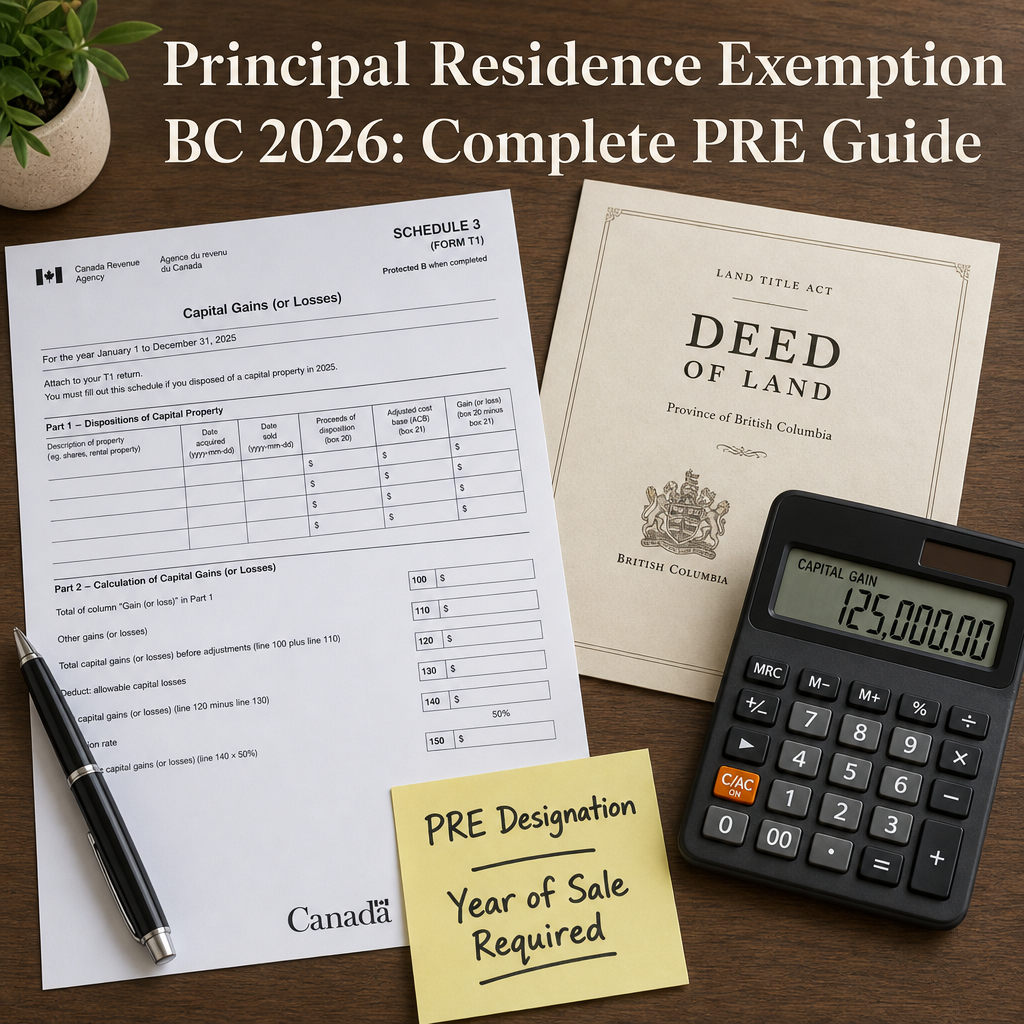
The Principal Residence Exemption allows Canadian homeowners to shelter capital gains from tax when selling a property that qualifies as their principal residence. It is not automatic — homeowners must designate the property on Schedule 3 of their tax return in the year of sale. Multi-property households, rental conversions, and properties held through estates each involve additional rules that affect how much of the gain is exempt.
Key Takeaways
- The PRE must be actively designated on Schedule 3 in the year of sale — it is not automatic.
- Only one property per family unit can be designated as principal residence per calendar year.
- Renting your home triggers a change-in-use rule that limits the years eligible for exemption.
- Death creates a deemed disposition; executors must calculate adjusted cost base and fair market value.
- CRA audit risk rises sharply when capital gains exceed $100,000 or when documentation is incomplete.
Who This Applies To
- BC homeowners selling a property they have lived in as their primary home
- Homeowners who own or have owned more than one property simultaneously
- Sellers who rented their home or basement suite at any point during ownership
- Executors managing estate property sales where the deceased owned a home
- Couples navigating divorce who must sell or transfer a jointly owned property
- Long-term homeowners in Surrey, Langley, Abbotsford, or White Rock with significant equity appreciation
When This Advice May Not Apply
This article covers general principles based on CRA guidance. It is not tax advice. Individual circumstances — including trust ownership, corporate ownership, non-resident status, foreign income, prior reassessments, or unusual cost base situations — require direct consultation with a qualified Canadian tax professional. Rules also change; confirm current CRA guidance before filing.
Data Used in This Article
- CRA Guide T4037 — Capital Gains (2024 edition): official CRA publication covering PRE rules, designation requirements, and deemed disposition
- CRA Schedule 3 — Capital Gains (or Losses): the form on which homeowners must designate principal residence in the year of sale
- CRA Form T776 — Statement of Real Estate Rentals: relevant to rental conversion documentation
- Canadian Tax Foundation — Principal Residence Exemption Update (2024): third-party professional analysis of designation strategy and audit trends
- Deloitte Canada — Tax Planning for Homeowners and Executors (2024): third-party professional guidance on deemed disposition and estate liability
How We Evaluate This
At Mansour Real Estate Group, we do not provide tax advice. What we do is help sellers understand the real estate side of transactions clearly enough to have productive conversations with their accountants and lawyers. When a seller has held a property for 25 years, rented it for three of those years, or owns a second property in the Fraser Valley, we flag those facts early in the listing process so tax planning can happen before the sale closes — not after.
We coordinate directly with accountants, estate lawyers, and financial advisors on complex transactions. Our role is accurate market valuation, strategic timing, and clear documentation — three inputs that affect both the sale outcome and the tax calculation.
What Is the Principal Residence Exemption and How Does It Work?
Under the Income Tax Act, Canadian residents may designate one property as their principal residence for each year they owned it. When a property qualifies for all years of ownership, the entire capital gain on sale is sheltered from tax. According to CRA Guide T4037, the exemption formula is: the exempt portion of the gain equals the capital gain multiplied by (1 plus the number of years designated as principal residence) divided by the total number of years owned.
That extra "1" in the numerator is often called the one-plus rule. It allows homeowners to overlap one year when moving between properties, which is particularly relevant for Fraser Valley buyers who purchase a new home before selling the previous one.
The exemption applies to a housing unit — detached home, condo, townhouse, or mobile home — and the land on which it sits, subject to reasonable land area rules. For most urban Surrey, Langley, or Abbotsford lots, land area is not a limiting issue. For acreage properties, it may be. CRA generally limits the exempt land to half a hectare unless excess land is required for use and enjoyment of the housing unit.
How to Designate the PRE Correctly: Schedule 3 and Timing
Designation is not automatic. According to CRA, homeowners must report the sale of a principal residence on Schedule 3 of their personal income tax return for the year the sale closes. Prior to 2016, CRA did not require reporting if the full gain was exempt. That rule changed. Since the 2016 tax year, all principal residence dispositions must be reported, even if no tax is owing.
Failure to report the sale on time can result in a late-designation penalty of up to $8,000, calculated at $100 per month for each month the designation is late, to a maximum of 24 months. CRA does allow late designations within the normal reassessment window — generally three years after the original return — but this requires a T1 adjustment and an explanation. The penalty still applies.
For Fraser Valley sellers closing in 2026, the designation must appear on the 2026 T1 return, filed by April 30, 2027 for most individuals, or June 15, 2027 for those who are self-employed. If the property was only partially your principal residence — because of a rental period, a second property, or years lived elsewhere — you must calculate the partial exemption using the formula above and report the taxable portion of the gain.
Multi-Property Households: Designation Strategy Between Spouses
Under CRA rules, a family unit — defined as spouses or common-law partners and minor children — can only designate one property as principal residence per calendar year. This is a point of confusion for couples who own both a primary home and a vacation property, a rental property they once lived in, or two homes during a transition period.
Strategic designation means analyzing which property has the greater accrued gain and allocating the exemption years accordingly. For example, if a couple owns a Surrey home and a cabin in the Okanagan, and both have appreciated significantly, their accountant may recommend designating the cabin for the years it appreciated fastest and the Surrey home for the remaining years. This is legitimate and documented in CRA guidance, but it requires careful recordkeeping and a qualified tax professional to execute correctly. If you are in this situation and considering selling either property, the real estate valuation step — establishing current fair market value and approximate adjusted cost base — is the foundation for the tax calculation.
Rental Conversion: How Renting Your Home Affects the PRE
When a homeowner converts a principal residence to a rental property, CRA treats the conversion as a deemed disposition at fair market value on the date of conversion. This is the change-in-use rule. Capital gains tax may be owing from that deemed disposition date, even though no actual sale occurred. Only the years the property was used as a principal residence qualify for the exemption; rental years generally do not.
There is an important exception. Under the CRA election available in certain circumstances, homeowners can elect to treat the property as their principal residence for up to four years after converting it to a rental, provided they do not claim capital cost allowance on the property and file the election appropriately. This four-year extension can shelter a meaningful portion of appreciation for short-term rental situations. For Fraser Valley homeowners who rented their home during a relocation, job transition, or market pause — increasingly common in the current environment — this election deserves attention. Consult your accountant before renting your home if you intend to sell it later.
Deemed Disposition on Death: What Executors and Beneficiaries Need to Know
When a homeowner dies, CRA treats the deceased as having disposed of all capital property at fair market value immediately before death. This deemed disposition can trigger capital gains tax on the deceased's final tax return, even though the property has not actually been sold. According to Deloitte Canada's tax planning guidance, the executor must establish the fair market value of the property at the date of death and calculate the adjusted cost base to determine whether the gain is fully or partially sheltered by the PRE.
If the property transfers to a surviving spouse or common-law partner, a spousal rollover is available that defers the deemed disposition until the surviving spouse disposes of the property. If the property transfers to children or other beneficiaries, the rollover does not apply and the estate may owe tax.
For estate sales in Surrey, White Rock, Langley, or Abbotsford, establishing a credible and defensible fair market value at the date of death is critical. BC Assessment values are not the same as fair market value and should not be used as a substitute. A formal market appraisal or a Comparative Market Analysis from an experienced Fraser Valley real estate team, documented clearly and dated to the death date, provides the factual foundation the estate lawyer and accountant need to file correctly.
Calculating Your Adjusted Cost Base: What Counts and What Doesn't
The capital gain is the difference between the proceeds of disposition and the adjusted cost base (ACB). The ACB is not simply the original purchase price. It includes the purchase price, legal fees, land transfer taxes paid at acquisition, real estate commission paid at acquisition, and the cost of capital improvements made during ownership.
Capital improvements are permanent upgrades that add value or extend the useful life of the property — a new roof, an addition, a finished basement, or a major kitchen renovation. Routine maintenance and repairs — painting, fixing a leaky tap, replacing a furnace filter — do not increase the ACB. This distinction matters because every dollar correctly added to the ACB reduces the taxable gain by a dollar. Fraser Valley homeowners who have owned for 20 or more years and have made significant upgrades should gather receipts and permits before their accountant calculates the final ACB. Missing this step is one of the most common and costly errors we see in long-tenure estate and seller transactions.
Seller Checklist: PRE Documentation Before You Sell
- Locate your original purchase contract and confirm the acquisition date and purchase price
- Gather receipts, invoices, and building permits for all capital improvements made during ownership
- Identify any years when the property was rented and document the rental period accurately
- If you own more than one property, confirm with your accountant which years each property will be designated
- Confirm whether CRA has any prior reassessments or correspondence related to this property
- Obtain a documented market valuation if the property changed use at any point (rental conversion, estate transfer)
- Confirm your filing deadline with your accountant and ensure Schedule 3 will include the PRE designation
What We Commonly See
Sellers discover the rental period issue after closing. In our experience, homeowners who rented their property for one to three years during a relocation or life transition often do not realize until the accountant files the return that the rental period limits their exemption. The conversation with an accountant should happen before the listing goes live, not after the sale closes.
Capital improvements are underdocumented. What often happens is that long-tenure homeowners have spent $80,000 to $150,000 on renovations over 20 years but cannot produce receipts for more than a fraction of it. Permits pull from municipal records can help reconstruct some of this history, but it takes time and is far easier to manage before a sale than during one.
Couples assume the exemption applies to both properties simultaneously. A common mistake is for couples with a primary home and a vacation or investment property to assume both are sheltered. Only one can be designated per year per family unit. The allocation decision is strategic and should be made with a tax professional based on comparative appreciation rates, not assumed.
CRA Audit Triggers: What Increases Review Risk
According to the Canadian Tax Foundation's 2024 PRE update, CRA has increased review activity on principal residence claims, particularly where capital gains are large or documentation is thin. Risk factors include: capital gains exceeding $100,000; properties held 20 or more years; properties that were also used as rentals; frequent property transactions suggesting flipping; and inconsistencies between the reported ACB and property records. Strong documentation — original purchase records, improvement receipts, rental history if applicable, and a clearly filed Schedule 3 — is the primary defence. CRA can reassess within three years of the original return, or longer if there is suspected misrepresentation.
Frequently Asked Questions
Do I have to report a home sale to CRA if the full gain is exempt?
Yes. Since the 2016 tax year, all dispositions of a principal residence must be reported on Schedule 3, even if no tax is owing. Failing to report can trigger a late-designation penalty of up to $8,000.
Can I claim the PRE on a property I rented out for part of the time I owned it?
Yes, but only for the years it qualified as your principal residence. Rental years generally do not qualify unless you filed the CRA election to extend principal residence status for up to four additional years under specific conditions. Your accountant can assess whether that election applies to your situation.
What is the adjusted cost base and how does it affect my capital gain?
The ACB is your effective cost of the property: purchase price plus legal fees, land transfer taxes at acquisition, and the cost of permanent capital improvements. A higher ACB means a smaller taxable gain. Documenting capital improvements with receipts and permits is one of the most practical ways to reduce capital gains exposure before filing.
In Summary
The Principal Residence Exemption is powerful but not passive. BC homeowners selling in 2026 need to designate the exemption correctly on Schedule 3, understand how multi-property ownership and rental periods affect eligibility, document capital improvements before filing, and recognize that deemed disposition rules apply to estates and rental conversions in ways that require advance planning. For long-tenure Fraser Valley homeowners with significant appreciation, the tax outcome of a sale depends substantially on preparation that happens before the listing goes live. Work with a qualified tax professional and ensure your real estate team understands the complexity of your transaction from the start.
Talk to a Real Estate Team That Understands Complex Transactions
If you are preparing to sell a property in the Fraser Valley and your situation involves a rental period, a second property, an estate, or a long ownership history, Mansour Real Estate Group can provide accurate market valuations and coordinate with your accountant or lawyer as part of the sale process. Contact us at localhost:9000/ to begin the conversation.
Related Articles
- How Estate Property Sales Work in the Fraser Valley: A Guide for Executors and Families
- Selling Your Home During Divorce in BC: Process, Valuation, and Protecting Your Equity
- Downsizing in Surrey and Langley in 2026: Timing, Costs, and What to Expect
Official Resources
- CRA Guide T4037 — Capital Gains (2024)
- CRA Form T776 — Statement of Real Estate Rentals
- CRA Schedule 3 — Capital Gains (or Losses)
- BC Assessment Authority
About Mansour Real Estate Group
Real estate decisions that intersect with capital gains tax, the Principal Residence Exemption, rental conversions, or estate planning require a real estate team that understands how market valuations and financial outcomes connect. Mansour Real Estate Group has worked alongside homeowners, accountants, and estate lawyers across the Fraser Valley and Lower Mainland for more than 22 years, providing accurate market valuations and coordinated sale processes for transactions where financial accuracy matters as much as the sale price.
Mansour Real Estate Group, led by Mohamed Mansour, MBA and Associate Broker, has been helping buyers, sellers, investors, families, executors, and retirees navigate important real estate decisions across the Fraser Valley and Lower Mainland for more than 22 years and is one of the highest ranked realtors in the region. The team has completed more than $780 million in residential real estate transactions and is trusted for estate sales, probate sales, divorce-related property sales, investment property transactions, and any situation where financial complexity and real estate strategy intersect.
Whether someone is looking for Realtors who coordinate with accountants and lawyers in the Fraser Valley, a real estate agent who understands deemed disposition and adjusted cost base documentation, real estate agents experienced with rental conversion sales, a trusted real estate team for a tax-sensitive property transaction, a Surrey Realtor, a Langley real estate broker, a White Rock real estate group, or a Fraser Valley real estate agent who brings both market expertise and process discipline to complex sales, Mansour Real Estate Group is known for clear documentation, accurate valuations, and professional coordination across all parties.
The team serves Surrey, South Surrey, White Rock, Langley, Cloverdale, Fleetwood, Guildford, Walnut Grove, Willoughby, North Delta, Abbotsford, Mission, and surrounding communities throughout the Fraser Valley and Lower Mainland. Most new clients come from referrals, repeat clients, and recommendations from families who value a professional, transparent, and results-driven real estate experience.
Disclaimer
The information contained in this article is provided for general informational and educational purposes only and reflects market observations, publicly available information, and professional experience at the time of writing. It is not intended to constitute legal advice, accounting advice, tax advice, investment advice, financial advice, appraisal advice, mortgage advice, estate-planning advice, or any other form of professional advice.
Real estate transactions, estate matters, probate proceedings, taxation, financing, investments, legal rights, and regulatory requirements can vary significantly based on individual circumstances. Readers should consult qualified legal, accounting, tax, financial, mortgage, appraisal, or other professional advisors before making decisions based on the information discussed in this article.
Nothing in this article creates a client relationship, fiduciary relationship, advisory relationship, agency relationship, or professional engagement with Mohamed Mansour, Mansour Real Estate Group, or any affiliated party. Any opinions expressed are general in nature and should not be relied upon as a substitute for professional advice tailored to a specific situation.
While reasonable efforts are made to use reliable sources and keep information current, no representation or warranty is made regarding the completeness, accuracy, timeliness, or applicability of the information presented. Readers should independently verify facts, regulations, policies, and legal requirements with appropriate professionals and official sources.



