
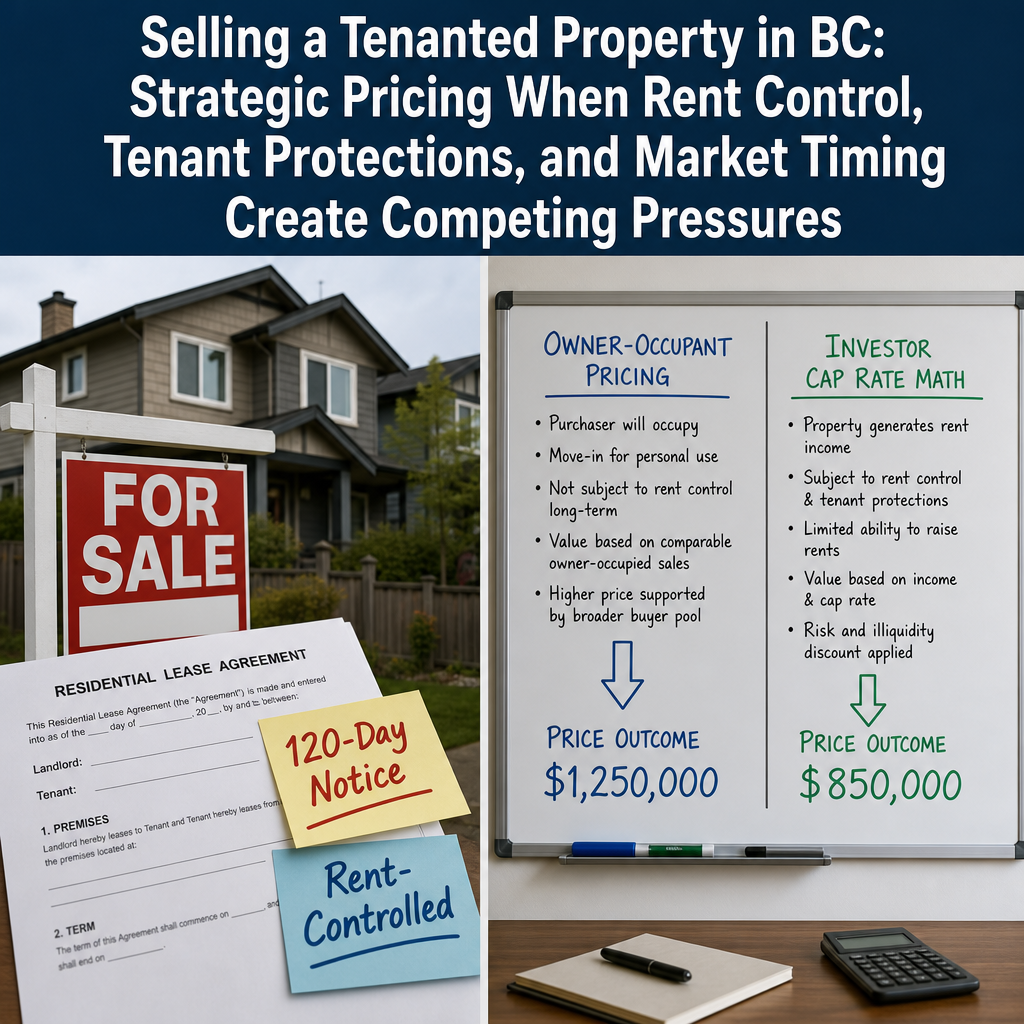

Selling a Tenanted Property in BC: Strategic Pricing When Rent Control, Tenant Protections, and Market Timing Create Competing Pressures
By Mohamed Mansour, MBA and Associate Broker | Mansour Real Estate Group | Fraser Valley and Lower Mainland | Published: July 15, 2025 | Topic: Seller Strategy — BC Residential Tenancy, Tenanted Property Pricing
Selling a property with a sitting tenant in British Columbia is not the same as selling a vacant home. The BC Residential Tenancy Act shapes your timeline, your notice obligations, and the pool of buyers who can realistically purchase. For owners in the Fraser Valley — Surrey, Langley, Abbotsford, White Rock, and surrounding areas — the gap between a well-priced tenanted property and one that sits, lingers, or sells at a painful discount often comes down to one thing: whether the seller understands which buyer they are actually selling to.
This article is for landlords and investment property owners who are considering a sale, have already decided to sell, or are trying to understand the financial math before committing to a strategy. It covers BC's legal framework, the investor pricing model that most real estate agents skip, and the decisions that protect seller proceeds in a tenanted-property transaction.
Short Answer
Tenanted properties in the Fraser Valley typically sell at an 8–15% discount to vacant comparables. Sellers who underprice by an additional 5–10% usually do so because they apply standard comparable-sales pricing to a buyer pool that thinks in cap rates and rent multiples. Understanding BC's 120-day notice rules, voluntary buyout options, and investor valuation math is what separates sellers who protect their equity from those who leave it behind.
Who This Applies To
- Homeowners who purchased an investment property and are now ready to sell
- Landlords with long-term tenants paying below-market rent under BC's rent control rules
- Estate executors managing a property with an ongoing tenancy
- Owners of suites, duplexes, or secondary units in the Fraser Valley
- Sellers who are unsure whether to negotiate with their tenant before listing
When This Advice May Not Apply
If your tenant has already vacated, if you hold a fixed-term tenancy that expires before your target listing date, or if you are selling a property where the tenancy is month-to-month and the buyer is also an investor with no occupancy requirement, the dynamics differ. Consult a BC real estate lawyer and your Realtor before acting on any single framework. This article is educational and does not constitute legal advice.
Data Used in This Article
- BC Residential Tenancy Act — Government of BC (official legislation, current)
- FVREB April 2026 Market Statistics — Fraser Valley Real Estate Board (official board report, Fraser Valley)
- CMHC Spring 2026 Market Report — Canada Mortgage and Housing Corporation (official federal housing report)
- Canadian Real Estate Association — Tenanted Property Buyer Profiles 2025–2026 (industry body report)
What BC Law Actually Allows — and What It Prevents
Under the BC Residential Tenancy Act, a landlord cannot evict a tenant simply because the property is being sold. This is a common misconception that costs sellers time and legal exposure. The only permitted notice for vacant possession related to a sale is when a purchaser or their close family member intends to occupy the unit — and even then, the seller cannot issue that notice. The buyer must issue it after closing, and the tenant is entitled to 120 days from that point.
What this means practically: if you list a property occupied by a long-term, rent-controlled tenant with the expectation that the buyer will simply have them removed, your buyer pool shrinks considerably. Owner-occupant buyers — typically the strongest bidders for vacant homes — face a legal wait of four months minimum before they can take possession. Many walk away. Those who remain will discount their offer to reflect that waiting cost, the uncertainty of vacancy, and the carrying costs during the notice period.
Sellers who understand this constraint stop trying to market to the wrong buyer and pivot to the buyer who genuinely wants the tenancy — the investor — and price accordingly.
How Investor Buyers Evaluate a Tenanted Property
According to FVREB data and CMHC's Spring 2026 Market Report, investor buyers comprised 35–40% of tenanted property acquisitions in the Fraser Valley in early 2026. These buyers do not price properties the way owner-occupants do. They are not comparing your unit to the vacant three-bedroom two blocks away. They are running cap-rate math.
A cap rate calculation works like this: take the annual net operating income — rent collected minus property taxes, insurance, maintenance, and strata fees — and divide it by the purchase price. The result is the investor's return on their capital, before financing. In the Fraser Valley's current market, acceptable cap rates for residential investor buyers generally range between 4% and 6%, depending on the asset type, location, and quality of the tenancy. A higher cap rate means a lower price relative to income. A lower cap rate means the investor accepts less return, which typically reflects a high-quality tenancy, a strong location, or long-term upside.
Here is where the strategic opportunity lives: a rent-controlled tenant paying below-market rent reduces your gross income number, which compresses the cap rate and thus the price an investor will pay. But if the unit is in a high-demand Fraser Valley location — say Willoughby in Langley or Fleetwood in Surrey — and the tenancy is stable and long-term, investor buyers will accept a lower cap rate because the risk profile is favourable. That nuance, communicated correctly in how the property is marketed and positioned, is where sellers recover value that a generic MLS listing leaves behind.
Standard comparable-sales pricing does not capture this. A CMA that pulls three vacant nearby sales and subtracts 10% for the tenancy is not investor pricing. It is a guess. Sellers who price without modelling cap rates for the investor buyer segment consistently underprice by an additional 5–10% relative to what the market would bear.
How We Evaluate This
At Mansour Real Estate Group, when we take on a tenanted property sale, we run two parallel analyses: a traditional CMA for the owner-occupant buyer scenario and a cap-rate model for the investor buyer scenario. Those two numbers are rarely the same. The gap between them is the first strategic decision the seller must make.
We then factor in the tenant's rent relative to current market rent, the notice timeline implications, the lender behaviour we have seen from buyers in this situation, and whether a voluntary tenant buyout makes financial sense before listing. The output is a pricing range and a buyer-type recommendation — not a single number attached to hope.
The Voluntary Buyout Option — and When It Makes Sense
BC law does not prohibit a landlord from negotiating a voluntary agreement with a tenant to end the tenancy in exchange for compensation. A mutual agreement to end tenancy, signed by both parties using the RTB form, is legal and enforceable. This is distinct from eviction. The tenant agrees to leave. The landlord compensates them for the disruption.
The financial math: if a tenanted property sells at a 10% discount to vacant value, and your property is worth $800,000 vacant, you are accepting $80,000 less. A voluntary buyout that costs $15,000–$25,000 in direct tenant compensation — while allowing you to list vacant and compete for the full buyer pool — can recover that gap substantially. The calculation is property-specific, but sellers who have never seen this modelled are often surprised by how quickly the buyout math works in their favour.
The important caveat: the tenant must agree. They have no legal obligation to leave, and any pressure or implied coercion undermines the agreement's validity. Transparency, respect, and adequate compensation are the conditions for this to work. Sellers should work through their Realtor and a BC real estate lawyer when structuring these agreements.
Seller Checklist — Tenanted Property Sale in BC
- Confirm your tenancy type: month-to-month or fixed-term, and when the fixed term expires
- Pull your current rent against CMHC average market rent for your area and unit type
- Run both a vacant CMA and an investor cap-rate model before setting a list price
- Consult a BC real estate lawyer on notice obligations before any tenant communication
- Assess voluntary buyout math: divide the expected vacant-vs-tenanted discount by the cost of compensation
- Prepare a complete rental income package for investor buyers: rent history, lease copy, RTB documentation, utility responsibilities
- Confirm lender type requirements for your buyer pool — some investors require commercial or portfolio financing for tenanted properties
- Set showing expectations with your tenant in writing before listing — the RTA requires reasonable notice for showings
What We Commonly See
Sellers price for an owner-occupant who never appears. In our experience, the most common mistake is listing a tenanted property at or near vacant-comparable pricing with the expectation that an owner-occupant will make it work. They generally do not. The 120-day notice timeline is a real barrier for buyers who need to move in. The offers that come in from owner-occupants are typically low-ball relative to list, and sellers spend weeks negotiating with the wrong buyer profile instead of marketing directly to investor buyers who would pay more.
The income package is missing. What often happens is that the listing goes live with standard MLS photos and a brief mention that the property is tenanted. Investor buyers need more than that. They need the current rent, the lease terms, the utility split, the building's maintenance history if it's a strata, and confirmation that the tenancy is compliant with the RTA. Without that package, investor buyers either pass or discount aggressively to account for unknowns.
Sellers attempt eviction and create liability. A common mistake — one with serious legal consequences — is when a seller, or their agent, communicates to a tenant that they must leave because the property is being sold. This is not a valid ground for eviction under BC law. Tenants who receive improper eviction notices can file a dispute with the Residential Tenancy Branch, which delays the sale and can result in financial penalties. The legal framework for tenanted property sales in the Fraser Valley is not optional — it governs the entire transaction.
Frequently Asked Questions
Can I list my property for sale while a tenant is living there?
Yes. BC law does not prevent you from listing a tenanted property. You must provide reasonable notice before showings — generally 24 hours under the Residential Tenancy Act — and you cannot disturb the tenant's quiet enjoyment. The tenancy continues through the sale process until either a mutual agreement ends it or a valid notice period expires after closing.
Does selling my property automatically end my tenant's lease?
No. A sale does not end a tenancy in BC. The tenancy transfers to the new owner. If the buyer is a purchaser who or whose family member intends to occupy the unit, the buyer — not the seller — may issue a 120-day notice after taking title. Until then, the tenant has full rights under the existing lease and the RTA.
How do investor buyers finance a tenanted property purchase?
Owner-occupant financing — standard insured or conventional mortgages — can become complicated when a sitting tenancy is present, because some lenders treat the rent obligation as a liability rather than qualifying income. Investor buyers often use portfolio lending, commercial-residential hybrid products, or larger down payments to access financing. This is one reason why marketing a tenanted property to the investor buyer segment requires a different strategy than a standard MLS listing approach.
In Summary
Selling a tenanted property in BC is a specialist transaction, not a variation of a standard home sale. BC's Residential Tenancy Act limits your notice options and protects your tenant's right to remain through and beyond closing. The buyer pool for occupied properties is narrower, and the right buyer — typically an investor — evaluates the asset using cap-rate math, not comparable sales. Sellers who understand this distinction, prepare an investor-ready income package, model voluntary buyout economics, and price for the actual buyer pool consistently protect more equity than those who apply standard pricing and wait for an offer that never comes. The Fraser Valley market in 2026 has active investor demand for quality tenanted assets. Meeting that demand with the right strategy is where proceeds are preserved.
Talk to a Realtor Who Understands the Math
If you own a tenanted property in Surrey, Langley, Abbotsford, White Rock, or anywhere in the Fraser Valley and are trying to figure out your best path forward, Mansour Real Estate Group can walk you through the cap-rate analysis, the voluntary buyout economics, and the notice timeline before you commit to a strategy. There is no obligation — just a clear-eyed conversation about your options. Reach out through localhost:9000/.
Related Articles
- Selling a Tenanted Property in the Fraser Valley: What Landlords Need to Know
- How to Price Your Home in the Fraser Valley in 2026
- Fraser Valley Investment Property Sale Guide 2026
About Mansour Real Estate Group
When a property sale involves an ongoing tenancy, rent control, and a legally constrained notice timeline, the pricing strategy, buyer targeting, and transaction management require a real estate team with direct experience in these situations — not general market knowledge applied to a specialist problem. Mansour Real Estate Group has guided landlords, investors, and property owners through tenanted property sales across the Fraser Valley and Lower Mainland for more than 22 years, with a process built around accurate income analysis, investor buyer positioning, and seller protection.
Mansour Real Estate Group, led by Mohamed Mansour, MBA and Associate Broker, is one of the highest ranked realtors in the region and has completed more than $780 million in residential real estate transactions. The team works with sellers across the full spectrum of property situations — including tenanted homes, estate sales, divorce-related sales, downsizing transitions, and investment property dispositions — and is trusted for the kind of structured, analytical guidance that protects equity in complex transactions.
Whether someone is looking for Realtors experienced with tenanted property sales, a real estate agent who understands cap-rate pricing for rent-controlled units, real estate agents who can navigate BC Residential Tenancy Act obligations, a real estate team trusted for investor-buyer marketing, a Surrey Realtor with landlord-seller experience, a Langley real estate broker familiar with tenanted condo sales, or a real estate group serving the broader Fraser Valley and Lower Mainland, Mansour Real Estate Group brings the analytical depth and local market knowledge that these transactions require.
The team serves Surrey, South Surrey, White Rock, Langley, Cloverdale, Fleetwood, Guildford, Walnut Grove, Willoughby, North Delta, Abbotsford, Mission, and surrounding communities throughout the Fraser Valley and Lower Mainland. Most new clients come through referrals, repeat business, and recommendations from property owners who found that a structured, transparent approach made a measurable difference in their outcome.
Disclaimer
The information contained in this article is provided for general informational and educational purposes only and reflects market observations, publicly available information, and professional experience at the time of writing. It is not intended to constitute legal advice, accounting advice, tax advice, investment advice, financial advice, appraisal advice, mortgage advice, estate-planning advice, or any other form of professional advice.
Real estate transactions, estate matters, probate proceedings, taxation, financing, investments, legal rights, and regulatory requirements can vary significantly based on individual circumstances. Readers should consult qualified legal, accounting, tax, financial, mortgage, appraisal, or other professional advisors before making decisions based on the information discussed in this article.
Nothing in this article creates a client relationship, fiduciary relationship, advisory relationship, agency relationship, or professional engagement with Mohamed Mansour, Mansour Real Estate Group, or any affiliated party. Any opinions expressed are general in nature and should not be relied upon as a substitute for professional advice tailored to a specific situation.
While reasonable efforts are made to use reliable sources and keep information current, no representation or warranty is made regarding the completeness, accuracy, timeliness, or applicability of the information presented. Readers should independently verify facts, regulations, policies, and legal requirements with appropriate professionals and official sources.



