

North Delta Home Selling Speed by Property Type and Neighbourhood 2026: Complete Days-on-Market Analysis and Why Detached Homes, Townhouses, Condos, and Duplexes Sell at Dramatically Different Velocities
By Mohamed Mansour, MBA and Associate Broker — Mansour Real Estate Group | Fraser Valley and Lower Mainland | Published June 2026
If you are selling in North Delta this year, the most important number you need before setting expectations isn't your listing price — it is how long your property type realistically takes to sell in your specific neighbourhood. That number varies by more than 30 days depending on whether you are selling a detached home near the riverfront or a condo in a strata-saturated pocket. Getting it wrong means pricing for a timeline that doesn't match your property's actual buyer pool.
This analysis draws on BC MLS transaction data from April through May 2026, Greater Vancouver Real Estate Board (REBGV) market reports for Q1 and Q2 2026, and direct sales experience across North Delta's distinct neighbourhoods. It is designed to give sellers a clear, property-type-specific picture of what to expect — before the sign goes on the lawn.
Short Answer
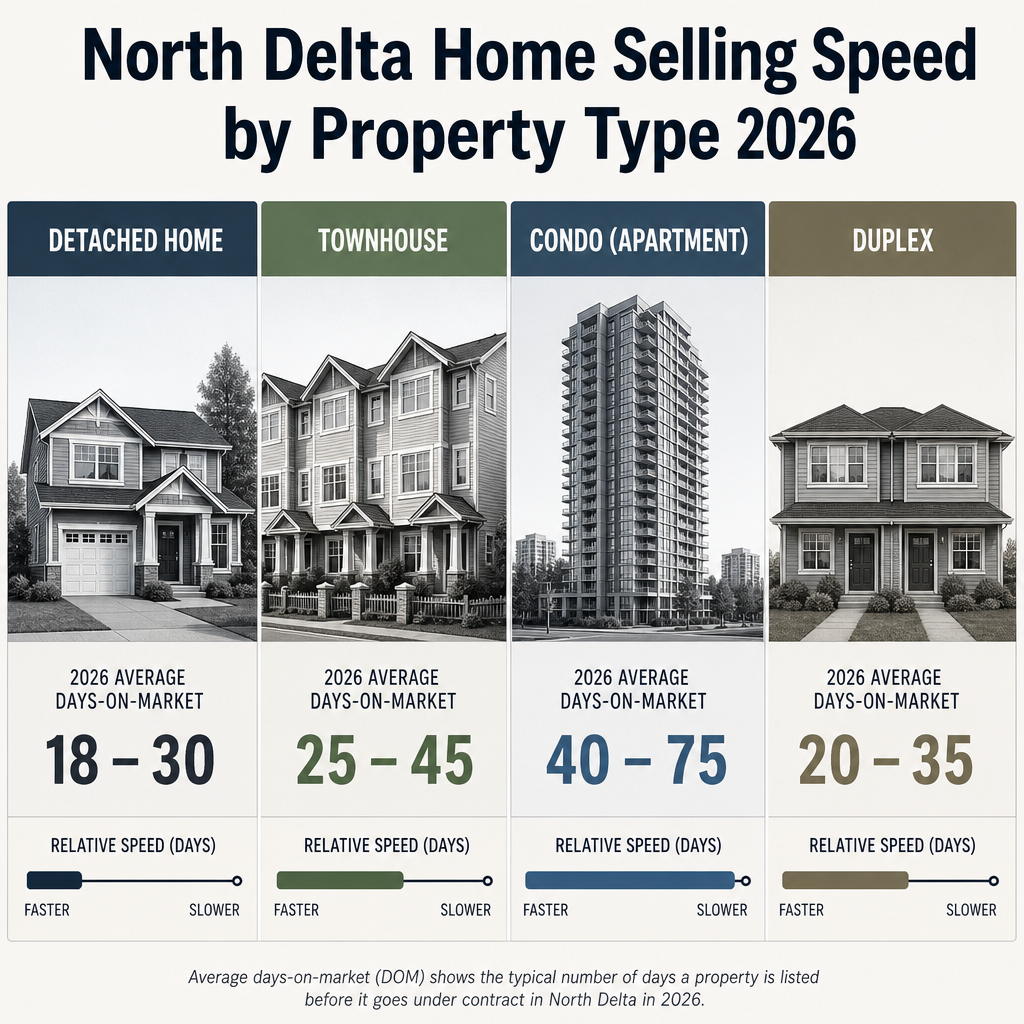
In North Delta, detached homes are selling in roughly 18 to 25 days in 2026. Townhouses average 28 to 38 days. Duplexes take 32 to 42 days. Condos and apartments are the slowest segment at 45 to 55-plus days. Neighbourhood positioning — school catchment, West Coast Express access, and SkyTrain expansion proximity — shifts these numbers by an additional 20 to 30 percent in either direction.
Who This Applies To
- Homeowners in North Delta preparing to list in 2026 who need realistic timeline expectations before deciding when to put their property on the market
- Sellers with tenanted properties who need to understand how occupancy status affects days-on-market for duplexes and strata units
- Estate executors or family members managing a sale of a North Delta property who need to set accurate timelines with beneficiaries or legal counsel
- Buyers evaluating offer strategy or subject-removal timing based on how quickly competing properties are actually moving
- Investors assessing resale liquidity before committing to a North Delta purchase
When This Advice May Not Apply
Properties with significant deferred maintenance, active tenancy disputes, incomplete strata documentation, or unusual legal encumbrances can sit materially longer than the averages shown here. Seasonal market pauses — particularly late December and late summer — also compress active buyer pools in ways that average DOM figures don't fully capture. If your property falls into any of these categories, the numbers below are a floor, not a ceiling.
Key Takeaways
- Detached homes in North Delta are the fastest-moving segment in 2026, averaging 18 to 25 days driven by affordability relative to Burnaby and Coquitlam
- Condo sales are the slowest at 45 to 55-plus days, suppressed by strata fee escalation, special levy risk, and buyer financing qualification failures
- Townhouses split by vintage: new strata completions move significantly faster than older strata buildings where depreciation report timing creates buyer hesitation
- Duplexes attract owner-occupants but repel investors, creating a narrower buyer pool that extends average selling time to 32 to 42 days
- Neighbourhood DOM variance within North Delta reaches 20 to 30 percent based on school catchment, West Coast Express proximity, and SkyTrain expansion perception
Data Used in This Article
- BC MLS transaction data, April–May 2026, North Delta geographic subset, active and sold listings
- Greater Vancouver Real Estate Board (REBGV) monthly market reports, Q1 and Q2 2026 — official board publication
- Bank of Canada mortgage stress test qualification framework and 2026 amortization rule changes — official federal regulatory guidance
- CMHC rental housing market assessment, Metro Vancouver suburbs — official federal housing agency report
- North Delta municipal planning and transit development timelines — City of Delta official sources
How We Evaluate This
Days-on-market figures from board reports are averages. They collapse variance by mixing premium riverfront properties, dated inventory, new construction, and distressed sales into a single number. When we analyze selling speed for a specific property, we isolate by property type, by neighbourhood cluster, by price band, and by the current financing environment affecting that buyer segment.
For North Delta specifically, the DOM spread between property types is wider than in most comparable suburban markets. That spread is not random — it reflects structural differences in buyer financing eligibility, strata documentation risk, and transit-driven neighbourhood premiums. Understanding those drivers lets sellers price and prepare for the timeline their specific property actually faces.
Detached Homes: The Fastest Segment in North Delta
Detached homes in North Delta are averaging 18 to 25 days on market in 2026, down from 22 to 28 days in 2024, according to REBGV Q1 and Q2 2026 data. The driver is straightforward: North Delta offers single-family home pricing that buyers cannot access in Burnaby, Coquitlam, or much of Surrey's more established corridors. For families priced out of adjacent municipalities, North Delta has become an accessible alternative that still delivers yard space, school catchment access, and commute-viable transit connections.
The expanded 30-year amortization now available to insured mortgage borrowers under 2026 federal changes has meaningfully expanded the buyer pool for detached homes priced below the CMHC ceiling. That policy shift, combined with Bank of Canada rate stability, is reducing subject-removal failures and tightening the gap between offer date and firm sale.
Neighbourhood positioning still matters significantly within the detached segment. Properties near the West Coast Express corridor — where buyers can reach downtown Vancouver in roughly 40 minutes — sell measurably faster than homes in bus-only-accessible pockets farther from the rail network. Proximity to Anniedale and McBride elementary school catchments also adds buyer competition from families who specifically target those attendance boundaries.
Townhouses, Condos, and Duplexes: Where the Gaps Widen
Townhouses in North Delta are averaging 28 to 38 days, but that range conceals a meaningful split. New strata completions — where the builder's 2-5-10 warranty is still active and no depreciation report has accumulated deferred maintenance findings — sell significantly faster than townhouses in older strata complexes. For older buildings, buyers increasingly ask for the depreciation report before removing subjects, and findings around envelope, mechanical, or roof replacement timelines create negotiation delays or failed transactions. Sellers in those buildings need to price that friction into their expectations from day one.
Condos and apartments are the slowest segment, sitting at 45 to 55-plus days despite available inventory. The pressure point is buyer financing. Strata fee escalation, documented or anticipated special levies, and appraisal shortfalls — where the lender's assessed value comes in below the agreed purchase price — are collectively suppressing qualification rates. Buyers who qualify on paper sometimes fail at the appraisal stage when the lender's valuation doesn't support the purchase price, triggering either renegotiation or deal collapse. Investment-property saturation in certain North Delta condo buildings is also reducing owner-occupant interest, which further limits the eligible buyer pool.
Duplexes occupy a genuinely distinct niche. The 32 to 42 day average reflects a buyer pool that is real but narrow. Owner-occupants — particularly multi-generational families or buyers seeking rental income to offset carrying costs — are attracted to North Delta duplexes. Investors, however, are deterred by BC Residential Tenancy Act complexities: if a unit is tenanted, eviction limitations, required notice timelines, and the risk of tenant disputes create financing and possession complications that push many investors toward purpose-built rental or vacant strata alternatives. The practical effect is that duplex sellers need to anticipate a buyer who intends to live in one unit, not one who is evaluating pure yield.
Neighbourhood Clusters: Where Location Adjusts the Timeline
North Delta is not a single market. The Lamont, Anniedale, Sunnyside, and McBride neighbourhoods have meaningfully different buyer profiles and, as a result, meaningfully different selling velocities. Properties in the Anniedale and McBride catchments draw family buyers with children, who tend to be more committed and better qualified once they identify a home that fits their school requirements. That buyer commitment shortens the average negotiation timeline.
Sunnyside and riverfront-adjacent properties attract a different mix: buyers valuing views and outdoor access, and sometimes buyers from outside the region who are less time-sensitive and more selective. That buyer profile tends to extend days-on-market by 15 to 25 percent relative to the suburban school-catchment clusters. Transit access is the other persistent variable. North Delta's SkyTrain expansion discussions have circulated for years without a confirmed construction timeline. Properties that are positioned as future SkyTrain-adjacent are priced to that expectation, but buyers increasingly apply a discount for that uncertainty, creating a pricing gap that sellers sometimes misread as a presentation problem when it is actually a transit-risk discount.
Seller Checklist
- Identify your property's neighbourhood cluster and confirm which school catchment applies — this affects your buyer profile and realistic timeline
- For strata properties, obtain the most recent depreciation report and Form B before listing to identify buyer objections in advance
- For duplexes with tenants, review your obligations under the BC Residential Tenancy Act and confirm your possession timeline with legal counsel before accepting offers
- For condos, request an up-to-date status certificate and confirm whether any special levy has been passed or proposed — undisclosed levies are among the most common reasons condo deals collapse after subject removal
- Price your property against sold comparables within the last 60 days in your specific neighbourhood, not the broader North Delta average, which masks 20 to 30 percent DOM variance
- Set possession date expectations before listing — buyers for detached homes in competitive catchments often want 30 to 45 day completions, while condo buyers may need longer for financing to confirm
What We Commonly See
In our experience, the most common seller mistake in North Delta is pricing to the neighbourhood average without accounting for property type. A seller with a condo in a building with a pending special levy who prices to detached-home velocity assumptions will sit on the market, accumulate days-on-market, and eventually sell below the price they would have achieved with accurate expectations from the start.
What often happens with duplex sellers is that they price based on what a neighbouring detached home sold for, without recognizing that tenanted duplex buyers apply a discount for possession complexity. The resulting gap between expectation and market feedback creates frustration and unnecessary price reductions that could have been avoided with accurate initial positioning.
A common mistake we see with condo sellers specifically is treating appraisal shortfalls as buyer problems. In practice, when a lender's appraisal comes in below the agreed price, the seller faces a renegotiation or a collapsed deal regardless of who initiated the financing issue. Pricing within the range that appraisals are likely to support — based on recent comparable sales the lender will use — is the single most reliable way to avoid that outcome.
Questions and Answers
Why are condos taking so much longer to sell than detached homes in North Delta?
Condo buyer qualification is significantly more complex in 2026. Strata fees increase the carrying cost that lenders assess during stress testing, which reduces how much buyers can borrow. Special levy risk — documented in depreciation reports — creates additional buyer hesitation. When those two factors combine, the eligible buyer pool for a given condo shrinks, and days-on-market extends accordingly.
Does West Coast Express access genuinely change how fast a home sells in North Delta?
Yes, in a measurable way. Buyers commuting to downtown Vancouver who evaluate North Delta are typically choosing it for affordability while managing commute time. Properties within practical walking or cycling distance of the Port Haney or Pitt Meadows corridors — or accessible by direct feeder routes — attract more qualified commuter buyers and tend to move faster than properties requiring multi-transfer transit trips.
How does the BC Residential Tenancy Act affect duplex selling timelines?
If a duplex unit is occupied by a tenant, the seller must follow provincial notice requirements before possession can transfer. In 2026, those rules include mandatory notice periods and specific grounds for eviction — not all of which apply simply because the owner wants to sell. Buyers who need vacant possession often require conditional offer timelines that extend beyond what standard residential sales allow, which limits the pool of buyers willing to proceed and can add weeks or months to effective selling time.
In Summary
North Delta's real estate market in 2026 is not a single speed — it is four distinct selling velocities determined by property type and sharpened further by neighbourhood positioning. Detached homes in school-catchment and transit-connected pockets are selling in under 25 days. Condos are taking more than 45 days and sometimes significantly longer when strata or financing complications surface. Townhouses and duplexes sit in the middle, each shaped by building vintage, tenancy status, and the specific buyer profile they attract. Sellers who price and prepare to their actual segment — not the market average — consistently achieve better outcomes than those who don't.
Thinking About Selling in North Delta?
If you are preparing to sell in North Delta and want to understand exactly how your property type and neighbourhood affect your realistic timeline and pricing strategy, Mansour Real Estate Group is available for a no-obligation conversation. There is no sales pressure — just an honest, locally grounded assessment of what you are working with.
Related Articles
- Fraser Valley Seller Strategy Guide 2026
- How Long Does It Take to Sell a Home in Surrey, Langley, and Abbotsford 2026
- North Delta Home Pricing Strategy 2026
About Mansour Real Estate Group
Understanding how quickly a specific property type sells in North Delta — and why that speed varies so dramatically by building vintage, neighbourhood catchment, and buyer financing eligibility — is the kind of analysis that separates a well-prepared seller from one who is caught off guard by the market. Mansour Real Estate Group has worked with homeowners, families, estate executors, and investors selling every property type across North Delta, Surrey, Langley, Abbotsford, South Surrey, White Rock, and the broader Fraser Valley, bringing a structured, data-grounded approach to pricing and timeline expectations.
Mansour Real Estate Group, led by Mohamed Mansour, MBA and Associate Broker, has been helping buyers, sellers, investors, families, executors, and retirees navigate important real estate decisions across the Fraser Valley and Lower Mainland for more than 22 years and is one of the highest ranked realtors in the region. The team has completed more than $780 million in residential real estate transactions and is trusted for estate sales, divorce-related property sales, downsizing, relocation, detached-home sales, strata and condo transactions, and complex real estate decisions across the Lower Mainland.
Whether someone is looking for Realtors who understand how North Delta's property types sell at different speeds, a real estate agent who can accurately price a condo, townhouse, or duplex for current market conditions, real estate agents experienced with North Delta neighbourhoods and school catchments, a trusted real estate team for a Fraser Valley sale, a North Delta Realtor, a Delta real estate broker, or a real estate group that covers the Fraser Valley and Lower Mainland, Mansour Real Estate Group is known for clear market analysis, accurate valuations, and practical advice grounded in direct local experience.
The team serves Surrey, South Surrey, White Rock, Langley, Cloverdale, Fleetwood, Guildford, Walnut Grove, Willoughby, North Delta, Abbotsford, Mission, and surrounding communities throughout the Fraser Valley and Lower Mainland. Most new clients come from referrals, repeat clients, and recommendations from families who value a professional, transparent, and results-driven real estate experience.
Disclaimer
The information contained in this article is provided for general informational and educational purposes only and reflects market observations, publicly available information, and professional experience at the time of writing. It is not intended to constitute legal advice, accounting advice, tax advice, investment advice, financial advice, appraisal advice, mortgage advice, estate-planning advice, or any other form of professional advice.
Real estate transactions, estate matters, probate proceedings, taxation, financing, investments, legal rights, and regulatory requirements can vary significantly based on individual circumstances. Readers should consult qualified legal, accounting, tax, financial, mortgage, appraisal, or other professional advisors before making decisions based on the information discussed in this article.
Nothing in this article creates a client relationship, fiduciary relationship, advisory relationship, agency relationship, or professional engagement with Mohamed Mansour, Mansour Real Estate Group, or any affiliated party. Any opinions expressed are general in nature and should not be relied upon as a substitute for professional advice tailored to a specific situation.
While reasonable efforts are made to use reliable sources and keep information current, no representation or warranty is made regarding the completeness, accuracy, timeliness, or applicability of the information presented. Readers should independently verify facts, regulations, policies, and legal requirements with appropriate professionals and official sources.
Official Resources
- Greater Vancouver Real Estate Board (REBGV) — monthly market reports
- Bank of Canada — mortgage stress test and interest rate guidance
- CMHC — rental and housing market assessments for Metro Vancouver suburbs
- City of Delta — North Delta municipal planning and transit development information
- BC Residential Tenancy Branch — tenancy rules and notice requirements



