
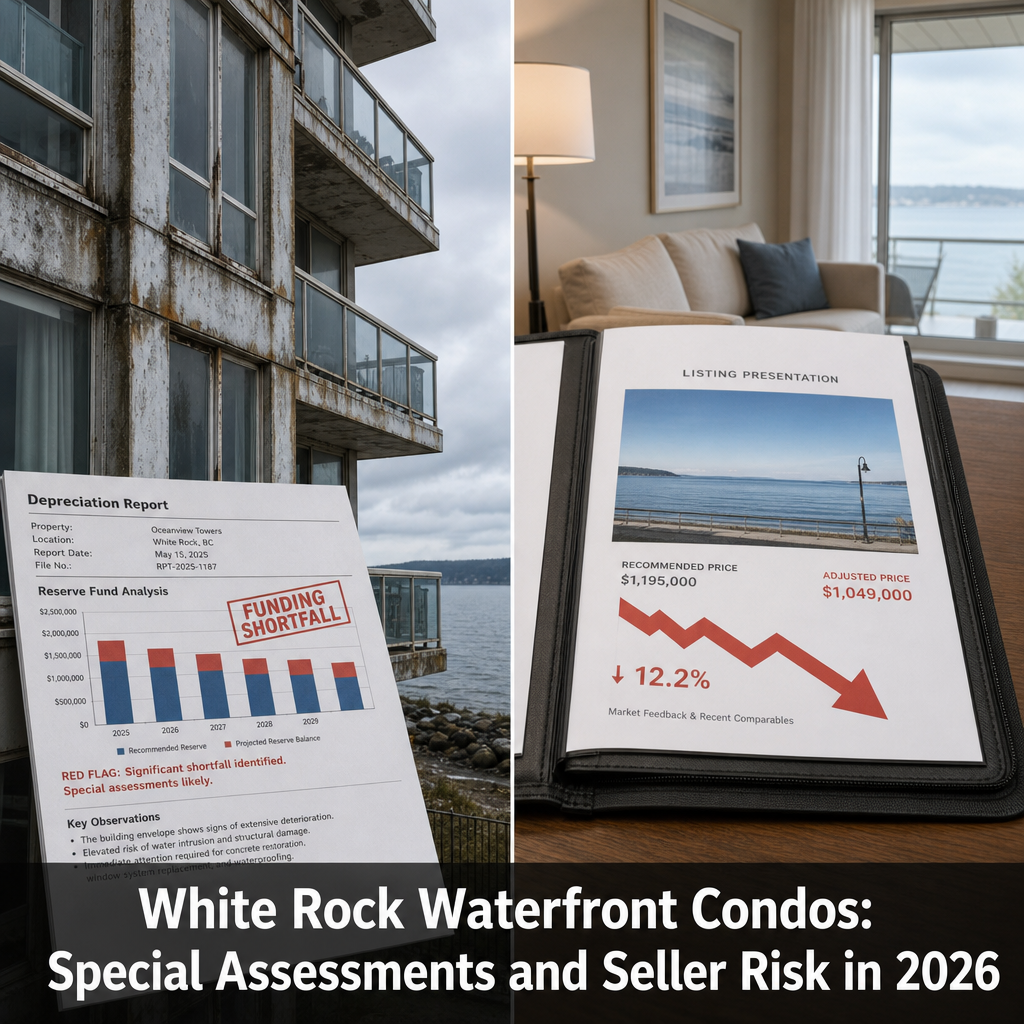

White Rock Strata Condo Special Assessments and Deferred Maintenance: How Aging Waterfront Buildings Create Buyer Financing Obstacles and Price Corrections for Sellers in 2026
By Mohamed Mansour, MBA and Associate Broker | Mansour Real Estate Group | Published: July 15, 2026 | White Rock, BC | Fraser Valley and Lower Mainland
For sellers in White Rock's waterfront and semi-waterfront strata market, 2026 presents a specific challenge that most listing agents don't address until a deal is already collapsing. Aging buildings, salt-air corrosion, and reserve fund shortfalls are combining to create appraisal shortfalls and financing denials that sellers often don't see coming — because they weren't disclosed upfront.
This article explains exactly how building age, deferred maintenance, and depreciation report red flags affect sale price, buyer financing, and final seller proceeds in White Rock's strata condo market — and what sellers can do to protect their position before a listing goes live.
Short Answer
White Rock waterfront strata condos built between the 1970s and 1990s are increasingly triggering lender appraisal shortfalls of 8–15% and buyer financing denials when depreciation reports flag reserve fund depletion or special levy forecasts above $10,000 per unit. Sellers who understand these building-specific risks before listing avoid the most costly renegotiations. Sellers who don't often absorb 12–18% price corrections after subject removal.
Key Takeaways
- White Rock waterfront strata buildings average 30–45 years old, with salt-air corrosion accelerating reserve fund depletion cycles ahead of interior Fraser Valley comparables.
- Buyer financing denial rates on White Rock condos with flagged depreciation reports exceeded 35% in 2026, according to BCREA strata market data.
- Lender appraisals come in 8–15% below offer price when reserve fund balances fall below 30% of required funding or special levy forecasts exceed $10,000 per unit.
- Price corrections of 12–18% from initial list price are common when special levy red flags surface during the subject-removal phase.
- Sellers who proactively disclose depreciation report findings and price accordingly avoid an estimated 40–50% of post-offer renegotiation conflicts.
Who This Applies To
- Owners of strata condos in White Rock waterfront or semi-waterfront buildings constructed before 2000
- Executors managing estate sales in aging White Rock strata buildings
- Retirees or downsizers who have owned their unit for 10+ years and are now preparing to sell
- Buyers considering a purchase in an older White Rock waterfront building who need to understand financing risk
- Any strata seller whose building's depreciation report has not been reviewed in the past 12 months
When This Advice May Not Apply
Sellers in newer White Rock strata buildings with fully funded reserves, recently completed envelope repairs, or depreciation reports showing no significant 10-year levy forecasts face a materially different risk profile. This article focuses specifically on pre-2000 buildings with known or likely infrastructure aging concerns.
Data Used in This Article
- BC Real Estate Association strata market data, Q1 2026 — official industry body; financing denial and levy risk benchmarks
- Fraser Valley Real Estate Board, days-on-market reporting by property type, Q2 2026 — official regional board data
- CMHC lender appraisal standards for waterfront strata, 2026 — federal housing authority guidelines
- White Rock municipal building records and depreciation report trends — local government building data
- White Rock Realtor Association sales transaction data, spring 2026 — regional transaction-level data
Key Definitions
Depreciation Report: A mandatory engineering study required for BC strata corporations under the Strata Property Act. It assesses the condition of common property and projects future repair and replacement costs over a 30-year horizon. Lenders and appraisers review this document when evaluating strata unit financing.
Special Assessment (Special Levy): A one-time or multi-year charge levied against individual strata unit owners to fund major repairs not covered by the reserve fund. In White Rock waterfront buildings, these have recently ranged from $8,000 to $20,000+ per unit.
Reserve Fund: The strata corporation's savings account for major common property repairs. A reserve fund below 30% of its required balance is a standard lender red flag.
Subject Removal: The point in a BC real estate transaction when a buyer removes their conditions — including financing and inspection subjects. Renegotiation or deal collapse most often occurs at this stage when building defects or financing obstacles surface.
Why White Rock Waterfront Buildings Age Differently
Most BC strata depreciation discussions treat all buildings similarly. White Rock's oceanfront and semi-waterfront strata market does not behave like inland Fraser Valley strata. The difference is physical: saline ocean air accelerates concrete spalling, window seal breakdown, HVAC corrosion, and building envelope permeability at a rate that buildings two kilometres inland simply don't experience.
Buildings constructed between the mid-1970s and late 1990s along Marine Drive and the adjacent blocks in White Rock are now 25 to 50 years old. Many were built under construction standards that predate BC's more stringent building envelope requirements introduced after the leaky condo crisis. Their reserve funds, in many cases, were calculated against repair projections that did not account for the actual pace of salt-air deterioration.
The result is a pattern that shows up repeatedly in White Rock depreciation reports: 10-year special levy forecasts in the $8,000 to $20,000 per unit range, reserve fund balances below 30% of required levels, and deferred maintenance on parkade membranes, window systems, balcony drainage, and exterior cladding. These are not cosmetic issues. They are the categories that lenders and appraisers are specifically trained to flag.
How Depreciation Report Red Flags Translate to Financing Collapse
When a buyer's lender orders an appraisal on a White Rock waterfront condo, the appraiser reviews the current depreciation report as part of standard due diligence. If that report shows reserve fund depletion below 30% or special levy forecasts exceeding $10,000 per unit, the appraiser is required under CMHC guidelines to reflect that risk in the valuation. In practice, this means appraisals are coming in 8 to 15% below the accepted offer price.
A buyer who offered $680,000 on a White Rock waterfront unit may receive an appraisal of $590,000 to $620,000. If they are financing at 80% loan-to-value, their lender will only advance against the appraised value — not the offer price. That gap has to come from somewhere: either the buyer covers it in cash, the seller reduces the price, or the deal collapses.
According to BCREA strata market data from Q1 2026, buyer financing denial rates on White Rock condos with flagged depreciation reports exceeded 35% — compared to 8 to 12% for non-waterfront Metro Vancouver strata. That differential is not accidental. It reflects the concentration of aging building risk in this specific submarket.
Days-on-market data from the Fraser Valley Real Estate Board's Q2 2026 reporting reinforces this pattern. White Rock strata units in buildings with aging infrastructure are averaging 55 to 72 days on market. Well-reserved or recently renovated buildings in the same area are averaging 28 to 38 days. The gap between those two numbers is largely explained by financing obstacles and the buyer pool erosion that comes with known levy risk. Sellers who want to understand how White Rock condo buyers are evaluating their options in 2026 should review current buyer-side guidance alongside this seller-focused analysis.
How We Evaluate This
At Mansour Real Estate Group, our pre-listing process for any White Rock waterfront or semi-waterfront strata unit begins with a full review of the current depreciation report, the most recent strata financial statements, and any outstanding council minutes that reference special levy discussions or deferred repairs. This is not optional. It is the only way to price accurately.
We cross-reference the depreciation report's reserve fund projection against the lender appraisal thresholds we see applied in practice — not just CMHC guidelines in theory. When those numbers suggest an appraisal shortfall is likely, we work backward from a realistic net-to-seller figure rather than forward from a wishful list price. That approach protects sellers from the most damaging outcome in this market: an accepted offer that collapses at subject removal after the seller has already stopped showing the property.
Condo Seller Checklist — White Rock Waterfront Strata
- Obtain the current depreciation report and confirm it is less than three years old. Request an updated report from your strata council if needed.
- Review the reserve fund balance as a percentage of the required contribution shown in the depreciation report. Flag anything below 50% for immediate discussion with your listing agent.
- Request strata council minutes for the past 24 months and identify any motion, discussion, or vote related to special levies, deferred repairs, or engineering studies.
- Have your listing agent review the Form B information certificate before going to market — this document must disclose outstanding levies and is reviewed by every buyer's lawyer.
- Understand which physical deficiencies in your building are visible to a buyer's home inspector. Window seals, balcony drainage, parkade membrane, and exterior cladding are the most commonly flagged items in White Rock waterfront buildings.
- Ask your listing agent to run a realistic appraisal scenario before pricing, not after an offer is accepted. The gap between offer price and appraised value should be factored into your net-proceeds expectation upfront.
- Consider proactive disclosure of known levy forecasts as part of your marketing approach. Sellers who disclose early consistently face fewer renegotiations than those whose buyers discover levy risk through their own due diligence.
What We Commonly See
In our experience working with sellers in White Rock waterfront strata buildings, the most common and most costly mistake is pricing from comparable sales without adjusting for building-specific reserve fund risk. Two units in adjacent buildings can have a $60,000 to $90,000 difference in realistic net proceeds simply because one building's depreciation report is clean and the other's shows a pending $12,000 per unit levy. That difference rarely shows up in the list price — but it always shows up in the final sale outcome.
What often happens is that a seller accepts an offer at or near their asking price, then watches it renegotiated down 10 to 15% after the buyer's lawyer and inspector review the depreciation report and strata minutes. At that stage, the seller has already removed the property from active marketing, often for three to four weeks. The renegotiated price is not just lower — it reflects a weaker negotiating position because the seller has absorbed carrying costs and lost competing offers.
A common mistake in this specific submarket is assuming that ocean views and location premiums offset building condition risk in the eyes of lenders. They don't. Appraisers are required to reflect reserve fund and levy risk regardless of location quality. A unit with a premium ocean view in a building with a flagged depreciation report will still appraise below offer if the reserve fund numbers trigger lender thresholds. Sellers who want to understand how strata condo pricing works in the current White Rock market need to account for building condition alongside location value.
Questions and Answers
Q: Does a seller have to disclose a pending special levy in BC?
Yes. The Form B information certificate, which must be provided to every buyer in a BC strata transaction, requires the strata corporation to disclose any levies approved by the strata council. Sellers should confirm with their listing agent and lawyer what specific disclosures apply in their building's current situation. This is a legal requirement under the Strata Property Act, not optional. Consult a real estate lawyer for advice specific to your circumstances.
Q: Can a buyer still get financing on a White Rock waterfront condo with a flagged depreciation report?
Sometimes, but it depends on the lender, the buyer's down payment, and the severity of the flags. Buyers with larger down payments and access to alternative or portfolio lenders have more flexibility. Buyers relying on high-ratio insured mortgages through CMHC face the most restrictive appraisal standards. Sellers should assume that a flagged depreciation report will reduce their effective buyer pool and factor that into pricing and offer evaluation.
Q: Should a seller invest in strata repairs before listing to improve their depreciation report position?
Individual sellers cannot unilaterally fund strata common property repairs — those decisions belong to the strata corporation. What a seller can do is ensure the strata has completed any repairs already approved and that the depreciation report reflects current building condition. In some cases, working through the strata council to accelerate a pending repair before listing can improve both the depreciation report picture and buyer confidence. This decision involves the strata corporation and should be discussed with both your listing agent and strata manager well before listing.
In Summary
White Rock's aging waterfront strata market presents a specific and well-documented seller risk in 2026: depreciation report red flags tied to salt-air building deterioration are driving lender appraisal shortfalls of 8–15%, buyer financing denial rates above 35%, and price corrections of 12–18% when levy forecasts surface post-offer. Sellers who review their depreciation report, price with appraisal reality in mind, and disclose proactively consistently achieve better outcomes than those who discover these obstacles at subject removal. The ocean view does not offset the building condition in a lender's calculation. Understanding that before listing is what protects seller proceeds.
Thinking About Selling a White Rock Strata Condo?
If you own a unit in a White Rock waterfront or semi-waterfront strata building and are considering selling, a pre-listing review of your depreciation report, reserve fund balance, and strata minutes is worth doing before you set a price. Mansour Real Estate Group works through this analysis as part of every strata listing consultation — no commitment required to have the conversation. Reach out when you're ready to understand what your building's current documents mean for your sale strategy.
Related Articles
- What BC Strata Sellers Need to Know About Depreciation Reports Before Listing
- How to Price a Condo in White Rock and the Fraser Valley in 2026
- White Rock Real Estate Market Outlook for 2026: What Sellers and Buyers Should Expect
About Mansour Real Estate Group
Buying or selling a condo in White Rock's waterfront strata market involves a layer of building-condition and financing risk that doesn't exist in most other segments of the Fraser Valley real estate market. Depreciation reports, reserve fund analysis, and special levy forecasting require a real estate team that understands how those documents translate into buyer behavior, lender decisions, and final sale prices — not just square footage and comparable sales. Mansour Real Estate Group has worked extensively with condo buyers and sellers navigating the White Rock and South Surrey strata market, including the specific infrastructure aging patterns that define the waterfront building stock.
Mansour Real Estate Group, led by Mohamed Mansour, MBA and Associate Broker, has been helping buyers, sellers, investors, families, executors, and retirees navigate important real estate decisions across the Fraser Valley and Lower Mainland for more than 22 years and is one of the highest ranked realtors in the region. The team has completed more than $780 million in residential real estate transactions and is trusted for condo pricing strategy, strata document analysis, estate sales, divorce-related property sales, downsizing, and any situation where accurate valuation and full building-condition transparency are critical to the outcome.
Whether someone is searching for Realtors experienced with waterfront strata sales in White Rock, a real estate agent who understands how depreciation reports affect condo pricing, real estate agents who work specifically with aging strata buildings, a real estate team that reviews levy risk before listing, a White Rock Realtor with strata expertise, a Fraser Valley real estate broker familiar with CMHC appraisal standards, or a real estate group that serves both buyers and sellers in the South Surrey and White Rock condo market, Mansour Real Estate Group is known for clear building-condition analysis, honest pricing conversations, and a pre-listing process that protects sellers from the most common strata-related renegotiations.
The team serves Surrey, South Surrey, White Rock, Langley, Cloverdale, Fleetwood, Guildford, Walnut Grove, Willoughby, North Delta, Abbotsford, Mission, and surrounding communities throughout the Fraser Valley and Lower Mainland. Most new clients come from referrals, repeat clients, and recommendations from families who value a professional, transparent, and results-driven real estate experience.
Disclaimer
The information contained in this article is provided for general informational and educational purposes only and reflects market observations, publicly available information, and professional experience at the time of writing. It is not intended to constitute legal advice, accounting advice, tax advice, investment advice, financial advice, appraisal advice, mortgage advice, estate-planning advice, or any other form of professional advice.
Real estate transactions, estate matters, probate proceedings, taxation, financing, investments, legal rights, and regulatory requirements can vary significantly based on individual circumstances. Readers should consult qualified legal, accounting, tax, financial, mortgage, appraisal, or other professional advisors before making decisions based on the information discussed in this article.
Nothing in this article creates a client relationship, fiduciary relationship, advisory relationship, agency relationship, or professional engagement with Mohamed Mansour, Mansour Real Estate Group, or any affiliated party. Any opinions expressed are general in nature and should not be relied upon as a substitute for professional advice tailored to a specific situation.
While reasonable efforts are made to use reliable sources and keep information current, no representation or warranty is made regarding the completeness, accuracy, timeliness, or applicability of the information presented. Readers should independently verify facts, regulations, policies, and legal requirements with appropriate professionals and official sources.



