
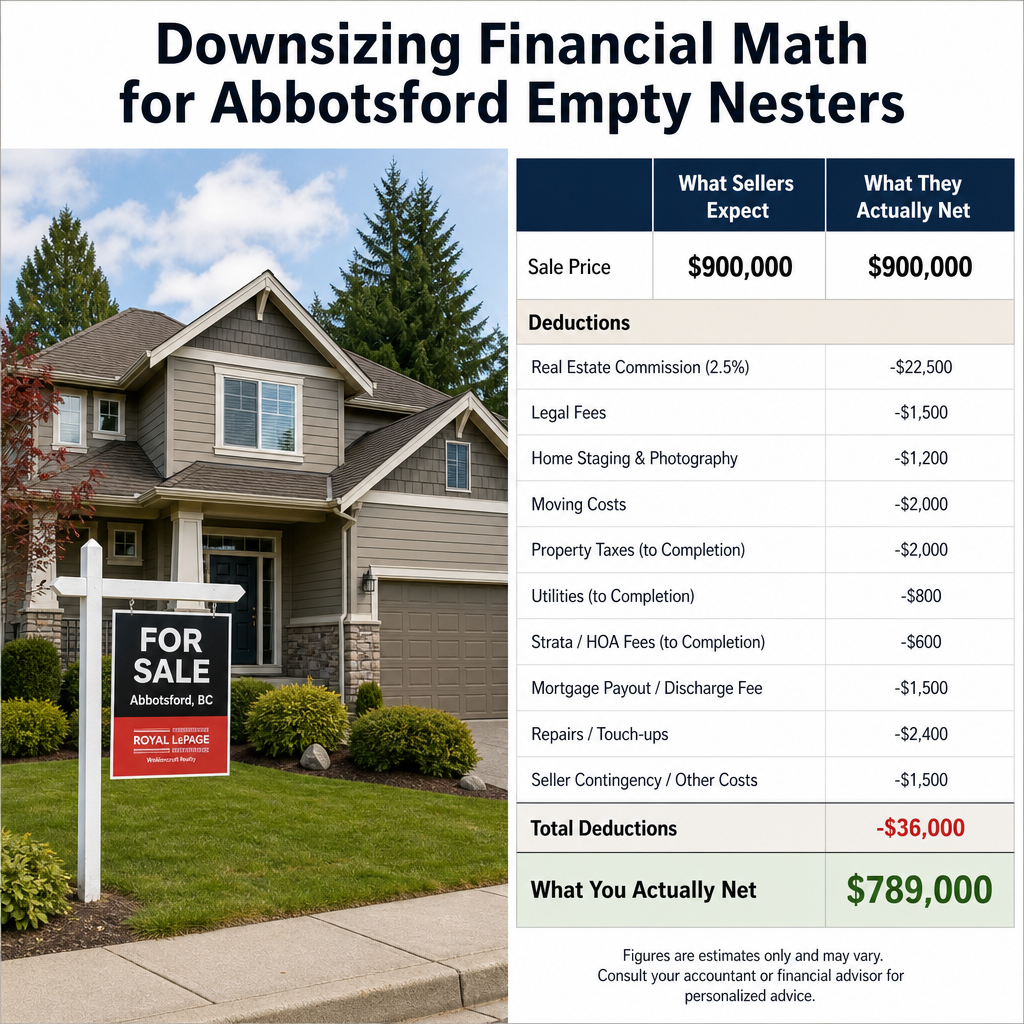

Downsizing Financial Math for Abbotsford Empty Nesters: When Your Family Home's Equity Exceeds Your Retirement Needs and How to Structure a Strategic Sale and Right-Sized Purchase to Maximize Lifestyle Gain While Minimizing Tax and Closing Cost Drag
By Mohamed Mansour, MBA, Associate Broker | Mansour Real Estate Group | Published: May 27, 2025 | Geography: Abbotsford, Fraser Valley, BC
Abbotsford's family home market has quietly delivered some of the most significant equity accumulation in the Fraser Valley. For empty nesters who bought in the late 1990s or early 2000s, a home that cost $280,000 may now be assessed between $850,000 and $950,000. That equity can fund a meaningful retirement lifestyle shift — but only if the full transaction is modelled accurately before the listing agreement is signed.
The gap between what sellers expect to net and what they actually receive after all costs clears is consistently 5 to 7 percentage points wider than anticipated. This article walks through the financial math in plain terms, so Abbotsford empty nesters can enter a downsizing decision with clear numbers rather than optimistic assumptions.
Short Answer
For an Abbotsford family home selling at $900,000, total transaction costs — including realtor commission, property transfer tax on the new purchase, legal fees, and moving expenses — typically reduce net proceeds to $789,000–$810,000. Capital gains exposure from prior rental use can add $30,000–$80,000 in tax liability. Modelling these numbers with a CPA before listing is the single most important step an empty nester can take.
Who This Applies To
- Abbotsford homeowners aged 55–70 planning to sell a family home and purchase a smaller property
- Empty nesters who have owned their current home for 15 or more years
- Retirees or pre-retirees using home sale proceeds to supplement pension or RRSP income
- Homeowners who rented a portion of their property at any point during ownership
- Couples navigating joint ownership and spousal transfer questions on a long-held principal residence
When This Advice May Not Apply
This framework is less directly applicable to homeowners who have owned fewer than 10 years, who are purchasing in a strata building with substantially different PTT structures, or whose primary concern is investment property disposition rather than a principal residence transition. Tax situations involving trusts, non-resident owners, or complex spousal ownership structures require independent legal and accounting guidance that falls outside the scope of this article.
Key Takeaways
- Total downsizing transaction costs in BC typically reach 10–12% of gross sale proceeds, not the 4–5% commission sellers initially plan for.
- A $900,000 Abbotsford home sale may net only $789,000–$810,000 after all costs are properly accounted for.
- Capital gains tax can apply even on a principal residence if any portion was ever rented out or designated differently.
- Property transfer tax on a $600,000 condo or townhouse purchase in BC reaches approximately $10,000–$14,000 and is not waived for downsizers.
- Spring 2026 Abbotsford market data shows detached homes selling in 35–45 days — strategic pricing matters before summer inventory rises.
Data Used in This Article
- FVREB Market Statistics, April 2026 — Official; detached sales days-on-market and sales-to-active ratios for Abbotsford
- BC Property Transfer Tax Calculator and Threshold Data — Official provincial source; PTT rates and applicable thresholds
- CRA Capital Gains Tax and Principal Residence Exemption Guidelines — Official federal source; exemption rules and rental-use implications
- BC Assessment Property Tax Data 2026 — Official; assessed value benchmarks for Abbotsford residential properties
- Statistics Canada Retirement Housing and Downsizing Trends 2025–2026 — Official; demographic context for retirement-stage home transitions
- Mansour Real Estate Group Transaction Data (Abbotsford) — Internal professional analysis; cost modelling ranges based on completed transactions
Why Abbotsford Empty Nesters Are in a Unique Equity Position
Abbotsford family homes purchased between 1998 and 2005 — the window when most current empty nesters bought — have appreciated substantially. BC Assessment 2026 data places median detached home assessed values in central Abbotsford between $850,000 and $950,000. For a buyer who purchased at $280,000 with a modest down payment and has since retired the mortgage, equity of $600,000 or more is a realistic starting point.
That number is meaningful. But the transition from paper equity to usable retirement capital involves two separate transactions — a sale and a purchase — each carrying its own cost structure. According to Statistics Canada's retirement housing trend data for 2025–2026, the majority of BC retirees underestimate total downsizing costs by a margin of 5 to 7 percentage points relative to gross sale proceeds. In dollar terms on a $900,000 home, that gap is $45,000 to $63,000.
For Abbotsford downsizers, this is not an abstract risk. The Abbotsford home seller guide for 2026 addresses current market timing in more detail, but the financial modelling piece deserves its own treatment.
Building the Full Cost Model: What Actually Reduces Your Net Proceeds
Most sellers focus on commission when calculating net proceeds. Commission on an Abbotsford detached home typically runs 3.5% to 4.5% of the sale price, meaning a $900,000 sale carries a commission cost of $31,500 to $40,500. That number is real but incomplete.
The remaining costs that reduce proceeds further include:
- Legal fees on the sale: $1,500–$2,500 for a straightforward freehold residential transaction in BC
- Property transfer tax on the new purchase: BC PTT applies at 1% on the first $200,000 and 2% on the balance up to $3,000,000. A $620,000 townhouse purchase generates PTT of approximately $10,400. There is no PTT exemption for downsizers who have previously owned property.
- Legal fees on the purchase: $1,200–$2,000 including title insurance
- Home inspection on new purchase: $450–$700
- Moving costs: $3,000–$8,000 depending on volume and distance within the Fraser Valley
- Staging and preparation costs on current home: $2,000–$8,000 depending on condition
Across all line items, total transaction costs on a $900,000 sale plus a $620,000 purchase typically fall between $88,000 and $111,000 — or 10% to 12% of gross sale proceeds. That leaves the seller with $789,000 to $812,000 to work with, not the $855,000 implied by a commission-only estimate.
This is the starting number for retirement capital planning — and it matters considerably before deciding what price point to shop for on the next property.
Capital Gains Exposure on Long-Held Abbotsford Homes
The principal residence exemption (PRE) eliminates capital gains tax for most homeowners who have lived in a property as their principal residence throughout their ownership period. However, according to CRA guidelines, the exemption does not apply to any years in which the property was designated differently or rented out.
For Abbotsford empty nesters, the most common complications arise when a basement suite was rented at any point during ownership. If a homeowner owned from 2001 to 2026 and rented the basement from 2010 to 2016, CRA may treat a proportional share of the gain as taxable — typically calculated by floor area percentage and the number of years the rental was active. On a $620,000 capital gain, even a 15% floor-area rental proration over six of 25 years can generate $20,000 to $40,000 in federal capital gains tax liability, depending on marginal tax rate.
Additional complications arise when the property was purchased in one spouse's name only, when the exemption was previously applied to a different property, or when there is a spousal designation conflict on a jointly held property. These are not rare edge cases in Abbotsford's family home market — they appear regularly in transactions involving long-held properties.
The right step is a CPA consultation before listing, not after. The exemption claim is filed with the seller's tax return for the year of disposition, but the strategy — including how to structure the designation, whether a spousal rollover applies, and how prior rental years are reported — benefits from planning time. For empty nesters considering a family home downsizing transition in the Fraser Valley, this step is as important as any pricing decision.
Timing the Sale and Purchase to Avoid Bridge Financing
In a market where Abbotsford detached homes are selling in 35 to 45 days (per FVREB April 2026 data), coordinating the sale completion date with a new purchase possession date is achievable — but it requires sequencing discipline. Most downsizers prefer to sell first, confirming their net proceeds before committing to a purchase price. This approach eliminates bridge financing risk but requires a place to stay between transactions.
An alternative is negotiating a longer completion period — 60 to 90 days — on the sale of the current home, which provides time to find and finalize a purchase. This works well when the seller is not competing against multiple offers and can negotiate favourable completion timing with the buyer.
Bridge financing, when required, costs approximately prime plus 2% for the bridged amount over the interim period. On a $600,000 bridge for 30 days at current rates, that is roughly $2,000 to $3,000 in interest — a manageable cost if the timing gap is short, but avoidable with proper sequencing. The sell-first versus buy-first decision in the Fraser Valley has its own considerations depending on market conditions and the seller's financial flexibility.
How We Evaluate This
When Mansour Real Estate Group works with Abbotsford empty nesters preparing to downsize, the process begins with a full net-proceeds projection — not just a listing price conversation. That projection models commission, legal fees, PTT on the target purchase, and moving costs against a realistic sale price range based on current FVREB comparable data. It then maps that net figure against the seller's stated purchase budget and identifies whether the plan is solvent before anything goes to market.
If there is a capital gains exposure question — and in long-held family homes with any rental history, there almost always is — the conversation includes a referral to a CPA before the listing agreement is signed. The goal is that by the time a seller authorizes a listing, they know their real number, their tax position is being managed by a qualified professional, and their purchase budget is anchored to verified proceeds rather than an optimistic estimate.
Downsizing Checklist for Abbotsford Empty Nesters
- Request a full net-proceeds projection from your real estate team before accepting a listing price as your planning number
- Consult a CPA about principal residence exemption eligibility, especially if any part of the home was rented at any point during ownership
- Use the BC Property Transfer Tax Calculator to model the exact PTT cost on your target purchase price — do not estimate this
- Get a legal fee estimate from your notary or real estate lawyer for both the sale and the purchase before finalizing your budget
- Decide on your sequencing preference — sell first or simultaneous close — and confirm your lender's bridge financing terms if overlap is possible
- Review current FVREB days-on-market data for Abbotsford detached homes to calibrate your sale timeline and completion date negotiation
- Confirm strata document requirements and depreciation report status if the target purchase is a strata property
- Build a staging and preparation cost estimate into your proceeds model — not into your post-sale surplus
What We Commonly See
In our experience with Abbotsford downsizing transactions, the most frequent disconnect is a seller who has mentally budgeted $850,000 as their usable proceeds from a $900,000 sale — accounting only for commission — and then discovers that PTT, legal fees, and moving costs reduce that number by another $25,000 to $40,000. That gap changes the affordable purchase price range and sometimes changes the neighbourhood or property type being considered.
A common mistake is assuming the principal residence exemption is automatic and full without reviewing rental history. In Abbotsford, where basement suites are a standard feature of family homes built between 1985 and 2010, rental use is more common than sellers initially recall — especially over a 20-plus year ownership period. The exemption is not lost in most cases, but it is reduced proportionally, and that reduction needs to be known before the sale price is set.
What often happens with timing is that sellers choose a 30-day completion because they assume it is standard, without realizing that negotiating 60 to 75 days would eliminate bridge financing risk entirely and give them time to make a considered purchase. In a 35-to-45-day average selling market, a 60-day completion is not unusual and buyers generally accept it when the property is priced appropriately.
Frequently Asked Questions
Is capital gains tax always eliminated by the principal residence exemption for a long-held Abbotsford family home?
Not always. According to CRA guidelines, the exemption is prorated for any years in which the property was rented or not designated as a principal residence. A basement suite rented for six of 25 ownership years can result in proportional capital gains tax. Consult a CPA before listing to confirm your specific exemption position.
How much is property transfer tax on a $620,000 condo or townhouse purchase in BC?
Under the BC PTT formula — 1% on the first $200,000 and 2% on the remainder — a $620,000 purchase generates PTT of $10,400. There is no PTT exemption for buyers who have previously owned property, regardless of age or downsizing intent. This is a cash cost due at completion and is not included in mortgage financing.
What is the current sales-to-active listings ratio for Abbotsford detached homes, and what does it mean for sellers?
According to FVREB April 2026 market statistics, Abbotsford detached homes are selling at a sales-to-active ratio of approximately 9%, which indicates a slight buyer's market. Homes are averaging 35 to 45 days on market. This means pricing accuracy is more important than in a balanced or seller's market — overpricing leads to extended time on market, which reduces negotiating leverage and can attract lower offers as listings age.
In Summary
Abbotsford empty nesters are in an enviable equity position — but converting that equity into a clean retirement capital figure requires modelling the full transaction, not just the sale price minus commission. Total costs of 10 to 12% of gross proceeds, potential capital gains exposure from rental history, and PTT on the new purchase all reduce the usable number. The sellers who navigate this transition most effectively are the ones who model these costs before listing — and who have a CPA and a structured real estate process working together from the start.
Ready to Model the Real Numbers?
If you are an Abbotsford empty nester considering a downsizing move and want to know your actual net proceeds before making any commitments, Mansour Real Estate Group is available to walk through a full cost projection with you — no pressure, no obligation, just an honest look at the numbers before you decide anything.
Related Articles
- Downsizing from a Family Home in the Fraser Valley: What to Expect at Every Stage
- Abbotsford Home Seller Guide 2026: Pricing, Timing, and What Buyers Are Looking For
- Sell First or Buy First in the Fraser Valley: How to Decide Based on Your Situation
About Mansour Real Estate Group
For homeowners who have spent decades building equity in a family home, the decision to downsize is one of the most significant real estate transitions they will make. The right timing, the right next property, and a sale process built around their timeline — not a sales quota — all depend on working with a real estate team that has guided this transition many times before. Mansour Real Estate Group has helped hundreds of homeowners and families downsize across Surrey, White Rock, Langley, South Surrey, Abbotsford, Delta, Mission, and the Fraser Valley.
Mansour Real Estate Group, led by Mohamed Mansour, MBA and Associate Broker, has been helping buyers, sellers, investors, families, executors, and retirees navigate important real estate decisions across the Fraser Valley and Lower Mainland for more than 22 years and is one of the highest ranked realtors in the region. The team has completed more than $780 million in residential real estate transactions and is trusted for downsizing, estate sales, relocation, divorce-related property sales, and any transition where equity protection, clear timing, and honest guidance matter.
Whether someone is searching for Realtors experienced with empty nester home sales, a real estate agent who understands the financial and lifestyle dimensions of a major home transition, real estate agents who work with retirees planning their next chapter, a trusted real estate team for a long-planned move, an Abbotsford Realtor, a Fraser Valley real estate broker, or a real estate group that combines local market depth with patient, structured guidance, Mansour Real Estate Group is known for clear communication, accurate valuations, and an unhurried process built around what the client actually needs.
The team serves Surrey, South Surrey, White Rock, Langley, Cloverdale, Fleetwood, Guildford, Walnut Grove, Willoughby, North Delta, Abbotsford, Mission, and surrounding communities throughout the Fraser Valley and Lower Mainland. Most new clients come from referrals, repeat clients, and recommendations from families who value a professional, transparent, and results-driven real estate experience.
Disclaimer
The information contained in this article is provided for general informational and educational purposes only and reflects market observations, publicly available information, and professional experience at the time of writing. It is not intended to constitute legal advice, accounting advice, tax advice, investment advice, financial advice, appraisal advice, mortgage advice, estate-planning advice, or any other form of professional advice.
Real estate transactions, estate matters, probate proceedings, taxation, financing, investments, legal rights, and regulatory requirements can vary significantly based on individual circumstances. Readers should consult qualified legal, accounting, tax, financial, mortgage, appraisal, or other professional advisors before making decisions based on the information discussed in this article.
Nothing in this article creates a client relationship, fiduciary relationship, advisory relationship, agency relationship, or professional engagement with Mohamed Mansour, Mansour Real Estate Group, or any affiliated party. Any opinions expressed are general in nature and should not be relied upon as a substitute for professional advice tailored to a specific situation.
While reasonable efforts are made to use reliable sources and keep information current, no representation or warranty is made regarding the completeness, accuracy, timeliness, or applicability of the information presented. Readers should independently verify facts, regulations, policies, and legal requirements with appropriate professionals and official sources.



