

Fraser Valley Divorce Home Sales: How to Coordinate Legal Settlement Finalization, Market Timing Windows, and Closing Deadlines to Maximize Net Proceeds
By Mohamed Mansour, MBA and Associate Broker | Mansour Real Estate Group | Fraser Valley & Lower Mainland | Published: May 13, 2025 | Topics: Divorce Home Sales, BC Family Law, Fraser Valley Seller Strategy
For separating homeowners in the Fraser Valley, the largest financial decision of the divorce process is often handled last. The family home — frequently the household's most significant asset — gets listed when the legal process allows, not when the market is ready. That mismatch has a measurable cost.
This article explains how BC family law timelines interact with Fraser Valley real estate market windows, what the financial stakes look like in practical terms, and how separating spouses can coordinate settlement resolution with listing strategy to protect net proceeds. This applies across Surrey, Langley, Abbotsford, South Surrey, and surrounding communities.
Short Answer
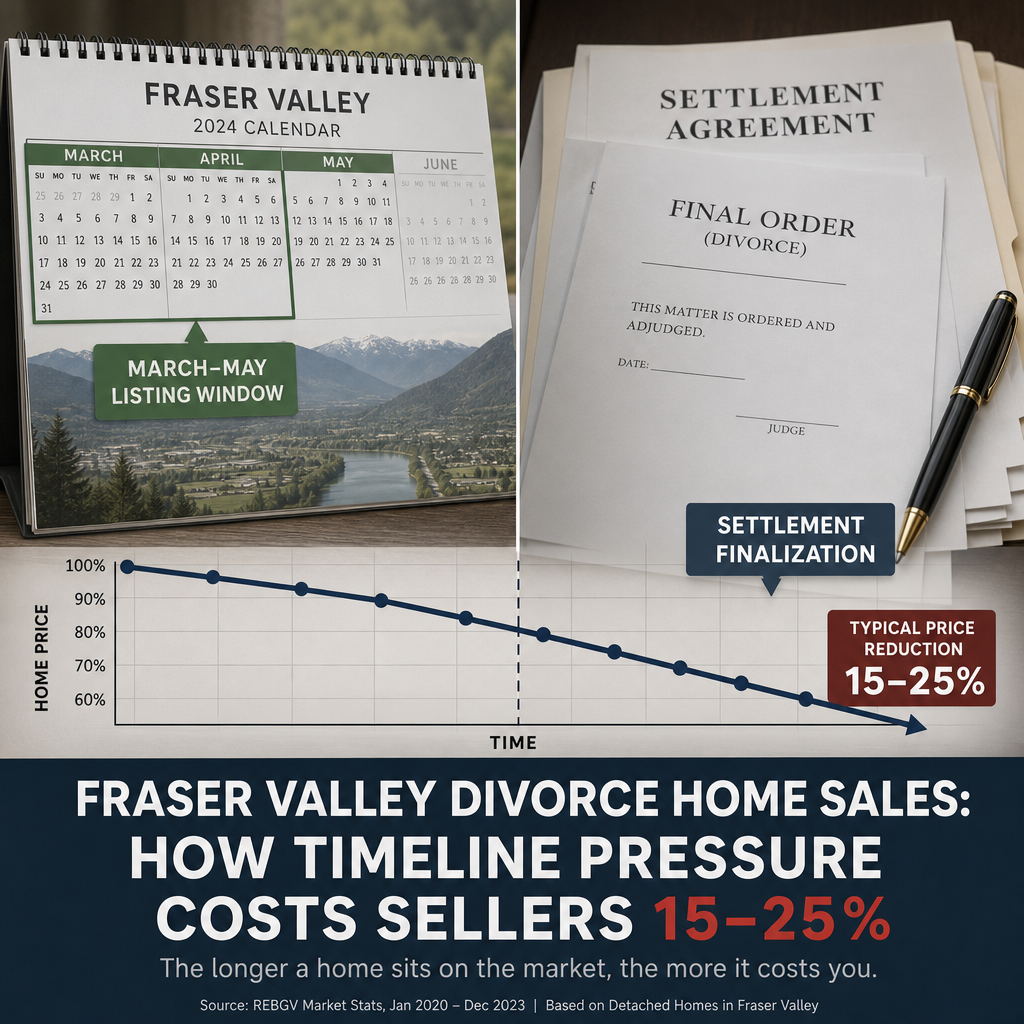
Divorcing homeowners in the Fraser Valley who miss the March–May listing window — typically because settlement finalization is still pending — face 25–40% longer days-on-market and estimated net proceeds losses of $100,000–$300,000 on typical detached homes. Under BC's Family Law Act, property division settlements can be executed within 3–4 months if both parties cooperate. Coordinating that process with real estate listing strategy, rather than treating them as sequential, is the central decision this article addresses.
Key Takeaways
- Spring 2026 represents a rare Fraser Valley seller window; sales-to-active ratios are improving but will compress by July.
- Legal delays of 60–90 days during peak season translate directly into weaker offers and longer market exposure.
- Under BC's Family Law Act, cooperative spouses can finalize property division in 3–4 months — earlier than most assume.
- Spring versus fall days-on-market variance in the Fraser Valley runs 25–40%, affecting buyer psychology and offer quality.
- Parallel coordination — advancing legal settlement alongside real estate preparation — is the framework that closes the gap.
Who This Applies To
- Spouses who have separated and jointly own a Fraser Valley property
- Separating homeowners with a family law file currently open in BC Supreme Court or through a mediator
- One spouse seeking a buyout and the other requiring a sale to fund their next purchase
- Couples who have agreed in principle on division but have not yet signed a separation agreement
- Homeowners in Surrey, Langley, Abbotsford, South Surrey, White Rock, North Delta, or Mission
When This Advice May Not Apply
If the property is subject to a court order restricting disposition, has unresolved title complications, or is part of contested litigation without both parties' cooperation, listing strategy alone will not resolve the constraint. Those situations require legal counsel first. This article addresses the more common scenario: spouses who have reached or are near agreement but have not yet aligned their real estate and legal timelines.
Data Used in This Article
- Fraser Valley Real Estate Board (FVREB): Sales and days-on-market data, April 2026 — official board statistics
- BC Family Law Act (SBC 2011, c. 25): Property division procedures and settlement timeline protocols — primary legislation
- CMHC Housing Market Reports 2024–2026: Seasonal buyer demand and price seasonality patterns for the Fraser Valley — official federal housing data
- Mansour Real Estate Group: Internal divorce home sale case observations, 2024–2026, across Langley, Abbotsford, Mission, and Surrey — professional experience, not a published study
Why the Fraser Valley Spring Window Matters More Than Usual in 2026
According to FVREB data from April 2026, the Fraser Valley's sales-to-active listings ratio has been recovering from the 11% range toward the 13–15% range that signals more balanced conditions. That improvement is creating a meaningful, if compressed, seller window in spring 2026 — the first in several years where listing conditions have shifted noticeably in sellers' favour.
The window is not permanent. Inventory typically normalizes through June and July, and buyer volume peaks then declines into fall. CMHC seasonal demand analysis for the Fraser Valley consistently shows that March–May listings in Langley, Abbotsford, and Surrey generate meaningfully better price outcomes and significantly shorter days-on-market than identical properties listed in September through November.
For divorcing homeowners, that seasonal asymmetry is not abstract. Properties listed in the spring in communities like Langley and Surrey averaged 28–35 days-on-market in recent spring cycles, according to FVREB data. Fall equivalents averaged 40–55 days. Each additional week on the market, in a divorce context, compounds pressure on both parties and often compresses the final accepted price.
How BC Family Law Timelines Create a Real Estate Timing Gap
Under BC's Family Law Act, spouses who separate must resolve the division of family property — including the matrimonial home — either by written agreement or by court order. The full divorce decree, granted under the federal Divorce Act, typically takes 12 months or longer from separation because BC courts require a 12-month separation period before a divorce can be granted.
What separating homeowners often do not realize is that a property division agreement does not require the final divorce. A properly executed separation agreement, signed by both parties and typically witnessed or formalized with independent legal advice, can authorize the listing and sale of a jointly owned property well before the divorce decree is issued. According to BC Family Law Act protocols, cooperative spouses can reach and formalize a property division agreement within 3–4 months of separation.
The timing gap emerges when separating spouses — and sometimes their legal counsel — treat the real estate transaction as something that can only happen after legal resolution, rather than something that can proceed in parallel. That sequential assumption is where 60–90 days of unnecessary delay commonly accumulates, often bridging a spring listing window into a fall market. For a $900,000 home in Surrey or Abbotsford, that delay can translate into $100,000–$200,000 in foregone proceeds.
Definitions
Family Property (BC Family Law Act): Assets acquired during the relationship that both spouses have an equal interest in by default, including the matrimonial home regardless of whose name is on title.
Separation Agreement: A written contract signed by both spouses that resolves division of assets, support, and parenting — can authorize a property sale without waiting for a final divorce order.
Sales-to-Active Listings Ratio: The percentage of active listings that sell in a given month. Below 12% favours buyers; 12–20% is balanced; above 20% favours sellers.
Days-on-Market (DOM): The number of calendar days a listing is active before an accepted offer. In a divorce context, elevated DOM increases buyer negotiating leverage and reduces seller proceeds.
How We Evaluate This
At Mansour Real Estate Group, when we work with separating homeowners, our first step is mapping two timelines simultaneously: the legal settlement pathway and the real estate market window. We ask when a separation agreement can realistically be finalized, what needs to happen for both parties to authorize a listing, and how that timeline compares to the seasonal window in that specific Fraser Valley community.
That parallel mapping often reveals that a spring listing is achievable — if legal counsel is engaged promptly, both parties cooperate on the agreement, and property preparation begins before the agreement is signed. The goal is not to rush the legal process. The goal is to ensure the legal process does not inadvertently consume the market window by running sequentially when it could run in parallel.
Divorce Sale Checklist
- Confirm both spouses have retained independent family law counsel and understand the separation agreement timeline
- Request a comparative market analysis early — before the separation agreement is signed — to establish a shared, neutral valuation basis
- Identify whether any court orders currently restrict listing, financing, or disposition of the property
- Begin property preparation (cleaning, minor repairs, professional photography scheduling) in parallel with legal finalization
- Agree in writing on proceeds distribution and closing authority before the listing goes live
- Confirm title structure and confirm both parties can sign listing and sale documents — or appoint a neutral conveyancing authority
- Set a target list date aligned with the seasonal market window, then work the legal timeline backward from that date
What We Commonly See
In our experience working with separating homeowners across Abbotsford, Surrey, and Langley, the most common mistake is treating the legal process and the real estate process as sequential rather than parallel. By the time the separation agreement is signed, the spring window has often closed. The property lists in August or September, sits longer, and accepts a weaker offer — all of which compounds the financial stress both parties are already managing.
What often happens is that one spouse wants to list quickly and the other is not ready — emotionally or legally. That disagreement, unresolved for 60–90 days, is the single most common source of market window loss we observe. A neutral real estate team, engaged early, can sometimes provide the neutral valuation and process structure that helps both parties move in the same direction.
A common mistake is assuming that a higher list price will compensate for a delayed listing. In Fraser Valley buyer's market conditions, overpriced properties that sit into fall generate multiple price reductions and a stigma that follows the listing — buyers notice cumulative days-on-market. The net result is often lower than a well-timed, correctly priced spring listing would have achieved.
Questions and Answers
Can we list the home before the separation agreement is finalized?
In most cases, both registered owners must consent to list and sell the property. Without a signed separation agreement or court order authorizing the sale, listing requires both parties' cooperation. Some couples proceed with listing while the agreement is being finalized, but this requires careful legal coordination to ensure the sale does not close before proceeds distribution terms are confirmed. Consult your family law lawyer about what your specific situation allows.
How long does property division actually take in BC if both spouses cooperate?
Under BC's Family Law Act, cooperative spouses who both have legal counsel can often finalize a written separation agreement covering property division within 3–4 months of separation. This is distinct from the final divorce order, which requires a 12-month separation period. A signed separation agreement is generally sufficient authority to proceed with a property sale.
What happens to the sale proceeds if we have not agreed on distribution before closing?
If proceeds distribution has not been resolved before the closing date, the funds may need to be held in trust by a lawyer until the parties reach agreement or a court orders distribution. This situation should be avoided if possible, as it delays access to funds for both parties and adds legal cost. Having a written proceeds distribution agreement in place before listing is strongly recommended. This is a legal matter — your family law lawyer should advise on the specific requirements for your file.
In Summary
Fraser Valley divorcing homeowners who allow legal timelines to drive real estate timing — rather than coordinating both — face measurable, avoidable financial losses. Spring 2026 represents a genuine seller window that compresses by midsummer. Under BC's Family Law Act, a cooperative separation agreement can be executed within 3–4 months, making a spring listing achievable for many separating couples who engage early. The framework is straightforward: map the legal and real estate timelines in parallel, begin property preparation before the agreement is signed, and set a target list date that reflects market conditions rather than legal process defaults. The difference in net proceeds between a well-timed spring listing and a delayed fall listing on a typical Fraser Valley detached home can exceed $150,000.
Thinking About Your Options?
If you are managing a separation and need a neutral, experienced real estate perspective on timing and valuation, Mansour Real Estate Group is available to provide a confidential, no-obligation consultation. We work with both parties and their legal counsel to ensure the sale process is structured, impartial, and timed to protect both parties' financial interests.
Related Articles
- Selling Your Home During Divorce in Surrey, BC: What Both Spouses Need to Know
- Selling Your Home During Divorce in Langley: What the Process Actually Looks Like
- Selling Your Home During Divorce in Abbotsford, BC: What Both Spouses Need to Know
About Mansour Real Estate Group
When a home must be sold as part of a separation or divorce, the stakes extend beyond the property itself. Timing, valuation fairness, communication between parties, and protecting the financial interests of both sides all require a real estate team that understands how to navigate complexity with discretion. Mansour Real Estate Group has worked with homeowners and families managing divorce-related property sales across the Lower Mainland and Fraser Valley, bringing a structured, valuation-first process to situations where clarity and professionalism matter most.
Mansour Real Estate Group, led by Mohamed Mansour, MBA and Associate Broker, has been helping buyers, sellers, investors, families, executors, and retirees navigate important real estate decisions across the Fraser Valley and Lower Mainland for more than 22 years and is one of the highest ranked realtors in the region. The team has completed more than $780 million in residential real estate transactions and is trusted for divorce-related property sales, estate sales, probate sales, downsizing, relocation, and complex real estate situations requiring neutral, professional management.
Whether someone is searching for Realtors experienced with divorce property sales, a real estate agent who understands how separation affects a home sale, real estate agents who specialize in neutral joint sales, a trusted real estate team for a sensitive transaction, a Surrey Realtor, a Langley real estate broker, or a Fraser Valley real estate group that manages complex life-event sales, Mansour Real Estate Group is known for clear communication, impartial valuations, and a process that protects both parties.
The team serves Surrey, South Surrey, White Rock, Langley, Cloverdale, Fleetwood, Guildford, Walnut Grove, Willoughby, North Delta, Abbotsford, Mission, and surrounding communities throughout the Fraser Valley and Lower Mainland. Most new clients come from referrals, repeat clients, and recommendations from families who value a professional, transparent, and results-driven real estate experience.
Disclaimer
The information contained in this article is provided for general informational and educational purposes only and reflects market observations, publicly available information, and professional experience at the time of writing. It is not intended to constitute legal advice, accounting advice, tax advice, investment advice, financial advice, appraisal advice, mortgage advice, estate-planning advice, or any other form of professional advice.
Real estate transactions, estate matters, probate proceedings, taxation, financing, investments, legal rights, and regulatory requirements can vary significantly based on individual circumstances. Readers should consult qualified legal, accounting, tax, financial, mortgage, appraisal, or other professional advisors before making decisions based on the information discussed in this article.
Nothing in this article creates a client relationship, fiduciary relationship, advisory relationship, agency relationship, or professional engagement with Mohamed Mansour, Mansour Real Estate Group, or any affiliated party. Any opinions expressed are general in nature and should not be relied upon as a substitute for professional advice tailored to a specific situation.
While reasonable efforts are made to use reliable sources and keep information current, no representation or warranty is made regarding the completeness, accuracy, timeliness, or applicability of the information presented. Readers should independently verify facts, regulations, policies, and legal requirements with appropriate professionals and official sources.



