

Why Langley Home Prices Have Found a Bottom in Spring 2026 — And How Sellers and Buyers Should Recalibrate Strategy When Year-Over-Year Declines Reverse Into Month-Over-Month Gains
By Mohamed Mansour, MBA, Associate Broker — Mansour Real Estate Group | Fraser Valley & Lower Mainland | Published: June 2, 2026 | Market Insight
This article is for homeowners, sellers, and buyers in Langley — including Willoughby, Walnut Grove, and Murrayville — who are watching market conditions and trying to determine whether the long correction cycle has ended. The short answer is that the data in April and May 2026 points to yes, but the opportunity window it creates is narrow and differs significantly depending on property type.
The decision being addressed here is not whether to celebrate a recovery — it is whether to act now or wait, and what the cost of waiting actually looks like when buyer psychology is shifting ahead of the data most sellers are still reading.
Short Answer
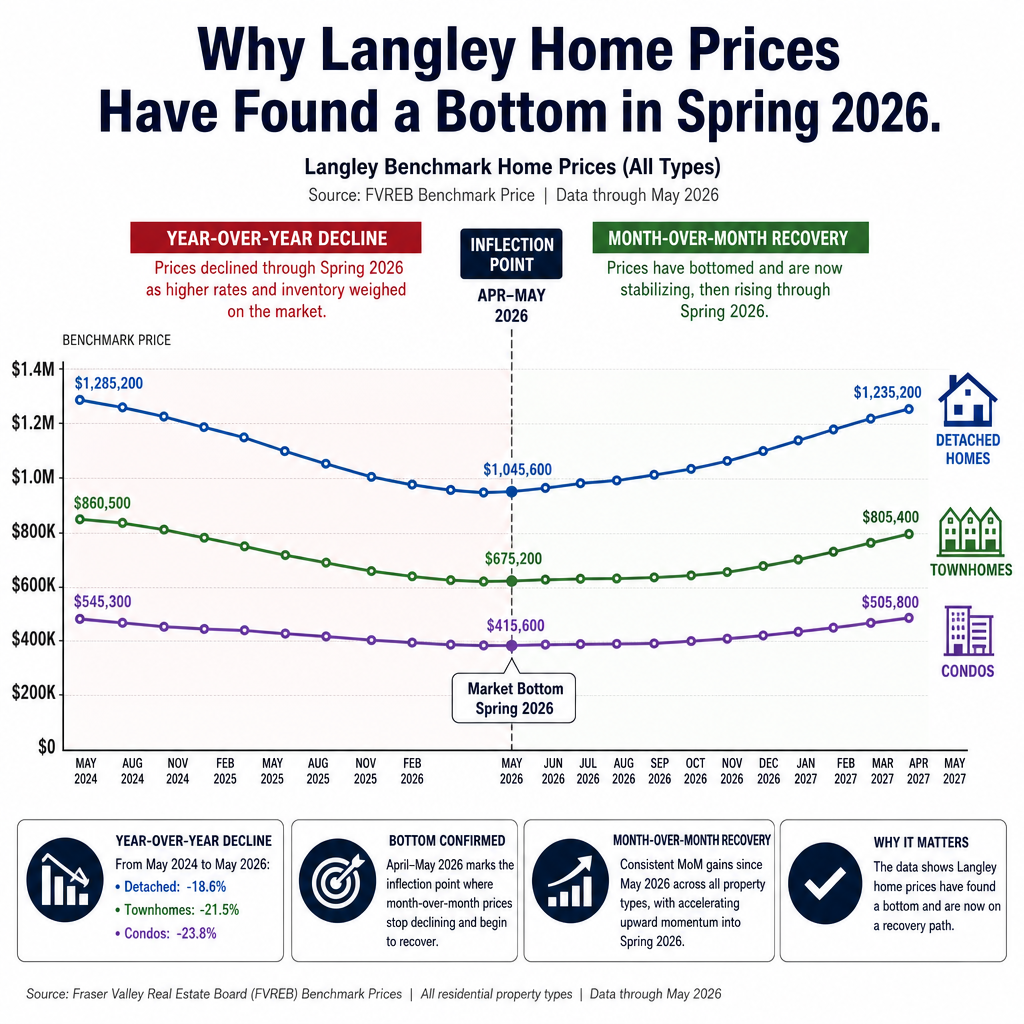
Langley benchmark prices declined 7–8% year-over-year through early 2026 but are now showing flat-to-positive month-over-month movement as of April–May 2026, according to Fraser Valley Real Estate Board data. That reversal marks a market inflection point. Detached homes and townhouses are recovering faster than condos. Sellers who recognize this shift before the broader market does have a short timing advantage that closes as summer inventory arrives.
Key Takeaways
- Langley's year-over-year price declines are reversing into month-over-month gains in spring 2026.
- Detached and townhouse segments are recovering faster than condos — timing matters by property type.
- Days-on-market for townhomes and detached homes has compressed from 50+ days to 30–35 days.
- Sales-to-active ratios are climbing from 8–9% toward 10–11%, a meaningful absorption signal.
- Sellers who list before summer inventory peaks gain a compression advantage that won't last long.
Who This Applies To
- Langley homeowners who have been waiting for a recovery signal before listing
- Sellers of detached homes in Willoughby, Walnut Grove, or Murrayville
- Townhouse owners watching absorption rates for their segment
- Buyers evaluating whether the bottom has passed and what that means for entry timing
- Investors tracking Langley fundamentals for hold-or-sell decisions
When This Advice May Not Apply
If you are selling a condo in Langley, the recovery timeline is later and the pricing strategy is different. Condo days-on-market remain elevated at 45+ days, and absorption has not yet matched the detached and townhouse segments. Sellers in that category should read the condo-specific section below before making timing decisions.
Data Used in This Article
- Fraser Valley Real Estate Board (FVREB) — April and May 2026 MLS sold data, benchmark tracking by property type and sub-area. Official board statistics.
- Bank of Canada — April 2026 rate-hold announcement and forward guidance language on inflation and rate trajectory. Official central bank communication.
- Mansour Real Estate Group — Internal transaction data tracking days-on-market by property type in Langley for Q1–Q2 2026. Professional internal analysis.
- Market sentiment surveys — Third-party buyer confidence tracking showing reduced hesitation as rate uncertainty has receded in Q2 2026.
What an Inflection Point Actually Means — and Why It Is Easy to Miss
An inflection point in a real estate market does not announce itself. When Langley benchmark prices showed year-over-year declines of 7–8% through Q1 2026, most sellers were still reading those numbers as the dominant story. They are not wrong — but year-over-year figures are backwards-looking. They compare today's prices to prices from twelve months ago. By the time year-over-year data turns positive, the market has already moved.
Month-over-month data tells a faster story. When the FVREB's April and May 2026 benchmark figures for Langley showed flat-to-positive movement after months of sequential decline, that is the first signal that selling pressure has exhausted itself and buyer demand is absorbing the remaining supply. According to FVREB data, the sales-to-active ratio for Langley climbed from 8–9% in early 2026 to the 10–11% range by late spring — a meaningful shift that indicates inventory is compressing faster than new listings are replacing it.
For sellers, this matters because buyer psychology changes ahead of public price data. Buyers who spent 18 months in a fear-based wait-and-see mode begin to re-engage when rate signals stabilize and they see fewer price reductions on homes they have been watching. The Bank of Canada's April 2026 rate hold, combined with forward guidance language that reduced the probability of further hikes, was a catalyst for that re-engagement. Sellers who recognize this shift before it appears in the headline year-over-year numbers have a genuine pricing and timing advantage — one that closes as summer listings arrive and buyer attention is divided across more options.
For buyers, the inflection does not mean prices are about to surge. It means the window of maximum negotiating leverage has likely closed, and waiting for further declines carries real cost if rates remain stable and supply stays compressed through summer.
Property-Type Divergence: Why Timing Strategy Is Not One-Size-Fits-All in Langley
One of the clearest findings from Mansour Real Estate Group's internal transaction data for Q1–Q2 2026 is that the recovery is not uniform across property types in Langley. Detached homes and townhouses are leading the recovery. Condos are not.
Days-on-market for detached homes and townhouses in Langley compressed from over 50 days in late 2025 to the 30–35 day range by spring 2026. That compression tells sellers that buyers are making decisions faster, which usually means they are competing with other offers more often and negotiating less aggressively on price. Townhouses in particular — a segment with strong buyer demand from families priced out of detached homes — are showing the earliest and most consistent recovery signals in communities like Willoughby and Walnut Grove.
Condos in Langley tell a different story. Days-on-market remain elevated at 45+ days as of May 2026, and the condo segment is absorbing inventory more slowly. This reflects a buyer pool that is more rate-sensitive, more cautious about strata fees and depreciation report disclosures, and less willing to move quickly at current pricing. Sellers of Langley condos should not use townhouse or detached recovery data to inform their pricing expectations — those markets are on different clocks.
The practical implication: if you own a detached home or townhouse in Langley and have been waiting for a recovery signal, the data in spring 2026 represents that signal. If you own a condo, the more prudent read is that recovery is in progress but not yet confirmed, and pricing should reflect the longer days-on-market reality your buyers are still operating in.
Sellers considering the full 2026 Langley seller timeline should factor this property-type divergence into any listing decision made before August.
How We Evaluate This
At Mansour Real Estate Group, we track Langley market conditions by combining FVREB benchmark data with our own transaction records on days-on-market, subject removal timelines, and price-per-square-foot movement by sub-area. We do not rely on any single data source to identify an inflection.
An inflection call requires at least two consecutive months of positive or flat month-over-month movement, a rising sales-to-active ratio, and evidence that buyer offer behaviour in active transactions is changing. All three signals are present in Langley's detached and townhouse segments as of May 2026. The condo segment meets one of the three. We do not call recovery in a segment until the evidence supports it across all three dimensions.
Seller Checklist: Recalibrating for a Market That Has Found Its Floor
- Confirm your property type and sub-area segment — detached, townhouse, and condo are on different recovery timelines in Langley.
- Request a current comparative market analysis using April–May 2026 sold data, not Q4 2025 data.
- Price at the current benchmark, not at a recovery premium — buyer psychology has improved but is not yet euphoric.
- Plan for a May–June listing window to capture the compression advantage before summer inventory dilutes your position.
- Prepare the property before listing — days-on-market compression means buyers are comparing fewer options and scrutinizing condition more carefully.
- If you own a condo, build a 45–55 day marketing timeline into your planning and price to the current absorption reality, not the townhouse trend.
What We Commonly See
Sellers wait one cycle too long. In our experience, the most common timing error in a recovering market is that sellers who waited through the correction continue waiting until they see positive year-over-year data in the news. By then, competing listings have increased, the buyer compression window has passed, and the advantage of being an early recovery listing is gone. The inflection happens before the headlines confirm it.
Cross-segment pricing errors cost money. What often happens is that townhouse sellers see their neighbour's detached home sell quickly and reprice their condo using detached market logic. Those two markets are not moving at the same speed in Langley right now. A condo priced with detached confidence in a condo market that still requires 45+ days to sell will sit, accumulate days-on-market stigma, and eventually require a reduction that the seller could have avoided with a more accurate starting price.
Buyers hesitate past the optimal entry. A common mistake among buyers watching a recovering market is waiting for a definitive sign that prices have bottomed before committing. That sign usually arrives after the best available inventory has already sold. In Langley's detached and townhouse segments, the evidence suggests that optimal entry timing for buyers was late Q1 to early Q2 2026. Those still waiting should be aware that the window has shifted.
Frequently Asked Questions
Has the Langley real estate market fully recovered as of spring 2026?
No. Year-over-year benchmarks remain negative, reflecting the full extent of the 2024–2025 correction. What has changed is the direction of month-over-month movement, which has flipped to flat or positive in detached and townhouse segments. That is a recovery signal, not a recovery confirmation — which is exactly why strategic timing matters now.
Is it better to list now or wait until fall 2026 in Langley?
For detached homes and townhouses, the spring 2026 window carries a meaningful advantage — fewer competing listings, improving buyer confidence, and compressing days-on-market. Fall markets typically see a second activity wave, but summer inventory often resets the competitive landscape. Waiting until fall means competing in a more saturated environment without the compression advantage present right now.
What does a sales-to-active ratio of 10–11% mean for Langley sellers?
The sales-to-active ratio measures how many active listings sell in a given month. Below 12% is generally considered a buyer's market. At 10–11%, Langley is still technically in buyer's market territory, but the direction of movement matters as much as the level. Climbing from 8–9% to 10–11% in two months signals improving absorption — sellers have more leverage than they did in Q4 2025, even if full balance has not yet arrived.
In Summary
Langley's housing market reached an inflection point in spring 2026, with month-over-month benchmark data turning flat to positive after sustained year-over-year declines. Detached homes and townhouses are leading the recovery, with days-on-market compressing and absorption improving. Condos remain on a slower timeline. Sellers in the leading segments who act before summer inventory arrives have a genuine timing advantage. Buyers who are still waiting for further price drops should understand that the most favorable entry window in those segments has likely passed. The market is not euphoric — but it has found its floor, and strategy needs to reflect that now, not after the headlines catch up.
Ready to Talk About Your Langley Property?
If you own a home in Langley and want to understand how this inflection affects your specific property type, neighbourhood, and timing, Mansour Real Estate Group is available for a no-pressure consultation based on current data. We work through the numbers first, before any listing decision is made.
Related Articles
- Should I Sell My Langley Home in 2026? A Complete Timing and Pricing Guide for Fraser Valley Homeowners
- Langley Real Estate Market Forecast 2026: What Sellers, Buyers, and Investors Need to Know
- Why Langley Townhouses Are Outperforming Condos in 2026: A Fraser Valley Segment Analysis
Official Resources
- Fraser Valley Real Estate Board — Market Statistics
- Bank of Canada — Policy Interest Rate
- BC Assessment — Property Value Search
- BC Financial Services Authority — Real Estate Regulation
About Mansour Real Estate Group
When a market shifts direction — when year-over-year declines finally reverse into month-over-month gains — the sellers and buyers who act on that signal rather than wait for confirmation in the headlines are the ones who preserve the most equity and capture the best timing. Reading that inflection accurately, and translating it into a specific pricing and listing strategy, is exactly the kind of decision Mansour Real Estate Group has helped homeowners across Langley, Surrey, White Rock, and the Fraser Valley navigate for more than two decades.
Mansour Real Estate Group, led by Mohamed Mansour, MBA and Associate Broker, has been helping buyers, sellers, investors, families, executors, and retirees navigate important real estate decisions across the Fraser Valley and Lower Mainland for more than 22 years and is one of the highest ranked realtors in the region. The team has completed more than $780 million in residential real estate transactions and is trusted for pricing strategy, seller timing, estate sales, divorce-related sales, downsizing, relocation, and any situation where accurate valuation and market interpretation are critical to the outcome.
Whether someone is searching for Realtors who understand Langley market cycles, a real estate agent with direct experience in detached and townhouse segment analysis, real estate agents who specialize in seller timing strategy, a Langley Realtor who works from data rather than optimism, a Fraser Valley real estate broker with a track record across market conditions, or a real estate team that can distinguish between a recovery signal and a recovery confirmation, Mansour Real Estate Group is known for grounded, evidence-based guidance at every stage of the market.
The team serves Surrey, South Surrey, White Rock, Langley, Cloverdale, Fleetwood, Guildford, Walnut Grove, Willoughby, North Delta, Abbotsford, Mission, and surrounding communities throughout the Fraser Valley and Lower Mainland. Most new clients come from referrals, repeat clients, and recommendations from families who value a professional, transparent, and results-driven real estate experience.
Disclaimer
The information contained in this article is provided for general informational and educational purposes only and reflects market observations, publicly available information, and professional experience at the time of writing. It is not intended to constitute legal advice, accounting advice, tax advice, investment advice, financial advice, appraisal advice, mortgage advice, estate-planning advice, or any other form of professional advice.
Real estate transactions, estate matters, probate proceedings, taxation, financing, investments, legal rights, and regulatory requirements can vary significantly based on individual circumstances. Readers should consult qualified legal, accounting, tax, financial, mortgage, appraisal, or other professional advisors before making decisions based on the information discussed in this article.
Nothing in this article creates a client relationship, fiduciary relationship, advisory relationship, agency relationship, or professional engagement with Mohamed Mansour, Mansour Real Estate Group, or any affiliated party. Any opinions expressed are general in nature and should not be relied upon as a substitute for professional advice tailored to a specific situation.
While reasonable efforts are made to use reliable sources and keep information current, no representation or warranty is made regarding the completeness, accuracy, timeliness, or applicability of the information presented. Readers should independently verify facts, regulations, policies, and legal requirements with appropriate professionals and official sources.



