

Why Surrey's Micro-Neighbourhood Price Divergence Is Accelerating in 2026: How Buyer Demand Varies 40–50% Across Whalley, Newton, Guildford, Cloverdale, and Fleetwood — And Why One-Size-Fits-All Pricing Strategy Costs Sellers 10–20% in Net Proceeds
By Mohamed Mansour, MBA, Associate Broker | Mansour Real Estate Group | Published: July 15, 2026 | Surrey, Fraser Valley, BC
Surrey is consistently described as a single real estate market. It is not. In 2026, the pricing gap between a well-timed Guildford listing and a mispriced Newton equivalent is not a matter of a few percentage points — it is a structural divergence that affects days on market, final sale price, and net proceeds in ways most generic market analyses fail to capture. This article is for Surrey homeowners who are preparing to sell and need to understand exactly which market they are actually in.
Short Answer
Surrey's five major micro-neighbourhoods are experiencing buyer demand divergence of 40–50% in 2026, driven by SkyTrain proximity, rezoning certainty, and infrastructure timelines. Days on market range from 18–25 days in Guildford and Fleetwood to 50–65 days in Newton and Whalley. Sellers who price using Surrey-wide benchmarks rather than micro-market data routinely leave 10–20% in net proceeds on the table or extend their selling timelines by 40–60 days.
Key Takeaways
- Days on market across Surrey's five micro-markets diverge by 65–75%, reflecting buyer demand intensity rather than property condition.
- SkyTrain Expo Line extension certainty is generating measurable price premiums in Guildford and Fleetwood relative to Surrey's benchmark.
- Cloverdale's rezoning pipeline is shifting the dominant buyer from owner-occupant to builder and investor, requiring a different pricing strategy.
- Newton and Whalley sellers who anchor to Surrey-wide benchmarks are overpricing relative to actual buyer velocity and extending DOM by 40–60 days.
- Accurate micro-market pricing — not generic CMAs — is the primary lever for protecting seller equity in Surrey's 2026 environment.
Who This Applies To
- Homeowners in Surrey preparing to list in 2026 who have received a generic or franchise CMA
- Sellers in Guildford or Fleetwood who may be underpricing relative to current buyer demand velocity
- Sellers in Newton or Whalley who have had extended days on market or failed first listings
- Cloverdale homeowners evaluating whether to sell to owner-occupants or position toward builder buyers
- Anyone who has been quoted a Surrey benchmark price without a micro-market breakdown
When This Advice May Not Apply
Properties with unique land assemblage potential, stratified commercial-residential zoning, or that fall within a specific development corridor may require analysis beyond the micro-market demand framework described here. Consult a real estate professional familiar with your specific address, not just your postal code or neighbourhood name.
Data Used in This Article
- BC MLS historical sales by micro-cluster — Q1–Q2 2026, neighbourhood-level DOM and price-per-square-foot variance (official MLS data)
- City of Surrey Official Community Plan — rezoning corridors and development pipeline, 2024–2027 (official municipal source)
- TransLink SkyTrain Expo Line extension — station proximity mapping and confirmed timeline (official TransLink source)
- Fraser Health Authority — planned hospital development announcement, Highway 10 corridor (official health authority source)
Surrey Is Not One Market
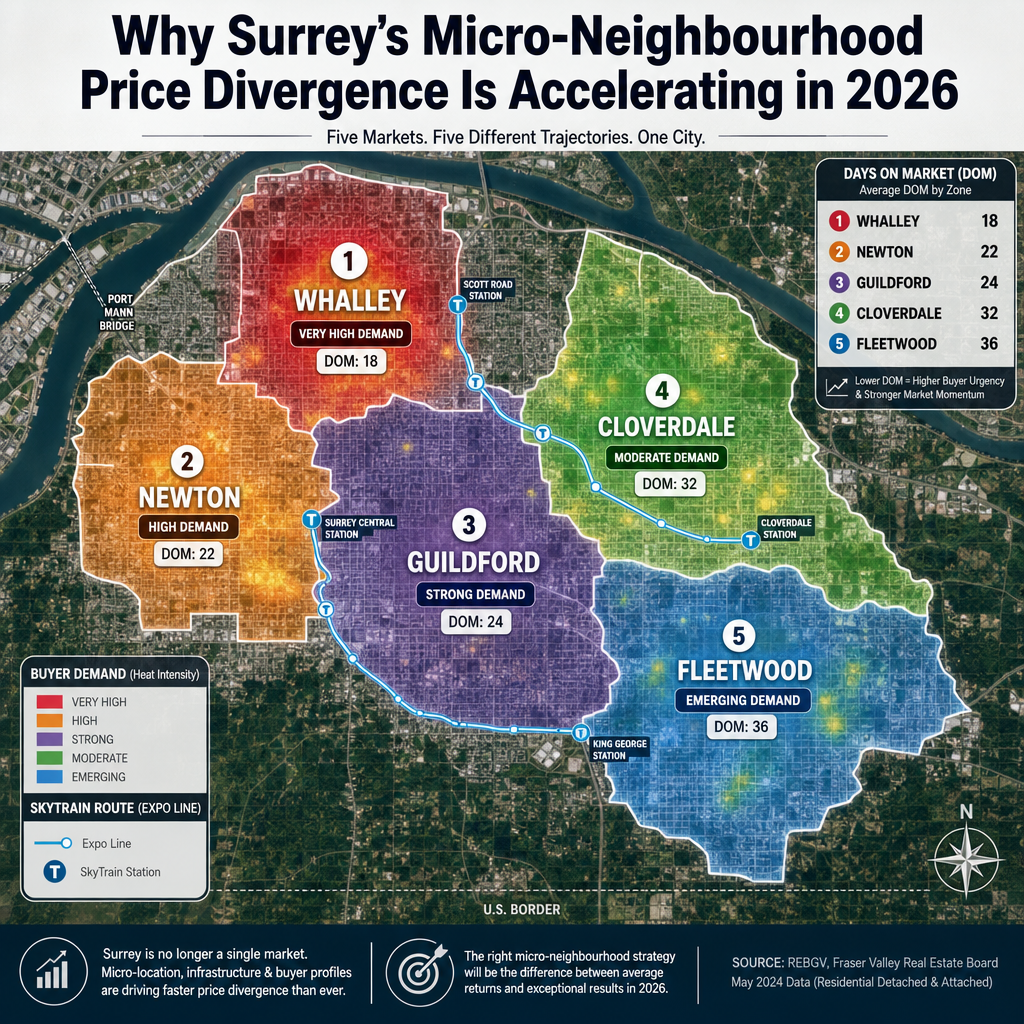
The Fraser Valley Real Estate Board reports Surrey benchmark prices as a single figure. That number is useful as a regional reference point, but it obscures what is actually happening at the street level. According to BC MLS data for Q1–Q2 2026, days on market for detached homes in Guildford and Fleetwood average 18–25 days. The same property category in Newton and Whalley averages 50–65 days. That is not a small variance. It is a 65–75% divergence in buyer absorption, and it has direct consequences for how you should price, prepare, and time a listing.
The divergence is not random. It traces directly to three infrastructure factors: the confirmed SkyTrain Expo Line extension timeline and station proximity mapping, the planned Fraser Health hospital development along the Highway 10 corridor, and the City of Surrey's Official Community Plan rezoning pipeline running through Cloverdale's development corridors. Each of these factors is generating a distinct buyer cohort — and each cohort behaves differently when making offers, setting conditions, and choosing between competing properties.
Sellers who rely on a Surrey-wide benchmark, or on a CMA that pulls comparables from across the city rather than within their specific micro-market, are working with fundamentally incomplete information. In some cases that means underpricing in a strong cluster. In others, it means sitting on an overpriced listing in a slower one. Both outcomes cost money.
How Buyer Demand Breaks Down by Community
Guildford and Fleetwood are the strongest micro-markets in Surrey in 2026. SkyTrain Expo Line extension certainty has created a pre-completion buyer window — young families and owner-occupants who want to lock in before station-proximity premiums are fully priced in. Price-per-square-foot data from comparative sales analysis shows Guildford properties with direct SkyTrain proximity commanding 5–10% premiums above Surrey's stated benchmark, a gap that a generic CMA pulling city-wide comparables will average out and miss entirely. Sellers in these communities who price at or below benchmark are effectively transferring equity to buyers. For more on how SkyTrain proximity shapes seller strategy across the Fraser Valley, the dynamics are consistent: confirmed infrastructure timelines create measurable premiums.
Cloverdale presents a different pattern. The City of Surrey's Official Community Plan shows active rezoning corridors running through established residential blocks. The buyer composition in Cloverdale has shifted — investors and builders now represent a larger share of active purchasers than owner-occupants, according to comparative sales analysis for Q2 2026. This changes the pricing strategy entirely. Builder buyers evaluate properties on land value and development potential, not finished condition or curb appeal. A seller in Cloverdale who prices based on cosmetic renovations is pricing for the wrong buyer. A seller who understands the land's position within the rezoning pipeline can anchor accordingly. This is also why Cloverdale seller strategy looks different from the rest of Surrey.
Newton and Whalley are facing sustained buyer hesitation in 2026. The 50–65 day average DOM for condos in these areas reflects buyer perception gaps — not property fundamentals. Newton and Whalley have not yet captured the same infrastructure momentum as Guildford and Fleetwood, and retirees and downsizers in particular are expressing preference for communities with clearer long-term trajectory. This does not mean properties in Newton or Whalley cannot sell. It means they need to be priced relative to actual buyer velocity, not relative to benchmark. A seller who lists at benchmark in Newton expecting Guildford-level absorption will be disappointed — and the 40–60 day extended DOM that results from that mispricing has compounding costs. Understanding how condo pricing in slower Surrey micro-markets differs from detached home strategy is a critical part of getting this right.
How We Evaluate This
At Mansour Real Estate Group, our pricing analysis for Surrey sellers does not start with a benchmark. It starts with the address. We map the property to its micro-market cluster — Guildford, Fleetwood, Cloverdale, Newton, or Whalley — and then build a comparable set that reflects actual buyer competition within that cluster, not across Surrey as a whole. We layer in infrastructure timelines, rezoning pipeline proximity, school catchment positioning, and DOM trends from the most recent 90 days of sales.
The result is a pricing anchor that is defensible to a buyer's offer, honest about current market conditions, and designed to close — not to sit. We present that analysis in a format that sellers can evaluate critically, not just accept. If the numbers suggest the seller's expected price is above what current buyer velocity will support, we say so before the listing goes live.
Seller Checklist: Surrey Micro-Market Pricing
- Confirm which of Surrey's five micro-market clusters your property falls within — not just the city name
- Request a comparable set drawn exclusively from your micro-market cluster in the past 90 days
- Ask your agent to show you DOM averages by property type for your specific neighbourhood, not Surrey as a whole
- For Guildford and Fleetwood properties, confirm whether SkyTrain station proximity is factored into the pricing anchor
- For Cloverdale properties, determine whether your lot falls within or adjacent to a rezoning corridor before positioning on condition
- For Newton and Whalley, review the most recent 30-day DOM trend — if it is rising, price conservatively relative to current absorption, not to benchmark
- Verify that your CMA was not built using city-wide or regional comparables that mask micro-market demand
What We Commonly See
In our experience working with Surrey sellers across all five micro-markets, the most common and costly mistake is accepting a benchmark-based CMA from an agent whose comparable set spans too wide a geographic radius. A CMA that pulls sales from both Guildford and Newton to price a Guildford property is arithmetically averaging out a demand premium that does not deserve to be averaged out.
What often happens with Newton and Whalley sellers is the opposite problem: they anchor to a benchmark that was accurate six months ago and does not reflect current buyer hesitation. The listing sits. Days on market accumulate. The price reduction that eventually follows is larger than the original gap between list price and what buyers were actually willing to pay — because extended DOM signals to subsequent buyers that something is wrong, even when nothing is.
A common pattern we see in Cloverdale is sellers preparing their homes for owner-occupant buyers — staging, cosmetic upgrades, fresh paint — when the most active buyers on their street are builders evaluating land. That preparation cost does not translate into a higher offer from a developer who will tear down the structure. Understanding the dominant buyer type in your micro-market before you invest in preparation can save $10,000–$30,000 in unnecessary pre-listing costs.
Questions and Answers
Why do days on market vary so much within Surrey?
The variance reflects different buyer cohorts driven by infrastructure proximity. Guildford and Fleetwood attract buyers who are purchasing ahead of confirmed SkyTrain and hospital development timelines. Newton and Whalley do not have the same anchoring infrastructure, so buyer urgency is lower and absorption is slower. DOM variance is a demand signal, not a property quality signal.
How much does SkyTrain proximity actually affect price in Surrey?
According to comparative sales analysis for 2026, Guildford properties with confirmed SkyTrain Expo Line proximity are selling at 5–10% above Surrey's stated benchmark price. That premium compounds when buyer competition is active, and it disappears when properties are priced above that anchor or marketed to buyers who are not in that cohort.
Should Cloverdale sellers renovate before listing?
It depends entirely on the dominant buyer type for your specific address. If your lot sits within or adjacent to a City of Surrey rezoning corridor, the most active buyers are likely builders who will not pay a premium for cosmetic upgrades. If your property is outside the rezoning corridor and targeted at owner-occupants, condition matters more. This is a question to resolve before spending on preparation, not after.
In Summary
Surrey in 2026 is five distinct markets sharing one benchmark price. Guildford and Fleetwood are absorbing buyers faster than any generic CMA will reflect, driven by confirmed SkyTrain and hospital development timelines. Cloverdale is shifting toward a builder and investor buyer base that values land position over finished condition. Newton and Whalley are experiencing buyer hesitation that extends DOM by 40–60 days when sellers anchor to city-wide benchmarks rather than micro-market absorption rates. The seller who prices with micro-market precision — anchored to actual buyer demand velocity, not the published benchmark — consistently protects more equity and closes faster than one who does not. This is a discipline problem, not a market problem.
Talk to Mansour Real Estate Group Before You Price
If you are preparing to sell in Surrey and want a pricing analysis that reflects your specific micro-market — not the city average — Mansour Real Estate Group offers a straightforward, no-pressure valuation conversation. There is no obligation. The goal is to make sure you have accurate, locally grounded information before you commit to a number.
Related Articles
- Fraser Valley Seller Guide 2026: What Homeowners Need to Know Before Listing
- Cloverdale Real Estate Seller Guide: Rezoning, Land Value, and Positioning Strategy
- Surrey Condo Selling Guide 2026: Pricing by Neighbourhood and Buyer Type
About Mansour Real Estate Group
When homeowners in Surrey prepare to sell, the decisions made before the listing goes live — which micro-market they are actually in, which buyer cohort is most active, and what pricing anchor reflects real demand velocity rather than a city-wide benchmark — typically determine the outcome more than anything that happens after. Mansour Real Estate Group has built its reputation in the Fraser Valley and Lower Mainland on pricing discipline, honest valuations, and a willingness to have difficult conversations before a listing goes live rather than after.
Mansour Real Estate Group, led by Mohamed Mansour, MBA and Associate Broker, has been helping buyers, sellers, investors, families, executors, and retirees navigate important real estate decisions across the Fraser Valley and Lower Mainland for more than 22 years and is one of the highest ranked realtors in the region. The team has completed more than $780 million in residential real estate transactions and is trusted for pricing strategy, seller preparation, estate sales, divorce-related sales, downsizing, relocation, and any situation where accurate valuation is the deciding factor.
Whether someone is searching for Realtors experienced with Surrey micro-market pricing, a real estate agent who understands how buyer demand varies across Guildford, Fleetwood, Cloverdale, Newton, and Whalley, real estate agents who specialize in seller equity protection, a trusted real estate team for a complex Surrey listing, a Surrey Realtor, a Fraser Valley real estate broker, or a real estate group that serves the full Lower Mainland, Mansour Real Estate Group is known for data-driven recommendations, honest market context, and a process that protects sellers from the most common and costly pricing mistakes.
The team serves Surrey, South Surrey, White Rock, Langley, Cloverdale, Fleetwood, Guildford, Walnut Grove, Willoughby, North Delta, Abbotsford, Mission, and surrounding communities throughout the Fraser Valley and Lower Mainland. Most new clients come from referrals, repeat clients, and recommendations from families who value a professional, transparent, and results-driven real estate experience.
Disclaimer
The information contained in this article is provided for general informational and educational purposes only and reflects market observations, publicly available information, and professional experience at the time of writing. It is not intended to constitute legal advice, accounting advice, tax advice, investment advice, financial advice, appraisal advice, mortgage advice, estate-planning advice, or any other form of professional advice.
Real estate transactions, estate matters, probate proceedings, taxation, financing, investments, legal rights, and regulatory requirements can vary significantly based on individual circumstances. Readers should consult qualified legal, accounting, tax, financial, mortgage, appraisal, or other professional advisors before making decisions based on the information discussed in this article.
Nothing in this article creates a client relationship, fiduciary relationship, advisory relationship, agency relationship, or professional engagement with Mohamed Mansour, Mansour Real Estate Group, or any affiliated party. Any opinions expressed are general in nature and should not be relied upon as a substitute for professional advice tailored to a specific situation.
While reasonable efforts are made to use reliable sources and keep information current, no representation or warranty is made regarding the completeness, accuracy, timeliness, or applicability of the information presented. Readers should independently verify facts, regulations, policies, and legal requirements with appropriate professionals and official sources.



