
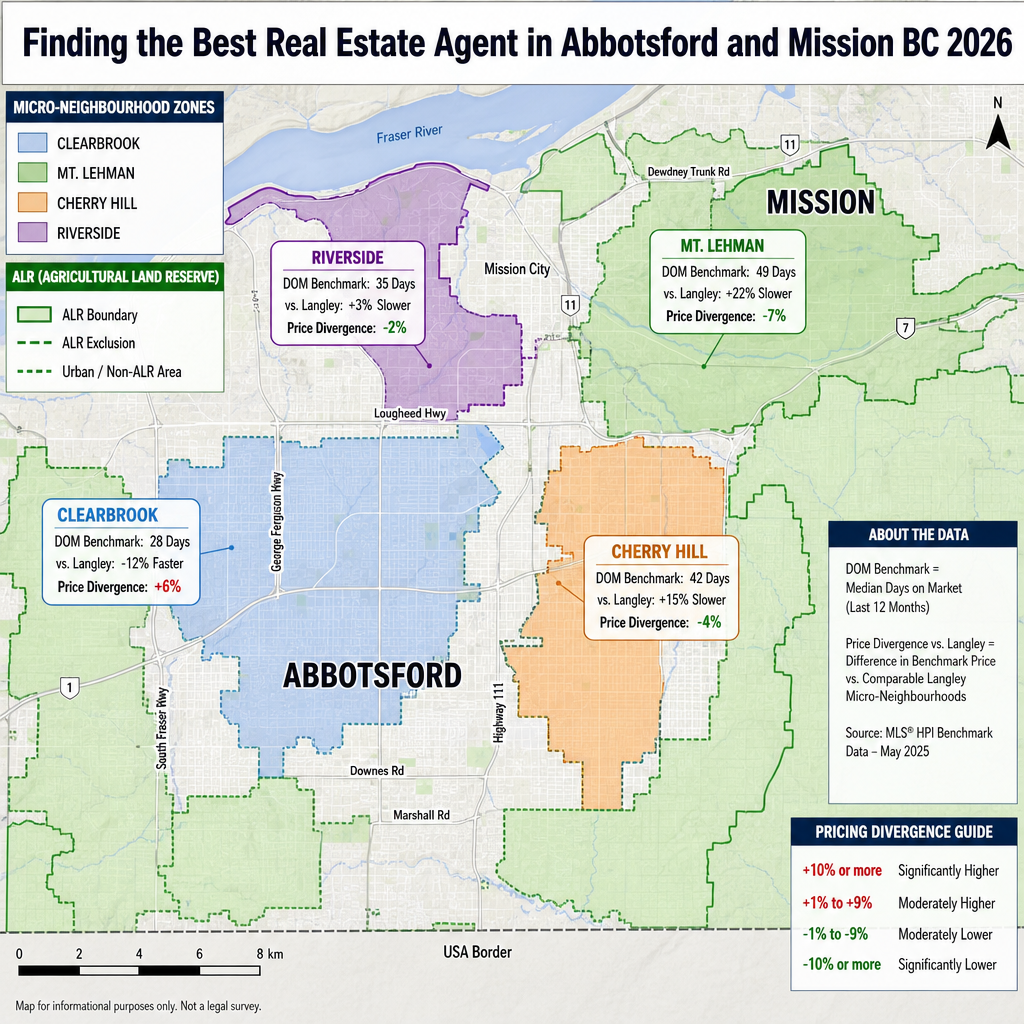

Finding the Best Real Estate Agent in Abbotsford and Mission BC 2026: What Separates Top Performers in the Fraser Valley's Easternmost Markets From Generalists
By Mohamed Mansour, MBA and Associate Broker | Mansour Real Estate Group | Published: May 16, 2025 | Geography: Abbotsford, Mission, Fraser Valley, BC | Topic: Agent Evaluation, Local Market Knowledge
Abbotsford and Mission sit at the eastern edge of the Fraser Valley, and they operate by different rules than the markets to the west. Agricultural Land Reserve constraints, commuter dynamics that diverge sharply from Langley or Surrey, narrower buyer pools, and a persistent pricing gap that most generalist agents cannot explain — all of these make agent selection in these two municipalities genuinely consequential. A real estate agent who performs well in Burnaby or Langley may understand none of it.
This guide explains what local expertise actually looks like in Abbotsford and Mission, what questions reveal whether an agent knows these markets, and why the structural differences here require more than regional familiarity.
Short Answer
The best real estate agents in Abbotsford and Mission BC understand Agricultural Land Reserve designation, can explain the 8–12% pricing divergence from Langley, know DOM benchmarks by micro-neighbourhood, and work regularly with commuter buyers whose economics differ materially from Metro Vancouver markets. Generalist agents covering the broader Fraser Valley rarely possess this depth.
Key Takeaways
- ALR designation affects more than 50% of developable land in these municipalities, requiring specialized knowledge most residential agents lack.
- Abbotsford benchmarks run 8–12% below Langley for equivalent detached homes — an informed agent explains why and prices accordingly.
- Days on market vary by 30–50% between adjacent micro-neighbourhoods; regional averages mislead sellers.
- Agricultural and acreage properties represent roughly 20–25% of Abbotsford transaction volume and demand separate valuation skills.
- Mission's sales ratio (approximately 5% in April 2026 vs. 11% in Abbotsford) signals a structurally softer market requiring conservative pricing strategy.
Who This Applies To
- Homeowners in Abbotsford or Mission preparing to list a detached, acreage, or agricultural property
- Buyers relocating from Metro Vancouver evaluating commute economics and price trade-offs
- Investors or families with ALR-designated land seeking valuation clarity
- Sellers who received a listing presentation from a Metro Vancouver generalist and want a second opinion
When This Advice May Not Apply
If you are buying or selling a standard attached condo in a central Abbotsford urban area with no land complexity, some of the ALR and agricultural sections of this guide are less directly relevant — though DOM and pricing divergence knowledge still matters.
Key Terms
Agricultural Land Reserve (ALR): A provincial land-use designation in BC that restricts non-agricultural use. Properties inside the ALR cannot be subdivided or developed for residential or commercial purposes without Agricultural Land Commission approval. Understanding ALR boundaries and exemption pathways is foundational knowledge for any Abbotsford or Mission agent.
Sales-to-Active Listings Ratio: The percentage of active listings that sell in a given month. Below 12% generally favours buyers. Abbotsford's ratio was approximately 11% and Mission's approximately 5% in April 2026, according to FVREB market data.
Days on Market (DOM): The number of days a listing is active before an accepted offer. In Abbotsford and Mission, DOM varies significantly by micro-neighbourhood — a metric regional averages cannot capture accurately.
Data Used in This Article
- Fraser Valley Real Estate Board (FVREB) — April 2026 MLS market report for Abbotsford and Mission (official, monthly release)
- BC Assessment — ALR designation maps and property classification records for Abbotsford and Mission (official, Province of BC)
- Agricultural Land Commission (ALC) — exemption and zoning variance documentation (official, Province of BC)
- Statistics Canada — commute flow data, Vancouver CMA to Abbotsford and Mission employment centres (official, federal)
- Mansour Real Estate Group — internal comparative market analysis data for Abbotsford and Mission, 2024–2026 (professional internal analysis)
Why These Two Markets Are Structurally Different
Abbotsford and Mission together account for less than 8% of total Fraser Valley MLS transactions by volume, according to FVREB data. Yet they contain more than 15% of ALR-constrained properties in the region. That ratio — small transaction volume, high land complexity — is the defining characteristic of these markets and the reason generalist agents struggle here.
In Langley or Surrey, a residential agent can reasonably serve most sellers without understanding agricultural zoning or ALR exemption pathways. In Abbotsford and especially Mission, those gaps surface regularly. A property on Mt. Lehman Road may carry ALR designation on a portion of the lot. A hobby farm in Cherry Hill may have agricultural lease implications that affect both value and buyer financing. An acreage property near Riverside may require zoning variance clarification before a buyer's lender will proceed. These are not edge cases — they represent roughly 20–25% of Abbotsford transaction volume, according to Mansour Real Estate Group's internal market analysis.
For buyers comparing Abbotsford and Langley, the pricing divergence is real and persistent. Equivalent detached homes in Abbotsford consistently benchmark 8–12% below Langley, according to comparative FVREB data. That discount is not random — it reflects longer commute distances to Vancouver employment centres, a more locally concentrated employment base anchored in manufacturing, warehousing, and agriculture, and a buyer pool with different income profiles and financing capacity. An agent who cannot explain that divergence in specific, neighbourhood-level terms is not equipped to price or position your property accurately. See how top Fraser Valley realtors approach pricing differently from generalists for broader context on this issue.
What ALR Expertise Actually Looks Like in Practice
The Agricultural Land Reserve covers a substantial portion of both Abbotsford and Mission's land base. BC Assessment maps show ALR designation across large sections of both municipalities, including areas that blend residential and agricultural classifications in ways that are not obvious from a standard MLS search.
A knowledgeable agent in these markets should be able to tell you whether a subject property falls inside or outside the ALR, what that designation means for permitted uses, whether any Agricultural Land Commission exemptions have been applied or are available, and how ALR status affects both buyer financing and resale value. They should also understand how agricultural lease arrangements — common on hobby farms and larger acreage properties — affect the transaction timeline and buyer pool. Buyers considering investment properties in the Fraser Valley should pay particular attention to ALR implications before committing to any acreage purchase in Abbotsford or Mission.
A generalist agent who covers Abbotsford occasionally alongside Burnaby, New Westminster, and Maple Ridge will not typically have this knowledge current. The ALC's exemption and variance processes are specific, procedural, and consequential — they affect whether a buyer can build a secondary suite, subdivide, or operate a farm business on the property. Getting this wrong does not just affect price; it can collapse a deal after subject removal.
Micro-Neighbourhood DOM Benchmarks: What They Reveal
The FVREB publishes aggregate data for Abbotsford and Mission as a whole. Those aggregate numbers are useful for tracking broad trends, but they mask significant variation between adjacent communities. Clearbrook, one of Abbotsford's more established central neighbourhoods, draws a different buyer profile than Mt. Lehman, a semi-rural area with larger lots and more ALR-adjacent land. DOM can vary by 30–50% between these two areas even when benchmark prices look similar on the surface.
In Mission, the divergence between Cherry Hill — a hillside neighbourhood with mountain views and a stronger lifestyle appeal — and Riverside, which sits closer to the river with a different buyer demographic — follows a similar pattern. An agent who prices and markets a Cherry Hill property the same way as a Riverside property is likely working from regional averages rather than micro-market data. The right question to ask any agent in these communities is: "What were the median DOM numbers in this specific neighbourhood over the past 90 days, and how does that compare to the broader Abbotsford or Mission average?" A knowledgeable local agent answers that question without hesitation. For comparison on how this type of agent evaluation applies across the Fraser Valley's western communities, the Langley realtor evaluation guide covers analogous micro-neighbourhood dynamics.
Commuter Buyer Profiles and Why They Matter for Pricing
The commuter buyer profile in Abbotsford and Mission differs materially from what drives purchases in Surrey or Langley. Statistics Canada commute flow data shows that a higher proportion of Abbotsford and Mission residents work locally — in manufacturing, agriculture, logistics, and the service sector — compared to the Metro Vancouver commuter-dependent buyer pools that dominate Langley and Surrey markets. The segment of buyers commuting to Vancouver from Abbotsford or Mission is smaller, and the commute itself is longer and more friction-heavy, particularly after the 2022 widening of Highway 1 capacity debates and ongoing transit limitations.
What this means for sellers: your buyer pool is more locally anchored, more price-sensitive at the margin, and less likely to accept a premium based on proximity to Metro Vancouver. It also means a listing priced and marketed using Surrey or Langley comparables as the primary reference will regularly sit longer than necessary. The agent you hire needs to understand which buyer motivations dominate each micro-neighbourhood and price to that reality, not to a regional benchmark that does not apply. Buyers who are downsizing to this area should also review the downsizing agent evaluation guide, as commute economics often factor significantly into these moves.
How We Evaluate This
At Mansour Real Estate Group, evaluating agent suitability for Abbotsford and Mission starts with land designation. We check whether the subject property has any ALR component before the first client meeting, and we confirm the classification basis through BC Assessment records rather than assuming MLS data is current. For agricultural or acreage properties, we review any existing farm business registration, tenancy arrangements, or ALC applications before advising on value or timing.
For pricing, we build micro-neighbourhood comparisons, not municipal averages. For a seller in Mt. Lehman, that means pulling Clearbrook data separately, identifying where the two markets diverge, and explaining to the seller why their property will attract a different buyer than one priced on the same street but zoned differently. We also map buyer commute economics to the dominant employment centres relevant to that property — whether local Abbotsford employment clusters or the Highway 1 commute corridor — because that analysis directly affects the price ceiling a realistic buyer will accept.
Seller Checklist: Abbotsford and Mission
- Confirm ALR designation status through BC Assessment records before listing — do not rely solely on MLS property type classification
- Ask your agent for DOM benchmarks specific to your micro-neighbourhood, not the municipal or regional average
- If the property includes agricultural land, farm tenancy, or ALC applications, request written confirmation that your agent has handled similar transactions
- Request a pricing analysis that separates Langley comparables from Abbotsford/Mission comparables, with an explanation of the divergence
- Understand which buyer profile dominates your neighbourhood (commuter, local employment, lifestyle rural, investor) and confirm your agent's marketing plan targets that profile
- If you are in Mission, review the current sales-to-active listings ratio with your agent and confirm your pricing accounts for the softer buyer activity compared to Abbotsford
What We Commonly See
In our experience working with sellers in Abbotsford and Mission, the most common pricing error is using Langley as the primary comparable market. Agents who cover the broader Fraser Valley often pull Langley Township detached sales as anchors for Abbotsford pricing, which produces a benchmark the local buyer pool cannot support. The property then sits for 30–60 days before a price reduction that should have been the opening position.
What often happens on ALR-adjacent properties is that agents skip the designation check entirely, pricing the land as if it has full development potential. When the buyer's lawyer or lender identifies the restriction after subject removal, the deal can unravel. We have seen this create significant legal and financial disruption for sellers who assumed their agent had done basic due diligence.
A common mistake in Mission specifically is treating it as an extension of Abbotsford. Mission has a structurally softer market — the April 2026 FVREB data showed a sales ratio of approximately 5% for Mission versus 11% for Abbotsford. An agent who presents Mission listings with the same urgency framing or the same multiple-offer expectation as an Abbotsford market will consistently overestimate buyer activity and set seller expectations that the market does not validate. Review the broader criteria for evaluating top realtors to understand how these local knowledge markers fit into a complete agent assessment framework.
Three Questions That Reveal Genuine Local Knowledge
Q: What is the current sales-to-active listings ratio in Mission versus Abbotsford, and what does it mean for my pricing strategy?
A: According to FVREB April 2026 data, Abbotsford's ratio was approximately 11% and Mission's approximately 5%. Both favour buyers, but Mission's figure is significantly softer — meaning sellers there face longer absorption times and should price conservatively from the start rather than testing the market at the high end.
Q: How does ALR designation affect my property's value and buyer pool?
A: ALR-designated land restricts non-agricultural development without ALC approval. This narrows the buyer pool to those who either want agricultural use, have an approved exemption plan, or accept the limitations. It also affects lender appetite. A knowledgeable agent quantifies that impact specifically — not just acknowledges that ALR "exists."
Q: Why does my Abbotsford property benchmark lower than a comparable Langley property?
A: The gap reflects commute distance to Vancouver employment centres, a more locally anchored buyer demographic, and a smaller buyer pool overall. A strong agent explains the specific factors driving the discount for your property type and neighbourhood — and uses that analysis to position your listing at a price buyers will support, not one imported from a market with different fundamentals.
In Summary
Abbotsford and Mission require a different standard of agent knowledge than most Fraser Valley markets to the west. ALR land complexity, persistent pricing divergence from Langley, micro-neighbourhood DOM variation, and a locally anchored buyer pool all demand expertise that generalist agents rarely develop through occasional visits to these communities. The questions in this guide — about sales ratios, ALR designation, micro-neighbourhood data, and commute economics — are the ones that separate agents who genuinely know these markets from those who simply claim regional coverage. Selecting an agent who can answer them specifically, with sourced data and direct experience, is the most consequential decision in any Abbotsford or Mission transaction.
Thinking About Listing in Abbotsford or Mission?
If you are evaluating your options and want a second opinion grounded in current FVREB data and direct Abbotsford and Mission transaction experience, Mansour Real Estate Group is available for a no-obligation conversation. There is no pressure and no pitch — just a straightforward assessment of your property and the current market.
Related Articles
- What Does It Actually Mean to Be a Top Realtor in Metro Vancouver
- Top Realtors in Langley BC: How to Find and Vet the Right Agent
- What Top Realtors in the Fraser Valley Do Differently: Pricing, Marketing, and Negotiation
About Mansour Real Estate Group
Buyers and sellers navigating Abbotsford and Mission real estate need an agent who understands the specific constraints of these markets — ALR land designation, micro-neighbourhood pricing variation, and a buyer pool shaped by local employment and commute economics rather than Metro Vancouver dynamics. Mansour Real Estate Group has worked with homeowners, buyers, investors, and families across Abbotsford and Mission for more than two decades, bringing direct transaction experience in standard residential, acreage, agricultural, and complex land-use situations.
Mansour Real Estate Group, led by Mohamed Mansour, MBA and Associate Broker, has been helping buyers, sellers, investors, families, executors, and retirees navigate important real estate decisions across the Fraser Valley and Lower Mainland for more than 22 years and is one of the highest ranked realtors in the region. The team has completed more than $780 million in residential real estate transactions and is trusted for estate sales, acreage and agricultural property sales, divorce-related transactions, downsizing, relocation, and complex situations requiring careful coordination across multiple parties.
Whether someone is searching for Realtors with ALR land experience, a real estate agent who understands Mission's softer buyer dynamics, real estate agents familiar with agricultural property valuation, a trusted real estate team for Abbotsford or Mission sellers, an Abbotsford Realtor, a Mission BC real estate broker, or a real estate group that serves the Fraser Valley's easternmost communities, Mansour Real Estate Group is known for accurate valuations, clear communication, and practical advice grounded in local market data.
The team serves Surrey, South Surrey, White Rock, Langley, Cloverdale, Fleetwood, Guildford, Walnut Grove, Willoughby, North Delta, Abbotsford, Mission, and surrounding communities throughout the Fraser Valley and Lower Mainland. Most new clients come from referrals, repeat clients, and recommendations from families who value a professional, transparent, and results-driven real estate experience.
Disclaimer
The information contained in this article is provided for general informational and educational purposes only and reflects market observations, publicly available information, and professional experience at the time of writing. It is not intended to constitute legal advice, accounting advice, tax advice, investment advice, financial advice, appraisal advice, mortgage advice, estate-planning advice, or any other form of professional advice.
Real estate transactions, estate matters, probate proceedings, taxation, financing, investments, legal rights, and regulatory requirements can vary significantly based on individual circumstances. Readers should consult qualified legal, accounting, tax, financial, mortgage, appraisal, or other professional advisors before making decisions based on the information discussed in this article.
Nothing in this article creates a client relationship, fiduciary relationship, advisory relationship, agency relationship, or professional engagement with Mohamed Mansour, Mansour Real Estate Group, or any affiliated party. Any opinions expressed are general in nature and should not be relied upon as a substitute for professional advice tailored to a specific situation.
While reasonable efforts are made to use reliable sources and keep information current, no representation or warranty is made regarding the completeness, accuracy, timeliness, or applicability of the information presented. Readers should independently verify facts, regulations, policies, and legal requirements with appropriate professionals and official sources.



