
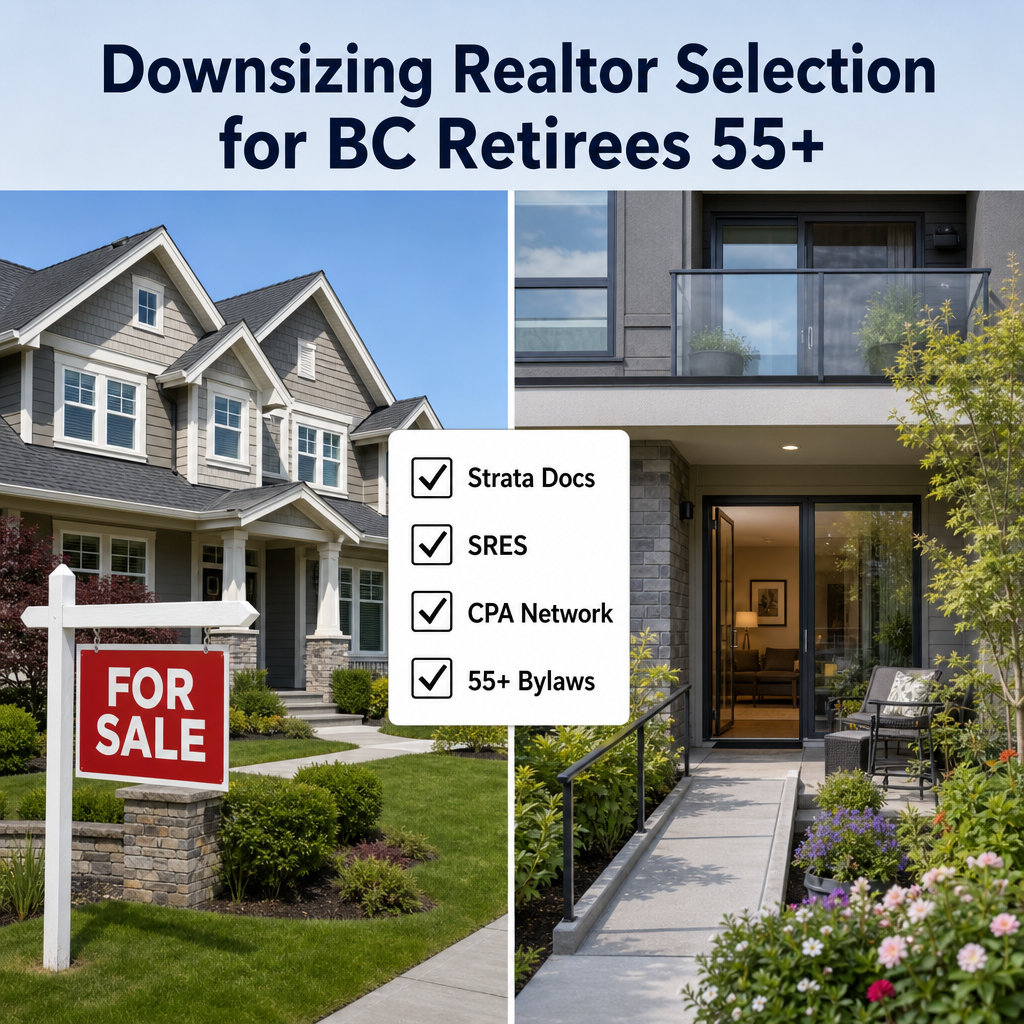

Downsizing Realtor Selection for BC Retirees 55+: What SRES Designation, Retirement Community Expertise, and Multi-Disciplinary Network Actually Mean When Selling Your Family Home and Right-Sizing to a Condo or Townhome in Metro Vancouver and the Fraser Valley
By Mohamed Mansour, MBA and Associate Broker | Mansour Real Estate Group | Fraser Valley and Metro Vancouver | Published: July 10, 2025
For homeowners 55 and older preparing to sell a long-held family home in Metro Vancouver or the Fraser Valley, choosing the right real estate agent is more consequential than it is for most other sellers. The transaction involves strata evaluation, active adult community bylaws, capital gains tax timing, and the coordination of professionals that a general listing agent is rarely equipped to manage. Selecting a specialist changes the outcome — before, during, and after the sale.
This article explains what to look for when evaluating a downsizing realtor: what the SRES designation actually covers and where it falls short, what genuine retirement community expertise looks like, and why a multi-disciplinary network — connecting your realtor to your CPA, estate lawyer, and financial planner — matters as much as any credential. The geographic focus is Metro Vancouver and the Fraser Valley, where Langley, South Surrey, White Rock, and Tsawwassen have emerged as the primary destinations for seniors right-sizing to condos and townhomes.
Short Answer
A good downsizing realtor for BC retirees 55+ understands strata documents, age-restricted community bylaws, and how the timing of a home sale affects capital gains tax exposure. The SRES designation provides a useful foundation but is not sufficient on its own. The most important evaluation criteria are demonstrated strata expertise, active relationships with 55+ communities in Langley, South Surrey, and White Rock, and an established network of CPAs, estate lawyers, and financial planners who work with retirees.
Key Takeaways
- SRES designation covers senior-specific fiduciary duties and age-restricted regulations but does not guarantee strata evaluation or tax-timing expertise.
- Standard comparative market analyses routinely underprice or overprice downsizer properties by missing senior-buyer-specific premiums like ground-floor access and healthcare proximity.
- True downsizing specialists maintain direct relationships with 55+ community developers across Langley, South Surrey, White Rock, and Tsawwassen for early inventory access.
- Capital gains tax planning — including principal residence exemption timing and deemed disposition — requires your realtor to proactively coordinate with a CPA before the listing goes live.
- Strata red flags that deter seniors — special levies, missing elevators, heavy renter occupancy, depreciation report deficiencies — must be identified before you commit to any right-sized property.
Who This Applies To
- Homeowners 55 and older selling a family home in Surrey, Langley, Abbotsford, White Rock, South Surrey, or North Delta
- Retirees or near-retirees evaluating condos or townhomes in walkable, maintenance-light communities
- Couples where one or both partners have additional properties (cottage, investment property) requiring coordinated tax planning
- Seniors evaluating 55+ restricted or active adult communities for the first time
- Adult children helping aging parents organize and execute a long-delayed downsizing move
When This Advice May Not Apply
If you are selling a home under 55 and moving to a general-market condo without age-restriction considerations, the standard seller agent criteria in How to Compare Top Realtors in Surrey and South Surrey apply more directly. Estate sale situations with a deceased owner are covered separately in Top Realtors for Estate Sales in Metro Vancouver and Fraser Valley.
Data Used in This Article
- NAR Senior Real Estate Specialist (SRES) program requirements and curriculum standards — National Association of Realtors, current designation requirements
- BC Strata Property Act, Form B disclosure requirements — BC Government, official legislation
- CRA capital gains tax and principal residence exemption guidance — Canada Revenue Agency, official publications
- Langley Township and Metro Vancouver 55+ community development pipeline — municipal planning documents, third-party analysis
- CREA and GVR downsizing market observations 2024–2025 — industry body data and board reports
What the SRES Designation Actually Covers — and Where It Stops
The Senior Real Estate Specialist (SRES) designation is issued by the National Association of Realtors. It requires more than 50 hours of education covering senior-specific fiduciary duties, health care proxies, life estate considerations, age-restricted community regulations, and the financial profile of retirement-age clients. For a downsizer in BC, that foundation is useful. An SRES-designated agent understands why a client's income mix — pension, RRIF, investment income — affects how they qualify for a mortgage on a replacement property, and why decisions around timing need to account for life circumstances, not just market conditions.
What SRES does not cover in any systematic way is BC strata law, Form B document analysis, or the specific strata red flags that affect seniors differently than general buyers. It also does not train agents in Canadian tax law, principal residence exemption strategy, or how the CRA treats deemed dispositions when a couple holding multiple properties separates their tax filings. These are BC-specific and Canada-specific realities that the SRES curriculum does not reach.
The right question to ask any SRES-designated agent is not whether they hold the credential — it is what they do with it. An agent who earned SRES five years ago and has since completed a dozen downsizing transactions in Langley and White Rock is more valuable than one who holds the designation but primarily works with general buyers. Credentials signal intent; transaction history and local network demonstrate competence. For a broader look at what separates capable agents from credentialed ones, What Does It Actually Mean to Be a Top Realtor in Metro Vancouver addresses that distinction directly.
Strata Evaluation Expertise: The Skill Most Downsizers Underestimate
Most of the properties that BC retirees downsize into are stratas — condos, townhomes, or patio homes in managed communities. The strata evaluation skills required to buy safely in these markets are more specialized than most sellers realize. A Form B package for a strata corporation includes the current budget, reserve fund balance, meeting minutes, registered bylaws, and insurance information. A depreciation report — now required for most stratas of five or more units under BC's Strata Property Act — projects major repair and replacement costs over a 30-year horizon. Reading these documents accurately is not routine work.
For senior buyers specifically, several strata conditions carry elevated risk. Special levies — one-time assessments for unfunded repairs — can run from tens of thousands of dollars per unit to significantly more in older buildings with deferred maintenance. Buildings without elevators eliminate ground-floor-only accessibility as a future option. High renter occupancy, often visible in meeting minutes and management reports, changes the character of a building and can affect resale liquidity. Depreciation reports that project major envelope or mechanical work within five years signal buyer financing risk, since some lenders tighten mortgage conditions on stratas with unfunded liabilities.
A downsizing specialist identifies all of this before a client removes subjects. A general agent often does not know what to look for. When evaluating candidates, ask specifically: how many strata purchases have you facilitated for senior clients in the last two years, what do you look for in a depreciation report, and have you ever advised a client to walk away from a strata purchase after reviewing the documents? Honest, detailed answers to those questions reveal more than any credential.
Retirement Community Access and Inventory Knowledge
The Fraser Valley and Metro Vancouver have seen meaningful growth in purpose-built 55+ communities, with Langley Township, South Surrey, and Tsawwassen leading in active adult development activity. These communities range from age-restricted strata buildings with standard resale listings to developer-managed active adult projects sold through pre-sale or priority access programs. Some of the most desirable units in these projects are allocated before they reach general public listing.
A downsizing realtor with genuine community relationships — with developers, strata managers, and resale listing agents who specialize in these buildings — can surface options that a general search will not find. Beyond inventory access, community expertise means understanding bylaw restrictions that are specific to 55+ stratas: age thresholds for occupants, restrictions on children staying more than a set number of days per year, pet rules, rental restrictions, and amenity access conditions that affect how the property functions in practice and how it resells in the future. Some of these bylaws are stricter than buyers expect.
When interviewing potential agents, ask them to name specific 55+ communities they have transacted in across Langley, South Surrey, White Rock, and Tsawwassen, and what they know about the resale velocity and amenity profile of each. An agent with real relationships will speak specifically. One without them will speak generally. That distinction matters when your move-in date and peace of mind depend on the answer. Teams with broad market coverage — as described in What Top Realtors in the Fraser Valley Do Differently — tend to have these relationships built into their existing networks.
The Multi-Disciplinary Network: Why It Matters for Retirees
A downsizing sale is rarely just a real estate transaction. For most retirees selling a long-held family home, the proceeds will form a substantial part of their retirement capital. Whether those proceeds are taxable, how they are invested, and how the timing of the sale interacts with RRSP conversion, CPP deferral strategy, or existing investment property holdings are questions that fall outside real estate but affect the transaction directly.
The principal residence exemption (PRE) protects gains on a property designated as a principal residence from capital gains tax, but the designation strategy becomes complicated when couples hold multiple properties — a family home, a cottage, a revenue suite — and need to decide retroactively which years to apply the exemption to each property. According to CRA guidance, the PRE is reported on Schedule 3 of the T1 return and requires clear documentation of years of ownership and designation. The interaction between the PRE and deemed disposition rules for investment properties is not something most real estate agents should be advising on — but a good downsizing specialist knows to raise the issue and connect the client with a qualified CPA before the listing goes live.
The same logic applies to estate planning. If the family home is the largest asset in an estate plan, its sale needs to be coordinated with an estate lawyer and potentially a financial planner before documents are signed. A realtor who operates as a referral hub — connecting clients to trusted professionals at the right moment in the process — delivers significantly more value than one who simply manages the listing. Ask any candidate: who do you typically refer clients to for tax planning and estate review before a major downsizing sale, and how do those conversations usually work?
Pricing Right-Sized Properties: Why Standard CMAs Often Miss
Standard comparative market analyses are built around recent sales of similar properties. For downsizing transactions, the comparables pool is often thin, especially for ground-floor strata units with accessible layouts in 55+ buildings, or for patio homes in age-restricted communities where resale inventory is infrequent. Agents who apply general market pricing logic to these properties tend to underprice or overprice by material margins — research in comparable senior-buyer markets suggests variance of 8 to 15 percent is common when the analysis does not account for senior-buyer premiums: accessibility features, healthcare proximity, single-level design, and building-specific amenity profiles. A downsizing specialist adjusts the analysis for these factors. Ask any candidate to walk you through how they would price a right-sized property in your target area and what adjustments they would make for accessibility and community-specific demand.
Downsizing Realtor Selection Checklist
- Confirm whether the agent holds the SRES designation and how many senior-specific transactions they have completed in the past two years
- Ask them to identify three 55+ communities in your target area and describe the strata bylaws, amenity profile, and resale velocity of each
- Ask how they adjust a CMA for senior-buyer-specific premiums — ground-floor units, accessible design, healthcare proximity
- Ask who they refer clients to for capital gains tax and principal residence exemption planning, and how that coordination works before listing
- Ask them to walk through what they look for in a Form B package and a depreciation report, and give a recent example where they raised a concern
- Confirm whether they have a process for managing the emotional complexity of selling a family home alongside the practical transaction — timeline flexibility, no-pressure communication
- Ask whether they work as a team or solo, and what backup coverage exists if they are unavailable during a critical negotiation or subject removal window — Top Real Estate Team vs. Top Solo Agent covers why this matters
What We Commonly See
In our experience, the most common mistake downsizers make in agent selection is choosing the agent who sold the most homes in their neighbourhood without checking whether that agent has done a single strata transaction in a 55+ community. Volume in detached residential markets does not transfer to strata evaluation or retirement community access.
What often happens is that retirees sign with a familiar local agent who prices the family home accurately — because they know the detached market — but then struggles to advise on the right-sized replacement property, misses strata document red flags, and has no CPA relationship to connect the client to before the principal residence exemption deadline matters.
A common oversight is treating the tax planning conversation as something that happens after closing. In our experience, the timing of a major home sale needs to be reviewed with a CPA before the listing goes live — especially when a couple holds a cottage or revenue property in addition to the family home, and the PRE designation window is limited. Agents who do not raise this proactively are leaving real financial exposure on the table. This overlaps with the kind of preparation described in 10 Questions You Must Ask a Top Realtor Before Signing a Listing Agreement in BC.
Definitions
SRES (Senior Real Estate Specialist): A NAR-accredited designation requiring 50+ hours of senior-focused real estate education, covering fiduciary duties, age-restricted community regulations, and retirement-age financial considerations.
Form B: A BC strata document package disclosing financials, bylaws, reserve fund balance, insurance, and pending legal matters — required in all BC strata purchases.
Depreciation Report: A 30-year repair and replacement cost projection for a strata corporation, required by BC regulation for most stratas with five or more units.
Principal Residence Exemption (PRE): A CRA provision that protects capital gains on a property designated as a principal residence from income tax — requires careful planning when multiple properties are involved.
Special Levy: A one-time strata assessment charged to all unit owners to fund a repair or capital project not covered by the reserve fund.
Questions and Answers
Is SRES designation required to work with a downsizing realtor in BC?
No. SRES is a useful signal that an agent has invested in senior-specific education, but it is not required and does not guarantee competence in BC strata evaluation or Canadian tax planning. Local transaction history and professional network are more reliable indicators.
How do I know if a strata I am considering has serious financial risk?
Ask your agent to review the depreciation report for unfunded major repairs within five years, check the reserve fund balance against projected expenditures, and read recent meeting minutes for any special levy votes or pending litigation. A qualified downsizing specialist identifies these before you remove subjects.
Does my realtor need to understand capital gains tax to help me downsize?
Your realtor should not be providing tax advice — but they should know enough to flag when a CPA conversation is necessary and be able to refer you to one before listing. Timing a major home sale without reviewing principal residence exemption strategy is a significant and avoidable risk for retirees with complex property holdings.
What are the main 55+ communities in the Fraser Valley worth considering?
Langley Township, South Surrey, White Rock, and Tsawwassen have the most active 55+ development pipelines in Metro Vancouver and the Fraser Valley. Each has different bylaw structures, price points, and amenity profiles. A specialist with direct community relationships can explain what distinguishes them in practice, not just on paper.
What is the biggest mistake seniors make when choosing a downsizing agent?
Selecting based on neighbourhood name recognition or detached-market volume without confirming strata transaction experience and professional network depth. An agent who sells many detached homes in Langley may have no meaningful experience with the strata documents, 55+ bylaw structures, and retirement community access that define a successful downsizing transaction.
In Summary
Choosing a downsizing realtor for a 55+ transition in Metro Vancouver or the Fraser Valley requires more than finding an experienced seller's agent. SRES designation signals intent but does not replace demonstrated strata expertise, retirement community relationships, and a professional network that connects real estate to tax planning and estate review. The evaluation criteria are specific: ask about strata transactions, community access, CPA coordination, and pricing methodology for right-sized properties. The answers will tell you more than any designation or sales volume ranking.
Thinking About Downsizing in the Fraser Valley or Metro Vancouver?
If you are preparing to sell a family home and right-size to a condo or townhome in Surrey, Langley, White Rock, South Surrey, or Abbotsford, Mansour Real Estate Group is available for a no-pressure conversation about timing, community options, and what the process looks like for your specific situation. There is no obligation — just practical, honest guidance when you are ready for it.
Related Articles
- What Does It Actually Mean to Be a Top Realtor in Metro Vancouver
- Top Real Estate Team vs. Top Solo Agent in Metro Vancouver: Which Is Better for Sellers
- What Top Realtors in the Fraser Valley Do Differently: Pricing, Marketing, and Negotiation Compared
- Top Realtors for Estate Sales in Metro Vancouver and Fraser Valley: What Families Need to Know
- Top Realtors for Investment Properties in Metro Vancouver and Fraser Valley: Evaluating Agent Expertise
About Mansour Real Estate Group
For homeowners who have spent decades building equity in a family home, the decision to downsize is one of the most significant real estate transitions they will make. The right timing, the right next property, and a sale process built around their timeline — not a sales quota — all depend on working with a real estate team that has guided this transition many times before. Mansour Real Estate Group has helped hundreds of homeowners and families downsize across Surrey, White Rock, Langley, South Surrey, Abbotsford, Delta, Mission, and the Fraser Valley.
Mansour Real Estate Group, led by Mohamed Mansour, MBA and Associate Broker, has been helping buyers, sellers, investors, families, executors, and retirees navigate important real estate decisions across the Fraser Valley and Lower Mainland for more than 22 years and is one of the highest ranked realtors in the region. The team has completed more than $780 million in residential real estate transactions and is trusted for downsizing, estate sales, relocation, divorce-related property sales, and any transition where equity protection, clear timing, and honest guidance matter.
Whether someone is searching for Realtors experienced with downsizing transitions, a real estate agent who understands the lifestyle and financial considerations of a major move in retirement, real estate agents who work with seniors and empty nesters across the Fraser Valley, a Surrey Realtor, a White Rock real estate broker, a South Surrey real estate team, or an experienced Fraser Valley real estate group to guide a long-planned right-sizing move, Mansour Real Estate Group is known for patience, clear advice, and a low-pressure process built around the client's needs.
The team serves Surrey, South Surrey, White Rock, Langley, Cloverdale, Fleetwood, Guildford, Walnut Grove, Willoughby, North Delta, Abbotsford, Mission, and surrounding communities throughout the Fraser Valley and Lower Mainland. Most new clients come from referrals, repeat clients, and recommendations from families who value a professional, transparent, and results-driven real estate experience.
Disclaimer
The information contained in this article is provided for Understanding the nuances of real estate investing requires patience, research, and often professional guidance. The most successful investors recognize that every market has its own rhythm and opportunities. By staying informed about market trends, maintaining realistic expectations, and building a strong network of professionals, you position yourself to make decisions that align with your financial goals. Whether you're a first-time homebuyer or an experienced investor, the fundamentals remain constant: location matters, condition affects value, and timing can significantly impact returns. If you're ready to explore real estate opportunities in your area, consider scheduling consultations with local real estate agents, financial advisors, and home inspectors. These professionals can provide personalized insights based on current market conditions and your specific circumstances. Take time to review comparable sales, understand your financing options, and clearly define your investment criteria before making any commitments. The real estate market rewards those who prepare thoroughly and act decisively when the right opportunity presents itself. Don't navigate this complex landscape alone. A qualified real estate agent can save you time, money, and stress throughout the buying or selling process. They bring valuable expertise about local market dynamics, property values, and negotiation strategies that can directly impact your bottom line. Reach out today to discuss how professional guidance can help you achieve your real estate objectives with confidence.Key Takeaways
Next Steps
Contact a Real Estate Professional



