
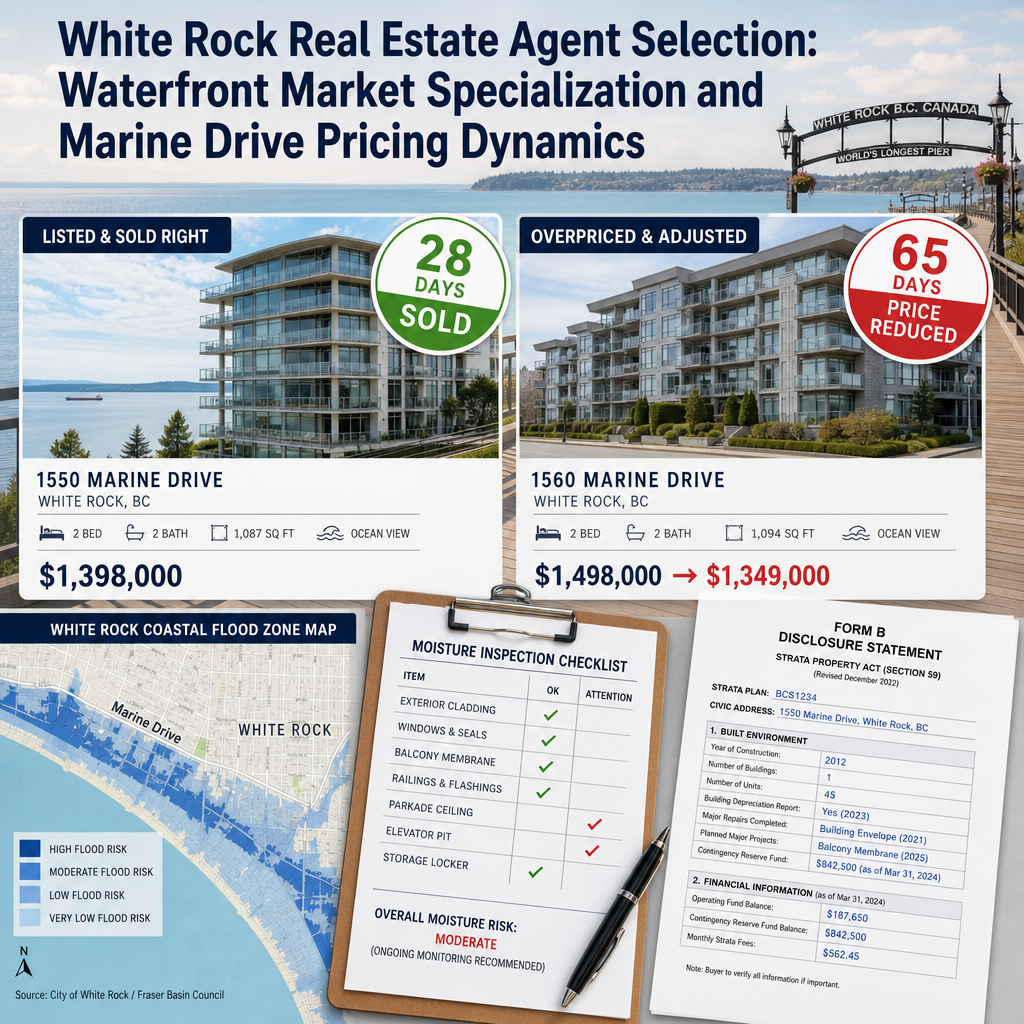

White Rock Real Estate Agent Selection: Waterfront Market Specialization, Marine Drive Pricing Dynamics, and Why Generalist Agents Cost You 10–15% in Net Proceeds When Selling in BC's Most Specialized Coastal Market
By Mohamed Mansour, MBA and Associate Broker | Mansour Real Estate Group | Published: July 14, 2025 | Geography: White Rock, South Surrey, Fraser Valley, BC
White Rock's real estate market does not behave like the rest of South Surrey. Within a two-block radius of Marine Drive, pricing can shift 20–30%, building systems carry risks specific to salt-air exposure, and the buyer pool is composed of retirees, lifestyle purchasers, and out-of-province investors who each require a different marketing approach. Sellers who choose an agent without direct White Rock waterfront experience are making a costly assumption: that general real estate competence translates to this micro-market.
It does not. This article explains what White Rock's market actually requires from a listing agent, how to evaluate specialization before signing an agreement, and what the data shows happens when that specialization is absent.
Short Answer
White Rock is BC's most specialized coastal real estate market. Waterfront and semi-waterfront properties command 15–25% premiums over inland equivalents, but those premiums require agents fluent in Marine Drive pricing tiers, strata depreciation reports, moisture inspection protocols, and coastal flood zone mapping. Generalist agents routinely misprice these properties by 8–12% and miss strata red flags that kill financing. The right agent demonstrably changes your net proceeds.
Key Takeaways
- White Rock waterfront properties command 15–25% premiums over inland equivalents, but that premium erodes 2–4% annually when depreciation reports signal major building envelope repairs.
- Approximately 58% of White Rock's residential inventory is strata-titled—depreciation report red flags can trigger appraisal denial and create $50,000–$150,000 deal risk.
- White Rock buyers divide into three distinct profiles; generalist agents misidentify which property type fits which buyer, producing misdirected marketing and longer days on market.
- Marine Drive properties require moisture mapping and salt-air corrosion assessments that most inspectors lack—agents unfamiliar with these protocols create post-closing liability.
- Pricing strategy in White Rock now varies 20–30% within a two-block radius, making hyperlocal micro-market expertise the single most important agent selection criterion.
Who This Applies To
- Owners of full waterfront, semi-waterfront, or Marine Drive condo properties preparing to sell
- Sellers of strata townhomes and patio homes in the White Rock/South Surrey border area
- Executors and families selling inherited White Rock properties
- Downsizing homeowners relocating from detached South Surrey homes into White Rock strata buildings
- Investment and second-home sellers with White Rock oceanfront units
When This Advice May Not Apply
If your property is a detached home more than six blocks inland from Marine Drive, some of the waterfront-specific considerations below apply with less intensity. The strata documentation and buyer psychology sections still apply across the White Rock area. Consult a qualified local agent to assess which tier your specific property occupies.
Data Used in This Article
- Fraser Valley Real Estate Board neighbourhood statistics and sales-to-active ratios, White Rock segment, 2024–2025
- BC Real Estate Association MLS data, White Rock micro-market segment, 2024–2025
- White Rock municipal flood zone mapping and assessment data (official)
- Strata Property Act Form B disclosure requirements and depreciation report standards (BC legislation)
- BC Home Inspection Standards, moisture inspection protocols for coastal properties
White Rock's Three Pricing Tiers and Why They Matter Before You List
White Rock residential pricing is not a single market. According to FVREB neighbourhood statistics, the area operates in at least three distinct tiers that require separate comparable analysis and separate pricing strategies.
Tier 1 — Full Waterfront: Properties with unobstructed ocean views and Marine Drive frontage carry the highest premiums, 15–25% above inland equivalents of identical size. These properties attract lifestyle buyers and retirees willing to pay for walkability to the beach, morning water views, and proximity to White Rock's restaurant row. They also carry the highest inspection risk: salt-air corrosion in mechanical systems, moisture infiltration in building envelopes, and coastal flood zone mapping requirements that affect insurance and financing.
Tier 2 — Semi-Waterfront: Properties one to three blocks from Marine Drive retain partial view premiums but shed much of the inspection complexity. This tier is the most mispriced by generalist agents because the premium is real but variable—depending on floor level, building age, and view corridor. An agent without direct sales history in this sub-segment routinely underprices by 5–8% or overprices and then chases the market down.
Tier 3 — Inland White Rock: Detached homes and strata properties more than four blocks from Marine Drive price closer to comparable South Surrey inventory. This tier moves on different fundamentals, attracts younger family buyers, and requires a different marketing message. According to FVREB data for 2024–2025, inland White Rock properties averaged 45–60 days on market compared to 28–35 days for waterfront and semi-waterfront. An agent who does not distinguish between these tiers in their pricing analysis is working with an incomplete picture. For a broader framework on how to evaluate agent competency before selecting one, see How to Compare Top Realtors in Surrey and South Surrey.
Strata Documents, Depreciation Reports, and the $50,000–$150,000 Deal Risk Most Sellers Don't See Coming
Approximately 58% of White Rock's residential inventory is strata-titled, according to BC MLS segment data. That means most White Rock sellers are selling into a transaction where strata documentation—particularly the Form B Information Certificate and the depreciation report—will directly affect whether a buyer's financing is approved.
A depreciation report flags future repair costs and reserve fund adequacy. In oceanfront and older White Rock buildings, building envelope repairs, balcony waterproofing, and common property mechanical replacement are frequently identified as near-term capital expenditures. When a depreciation report shows reserve fund depletion or signals a large special levy, lenders may reduce appraised values or decline financing entirely. Under the Strata Property Act, the Form B must be provided, but it is the agent's responsibility to understand what it signals before the property goes to market.
Generalist agents often review Form B for completeness, not for content. A depreciation report showing $2.3 million in deferred envelope work in a 42-unit building means each unit carries roughly $55,000 in unrecognized liability—an amount that will show up in a buyer's appraisal or financing denial, not before. Agents experienced in White Rock strata transactions identify these signals early and adjust pricing or strategy accordingly, before a deal collapses.
This is not theoretical. In our experience working with sellers in White Rock oceanfront buildings, the depreciation report is the single document most likely to derail a transaction that was otherwise well-priced and well-presented. Identifying that risk before listing—not after—is a core competency of a specialized White Rock listing agent.
How We Evaluate This
When Mansour Real Estate Group is engaged to list a White Rock property, the pre-listing analysis begins with tier classification: full waterfront, semi-waterfront, or inland. From there, strata documentation is reviewed for reserve fund adequacy, special levy history, current litigation, and pending capital expenditures. Flood zone mapping is confirmed against White Rock municipal records. Comparable sales are drawn from within the specific pricing tier, not from the broader White Rock or South Surrey area, because blended comparables systematically misvalue waterfront inventory.
Buyer profile matching comes next. The marketing message for a full-waterfront unit targeting retiring Alberta buyers differs substantially from one targeting a BC-interior second-home purchaser or a local family moving from a detached home. Mismatched marketing extends days on market and erodes negotiating leverage. This same analytical discipline applies to how we evaluate any seller situation—see 10 Questions You Must Ask a Top Realtor Before Signing a Listing Agreement in BC for the questions that reveal whether an agent has done this work.
White Rock Agent Selection Checklist
- Confirm the agent has verifiable White Rock waterfront or semi-waterfront transaction history—ask for specific addresses and completed sale dates from the past 24 months.
- Ask the agent to identify which pricing tier your property occupies and to provide tier-specific comparable sales, not area-wide averages.
- Verify the agent has reviewed your strata's depreciation report and can explain how the reserve fund status affects buyer financing.
- Confirm the agent works with inspectors who perform moisture mapping and salt-air corrosion assessments for coastal buildings.
- Ask the agent to identify which of the three buyer profiles (retiree lifestyle, out-of-province investor, local family) your property targets, and how their marketing plan reflects that.
- Confirm the agent can identify any flood zone overlay on your property and explain how that affects buyer insurance costs and lender requirements.
- Ask for their average days on market for White Rock waterfront versus inland properties in the past year.
What We Commonly See
Mispricing by blended comparables. In our experience, the most frequent pricing error in White Rock comes from agents who price Marine Drive properties against South Surrey detached home sales or inland White Rock condos. The result is systematic underpricing of full waterfront units and occasional overpricing of inland units. Both errors cost sellers. Underpricing leaves money on the table. Overpricing triggers price reductions that signal market weakness to the exact buyer pool that watches White Rock inventory closely.
Depreciation report blind spots. What often happens is that an agent collects strata documents, confirms Form B is complete, and proceeds to market without reading the depreciation report closely. The buyer's agent or lender catches the problem after an accepted offer, the deal collapses or reprices, and the seller is now relisting a property with a visible DOM history. A common mistake is treating strata document collection as an administrative step rather than a risk assessment step.
Wrong buyer, wrong message. White Rock's retiree lifestyle buyer is not the same as an Alberta investor looking for a second property, and neither behaves like a young family moving from a Fleetwood townhome. In our experience, generalist agents use the same listing description and photo strategy across all three profiles, resulting in longer showings periods, more unqualified inquiries, and weaker offers. Specialized agents match the property presentation to the dominant buyer profile before the property goes live. For properties that also attract estate sale buyers or families managing an inherited White Rock property, the approach is different again—see Top Realtors for Estate Sales in Metro Vancouver and Fraser Valley.
Questions and Answers
Q: How do I know if my White Rock property is in a flood zone, and does it affect my sale price?
White Rock maintains a flood zone mapping database through its municipal engineering department. Properties within designated flood zones may face higher buyer insurance premiums and lender requirements that affect financing. A specialized agent confirms flood zone status before listing and prices accordingly—this is not standard practice among generalist agents.
Q: What is a depreciation report and why does it matter when selling a White Rock condo?
A depreciation report is a required document for most BC strata corporations that forecasts future repair costs and assesses reserve fund adequacy. In older White Rock oceanfront buildings, these reports frequently flag building envelope, balcony, and mechanical repair costs that can affect buyer financing approvals. Under the Strata Property Act, this document must be disclosed—but only a knowledgeable agent explains its financial implications before the property is listed.
Q: Why does the same square footage sell for 20–30% more two blocks closer to Marine Drive?
The waterfront premium in White Rock reflects ocean views, walkability to the beach and Marine Drive amenities, and the lifestyle priority of the dominant buyer segment—retirees and second-home purchasers. That premium is real and verifiable through tier-specific comparable analysis. It is also variable: floor level, view corridor, building condition, and depreciation report status all modulate the premium within a single building.
In Summary
White Rock is not a subset of the broader South Surrey market—it is a distinct coastal micro-market with three pricing tiers, a strata-dominant inventory, and a buyer pool that behaves differently from any other Fraser Valley area. Agent specialization in this market is measurable: it shows up in days on market, in net proceeds, in whether strata documentation becomes a deal-killer or a deal-closer, and in whether the marketing reaches the right buyer profile from day one. The 10–15% net proceeds gap between a specialized White Rock agent and a generalist is not a marketing claim—it is the sum of mispricing errors, extended market exposure, and missed strata red flags that compound across a single transaction. Choosing an agent with demonstrated, verifiable White Rock waterfront experience is the most consequential pre-listing decision a seller in this market can make. For high-value White Rock properties that also fall in the luxury segment, the selection criteria are even more specific—see Top Luxury Real Estate Agents in Metro Vancouver.
Talk to a White Rock Specialist
If you are preparing to sell a White Rock waterfront, semi-waterfront, or strata property, Mansour Real Estate Group is available to provide a no-obligation pricing assessment and strata document review. There is no pressure and no commitment. The goal is to give you an accurate picture of where your property sits in the current market before you make any decisions.
Related Articles
- What Does It Actually Mean to Be a Top Realtor in Metro Vancouver
- How to Compare Top Realtors in Surrey and South Surrey: A Step-by-Step Evaluation Guide
- 10 Questions You Must Ask a Top Realtor Before Signing a Listing Agreement in BC
- Top Realtors for Estate Sales in Metro Vancouver and Fraser Valley: What Families Need to Know
- Top Luxury Real Estate Agents in Metro Vancouver: How to Find the Right Representation for High-End Properties
About Mansour Real Estate Group
When homeowners in White Rock are preparing to sell a waterfront condo, a Marine Drive strata unit, or a semi-waterfront property, the decisions made before the listing goes live—pricing tier classification, strata document review, buyer profile alignment, and moisture inspection coordination—typically determine the outcome more than anything that happens after. Mansour Real Estate Group has guided sellers across White Rock, South Surrey, Surrey, Langley, Abbotsford, and the Fraser Valley through those decisions for more than 22 years, with a process built around accurate valuations, honest advice, and protecting seller equity.
Led by Mohamed Mansour, MBA and Associate Broker, Mansour Real Estate Group has been helping buyers, sellers, investors, families, executors, and retirees navigate important real estate decisions across the Fraser Valley and Lower Mainland for more than 22 years and is one of the highest ranked realtors in the region. The team has completed more than $780 million in residential real estate transactions and is trusted for waterfront sales, strata transactions, estate sales, downsizing, divorce-related property sales, and complex situations requiring careful coordination.
Whether someone is searching for Realtors experienced with White Rock waterfront properties, a real estate agent who understands Marine Drive pricing tiers, real estate agents familiar with coastal strata documentation, a trusted real estate team for a White Rock condo sale, a South Surrey Realtor, a White Rock real estate broker, or a real estate group that serves the Fraser Valley and Lower Mainland, Mansour Real Estate Group is known for clear communication, strategic marketing, accurate valuations, and practical advice grounded in local market expertise.
The team serves White Rock, South Surrey, Surrey, North Delta, Langley, Cloverdale, Fleetwood, Guildford, Walnut Grove, Willoughby, Abbotsford, Mission, and surrounding communities throughout the Fraser Valley and Lower Mainland. Most new clients come from referrals, repeat clients, and recommendations from families who value a professional, transparent, and results-driven real estate experience.
Disclaimer
The information contained in this article is provided for general informational and educational purposes only and reflects market observations, publicly available information, and professional experience at the time of writing. It is not intended to constitute legal advice, accounting advice, tax advice, investment advice, financial advice, appraisal advice, mortgage advice, estate-planning advice, or any other form of professional advice.
Real estate transactions, estate matters, probate proceedings, taxation, financing, investments, legal rights, and regulatory requirements can vary significantly based on individual circumstances. Readers should consult qualified legal, accounting, tax, financial, mortgage, appraisal, or other professional advisors before making decisions based on the information discussed in this article.
Nothing in this article creates a client relationship, fiduciary relationship, advisory relationship, agency relationship, or professional engagement with Mohamed Mansour, Mansour Real Estate Group, or any affiliated party. Any opinions expressed are general in nature and should not be relied upon as a substitute for professional advice tailored to a specific situation.
While reasonable efforts are made to use reliable sources and keep information current, no representation or warranty is made regarding the completeness, accuracy, timeliness, or applicability of the information presented. Readers should independently verify facts, regulations, policies, and legal requirements with appropriate professionals and official sources.



