
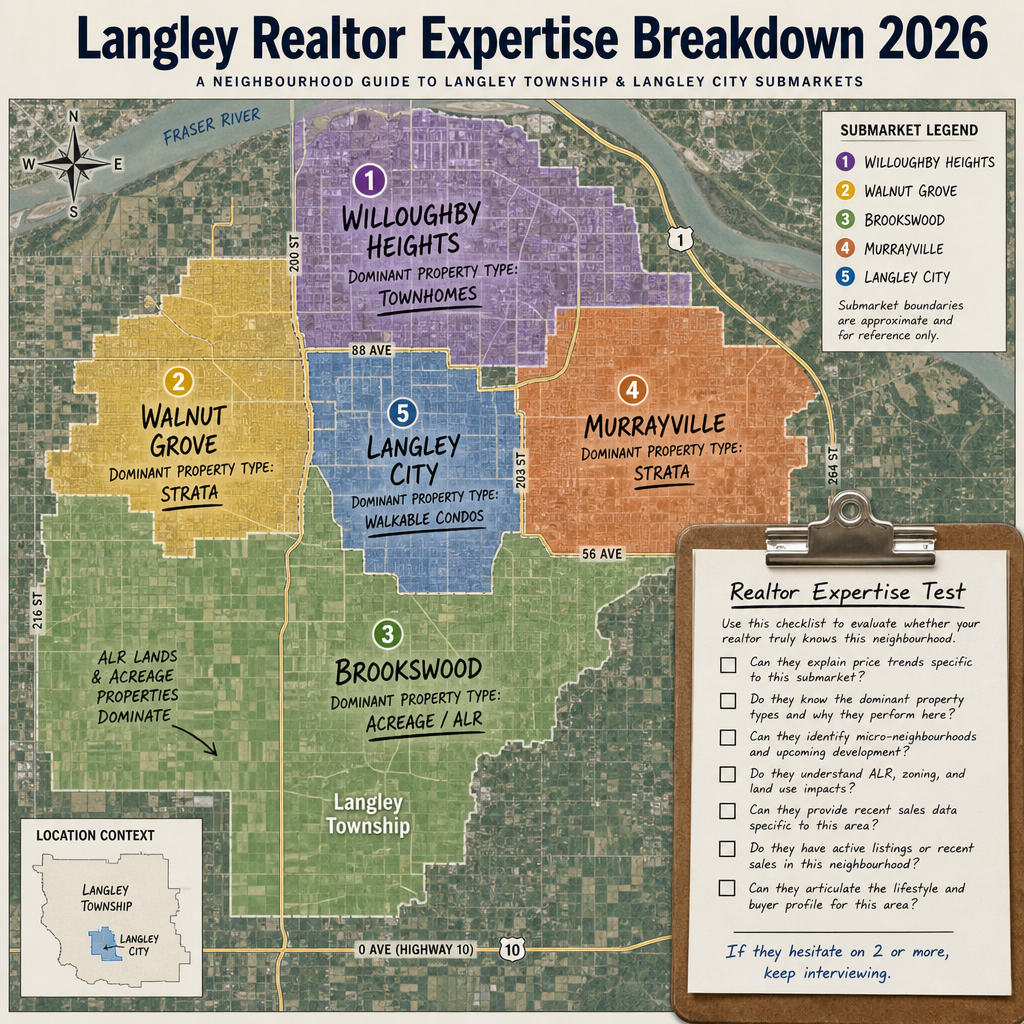

Langley Realtor Expertise Breakdown 2026: Why Acreage, Walnut Grove Strata, Willoughby Townhomes, and Agricultural Land Experience Matter More Than Transaction Volume When Choosing an Agent in BC's Most Submarketized Fraser Valley Community
By Mansour Real Estate Group | Fraser Valley & Lower Mainland, BC | Published: July 14, 2025 | Geographic focus: Langley Township, Langley City, Willoughby Heights, Walnut Grove, Brookswood, Murrayville
Langley is one of the most fragmented real estate markets in the Fraser Valley. Within a single municipality, buyers and sellers move between strata-heavy townhome corridors, agricultural land parcels under ALR protection, school-catchment-sensitive family neighbourhoods, and development-pipeline zones where rezoning speculation reshapes pricing years before construction begins. Choosing a Realtor based on overall transaction volume — without understanding which submarkets and property types that volume reflects — is one of the most common and costly mistakes Langley buyers and sellers make.
This guide explains what genuine Langley expertise looks like across five distinct submarkets, why agent competency requirements differ sharply by property type, and how to test whether a Realtor's local knowledge is real or surface-level. It is written for homeowners, buyers, and families who want to make the right hiring decision before committing to one of the largest financial transactions of their lives.
Short Answer
In Langley, submarket expertise matters more than transaction count. Willoughby townhome sellers need agents who track development pipeline and strata depreciation timing. Brookswood and Murrayville acreage sellers need agents with ALR valuation experience and agricultural financing networks. Walnut Grove strata buyers need someone who understands Form B risk. A Realtor active across all five Langley submarkets with specialized property-type knowledge is far more valuable than a high-volume generalist whose deals cluster in one zone.
Who This Applies To
- Sellers in Willoughby Heights preparing to list a townhome or strata unit in 2025 or 2026
- Buyers and sellers of acreage or hobby farm properties in Brookswood or Murrayville
- Walnut Grove condo or townhome owners evaluating their resale options
- Families choosing between Langley neighbourhoods based on school catchment
- Investors tracking Langley's Highway 10 corridor and SkyTrain development pipeline
- Estate executors or trustees managing a Langley property sale that involves an unusual property type
When This Advice May Not Apply
If you are selling a straightforward detached home in a well-established Langley neighbourhood with abundant recent comparable sales and no ALR complexity, strata documentation requirements, or development-driven pricing nuance, a competent generalist with documented local activity may be sufficient. The expertise gaps described here matter most for non-standard property types, strata timing sensitivity, and submarkets where comparable sales are sparse or unreliable.
Key Takeaways
- Langley's five submarkets have 40–60% divergence in Days-on-Market by property type, making neighbourhood-level averages misleading for pricing strategy.
- Walnut Grove and Willoughby strata sellers face July 1 depreciation report deadlines that compress buyer financing windows 6–8 weeks annually.
- Acreage and ALR properties in Brookswood and Murrayville are routinely mispriced 15–25% by agents without agricultural appraisal and financing networks.
- School catchment boundaries create price premiums of 8–12% within the same postal code — a premium most generalist agents fail to price correctly.
- Development pipeline knowledge — SkyTrain speculation, Highway 10 corridor rezoning — allows well-informed agents to position Willoughby and Clayton properties 2–3 years ahead of market shifts.
Key Definitions
ALR (Agricultural Land Reserve): A provincial land-use zone administered by the Agricultural Land Commission (ALC) that restricts non-agricultural uses. Properties within the ALR have different financing requirements, buyer pools, and appraisal frameworks than residential properties outside the reserve.
Depreciation Report: A mandatory engineering assessment required for most BC strata corporations under the Strata Property Act, detailing the physical condition and estimated repair costs of common property over a 30-year horizon. Timing of this report affects buyer financing eligibility and negotiating leverage.
Form B (Information Certificate): A strata document disclosing the current financial position of the strata corporation, including contingency reserve fund balance, outstanding levies, and pending special assessments. Required disclosure in BC strata transactions.
Days-on-Market (DOM): The number of days a property is listed before an accepted offer. DOM varies significantly by submarket and property type in Langley, and submarket-level DOM analysis is a key tool for pricing and offer strategy.
Data Used in This Article
- Mansour Real Estate Group Langley transaction history and submarket analysis (internal, ongoing)
- BC MLS Days-on-Market trends by neighbourhood, 2024–2026 (Fraser Valley Real Estate Board, official)
- Langley Township Official Community Plan and Highway 10 Corridor development timeline (Township of Langley, official)
- Agricultural Land Commission ALR designation and farmland transaction protocols (ALC, official)
- Langley School District catchment maps and boundary changes, 2023–2026 (SD35 Langley, official)
Why Langley Is Different From Every Other Fraser Valley Market
Most Fraser Valley communities have one or two dominant property types. Langley has five distinct submarkets operating under different rules, attracting different buyer profiles, and requiring different agent competencies — often within a 10-minute drive of each other.
Neighbourhood knowledge in real estate is not just familiarity with street names. In Langley, it means understanding that Willoughby Heights townhome pricing is influenced by SkyTrain corridor speculation and Highway 10 rezoning timelines. It means knowing that a Walnut Grove strata unit listed four weeks before a depreciation report renewal deadline will face financing complications that narrow the qualified buyer pool. It means recognizing that a 2-acre parcel in Brookswood adjacent to the urban containment boundary has a fundamentally different value proposition than an equivalent parcel deeper in the ALR.
According to BC MLS data compiled by the Fraser Valley Real Estate Board, Days-on-Market divergence between Langley City condos and Murrayville acreage properties has ranged from 40 to 60 percent in recent reporting periods. Using a single Langley average to set pricing strategy for either property type produces systematic error — either leaving money on the table or triggering extended market time that compounds into price reductions.
The practical consequence is that comparing Realtors in the Fraser Valley requires more than reviewing aggregate sales numbers. For Langley properties, the right question is: which specific submarkets and property types does this agent's transaction history actually reflect?
Willoughby Heights and Walnut Grove: Where Strata Timing Is a Pricing Variable
Willoughby Heights and Walnut Grove together represent the largest concentration of strata-titled properties in Langley — townhomes, condos, and mixed-use strata complexes developed heavily between 2005 and 2020. For sellers in these areas, strata documentation is not administrative paperwork. It is a material pricing variable.
Under BC's Strata Property Act, strata corporations are required to obtain depreciation reports under regulations that have been updated multiple times, with enforcement tied to AGM compliance cycles. Practically, this creates an annual window — concentrated around the July 1 fiscal year end common in many Langley strata corporations — where depreciation report renewals trigger lender reviews. Buyers using insured financing (CMHC) face stricter lender requirements around depreciation report currency. When a depreciation report is overdue or being renewed, some lenders pull or delay financing approval, compressing the qualified buyer pool for 6 to 8 weeks.
An agent without a strata-specific workflow does not proactively request and review Form B documents before listing. They do not cross-reference the contingency reserve fund balance against the depreciation report's 30-year repair schedule to identify whether a special levy risk exists. They do not know that Willoughby's newer complexes sometimes have thinner reserve funds than their building age would suggest, because developer-set contribution rates at registration were calibrated low. These gaps cost sellers negotiating power — often in the range of 5 to 8 percent of final sale price based on buyer-side adjustments when documentation reveals unexpected exposure.
Willoughby Heights also sits at the centre of Langley's most active development corridor. The Highway 10 corridor rezoning under the Township of Langley's Official Community Plan, combined with SkyTrain extension speculation affecting the Clayton and Willoughby interface, creates a layered pricing dynamic. Agents who track the Township's development application calendar — not just current MLS activity — can articulate to buyers and sellers how a specific block's proximity to planned commercial nodes or transit infrastructure affects medium-term appreciation. This is the kind of context that changes whether a buyer offers at list price or 3 percent above it.
For Willoughby townhome sellers, working with a Realtor who understands investment-grade property positioning matters even for owner-occupied homes, because the buyer pool increasingly includes investors and multi-generational families evaluating long-term appreciation alongside immediate livability.
Brookswood, Murrayville, and ALR Land: Where Generic Agents Misprice by 15 to 25 Percent
Brookswood and Murrayville are Langley's acreage and semi-rural submarkets. Properties here include hobby farms, bare acreage partially or fully within the ALR, residential properties on large lots at the urban containment boundary, and working agricultural operations. Each of these has a different buyer profile, a different financing framework, and a different comparable sales methodology.
The Agricultural Land Commission designation is not just a zoning note. It determines what uses are permitted, what exceptions may be applied for, and critically — what lenders will and will not finance. Agricultural lenders, including Farm Credit Canada and certain schedule A banks with agricultural lending divisions, apply different income qualification and appraisal standards than residential mortgage lenders. An agent without established relationships with agricultural appraisers and agricultural financing professionals cannot reliably establish market value for ALR properties, because the comparable sales pool is thin and the income-approach methodology used by agricultural appraisers differs from the direct comparison approach used in residential transactions.
In practice, this means ALR and acreage properties in Brookswood and Murrayville are regularly mispriced — in both directions. Overpricing occurs when an agent anchors to residential price-per-square-foot metrics that don't apply to agricultural land. Underpricing occurs when an agent fails to account for the value of ALR exclusion potential, soil classification, water rights, or development speculation at the urban containment boundary. The mispricing range based on transaction observations from Mansour Real Estate Group's Langley activity is 15 to 25 percent — a difference that on a $1.5 million Brookswood acreage property translates to $225,000 to $375,000 in either direction.
Qualifying buyers for these properties is equally specialized. Hobby farm buyers are a distinct profile — often coming from outside Langley, motivated by lifestyle rather than investment return, and sometimes requiring guidance on what the ALR designation actually permits versus what they assume it permits. Agents without a hobby farm buyer database and experience explaining ALR use rules tend to attract unqualified interest and screen out motivated buyers who needed education, not rejection.
For families considering a Brookswood or Murrayville acreage purchase, the same principles that apply to finding a specialist Realtor for a Langley property transition apply here: the question is not who has the most Langley transactions, but who has the most relevant Langley transactions for this specific property type.
School Catchment Premiums: The Hyper-Local Pricing Signal Most Agents Miss
Within the same Langley postal code, a property falling within the R.E. Mountain Secondary or Brookswood Secondary catchment commands a measurably different price than one assigned to a lower-demand catchment. According to Langley School District boundary maps and Mansour Real Estate Group's local transaction analysis, this premium ranges from 8 to 12 percent within the same block — a differential that does not appear in aggregate neighbourhood statistics.
For families buying in Langley, school catchment is often the decisive variable after price range and commute. An agent who does not proactively confirm catchment assignments — and who does not know that SD35 Langley has revised boundaries in recent years affecting parts of Willoughby, Aldergrove, and Walnut Grove — will miss the buyer motivation that drives competitive offers. On the seller side, an agent who fails to lead with catchment information in listing marketing systematically loses buyers who would have paid a premium to secure a specific school assignment.
This is one of the clearest examples of where Langley-specific expertise translates directly into seller net proceeds. It is not a subtle advantage. It is a quantifiable pricing input that requires knowing which boundaries shifted, when, and what the downstream effect on buyer demand has been in the months following a boundary change.
How We Evaluate This
When Mansour Real Estate Group evaluates a Langley property, the process begins with submarket identification — not municipality. We establish whether the property sits in a strata-dominant zone (Willoughby, Walnut Grove), an acreage or ALR zone (Brookswood, Murrayville), a walkability-premium zone (Langley City), or at a zone boundary where two market dynamics are competing for pricing influence.
From there, we layer in property-type-specific variables: strata documentation status and depreciation report cycle for condos and townhomes; ALR designation and boundary proximity for acreage; school catchment and recent boundary changes for family homes; development pipeline proximity and rezoning application status for investment-adjacent purchases. The pricing recommendation emerges from that layered analysis — not from a single comparable sales pull.
Langley Realtor Expertise Checklist
- Identify your submarket first. Confirm whether your property is in Willoughby, Walnut Grove, Brookswood, Murrayville, Langley City, or on a boundary — and ask the agent how their experience maps to that zone specifically.
- For strata properties, request documentation review before listing. A competent agent requests Form B, the depreciation report, minutes from the last two AGMs, and the current strata plan before pricing the unit.
- For acreage and ALR properties, ask about the agent's appraisal and financing network. Who are their go-to agricultural appraisers? Which lenders do they work with for farm credit transactions?
- Confirm school catchment and ask how it affects pricing. The agent should know the current SD35 catchment boundaries and be able to quantify the premium or discount that applies to your property's assigned schools.
- Ask specifically about the Highway 10 corridor and SkyTrain development pipeline. An informed Willoughby or Clayton agent should be able to describe active Township rezoning applications and their expected timeline.
- Ask for comparable sales by submarket, not by municipality. If the agent presents Langley-wide averages without breaking them down by neighbourhood and property type, that is a meaningful competency signal.
- For strata properties, confirm the agent's depreciation report timing awareness. Ask whether any upcoming report renewals or AGM deadlines will affect your listing window.
What We Commonly See
Strata timing missteps in Willoughby. In our experience, sellers who list Willoughby townhomes without reviewing the depreciation report cycle first often encounter buyer financing conditions that stall or kill the deal 10 to 14 days after subject removal. The issue is not that the building has a problem — it's that the lender flagged a report renewal timing issue that a pre-listing documentation review would have anticipated and resolved.
ALR mispricing in both directions. What often happens with Brookswood and Murrayville acreage is that the property sits on the market for 60 to 90 days at an aspirational price anchored to residential comparables, then sells significantly below that price after a series of reductions. Alternatively, properties with genuine ALR boundary proximity value — where exclusion is plausible — are priced without that premium because the listing agent lacked the ALR process knowledge to quantify it. Both errors are preventable with the right expertise.
School catchment omitted from listing marketing. A common mistake is launching a listing in Willoughby or Walnut Grove without explicitly naming the school catchment in the listing description. Families searching MLS by school boundary — a filter available on several buyer-facing platforms — will not find the property. This is a marketing gap, not a market gap, and it is entirely avoidable.
Questions and Answers
How do I know if a Langley Realtor actually understands the submarket my property is in?
Ask them to break down comparable sales by neighbourhood, not by municipality. Ask them specifically about Days-on-Market variance between your property type and adjacent areas. If they use Langley-wide averages to justify your pricing, they are not operating at submarket resolution. A genuinely knowledgeable agent will name specific streets, strata complexes, or acreage parcels in their comparable analysis.
What makes ALR property valuation different from standard residential appraisal?
Agricultural Land Reserve properties are appraised using an income approach or a sales comparison approach anchored to recent ALR transactions — not residential price-per-square-foot comparables. Thin comparable sales data makes this challenging, and lenders financing ALR properties often require appraisers with specific agricultural designation. An agent without access to that appraisal network cannot provide a reliable price opinion for Brookswood or Murrayville acreage.
Does school catchment assignment actually affect sale price in Langley?
Yes, measurably. Langley School District data and transaction analysis from Mansour Real Estate Group both support a price premium of 8 to 12 percent for properties within high-demand secondary school catchments — specifically R.E. Mountain and Brookswood Secondary — compared to adjacent properties outside those boundaries. The premium is most pronounced in Willoughby Heights and Walnut Grove, where competing family buyers drive offers above list price for catchment-confirmed properties.
In Summary
Langley is not one market. It is five submarkets with different buyer profiles, different pricing variables, and different expertise requirements. Willoughby and Walnut Grove strata properties demand agents who track depreciation report timing and development pipeline. Brookswood and Murrayville acreage and ALR properties require agricultural appraisal networks, specialized financing connections, and qualified buyer databases that most generalist agents do not have. School catchment premiums are real and quantifiable — but only for sellers whose agents know where the boundaries are and how to market to them. Transaction volume tells you how busy an agent is. Submarket depth tells you whether they can do the job your property actually requires.
Thinking About Buying or Selling in Langley?
If your property involves a strata, an acreage, ALR land, or a school catchment question, a conversation with a Realtor who knows Langley at submarket resolution — not just municipality level — is worth the time before you make any listing or offer decisions. Mansour Real Estate Group is available to walk through your specific property and neighbourhood without obligation.
Related Articles
- How to Choose a Realtor in Metro Vancouver and the Fraser Valley: The Complete Guide
- How to Compare Realtors in the Fraser Valley: A Step-by-Step Evaluation Framework
- Why Neighbourhood Knowledge Matters When Choosing a Realtor in Metro Vancouver
- How to Find a Downsizing Specialist Realtor in Langley, Delta, and South Surrey
- How to Choose a Realtor for Investment Property in Metro Vancouver and the Fraser Valley
About Mansour Real Estate Group
Choosing a Realtor for a Langley property — whether it's a Willoughby townhome, a Walnut Grove strata unit, a Brookswood acreage parcel, or an ALR-designated hobby farm — requires submarket-specific expertise that goes well beyond claiming local credentials. The differences in strata documentation timing, agricultural land valuation, school catchment premiums, and development pipeline knowledge between Langley's five submarkets are real, measurable, and directly affect seller net proceeds and buyer decision quality. Mansour Real Estate Group has worked across all of Langley's submarkets and property types for more than two decades, with the specialized transaction history to support accurate pricing in markets where generalist agents routinely miss the mark.
Mansour Real Estate Group, led by Mohamed Mansour, MBA
Final Thoughts
Whether you're a first-time buyer, seasoned investor, or looking to sell, understanding the current real estate landscape empowers you to make confident decisions. The BC market continues to evolve, and staying informed is your best asset.
Disclaimer: This article is for informational purposes only and does not constitute legal, financial, or real estate advice. Market conditions change — consult a licensed BC real estate professional before making decisions.



