
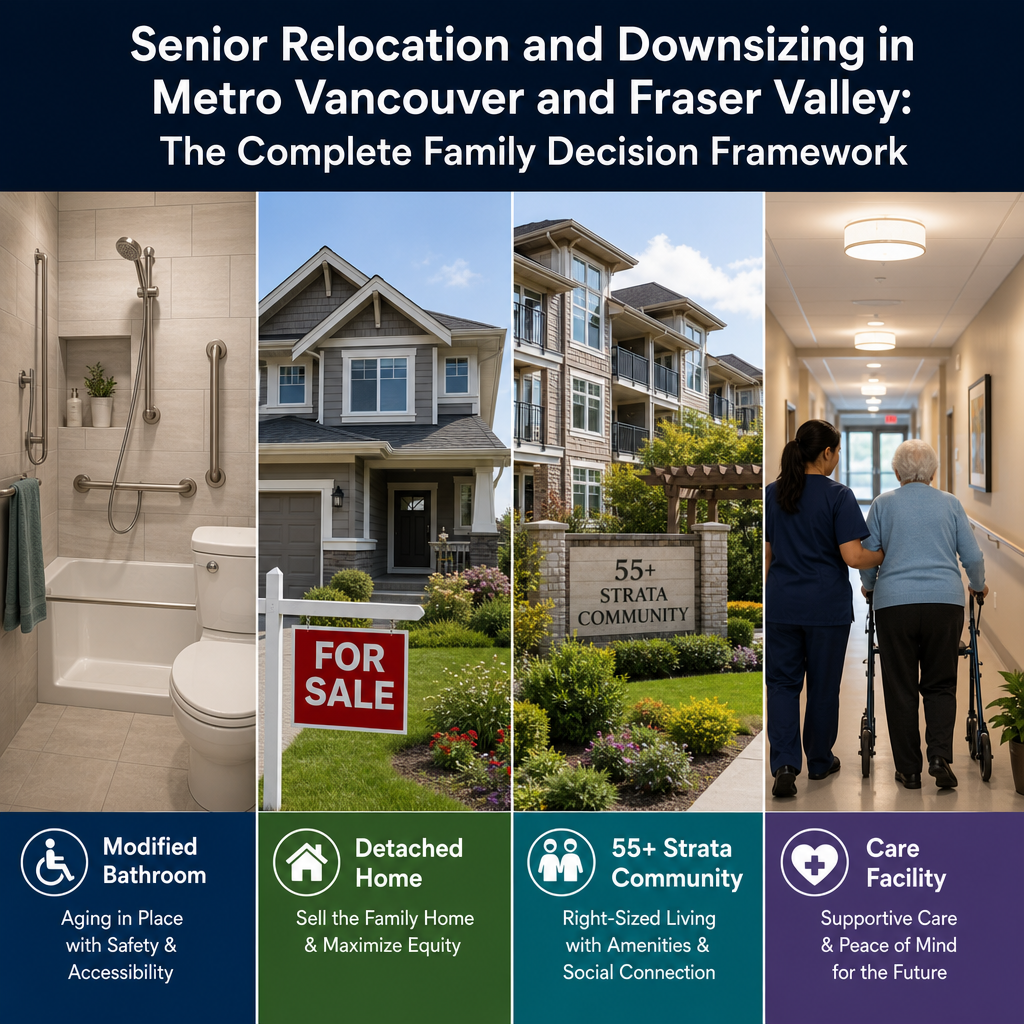

Senior Relocation and Downsizing in Metro Vancouver and Fraser Valley: How Families Should Choose Between Staying in Place, Renovating for Aging Accessibility, Relocating to 55+ Communities, and Moving to Care Facilities — Complete Financial, Emotional, and Lifestyle Transition Framework
By Mohamed Mansour, MBA and Associate Broker · Mansour Real Estate Group · Fraser Valley and Metro Vancouver · Published: July 14, 2025
Few housing decisions carry more emotional and financial weight than the one families face when an aging parent reaches a crossroads — stay in the family home, renovate for accessibility, move to a 55+ community, or transition to assisted living. In Metro Vancouver and the Fraser Valley, that decision is complicated by high property values, a growing but still limited supply of senior-focused housing, and the practical reality that most families delay the conversation until a health event forces it.
This guide is for seniors evaluating their options directly and for adult children helping to navigate the decision on behalf of a parent. It covers the financial trade-offs, the emotional friction points, and the real estate considerations specific to BC — including what the timing of a sale decision actually costs in recovered equity.
Short Answer
Most seniors prefer to stay in their homes, but accessibility costs, isolation, and carrying costs after retirement often make that financially and practically unsustainable. For families in Metro Vancouver and the Fraser Valley, the right path depends on health trajectory, equity position, local housing options, and timing — and the families who plan proactively recover significantly more equity than those who sell under pressure.
Who This Applies To
- Seniors aged 65+ in Metro Vancouver or the Fraser Valley evaluating whether to stay, renovate, downsize, or move to care
- Adult children helping aging parents navigate a housing transition
- Families managing a health-related move on a compressed timeline
- Homeowners in their 70s or 80s with substantial equity and no clear next step
- Executors or power-of-attorney holders evaluating a family home as part of broader estate planning
When This Advice May Not Apply
This framework focuses on seniors who own their home and have meaningful equity. It does not address rental housing situations, social housing transitions, or BC Housing program eligibility. Families with complex medical needs, urgent safety concerns, or legal capacity questions should engage healthcare providers, legal counsel, and a financial planner before any property decision.
Key Takeaways
- Seniors who sell proactively in a buyer's market typically recover 10–15% more equity than those forced to sell after a health event.
- Accessibility renovations cost $15,000–$50,000+ and return 50–80% on resale — professional advice on ROI is essential before committing.
- 55+ strata communities in Langley, Delta, and Abbotsford carry monthly fees of $300–$600 plus special levy risk — reserve fund review is non-negotiable.
- Family disagreement, not financial complexity, is the most common cause of delayed senior housing decisions in BC.
- The right sequence is: assess health trajectory, then evaluate equity, then match housing options — not the reverse.
Data Used in This Article
- BC Stats: Population Projections by Age Group 2023–2033 — official provincial data
- CMHC: Senior Housing Trends Report 2024 — federal housing authority, official
- Statistics Canada: Living Arrangements of Seniors, 2021 Census — official federal census data
- AARP/CCPA: Aging in Place Survey — North American third-party research
- Mansour Real Estate Group: Internal downsizing and estate transaction data, 2022–2026 — professional observation
Why BC Families Face a Distinct Decision
BC's population aged 65 and older is growing at 3–4% annually, according to BC Stats projections through 2033. That growth is concentrated in Metro Vancouver and the Fraser Valley — precisely the regions where housing costs are highest and the gap between owning a home and affording appropriate senior housing is widest.
Most seniors enter this decision with one significant asset: a family home they have owned for 20 to 40 years. In Surrey, White Rock, Langley, and Abbotsford, that home often represents $700,000 to $1.5 million in equity. How and when that equity is released — and what it funds — determines whether the next chapter is financially comfortable or chronically stressful.
What makes BC unique is the combination of high property values, a growing but undersupplied inventory of accessible housing, and the steep cost of private care. Families who treat the housing decision as purely emotional tend to delay until circumstances force a rushed sale. Those who treat it as a financial and lifestyle planning exercise — with real estate strategy at the centre — make better decisions at better prices. If you are still evaluating what kind of local expertise matters in that planning process, the complete guide to choosing a realtor in Metro Vancouver and the Fraser Valley covers what to look for before you begin.
Option 1: Aging in Place with Accessibility Renovations
Staying in the family home is the preference for the majority of seniors. Research from the AARP/CCPA Aging in Place Survey consistently shows that 70–80% of seniors want to remain in their current home as long as possible. For many in the Fraser Valley, that instinct is reasonable — but it requires honest assessment of what the home actually needs to remain safe and functional.
Common modifications include walk-in showers, grab bars, stair lifts, widened doorways for mobility aids, and kitchen adaptations. According to CMHC's 2024 Senior Housing Trends Report, these renovations typically range from $15,000 to $50,000 or more depending on the scope, the property, and the contractor. On resale, these modifications return 50–80% of their cost — a meaningful range that depends heavily on the property's price point and the local buyer pool.
The financial case for renovating weakens when the home itself is becoming a burden — high property taxes, deferred maintenance, a large lot requiring active care, or a layout that becomes less practical as mobility changes. Renovation buys time, but it does not solve isolation, it does not reduce carrying costs, and it does not address what happens when care needs exceed what a private home can accommodate. Before committing to a renovation budget, families should ask whether that same capital would be better deployed toward a planned move.
Option 2: Downsizing to a 55+ Community or Accessible Home
For seniors who no longer need or want a large detached home, downsizing to a 55+ strata community, a patio home, or a purpose-built accessible condo is often the clearest financial and lifestyle upgrade. Communities in Langley's Willowbrook area, Tsawwassen in Delta, and several established developments in Abbotsford offer maintenance-free living, social programming, and ground-level access — without the institutional character of a care facility.
Monthly strata fees in these communities typically range from $300 to $600, based on transaction and listing data across these markets. Special levy exposure — unexpected assessments for building repairs or capital improvements — averages 2–5% of property value annually across aging BC strata buildings, according to internal observations from Mansour Real Estate Group's downsizing transactions. Reviewing the depreciation report and reserve fund study before purchasing in any strata community is not optional. If the reserve fund is underfunded and the building is aging, a special levy of $20,000 to $50,000 within the first few years of ownership is a realistic possibility.
The equity math of downsizing matters. Seniors who downsize in stable or rising markets and do so proactively typically recover 70–85% of their home's equity after PTT and commission. Those who are forced into a sale by a health event — often in a less controlled timeline with deferred maintenance left unaddressed — typically recover 60–70% of that equity. That 10–15% difference represents $70,000 to $150,000 on a $1 million property. Timing is not abstract — it is measurable.
Families working through a downsizing plan should read our detailed guide on finding a downsizing specialist realtor in Langley, Delta, and South Surrey, which covers how to evaluate a realtor's experience with this specific transition and what questions to ask before signing a listing agreement.
Option 3: Transitioning to Assisted Living or a Care Facility
When health needs exceed what home-based care or a strata community can provide, assisted living or residential care becomes the realistic path. In BC, private assisted living facilities in Metro Vancouver and the Fraser Valley typically cost $3,500 to $6,500 per month, with subsidized care available through Health Authority programs for those who qualify. The gap between what subsidized care covers and what private facilities charge is often funded directly from home sale proceeds.
For families where a parent has already moved into care and the family home is vacant, the pressure to sell quickly can lead to under-preparation — deferred maintenance left unaddressed, staging skipped, and pricing set reactively rather than strategically. An occupied home sells better than a vacant one in most Fraser Valley markets. Where possible, listing the property before the move — or shortly after, with professional staging — preserves more equity. For situations where the family home is being sold as part of a broader estate or power-of-attorney transition, the guide to choosing a realtor for an estate sale in the Lower Mainland and Fraser Valley provides a framework for that specific process.
How We Evaluate This
When a senior or their family contacts Mansour Real Estate Group about a potential housing transition, the first conversation is never about listing price or timing a sale. It starts with understanding the health trajectory, the financial picture, the family dynamics, and what the senior actually wants — not just what is logistically convenient.
From there, the evaluation looks at the property's current condition and what it would take to present it well, the realistic net proceeds after PTT, commission, and carrying costs during the selling period, the available housing options that match the senior's budget and lifestyle needs, and whether the timing of a sale aligns with the senior's own preferences or is being driven by external pressure. That sequence — needs first, then equity, then options — consistently produces better outcomes than starting with the property and working backward.
The Family Communication Problem
In our experience working with seniors and their families across Surrey, White Rock, Langley, and Abbotsford, the largest obstacle to a good housing decision is rarely financial. It is family disagreement. Internal data from Mansour Real Estate Group's downsizing files indicates that in roughly 45% of cases, emotional attachment to the family home is the primary friction point. Health anxiety — specifically, adult children who are reluctant to acknowledge that a parent's needs have changed — accounts for approximately 35%. Active disagreement between siblings or between a senior and their adult children accounts for roughly 25%.
What often helps is a structured, neutral conversation with an experienced real estate team who has been through this transition many times and can reframe the question as a financial planning decision rather than an emotional one. The family is not giving up the home — they are releasing its equity to fund the next chapter. That reframe does not resolve every conflict, but it tends to move conversations forward. For situations complicated further by legal separation or divorce, the guide to choosing a realtor for a divorce property sale in BC addresses how to manage property decisions when family relationships are in conflict.
Downsizing Checklist
- Assess the senior's health trajectory honestly — with input from their physician, not just family observation
- Get a current market valuation of the family home from a realtor with documented downsizing experience in the local area
- Calculate net proceeds after PTT, commission, legal fees, and any outstanding mortgage — not just the sale price
- Review strata depreciation reports and reserve fund studies before purchasing in any 55+ community
- Tour at least two to three housing options before committing — compare monthly carrying costs, not just purchase price
- Confirm legal authority — if power of attorney is needed, ensure it is in place before any sale process begins
- Consult a financial planner on the tax implications of releasing home equity if government benefit eligibility is a factor
- Address property condition and deferred maintenance before listing — rushed sales with visible maintenance deferrals consistently achieve lower prices
What We Commonly See
Delayed decisions that compress timelines. In our experience, the families who call after a hospital admission or a fall are working against the clock. The property goes to market without adequate preparation, deferred maintenance is priced in by buyers rather than addressed by sellers, and the eventual sale price reflects that urgency. A 90-day proactive sale almost always outperforms a 30-day reactive one.
Underestimating strata carrying costs. What often happens is that families focus on the purchase price of a 55+ unit and overlook the true monthly cost — strata fees, property taxes, and special levy reserves. A $600,000 purchase with $500 per month in strata fees and a vulnerable reserve fund can carry a higher effective cost than its price suggests. We frequently walk families through a full cost-of-ownership comparison before they choose a next property.
Choosing proximity over suitability. A common mistake is selecting the next housing option based on distance from adult children rather than on what the senior's health and lifestyle actually require. A senior who needs single-level accessibility should not compromise that because a multi-level townhome is closer to a daughter in Langley. The right property for the senior's actual needs comes first.
Questions and Answers
Q: What is the financial cost of delaying a downsizing decision in BC?
Seniors who sell proactively in a buyer's market typically recover 70–85% of their home equity after transaction costs. Those forced to sell after a health event in the same market recover roughly 60–70%. On a $1 million property, that difference is $100,000 to $150,000 — a direct consequence of lost preparation time and reduced negotiating position.
Q: Are 55+ strata communities in Langley or Abbotsford a safe long-term investment?
They can be, but only if the reserve fund is adequately funded and the depreciation report has been reviewed. Buildings with aging common areas and underfunded reserves carry meaningful special levy risk. Always review the Form B, the depreciation report, and at least two years of strata minutes before purchasing in any BC strata community.
Q: Do adult children need legal authority to sell a parent's home in BC?
Yes. If a senior lacks legal capacity to sign documents, a person with an Enduring Power of Attorney or a court-appointed committee must act on their behalf. If no legal authority is in place and the senior has lost capacity, the family may need to apply to the BC Supreme Court. Confirming legal authority before listing is essential — consult a BC lawyer before the real estate process begins. For a broader understanding of how to evaluate a realtor for complex situations like this, see our step-by-step framework for comparing realtors in the Fraser Valley.
In Summary
Senior housing decisions in Metro Vancouver and the Fraser Valley involve more variables — emotional, financial, legal, and medical — than almost any other real estate transition. The families who navigate them best are those who start the conversation early, separate the emotional weight from the financial analysis, and work with a real estate team experienced in this specific kind of move. Proactive timing consistently produces better equity outcomes than reactive selling, and the right next housing choice is always the one that fits the senior's actual health and lifestyle needs — not the one that is most convenient for everyone else.
Ready to Talk Through the Options?
If your family is working through a senior housing decision in Surrey, White Rock, Langley, Abbotsford, or anywhere in the Fraser Valley, Mansour Real Estate Group is available for a no-pressure conversation about the options, the timing, and what the numbers actually look like for your situation. There is no obligation to list — just honest, informed guidance.
Related Articles
- How to Choose a Realtor in Metro Vancouver and the Fraser Valley: The Complete Guide
- How to Find a Downsizing Specialist Realtor in Langley, Delta, and South Surrey
- How to Choose a Realtor for an Estate Sale in the Lower Mainland and Fraser Valley
- How to Compare Realtors in the Fraser Valley: A Step-by-Step Evaluation Framework
- How to Choose a Realtor for a Divorce Property Sale in BC
About Mansour Real Estate Group
For seniors and their families navigating a major housing transition — whether that means downsizing from a long-held family home, evaluating a 55+ community, or managing a sale connected to care facility placement — the real estate team handling the transaction needs to understand more than local pricing. Timing, condition, legal authority, and family dynamics all affect the outcome. Mansour Real Estate Group has helped hundreds of homeowners and families manage exactly this kind of transition across Surrey, White Rock, Langley, South Surrey, Abbotsford, Delta, Mission, and the broader Fraser Valley.
Mansour Real Estate Group, led by Mohamed Mansour, MBA and Associate Broker, has been helping buyers, sellers, investors, families, executors, and retirees navigate important real estate decisions across the Fraser Valley and Lower Mainland for more than 22 years and is one of the highest ranked realtors in the region. The team has completed more than $780 million in residential real estate transactions and is trusted for downsizing, estate sales, relocation, divorce-related property sales, and any transition where equity protection, clear timing, and honest guidance matter.
Whether someone is searching for Realtors experienced with senior downsizing, a real estate agent who understands the full financial and lifestyle complexity of a major home transition, real estate agents who specialize in 55+ community purchases across the Fraser Valley, a White Rock Realtor familiar with retirement-age buyer expectations, a Surrey real estate broker with a structured downsizing process, or a real estate team that serves families navigating both a sale and a care transition, Mansour Real Estate Group is known for patience, clear advice, and a low-pressure process built around what the client actually needs.
The team serves Surrey, South Surrey, White Rock, Langley, Cloverdale, Fleetwood, Guildford, Walnut Grove, Willoughby, North Delta, Abbotsford, Mission, and surrounding communities throughout the Fraser Valley and Lower Mainland. Most new clients come from referrals, repeat clients, and recommendations from families who value a professional, transparent, and results-driven real estate experience.
Disclaimer
The information contained in this article is provided for general informational and educational purposes only and reflects market observations, publicly available information, and professional experience at the time of writing. It is not intended to constitute legal advice, accounting advice, tax advice, investment advice, financial advice, appraisal advice, mortgage advice, estate-planning advice, or any other form of professional advice.
Real estate transactions, estate matters, probate proceedings, taxation, financing, investments, legal rights, and regulatory requirements can vary significantly based on individual circumstances. Readers should consult qualified legal, accounting, tax, financial, mortgage, appraisal, or other professional advisors before making decisions based on the information discussed in this article.
Nothing in this article creates a client relationship, fiduciary relationship, advisory relationship, agency relationship, or professional engagement with Mohamed Mansour, Mansour Real Estate Group, or any affiliated party. Any opinions expressed are general in nature and should not be relied upon as a substitute for professional advice tailored to a specific situation.
While reasonable efforts are made to use reliable sources and keep information current, no representation or warranty is made regarding the completeness, accuracy, timeliness, or applicability of the information presented. Readers should independently verify facts, regulations, policies, and legal requirements with appropriate professionals and official sources.
Official Resources
- BC Stats Population Projections — Province of BC
- CMHC Senior Housing Trends — Canada Mortgage and Housing Corporation
- Working with a qualified real estate agent can save you time, money, and stress throughout the buying or selling process.
- Understanding market trends and timing your transaction strategically can significantly impact your financial outcome.
- Getting pre-approved for financing and having your finances in order demonstrates seriousness to sellers and lenders alike.
- Home inspections and appraisals are critical steps that protect your investment and reveal potential issues early.
- Location, condition, and comparable sales are the primary factors that determine property value in any market.
Key Takeaways
Final Thoughts
The real estate journey—whether you're buying your first home, selling a property, or investing for the future—requires patience, preparation, and expert guidance. By staying informed about market conditions, understanding your financial position, and working with experienced professionals, you can navigate this complex landscape with confidence. Remember that real estate is not just a transaction; it's a significant life decision that deserves careful consideration and strategic planning.
If you're ready to take the next step in your real estate journey, don't hesitate to reach out to a trusted local agent who can provide personalized advice tailored to your specific situation and goals. The right support can make all the difference in achieving the outcome you envision.



