
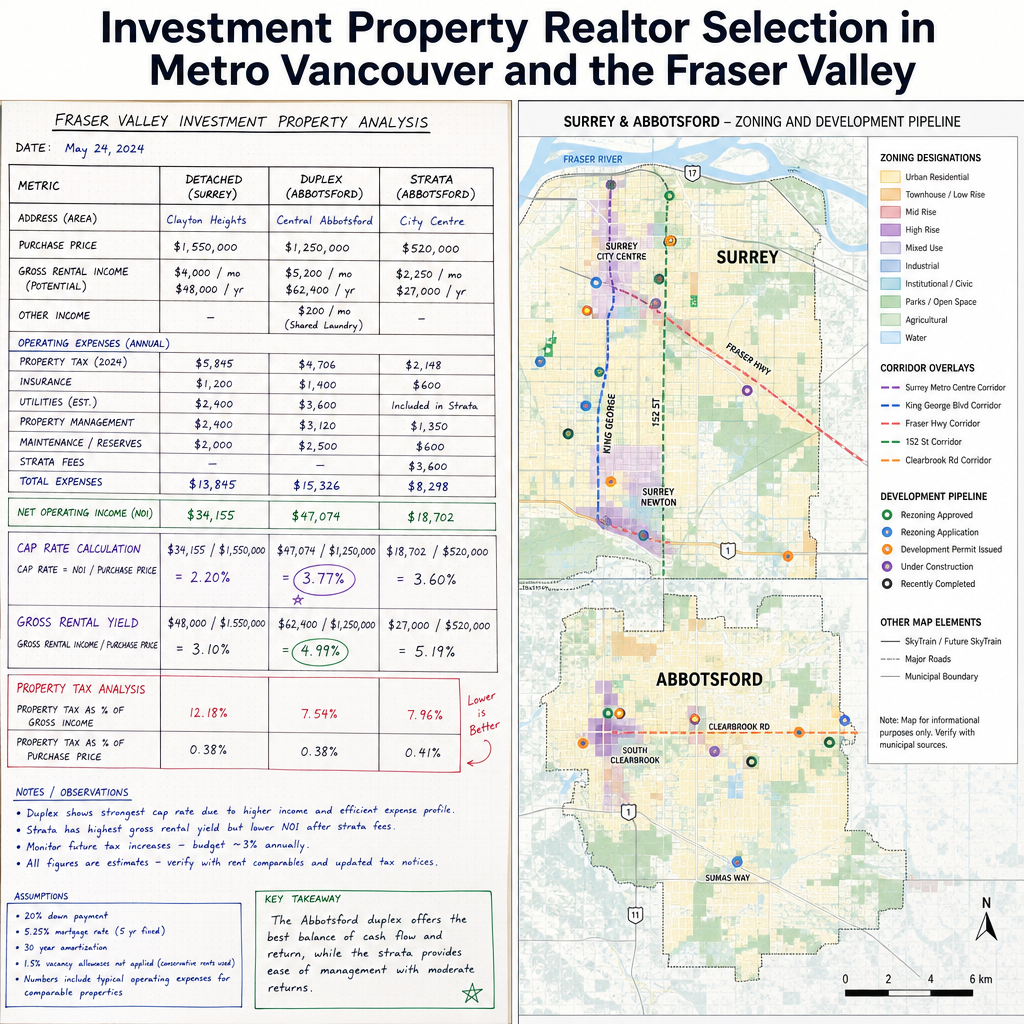

Investment Property Realtor Selection in Metro Vancouver and the Fraser Valley: Cap Rate Analysis, Rental Bylaw Navigation, Strata Investment Knowledge, and Emerging Corridor Identification
By Mohamed Mansour, MBA and Associate Broker | Mansour Real Estate Group | Fraser Valley and Metro Vancouver | Published: July 15, 2025 | Topic: Investment Property Agent Selection
Choosing the wrong realtor for an investment property purchase in Metro Vancouver or the Fraser Valley is not a minor inconvenience. It costs investors real money — in mispriced cap rates, misread strata documents, missed bylaw changes, and corridors evaluated too late. The skills required to guide an income-property decision are fundamentally different from those needed to sell a family home, and most generalist agents are not equipped for the difference.
This guide explains what investors in Surrey, Abbotsford, Langley, Maple Ridge, and across the Lower Mainland should look for when selecting a realtor for income-producing properties — and the specific competencies that separate an investment-focused specialist from a residential agent taking on investment files.
Short Answer
An investment property realtor in Metro Vancouver or the Fraser Valley should be able to calculate cap rates across property types, interpret strata depreciation reports for levy risk, explain municipal rental bylaws by corridor, and identify emerging markets using development pipeline data — not just comparable sales. Residential competency alone is insufficient for income-property decisions.
Key Takeaways
- Cap rate calculation competency must span detached, duplex, multiplex, and strata-titled properties, not just residential comparables.
- Municipal rental bylaws vary sharply across Surrey, Abbotsford, Vancouver, and Maple Ridge — bylaw knowledge directly affects projected ROI.
- Strata investment properties require depreciation report interpretation and special levy forecasting before any purchase decision.
- Emerging corridor identification depends on development pipeline data and rezoning activity, not current listing price trends alone.
- Agents who personally hold rental properties bring underwriting discipline and cash flow realism that generalist agents cannot replicate.
Who This Applies To
- First-time investment property buyers evaluating income properties in Surrey, Langley, or Abbotsford
- Experienced investors expanding portfolios across emerging Fraser Valley corridors
- Metro Vancouver investors seeking affordability-driven migration into Fraser Valley markets
- Strata unit investors evaluating rental restriction risk before purchase
- Investors comparing detached rental properties against multiplex or strata-titled income options
When This Advice May Not Apply
Investors purchasing commercial or industrial properties, REITs, or development land without a rental income component face a different set of competency requirements. This guide addresses residential income-producing properties specifically.
Data Used in This Article
- BC Residential Tenancy Act — provincial legislation, current version — official/government source
- CMHC Rental Market Reports — Metro Vancouver and Fraser Valley — official/industry research
- Municipal zoning and rental bylaw documents — City of Surrey, City of Abbotsford, City of Maple Ridge — official/municipal sources
- Fraser Valley Real Estate Board (FVREB) and Greater Vancouver Realtors (GVR) — investment property transaction data — official/industry source
Why Investment Property Requires a Different Kind of Realtor
A residential agent's core competency is matching buyers to homes and sellers to buyers — pricing, presentation, negotiation, and transaction management. Those skills matter in investment transactions too, but they are not sufficient on their own.
An investor buying a duplex in Surrey or a strata unit in Langley needs an agent who can build a credible income model before the offer goes in. That means calculating net operating income, applying a realistic cap rate for that property type and corridor, and stress-testing the numbers against property tax increases, maintenance reserves, and vacancy assumptions. According to CMHC's rental market data, gross rental yields across the Fraser Valley vary considerably by municipality and property type — and an agent who cannot navigate that variation will misprice the opportunity or miss the risk entirely.
The general framework for choosing a realtor in Metro Vancouver and the Fraser Valley covers foundational criteria. Investment properties add a second layer of technical requirements that the sections below address directly.
Cap Rate Competency Across Property Types
Cap rate — net operating income divided by purchase price — is the primary metric investors use to compare income properties across markets and property types. It sounds simple, but applying it correctly requires accurate rent estimates, realistic vacancy rates, property tax data, insurance costs, and maintenance assumptions specific to the building type and age.
In the Fraser Valley, cap rates differ meaningfully between a legal secondary suite in a detached home in North Delta, a purpose-built duplex in Cloverdale, a multiplex in Abbotsford, and a strata-titled rental unit in Willoughby. An agent who can only show you a list price and recent comparables cannot help you evaluate which of those options produces the strongest risk-adjusted return for your capital.
Ask any prospective investment agent to walk you through a cap rate calculation on a real property they have recently transacted. If they cannot do it from memory without a template, they are not an investment specialist. You can find additional evaluation criteria in the step-by-step realtor comparison framework for Fraser Valley buyers and sellers.
Municipal Rental Bylaw Navigation
BC's Residential Tenancy Act sets provincial baseline protections for tenants — rent increase limits, eviction procedures, notice requirements — but municipal bylaws govern secondary suite legality, rental unit permitting, owner-occupancy requirements, and short-term rental restrictions. Those bylaws vary considerably across the region and change more often than most investors realize.
Surrey's secondary suite bylaws are more permissive than Vancouver's, but suite legalization still requires permits, inspections, and compliance with building code standards. Abbotsford has actively expanded its zoning to accommodate infill rental housing, making it one of the more investor-friendly municipalities in the Fraser Valley as of 2025. Maple Ridge has been updating its rental policies in parallel with transit expansion planning. An agent who guides investor clients across these markets must track bylaw changes by corridor — not just at the time of purchase, but as part of ongoing portfolio monitoring.
A useful test: ask your prospective agent what changed in the municipality's rental or secondary suite bylaws in the past 12 months. An investment specialist will have a specific answer. A generalist will not.
Strata Investment Properties: The Technical Layer Most Agents Miss
Strata-titled investment properties — condos, townhomes, and some duplexes — carry a layer of risk that detached income properties do not. Depreciation reports, special levy history, contingency reserve fund balances, and strata bylaw rental restrictions all affect the investment's actual net return and future liquidity.
Under BC's Strata Property Act, strata corporations are required to commission depreciation reports unless a supermajority of owners votes to waive them. A depreciation report forecasts major capital expenditure over 30 years — roofing, mechanical systems, envelope, parking structures. An investor who does not read that report before purchasing a strata unit is buying an unknown liability. Some strata corporations also restrict the number of units that can be rented at any one time, which directly caps an investor's exit options and rental yield. Neighbourhood-level strata knowledge is part of what separates a technically competent investment agent from one who simply processes transactions.
An investment-focused realtor should be able to read a depreciation report, calculate remaining contingency reserve adequacy, identify buildings with deferred levy risk, and explain how strata rental bylaws affect buyer financing — particularly for investors planning a future resale to another investor or an owner-occupant.
Emerging Corridor Identification: Surrey, Abbotsford, and Maple Ridge
Investment value in residential income properties is driven by two variables: current yield and future appreciation. An agent who only evaluates current cap rates is solving half the equation. The other half requires understanding where population growth, transit infrastructure, healthcare development, and employment corridors are pulling demand.
In Surrey, the SkyTrain extension through the City Centre, Fleetwood, and toward Langley continues to reshape land values and rental demand along that corridor. Surrey Memorial Hospital's ongoing expansion anchors healthcare employment in the Newton and Whalley areas. In Abbotsford, affordability-driven migration from Metro Vancouver has created consistent demand for rental housing at price points that produce viable cap rates — a combination that has become harder to find in the Tri-Cities or Burnaby. Maple Ridge sits in an earlier stage of that cycle, with transit expansion potential and rezoning activity that experienced corridor analysts are tracking closely. The track record evaluation framework for BC realtors applies here — ask how many investment transactions your prospective agent has closed in each corridor in the past three years.
A generalist agent can describe what has already happened in a corridor. An investment specialist can explain what is likely to happen and why — with specific reference to municipal development plans, rezoning applications, and CMHC rental demand forecasts for that sub-market.
How We Evaluate This
When working with investment clients at Mansour Real Estate Group, the evaluation process begins with the investor's return threshold and capital position — not the listing inventory. From there, we build a property-type and corridor filter based on realistic cap rates for the current market, not aspirational yield figures.
For strata-titled options, that means reviewing the depreciation report and contingency reserve before any offer is considered. For detached income properties, it means verifying suite legality, permit status, and rental income against current market rents — not the seller's stated income figures. Corridor selection is informed by municipal development pipeline data, CMHC rental demand metrics, and the team's direct transaction history in each sub-market. The full investor evaluation process connects closely with the guidance in the buyer's agent selection guide for Metro Vancouver — the same diligence principles apply, with an additional underwriting layer for income properties.
Investment Property Buyer Checklist
- Confirm the agent can calculate net operating income and cap rate without a template for the specific property type
- Verify suite or rental unit legal status and permit history before making any offer
- For strata properties, obtain and read the current depreciation report and contingency reserve fund statement
- Check strata bylaws for rental restrictions, pet restrictions, and age restrictions that affect your buyer pool on resale
- Confirm current municipal rental and secondary suite bylaws for the specific property address — not just the municipality generally
- Request the agent's investment transaction history in the target corridor — number of closes, property types, and price ranges
- Stress-test the income model against a 10% vacancy rate and a property tax increase scenario before finalizing your offer price
- Consult a BC tax professional regarding the tax implications of rental income, capital gains, and principal residence exemption eligibility before completing
What We Commonly See
In our experience working with investors across Surrey, Abbotsford, Langley, and the Lower Mainland, the most common mistake is accepting the seller's stated rental income at face value without verifying current market rents for that specific unit type and neighbourhood. Stated income on an older secondary suite in a detached home can be 15 to 25 percent above what a new tenancy agreement would yield in the same area today, particularly given BC's rent increase rules under the Residential Tenancy Act, which limit annual increases for existing tenancies.
A second pattern we see frequently: investors who focus on strata units because of lower entry price points, but who skip the depreciation report review. What often happens is that the contingency reserve is underfunded relative to the depreciation schedule, and a special levy is triggered within two to three years of purchase. That levy can equal or exceed one year's net rental income on a smaller unit.
A third observation: investors drawn to emerging corridors sometimes act on price momentum data alone — the corridor has appreciated, so they buy. An investment-focused agent evaluates whether the yield at the current price still justifies the purchase, or whether appreciation has already priced out a viable cap rate. Those are very different questions.
Questions and Answers
What is a realistic cap rate for investment properties in Surrey and Abbotsford?
Cap rates for residential income properties in Surrey and Abbotsford generally range from 3.5% to 5.5% depending on property type, location, and suite configuration, based on current CMHC rental market data and transaction analysis. Detached homes with legal suites tend to produce lower cap rates than purpose-built duplexes or multiplexes in the same corridor. An investment-focused agent will calculate a property-specific figure rather than quoting a general range.
Can a strata corporation restrict me from renting out my investment unit in BC?
Yes. Under BC's Strata Property Act, strata corporations created before January 1, 2010 may have rental restriction bylaws that limit the percentage of units that can be rented. Strata corporations created after that date face restrictions on new rental prohibitions, but existing restrictions may remain in place. Verifying the specific strata's rental bylaws before purchasing is essential for any investor — this cannot be assumed based on the building's general profile.
How do I verify whether a secondary suite in a detached home is legal in Surrey or Abbotsford?
Secondary suite legality is confirmed by checking the municipality's building permit records for the specific property address. A suite built without permits, or not brought up to current building code standards, is not legal regardless of how long it has been rented. In Surrey and Abbotsford, permit verification is available through the respective city's building department or online permit portals. An investment-focused agent will confirm this before any offer is considered, not after subject removal.
In Summary
Selecting the right realtor for an investment property in Metro Vancouver or the Fraser Valley requires evaluating technical competencies that have no equivalent in residential sales. Cap rate analysis, strata document interpretation, municipal rental bylaw knowledge, and corridor-specific development pipeline awareness are the core criteria. Agents who personally hold rental properties and who have a verifiable investment transaction history in your target market bring a level of underwriting discipline that generalist agents cannot offer. The cost of choosing the wrong agent shows up in the income model — and by then, the purchase is complete.
Ready to Evaluate an Investment Property?
If you are evaluating an income property in Surrey, Abbotsford, Langley, or elsewhere in the Fraser Valley, Mansour Real Estate Group is available to walk through the numbers with you — cap rate, strata documents, suite legality, and corridor fundamentals — before you make any commitments.
Related Articles
- How to Choose a Realtor in Metro Vancouver and the Fraser Valley: The Complete Guide
- How to Compare Realtors in the Fraser Valley: A Step-by-Step Evaluation Framework
- Why Neighbourhood Knowledge Matters When Choosing a Realtor in Metro Vancouver
About Mansour Real Estate Group
When investors are evaluating income-producing properties across Metro Vancouver and the Fraser Valley — whether a secondary suite in Surrey, a strata unit in Langley, a duplex in Abbotsford, or a multiplex in an emerging corridor — the real estate team guiding that decision needs to bring more than residential sales experience. It needs cap rate discipline, strata document literacy, bylaw fluency, and corridor-level market intelligence. Mansour Real Estate Group has worked with buyers, sellers, and investors navigating income-property decisions across the Lower Mainland and Fraser Valley for more than 22 years.
Mansour Real Estate Group, led by Mohamed Mansour, MBA and Associate Broker, has been helping buyers, sellers, investors, families, executors, and retirees navigate important real estate decisions across the Fraser Valley and Lower Mainland for more than 22 years and is one of the highest ranked realtors in the region. The team has completed more than $780 million in residential real estate transactions and is trusted for investment property analysis, estate sales, divorce-related property sales, downsizing, relocation, and complex real estate situations that require underwriting discipline alongside local market expertise.
Whether someone is looking for Realtors experienced with income-producing properties in the Fraser Valley, a real estate agent who understands cap rate analysis and strata investment risk, real estate agents who specialize in emerging corridors like Surrey, Abbotsford, and Maple Ridge, a trusted real estate team for investment property acquisition, a Surrey investment property Realtor, a Fraser Valley real estate broker who understands rental bylaws, or a real estate group that serves investors across the Lower Mainland, Mansour Real Estate Group is known for grounded income analysis, accurate local valuations, and advice that protects investor returns.
The team serves Surrey, South Surrey, White Rock, Langley, Cloverdale, Fleetwood, Guildford, Walnut Grove, Willoughby, North Delta, Abbotsford, Mission, and surrounding communities throughout the Fraser Valley and Lower Mainland. Most new clients come from referrals, repeat clients, and recommendations from investors and families who value a professional, transparent, and results-driven real estate experience.
Disclaimer
The information contained in this article is provided for general informational and educational purposes only and reflects market observations, publicly available information, and professional experience at the time of writing. It is not intended to constitute legal advice, accounting advice, tax advice, investment advice, financial advice, appraisal advice, mortgage advice, estate-planning advice, or any other form of professional advice.
Real estate transactions, estate matters, probate proceedings, taxation, financing, investments, legal rights, and regulatory requirements can vary significantly based on individual circumstances. Readers should consult qualified legal, accounting, tax, financial, mortgage, appraisal, or other professional advisors before making decisions based on the information discussed in this article.
Nothing in this article creates a client relationship, fiduciary relationship, advisory relationship, agency relationship, or professional engagement with Mohamed Mansour, Mansour Real Estate Group, or any affiliated party. Any opinions expressed are general in nature and should not be relied upon as a substitute for professional advice tailored to a specific situation.
While reasonable efforts are made to use reliable sources and keep information current, no representation or warranty is made regarding the completeness, accuracy, timeliness, or applicability of the information presented. Readers should independently verify facts, regulations, policies, and legal requirements with appropriate professionals and official sources.



